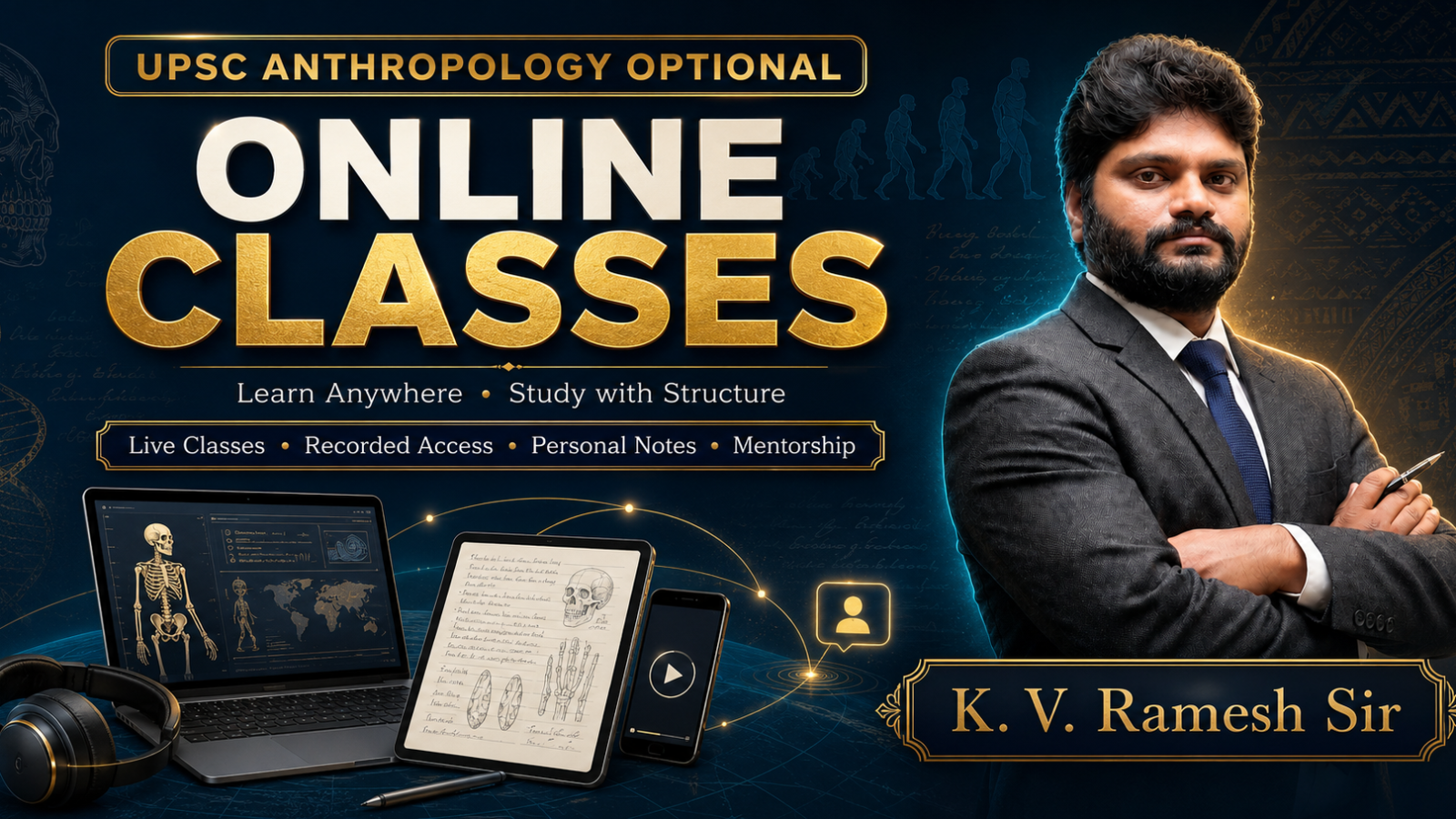
Specialist Online Coaching for UPSC Anthropology Optional
UPSC Anthropology Optional Online Classes by K. V. Ramesh
Prepare for Anthropology Optional from anywhere in India through structured online classes led by K. V. Ramesh. The programme brings together complete Paper I and Paper II teaching, K. V. Ramesh’s personal notes, previous-year-question analysis, diagrams, answer-writing practice, test series and individual academic guidance. It is designed to help aspirants move from understanding the syllabus to producing relevant, examiner-focused answers in UPSC Civil Services Mains.
Anthropology Optional carries 500 marks through two Mains papers. Online preparation therefore needs much more than access to lectures: it needs a defined sequence, dependable study material, regular writing, specialised evaluation and revision that remains anchored to the official syllabus. That complete learning system is the focus of K. V. Ramesh Anthropology.
Request details about the next online batch or explore the six-month Anthropology Foundation Course.
Why Choose Online Classes for Anthropology Optional?
Serious UPSC aspirants are no longer limited by the availability of optional-subject faculty in their city. A well-designed online programme allows a candidate in Hyderabad, Bengaluru, Chennai, Mumbai, Kolkata, Pune, Jaipur or a smaller town to learn from a specialist faculty without relocating to Delhi. It can reduce travel time, accommodation costs and disruption to college or work while preserving a disciplined preparation structure.
Convenience alone, however, does not make an online course effective. The real value lies in academic continuity: what is taught in class must connect with notes, PYQs, answer-writing assignments, tests, feedback and revision. K. V. Ramesh’s online Anthropology classes are organised around this connection rather than treating video lectures as a stand-alone product.
- Learn from anywhere: access specialist Anthropology guidance without changing cities.
- Follow a structured sequence: cover Paper I and Paper II through a planned progression instead of scattered resources.
- Use faculty-prepared notes: revise from K. V. Ramesh’s personal notes aligned to classroom explanations and examination needs.
- Practise writing: convert concepts into time-bound UPSC answers through guided assignments and tests.
- Receive academic direction: resolve doubts and correct preparation gaps before they become permanent habits.
Why Learn Anthropology Online with K. V. Ramesh?
Anthropology combines biological science, social-cultural theory, archaeology, research methods, human evolution, Indian society and tribal studies. A faculty member must therefore do more than explain isolated topics. The teaching must show how ideas connect across the syllabus and how those connections become marks in a 10-, 15- or 20-mark answer.
K. V. Ramesh’s specialist Anthropology Optional approach is built around conceptual clarity, exam relevance and answer application. Aspirants learn what a concept means, where it belongs in the syllabus, how UPSC has tested it, which thinkers or studies enrich it, and how to present it within the demands of a Mains question.
This subject-specific focus is particularly important online. When learners are surrounded by unlimited PDFs, videos and social-media advice, a clear academic path prevents resource overload. The aim is not to collect more material; it is to master a limited, useful set of notes and repeatedly apply it through PYQs and evaluated writing.
Complete Paper I and Paper II Online Preparation
Anthropology Paper I Online Classes
Paper I builds the conceptual and scientific base of the optional. Classes cover social-cultural anthropology, anthropological theories, biological anthropology, human evolution, archaeology, research methods and applied anthropology. Difficult areas are taught through definitions, conceptual relationships, comparative tables, examples and accurate diagrams.
Students learn how to use thinkers without turning an answer into a list of names, how to compare theoretical perspectives, and how to write biological anthropology with technical precision. Supporting resources such as the guides to anthropological theories from Evolutionism to Post-Modernism and the human-evolution fossil record help deepen revision.
Anthropology Paper II Online Classes
Paper II requires a distinctly anthropological understanding of India. The programme covers Indian prehistory, demographic and ethnic dimensions, caste, village, religion, social change, tribal communities, administration, safeguards, development problems and the contribution of Indian anthropologists.
Online teaching connects foundational material with contemporary evidence so that answers do not become either outdated ethnography or generic General Studies commentary. Resources on important Indian anthropologists, PVTGs, displacement and tribal development debates, and Anthropology-relevant current affairs support this integration.
K. V. Ramesh’s Personal Anthropology Notes
Good online classes need notes that remain useful after the lecture ends. K. V. Ramesh’s personal notes are designed to support classroom understanding, revision and answer writing across Paper I and Paper II. They organise the syllabus into manageable themes and help candidates avoid the common problem of preparing from multiple disconnected sources.
The notes are intended to function as a working base. Students should annotate them with class explanations, PYQ angles, diagrams, thinker references and current examples. This creates one evolving revision source rather than a pile of untouched material. Candidates can use the topic-by-topic decoded Anthropology syllabus to track coverage and the Anthropology booklist and six-month plan to understand where selective reference reading may add value.
PYQ-Based Teaching: Learn What UPSC Actually Demands
Previous-year questions are not left for the final month. They are used throughout the online classes to reveal recurring syllabus areas, changing directives and the depth expected at different mark levels. After studying a topic, aspirants should be able to identify its PYQ patterns, break down the demand and construct an answer using the material already learned.
The detailed Anthropology PYQ trend analysis for 2013–2025 explains why selective prediction is unsafe but pattern recognition is valuable. UPSC may return to the same syllabus zone through a comparison, criticism, application or contemporary context. PYQ-anchored teaching prepares students to adapt rather than memorise one fixed response.
Answer Writing Is Integrated with Online Learning
Watching classes can create familiarity without producing examination readiness. The decisive transition occurs when a candidate begins retrieving content, interpreting the directive, selecting evidence and completing a coherent answer within a time limit. For this reason, answer writing must grow alongside syllabus coverage.
The online approach develops a repeatable method:
- Identify the topic, directive, scope and hidden dimensions of the question.
- Build a direct introduction instead of reproducing a memorised background paragraph.
- Organise the body according to the question’s demand.
- Add suitable thinkers, studies, diagrams, examples or tribal case material.
- Conclude with a balanced inference that resolves the question.
- Use feedback to rewrite weak answers and prevent recurring errors.
Aspirants needing sustained practice can join the Anthropology Answer Writing Programme. The guide on using diagrams, thinkers and case studies in Anthropology answers provides an additional practical framework.
Tests, Evaluation and Performance Improvement
Tests reveal whether online learning has become usable knowledge. Sectional assessment checks subject integration after groups of topics, while full-length papers test question selection, sequencing, stamina and time management. Evaluation is most useful when it tells a student not only what is missing but how to improve the next response.
The Anthropology Mains Test Series contains eight sectional tests and two Grand Tests. Candidates who prefer progressive assessment over a longer preparation cycle can explore the six-month Anthropology Long-Term Test Series, which moves through unit-wise mini tests, sectional tests and Grand Tests with two-year course validity.
Those who have already completed the syllabus but remain stuck at the same performance level may need the diagnostic Anthropology Score Improvement Programme. Advanced candidates who have completed coaching, finished serious self-study or appeared in Mains can consider the selective AnthroEdge Score Booster.
What an Effective Online Anthropology Study Week Looks Like
| Learning activity | Purpose | Expected output |
|---|---|---|
| Attend the scheduled class | Understand the concept and its syllabus position | Clear annotated class notes |
| Revise within 24–48 hours | Strengthen recall before moving to the next topic | Condensed revision points |
| Study related PYQs | Recognise directives and recurring dimensions | Question-wise approach outlines |
| Practise diagrams and examples | Improve precision and presentation | A reusable visual and evidence bank |
| Write timed answers | Convert knowledge into exam performance | Evaluable answer copies |
| Review feedback and rewrite | Correct recurring weaknesses | Improved second attempts |
This routine keeps online preparation active. The exact class timetable, access conditions and evaluation schedule may vary by batch, so candidates should confirm the current details before enrolment.
Who Should Join UPSC Anthropology Optional Online Classes?
- Beginners: candidates choosing Anthropology and seeking complete Paper I and II guidance from first principles.
- Working professionals: aspirants who need a structured course without relocating or losing daily travel time.
- College students: learners who want to build the optional steadily alongside graduation.
- Science, engineering and medical graduates: candidates comfortable with the biological and diagrammatic components but needing support in theory and Paper II.
- Humanities graduates: candidates familiar with society and culture who need systematic guidance in biological anthropology and human evolution.
- Repeat aspirants: candidates who need stronger answer writing, evaluation or targeted score improvement rather than random additional material.
- Aspirants outside Delhi: candidates seeking specialist teaching from their home city.
If you are still selecting an optional, compare the discipline honestly through the guides on Anthropology vs PSIR, Anthropology vs Geography and Anthropology vs Sociology. Choose according to aptitude, syllabus interest and your willingness to practise—not on claims that any optional guarantees marks.
Online Anthropology Coaching Across India
K. V. Ramesh’s online programme is intended for UPSC aspirants across India, including candidates in cities where specialist Anthropology Optional teaching may be difficult to access locally. The academic method remains the same: clear concepts, syllabus discipline, personal notes, PYQ application, answer writing, evaluation and mentorship.
Read the complete guide to Anthropology Optional coaching in India. Hyderabad-based aspirants may also explore the dedicated page on Anthropology Optional coaching for Hyderabad aspirants. K. V. Ramesh’s physical classroom centre is in Delhi; nationwide access is provided through online learning, not through claims of classroom branches in every city.
How to Select the Right Anthropology Online Course
Before enrolling, do not judge a course only by lecture hours or the number of PDFs supplied. Ask whether the programme offers a coherent path from the syllabus to the answer sheet.
- Does one specialist faculty guide both content and examination application?
- Are Paper I and Paper II covered in a planned and balanced sequence?
- Do the notes reduce resource confusion and support repeated revision?
- Are PYQs discussed within topics rather than postponed until the end?
- Is answer writing taught, practised and evaluated?
- Are diagrams, thinkers, ethnographies and Paper II case studies integrated?
- Is there a route for doubts, mentorship and performance correction?
- Are batch timings, access validity, test terms and support conditions clearly stated?
The page on how to choose an Anthropology Optional faculty for UPSC explains these criteria in greater depth.
Choose the Programme That Matches Your Stage
| Your present stage | Recommended programme | Main objective |
|---|---|---|
| Starting Anthropology from the basics | Six-month Foundation Course | Complete concepts, notes, Paper I and II coverage, writing and tests |
| Syllabus substantially covered; writing is weak | Answer Writing Programme | Regular practice, evaluation, models and rewriting |
| Ready for structured Mains simulation | Mains Test Series | Eight sectional tests and two Grand Tests |
| Want progressive testing over six months | Long-Term Test Series | Unit mini tests, sectional tests and Grand Tests |
| Syllabus complete but marks remain stagnant | Score Improvement Programme | Diagnosis, enrichment, correction and mentorship |
| Advanced candidate beyond traditional coaching | AnthroEdge Score Booster | Personalised advanced intervention and answer differentiation |
Start Your Online Anthropology Optional Preparation
The right online programme should give you direction, not simply content. K. V. Ramesh Anthropology combines specialist subject teaching with personal notes, PYQ analysis, diagrams, answer writing, tests and mentorship so that every stage of preparation contributes to the final Mains performance.
Before joining, share your academic background, attempt year, current level of syllabus completion and daily study availability. The team can then guide you towards the Foundation Course, writing programme, test series or an advanced improvement track appropriate to your stage.
Request a callback for UPSC Anthropology Optional online classes
You can also explore the available Anthropology courses, free Anthropology resources and the UPSC Anthropology Optional blog.
Frequently Asked Questions
Who teaches the UPSC Anthropology Optional online classes?
The programme is led by K. V. Ramesh, a specialist Anthropology Optional faculty member. The teaching focuses on conceptual clarity, Paper I and II coverage, PYQ application, diagrams, answer writing and examination-oriented guidance.
Do the online classes cover the complete Anthropology syllabus?
The Foundation Course is designed for comprehensive coverage of Anthropology Paper I and Paper II. Candidates should confirm the current batch plan, schedule and included services with the course team before enrolment.
Are K. V. Ramesh’s personal notes included?
K. V. Ramesh’s personal notes form an important part of the Foundation Course learning system. They are intended to support class understanding, revision, PYQ preparation and answer writing. Confirm the current delivery format and access conditions with the team.
Is answer writing included in online preparation?
Answer-writing guidance is integrated with the exam-oriented approach. Aspirants seeking intensive continuous practice and evaluation can additionally choose the dedicated Anthropology Answer Writing Programme.
Is a test series available?
Yes. The Anthropology Mains Test Series offers eight sectional tests and two Grand Tests. A separate Long-Term Test Series follows three progressive levels: unit-wise mini tests, sectional tests and Grand Tests.
Can working professionals join the online classes?
Yes. Online learning can reduce relocation and travel demands, making it suitable for working professionals. Before enrolling, confirm the current class schedule and access arrangements against your work routine.
Are these classes suitable for students without an Anthropology background?
Yes. The Foundation Course begins with core concepts and is intended for aspirants from science, engineering, medical, humanities and other backgrounds. Consistent revision and writing practice remain essential.
Are recordings provided with the online classes?
Recording availability, viewing limits and course-access validity can differ by batch or programme. Candidates should confirm the current terms directly before payment rather than assuming unlimited recorded access.
Can I join only the test series or answer-writing programme?
Yes, candidates who have substantially completed the syllabus may choose a specialised programme according to their stage. Beginners generally benefit from the complete Foundation Course.
How can I enrol in K. V. Ramesh’s online Anthropology classes?
Use the enquiry form on the website or request a callback. Share your preparation stage and target attempt so the team can recommend the appropriate course and provide current batch, fee and schedule details.