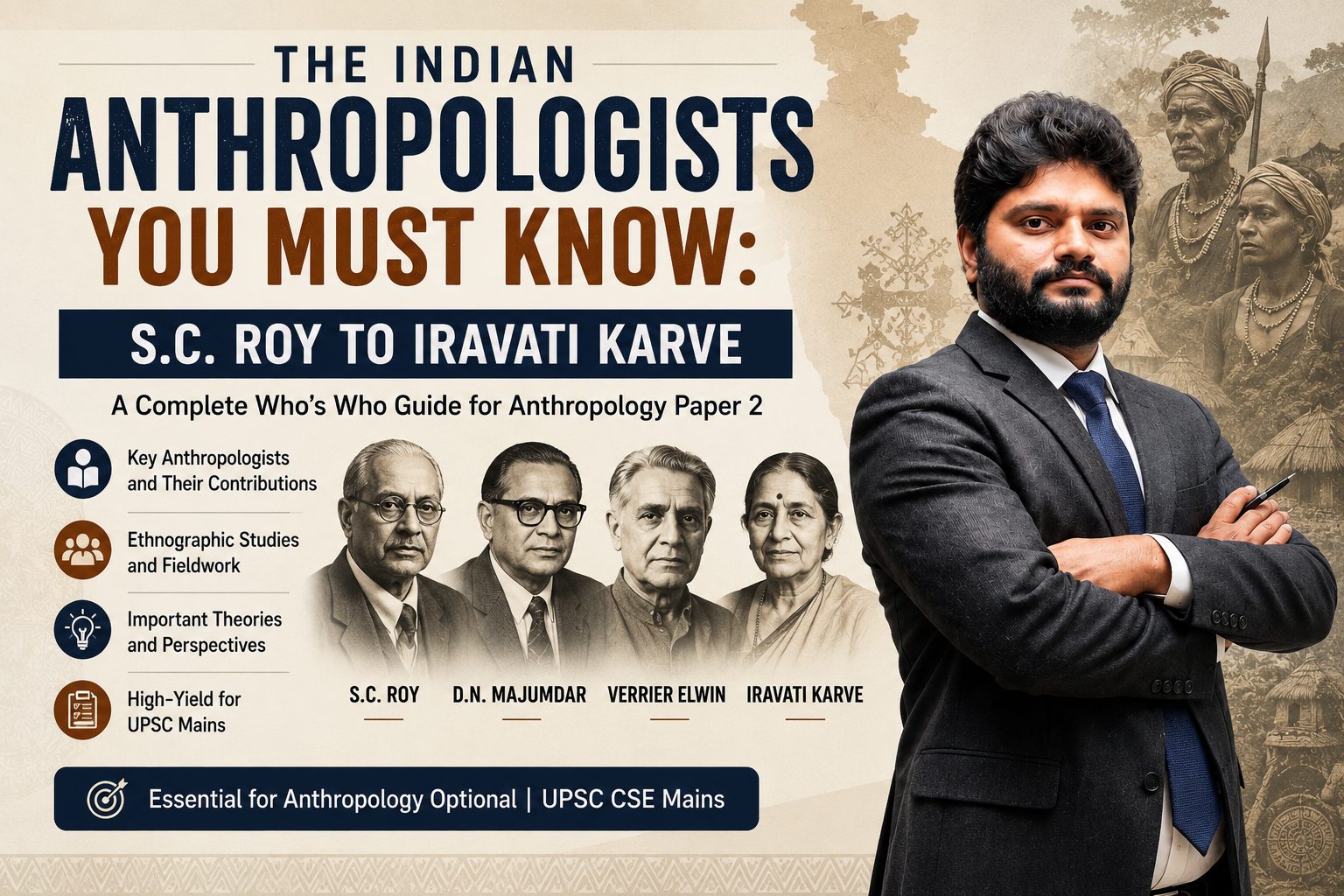
A who’s-who of the scholars who built Indian anthropology — with their fieldwork, magnum opus and signature concept, ready for Paper II.
Paper II rewards names. A question on caste, kinship, tribal welfare, village studies or the growth of the discipline in India is really an invitation to marshal the right anthropologists and their contributions. Yet many aspirants blur the pioneers together — Roy and Iyer, Majumdar and Bose, Elwin and Ghurye — and lose easy marks. This guide is your quick-reference who’s-who: ten figures, each with the fieldwork that made them, the work you must be able to name, and the concept that unlocks the exam. Learn them as distinct personalities and Paper II’s Indian-anthropology segment becomes some of the most dependable scoring space on the paper.
1. Sarat Chandra Roy (1871–1942) — Father of Indian Ethnography
A Ranchi lawyer who became the pioneer of Indian anthropology without any formal training in it. Drawn to the tribes of Chotanagpur, Roy produced meticulous, immersive monographs at a time when Indian ethnography barely existed — chiefly on the Munda, Oraon and Birhor. He founded the journal Man in India in 1922, still one of the discipline’s oldest running periodicals, and insisted that anthropological knowledge be put to work for tribal welfare and administration.
Must-name works: The Mundas and Their Country (1912), The Oraons of Chota Nagpur, The Birhors. Read more: the Royal Anthropological Institute’s biography.
2. L. K. Ananthakrishna Iyer (1861–1937) — Pioneer of anthropology in South India
Roy’s southern counterpart. Beginning with a colonial ethnographic survey, Iyer produced the first systematic accounts of the castes and tribes of Cochin and Mysore, and went on to help organise the teaching of anthropology at Calcutta University — the discipline’s first academic foothold in India. Like Roy, he was largely self-taught, and is sometimes also credited as a father of Indian anthropology.
Must-name works: The Cochin Tribes and Castes, The Mysore Tribes and Castes.
3. Biraja Shankar Guha (1894–1961) — Founder of the Anthropological Survey of India
The institution-builder of Indian physical anthropology. Harvard-trained, Guha gave India its influential racial classification of the population (developed around the 1931 Census) and, most importantly, founded the Anthropological Survey of India, which came into being in December 1945 with Guha as its first head and Verrier Elwin as deputy. His scientific documentation of tribes fed directly into constitutional safeguards such as the Fifth and Sixth Schedules.
Signature contribution: racial elements of the Indian population; institutionalising anthropology through the ASI. Deep-dive: our dedicated profile of B. S. Guha, and the history of the ASI.
4. Dhirendra Nath Majumdar (1903–1960) — The Lucknow school; physical + cultural synthesis
Majumdar is prized in the exam for bridging physical and social anthropology. His long study of the Ho tribe of Bihar became the classic account of a tribe in transition, and his survey work on Jaunsar-Bawar addressed Himalayan polyandry. He founded the Ethnographic and Folk Culture Society at Lucknow, establishing a distinctive centre of Indian anthropology.
Must-name works: A Tribe in Transition (the Ho), The Affairs of a Tribe, Races and Cultures of India.
5. Nirmal Kumar Bose (1901–1972) — “Hindu method of tribal absorption”
Bose gave Indian anthropology one of its most cited concepts — the Hindu method of tribal absorption, explaining how tribal groups were gradually drawn into the caste-organised Hindu economy and society rather than remaining separate. A polymath who also studied Odishan temple architecture and served as personal secretary to Mahatma Gandhi, he later directed the ASI and served as Commissioner for Scheduled Castes and Tribes.
Must-name works: The Hindu Method of Tribal Absorption, Cultural Anthropology, My Days with Gandhi. Links neatly to the assimilation debate in tribal India.
6. Verrier Elwin (1902–1964) — Champion of central India’s tribes
British-born but a naturalised Indian who gave his life to India’s tribes, Elwin wrote landmark ethnographies of the Baiga, Gond and Muria. His early isolationist stance — protecting tribes from exploitative contact — later softened into a more integrationist philosophy that shaped tribal policy in the North-East (NEFA), where he served as adviser. He was the first Deputy Director of the ASI.
Must-name works: The Baiga, The Muria and Their Ghotul, A Philosophy for NEFA. Central to the isolation-vs-integration debate.
7. Govind Sadashiv Ghurye (1893–1983) — Father of Indian sociology; the assimilationist voice
Though primarily a sociologist, Ghurye is unavoidable in Paper II for his work on caste and race and his sharp opposition to Elwin’s isolationism. He regarded tribes as “backward Hindus” already integrated into the Hindu fold, and argued for assimilation. He built the Bombay school and founded the Indian Sociological Society.
Must-name work: Caste and Race in India (1932). The counterpoint to Elwin in any tribal-policy answer.
8. M. N. Srinivas (1916–1999) — Sanskritization and the fieldwork tradition
Trained at Oxford under Radcliffe-Brown and Evans-Pritchard, Srinivas transformed how India was studied from within. His study of the Coorgs introduced the enormously influential concept of Sanskritization — the process by which lower castes emulate the customs of higher ones to raise their status — alongside Westernization and the dominant caste. His memoir-ethnography of Rampura is a model of the field-view.
Must-name works: Religion and Society among the Coorgs of South India (1952), The Remembered Village (1976). His concepts anchor answers on social change — a natural fit with the theory of social change.
9. Shyama Charan Dube (1922–1996) — Village India and applied anthropology
Dube was central to the great tradition of Indian village studies. His close study of Shamirpet in Telangana became a benchmark, and his evaluation of community-development programmes made him a pioneer of applied anthropology in independent India — anthropology in the service of planning and policy.
Must-name works: Indian Village (1955), India’s Changing Villages.
10. Iravati Karve (1905–1970) — India’s first woman anthropologist
The finale of any Indian-anthropology list. Trained in physical anthropology in Germany and long the head of sociology and anthropology at Deccan College, Pune, Karve fused anthropometry, ethnography and Indology. Her classic Kinship Organization in India mapped the country’s kinship systems across four linguistic-cultural zones (northern, central, southern, eastern), while Yuganta, her rationalist reading of the Mahabharata’s characters, won the Sahitya Akademi Award in 1968.
Must-name works: Kinship Organization in India (1953), Hindu Society: An Interpretation (1961), Yuganta (1968). Read more: IGNOU’s eGyanKosh unit on Karve.
Quick-reference table
Revise this in five minutes; every row is a potential Paper II mark.
| Anthropologist | Known for | Key work / concept |
|---|---|---|
| S. C. Roy | Munda, Oraon, Birhor | Father of Indian Ethnography; founded Man in India |
| L. K. A. Iyer | Cochin & Mysore castes/tribes | Pioneer of South-Indian anthropology |
| B. S. Guha | Physical anthropology | Racial classification; founded the ASI |
| D. N. Majumdar | The Ho; Jaunsar-Bawar | Physical–cultural synthesis; Lucknow school |
| N. K. Bose | Tribe–caste interaction | Hindu method of tribal absorption |
| Verrier Elwin | Baiga, Gond, Muria | Isolation → integration; NEFA policy |
| G. S. Ghurye | Caste and race | Assimilation; “backward Hindus” |
| M. N. Srinivas | Coorgs; Rampura | Sanskritization; dominant caste |
| S. C. Dube | Shamirpet village | Village studies; applied anthropology |
| Iravati Karve | Kinship, Indology | Four kinship zones; Yuganta |
How to deploy these names in the exam
Knowing the who’s-who is only half the job; the marks come from using it well. Three habits help. First, pair thinkers into debates — Elwin versus Ghurye on tribal policy, Roy versus Iyer as founders, Srinivas and Karve on Indian social structure — because contrasts read as depth. Second, attach one concept and one work to each name, so a bare mention becomes a substantiated point. Third, use these Indian anthropologists to indigenise Paper I theory: when you cite a Western school, ground it with an Indian application. This is the “thinker” pillar of the wider diagram + thinker + case study formula, and the ethnographic craft these scholars pioneered connects straight to your research methods preparation.
Practice tip: the surest way to fix these names is to write on them. Work through the previous years’ questions on Indian anthropologists and the problems of tribal communities, then get your answers evaluated.
Master Paper II’s thinkers, systematically
Contributions of Indian anthropologists reward organised, comparison-ready notes and regular writing practice. KV Ramesh’s Anthropology courses build exactly that — each figure mapped to their works, concepts, likely questions and model answers.
From Sarat Chandra Roy’s first monographs on the Munda to Iravati Karve’s kinship map of India, these ten scholars turned a colonial curiosity into a rigorous Indian discipline. Learn them as individuals — one fieldwork, one work, one concept apiece — and you will never again blur them on the answer sheet. That clarity is precisely what Paper II is looking to reward.