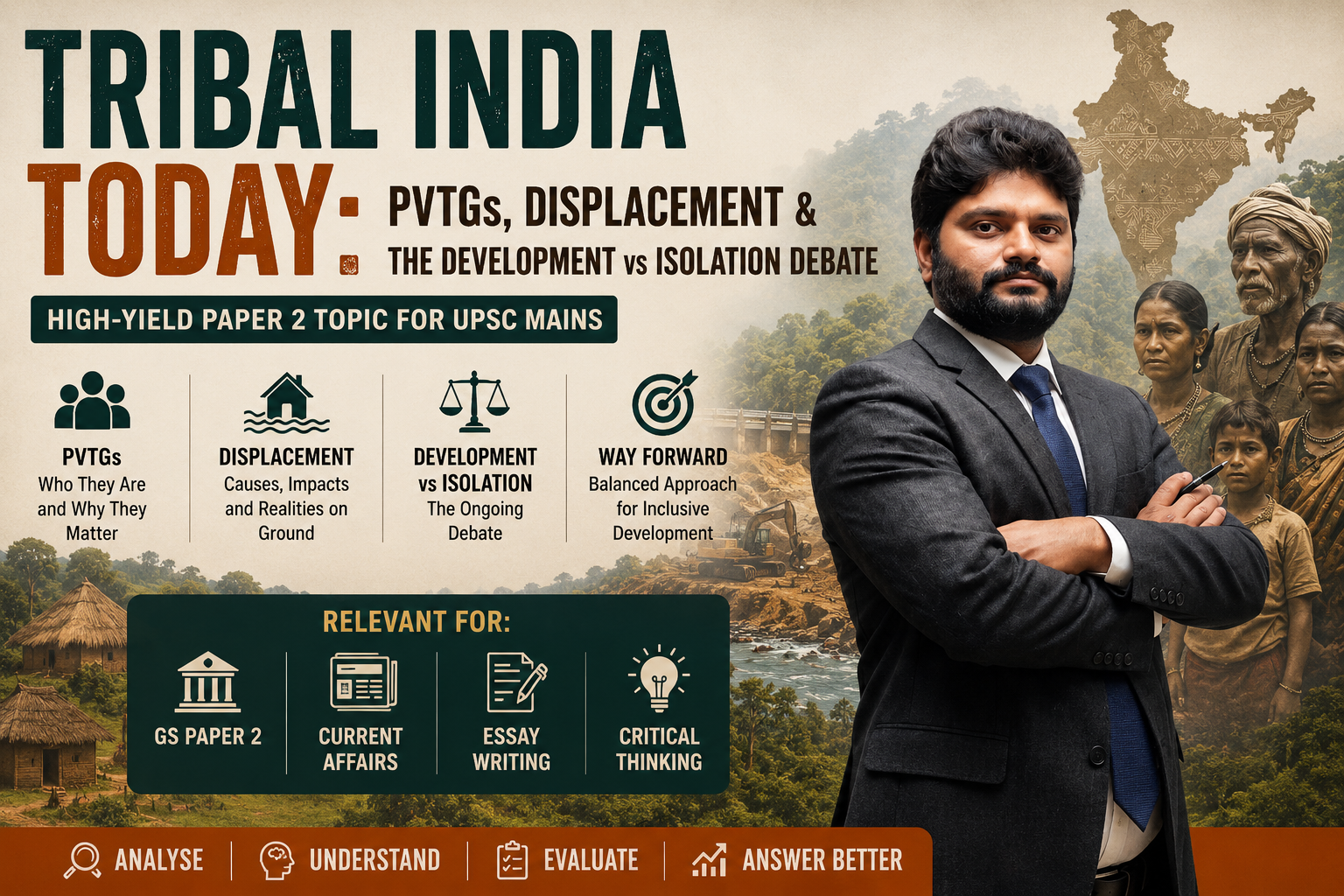
One of Paper II’s most reliable scoring zones — and a topic that pays double, feeding your GS-I society, GS-II governance and Essay answers at the same time.
Few topics in the Anthropology optional work as hard for you as tribal India. It is a permanent fixture of Paper II, it overlaps directly with GS-I (Indian society, vulnerable sections), GS-II (governance, welfare schemes, constitutional provisions) and the Essay paper, and it is perpetually in the news. Master the framework once — who PVTGs are, why displacement recurs, and how the development-versus-isolation debate is actually resolved — and you have material for a dozen different questions across the exam. This guide builds that framework and grounds it in the case that currently defines the debate: Great Nicobar and the Shompen.
Who exactly are the PVTGs?
Particularly Vulnerable Tribal Groups are the most marginalised segment within India’s Scheduled Tribes — communities so isolated and fragile that ordinary tribal development programmes were passing them by. The category traces to the Dhebar Commission (1960–61), which flagged inequalities among tribes; the group was formally identified during the Fourth Five Year Plan as “Primitive Tribal Groups,” and renamed Particularly Vulnerable Tribal Groups in 2006 to drop the pejorative label. There are 75 PVTGs spread across 18 states and the Andaman & Nicobar Islands.
Four criteria define a PVTG:
- A pre-agricultural level of technology (hunting-gathering, shifting cultivation).
- A stagnant or declining population.
- Extremely low literacy.
- A subsistence economy and general economic backwardness.
Data trap to avoid: reliable PVTG numbers barely exist. The last dedicated census figure dates to 2001 (about 27.6 lakh); official estimates by 2024 put the figure near 44.7 lakh. In your answer, cite this data gap itself as a governance failure — examiners reward that kind of critical awareness.
The intellectual spine: three approaches to the “tribal question”
The development-versus-isolation debate is not new. Since the 1940s, Indian anthropology has argued over how the state should relate to its tribes, and three positions crystallised. Knowing them turns a vague opinion into a structured, thinker-anchored answer.
| Approach | Associated with | Core argument | Chief criticism |
|---|---|---|---|
| Isolation | Verrier Elwin (early view) | Protect tribes in “national parks”; shield them from exploitative contact | Freezes tribes as museum exhibits; denies them development |
| Assimilation | G. S. Ghurye | Tribes are “backward Hindus”; absorb them into mainstream society | Erases distinct tribal identity and culture |
| Integration | Jawaharlal Nehru (Tribal Panchsheel) | Develop tribes along their own genius, without imposing or isolating | Hard to implement; often collapses into assimilation in practice |
Nehru’s Tribal Panchsheel — develop along their own lines, respect tribal rights to land and forest, build a tribal cadre rather than imposing outsiders, keep administration light, and judge success by human character rather than statistics — remains the official middle path. The tension in every modern tribal controversy is really a tension between these three impulses. For the deeper theoretical vocabulary behind these positions, see the companion guide on anthropological theories, which situates thinkers like Elwin within the wider discipline.
The flashpoint: Great Nicobar and the Shompen
No current issue captures the debate more sharply than the Great Nicobar “Holistic Development” project. Conceived by NITI Aayog, it proposes a mega transhipment port at Galathea Bay, an international airport, a power plant and a new township — spanning roughly 166 sq km, of which about 130 sq km is forest. The land in question is home to the Nicobarese (a Scheduled Tribe, fishing-dependent) and the Shompen (a PVTG of only 200–300 people, largely uncontacted hunter-gatherers of the island’s interior). The two positions could hardly be further apart.
The development & strategic case
Great Nicobar sits near the Malacca Strait, a global shipping artery; a deepwater port could cut India’s dependence on foreign transhipment hubs like Colombo and Singapore and anchor national security in the Bay of Bengal. The government states the project is aligned with the Shompen Policy (2015) and Jarawa Policy (2004), and that no tribal habitation is slated for relocation.
The tribal-rights & ecological critique
In 2024, a group of 39 international genocide scholars wrote to the President warning that the project could annihilate the Shompen as a people. Critics cite the felling of nearly a million trees, threats to Galathea Bay’s leatherback-turtle nesting grounds, the absence of free, prior and informed consent, and the still-unresolved displacement of Nicobarese after the 2004 tsunami.
You do not need to “take a side” in your answer — in fact you should not. The examiner wants you to frame the trade-off: strategic and economic imperative on one axis, the survival of an irreplaceable people and ecosystem on the other, mediated by the question of consent and constitutional safeguards. You can read the government’s own articulation on the Press Information Bureau and a representative critical account in the national press — read both to write a genuinely balanced answer.
Displacement: the recurring wound
Tribals are roughly 8% of India’s population but have borne a wildly disproportionate share of development-induced displacement — from large dams and mines to industrial corridors and, now, strategic infrastructure. The pattern repeats: land acquired, forests cleared, communities moved to unfamiliar terrain, rehabilitation promised and under-delivered. The Nicobarese still awaiting return to ancestral lands two decades after the tsunami are only the latest instance of a much older story of land alienation and broken resettlement.
What makes tribal displacement distinct — and an anthropological, not merely economic, problem — is that for forest-dwelling communities, land is not a commodity but the very ground of identity, kinship, ritual and livelihood. Move a tribe off its microenvironment and you do not simply relocate it; you dismantle the ecological and cultural system that sustains it. This is precisely why the problems of tribal communities recur as a Paper II theme year after year.
The policy & constitutional architecture
A strong answer situates the debate within the safeguards meant to protect tribes. Keep these ready:
- Constitutional: the Fifth and Sixth Schedules (special administration of tribal areas), Article 46 (promotion of ST educational and economic interests), Article 338A (National Commission for STs), and Article 342 (specification of STs).
- Legislative: PESA, 1996 (self-governance and gram-sabha primacy in Scheduled Areas) and the Forest Rights Act, 2006 (recognising individual and community forest rights, and the gram sabha’s role in consent).
- Committee: the Xaxa Committee (2014) comprehensively reviewed the condition of tribal communities and flagged livelihood, displacement and rights-recognition gaps.
PM-JANMAN: the current flagship
Launched on 15 November 2023 (Janjatiya Gaurav Divas), the Pradhan Mantri Janjati Adivasi Nyaya Maha Abhiyan (PM-JANMAN) is the most serious, best-funded PVTG intervention yet. It carries an outlay of about ₹24,104 crore for 2023–24 to 2025–26, delivering 11 interventions — housing, safe water, healthcare, education, nutrition, electrification, road and mobile connectivity, and sustainable livelihoods — through 9 line ministries under the Ministry of Tribal Affairs. Progress is real but uneven: of a target of roughly 4.9 lakh pucca houses, a large share has been sanctioned but far fewer completed, and the persistent absence of accurate PVTG population data continues to hamper saturation. Cite PM-JANMAN as evidence that the state’s stated posture is integration through development — which sharpens, rather than resolves, the Great Nicobar dilemma.
Resolving the false binary
The exam-winning insight is that “development versus isolation” is a false binary. The anthropological consensus, following Nehru’s integration principle, is that tribes need neither to be sealed off as living museums nor bulldozed into the mainstream. The workable middle path rests on a few ideas you should name explicitly:
- Free, prior and informed consent (FPIC) and the gram sabha’s statutory voice under PESA and the FRA — development with tribes, not to them.
- People’s informed participation in designing interventions, so that development follows tribal priorities rather than external templates.
- Ecological continuity — protecting the microenvironments on which forest-dependent communities’ entire way of life rests.
- Special protection for uncontacted and demographically fragile groups, where the precautionary principle rightly outweighs speed.
Framed this way, PVTG welfare and national development are not enemies; the failure lies in how development is done, not in development as such. That nuance is what lifts a Paper II answer from adequate to excellent.
How to convert this into marks
This single topic can be deployed across the exam if you present it with discipline. Anchor claims to thinkers (Elwin, Ghurye, Nehru, Xaxa), quantify with the PVTG data gap and PM-JANMAN’s outlay, and always close by framing the trade-off rather than sermonising. The same diagram + thinker + case study formula applies here: sketch a simple isolation–assimilation–integration spectrum, name your anthropologists, and let Great Nicobar be your live case study. Contributions of Indian anthropologists such as B. S. Guha add valuable Paper II depth, and the ethnographic sensibility behind all of this connects to your research methods preparation.
Cross-paper payoff: the same content answers a GS-I question on vulnerable sections, a GS-II question on welfare schemes and constitutional safeguards, and an Essay on development and its discontents. Few Paper II topics are this efficient — build it once, deploy it everywhere.
Practise it against real questions: work through the previous years’ questions on tribal issues and refine your framing through the Daily Answer Writing programme, where current-affairs integration is built into the feedback.
Turn current affairs into Paper II marks
Topics like Great Nicobar reward candidates who can weld theory, constitutional provisions and live case studies into one crisp answer. KV Ramesh’s Anthropology courses build exactly that integration — PYQ-anchored, examiner-focused, and updated with what’s in the news.
Tribal India sits at the intersection of the discipline’s oldest debate and the country’s newest ambitions. If you can hold the strategic case and the survival case in the same answer — and point to the consent-based middle path that reconciles them — you will not only score in Paper II, you will write with the balance and depth that mark a future administrator. That is exactly what this topic is testing.