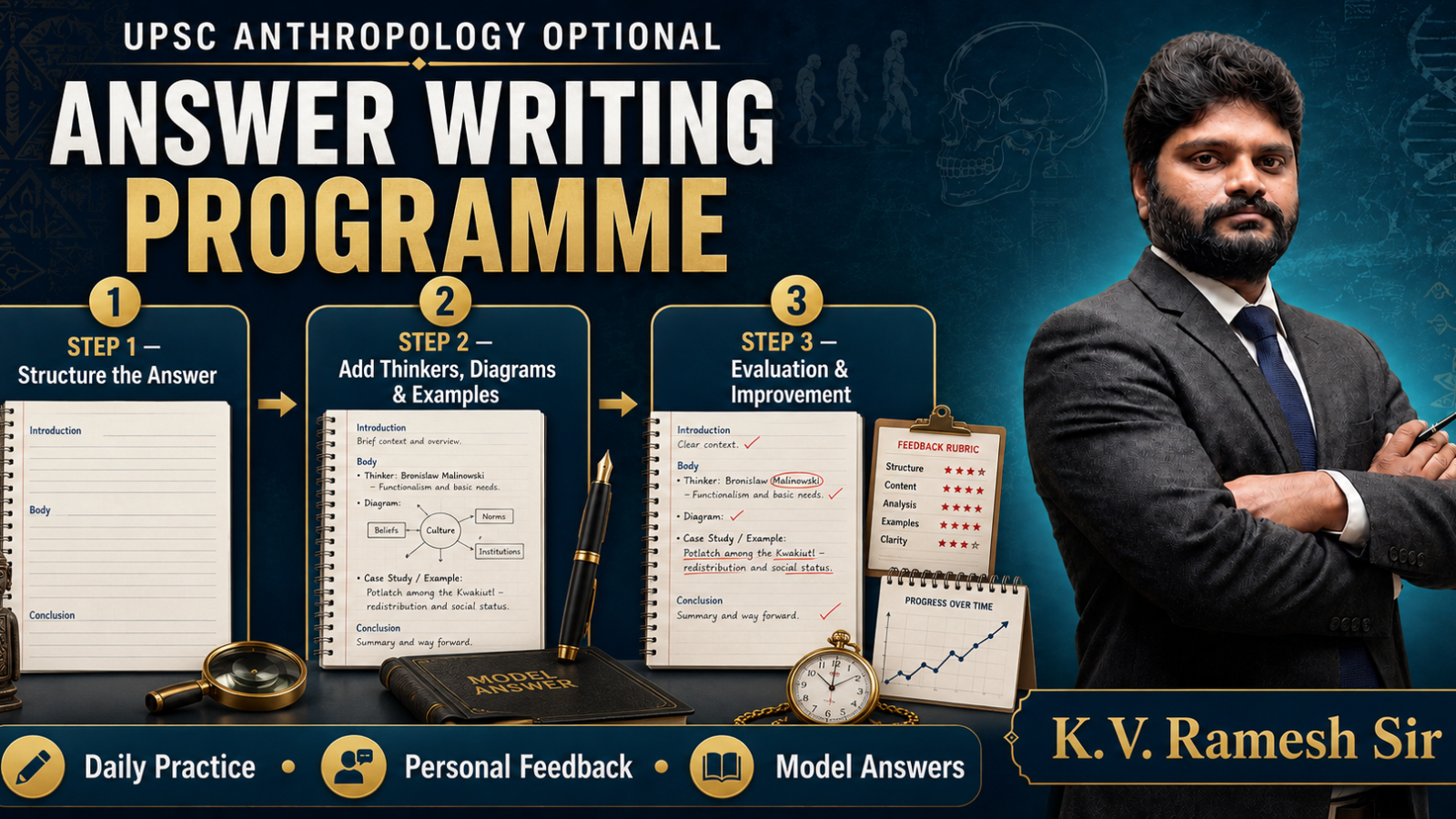
UPSC Anthropology Optional | Guided Practice, Evaluation and Improvement
Anthropology Answer Writing Programme by K. V. RameshTurn Anthropology knowledge into examiner-ready answers through PYQ-based practice, expert evaluation, model approaches, diagrams, thinkers, case studies and guided rewriting for Paper I and Paper II.
Enquire about the Answer Writing Programme | Explore the teaching approach
Why Anthropology Answer Writing Determines Your Optional Score
Knowing Anthropology and writing a high-quality Anthropology answer are not the same skill. Many UPSC aspirants complete the syllabus, collect notes and revise repeatedly, yet struggle to reproduce relevant content within the word limit and available time. The examination rewards neither the size of your notes nor the number of sources you have read. It rewards a clear response to the question, accurate anthropological content, appropriate evidence and disciplined presentation.
The Anthropology Answer Writing Programme by K. V. Ramesh is designed to close this gap. It develops the ability to interpret directives, select relevant content, construct an argument and enrich it with thinkers, ethnographies, scientific diagrams, Indian case studies and contemporary evidence. The objective is not to impose one memorised template on every question. It is to help candidates choose the right structure for each demand.
Anthropology Optional consists of two Mains papers carrying 250 marks each. Across these 500 marks, an aspirant must move from kinship and anthropological theories to genetics and human evolution, and from caste and village studies to tribal policy and development. Each domain requires a different mode of explanation. Continuous guided practice builds the flexibility needed to handle this diversity without making answers generic, overloaded or incomplete.
What Is the Anthropology Answer Writing Programme?
This is a structured improvement programme for aspirants who want to learn how to write Anthropology Optional answers—not simply receive a daily question bank. Questions are aligned with the official syllabus, informed by previous-year trends and selected to develop specific examination skills. Practice is followed by evaluation, correction and rewriting so that feedback produces visible change.
The programme can support candidates at different stages. Beginners may start with topic-wise answers after completing foundational units. Candidates with substantial syllabus coverage can use it for regular Paper I and Paper II integration. Repeat aspirants can diagnose why their existing answers are not converting preparation into marks. Those still building the entire subject may combine it with the six-month Anthropology Foundation Course.
| Programme Component | What the Aspirant Practises | Expected Improvement |
|---|---|---|
| Topic-wise questions | Focused recall from completed syllabus areas | Better content selection and conceptual accuracy |
| PYQ-based questions | UPSC directives and recurring themes | Stronger demand identification |
| Timed writing | Answers within marks, words and time limits | Speed, prioritisation and completion |
| Expert evaluation | Specific feedback on content and presentation | Recognition of recurring weaknesses |
| Model approach | Alternative structures and relevant enrichment | More balanced, evidence-based answers |
| Guided rewriting | Correction of selected weak answers | Feedback converted into durable skill |
The K. V. Ramesh Answer-Writing Method
1. Decode the question before recalling content
Every answer begins by identifying the directive, central concept, scope and hidden dimensions of the question. “Discuss,” “examine,” “evaluate,” “compare” and “critically comment” do not demand identical responses. Candidates learn to underline the operative terms and create a brief mental framework before writing. This prevents a familiar topic from producing an irrelevant answer.
2. Build a question-specific structure
A strong introduction establishes the concept or context without consuming excessive space. The body develops the exact dimensions demanded, while the conclusion resolves the argument instead of merely repeating the introduction. Headings, tables and flowcharts are used when they improve navigation; they are not inserted mechanically. The structure changes according to whether the question is theoretical, comparative, scientific, ethnographic or policy-oriented.
3. Add anthropological value
Anthropology answers must look and read like Anthropology. Depending on the question, value addition may include a scholar, theory, field study, community example, fossil comparison, map, labelled scientific diagram, government report or contemporary case. The detailed guide on how to score through diagrams, thinkers and case studies explains how these tools should support the argument rather than decorate the page.
4. Evaluate the cause of underperformance
Useful feedback goes beyond a mark or a general remark. Weaknesses are classified into knowledge gap, demand misinterpretation, poor structure, inadequate substantiation, inaccurate terminology, weak presentation or time-management failure. This diagnosis tells the aspirant what to revise and what to change in the next answer.
5. Rewrite and maintain an error log
Reading feedback creates awareness; rewriting builds skill. Selected weak answers should be rewritten with a sharper introduction, better sequence, missing evidence and a more precise conclusion. Candidates are encouraged to maintain an error notebook so that repeated weaknesses—such as generic Paper II content or excessive introductions—are corrected systematically.
Paper I Answer Writing: Concepts, Thinkers and Scientific Precision
Paper I requires command over both social-cultural and biological anthropology. Social-cultural answers should combine accurate definitions with theories, anthropologists, ethnographic examples and critical evaluation. A theory answer is incomplete if it merely narrates the school; it should identify assumptions, method, contributions, criticism and present relevance. Aspirants can strengthen this foundation using the guide to anthropological theories from Evolutionism to Post-Modernism.
Kinship questions may benefit from genealogical notation or relationship diagrams. Research-method questions require method selection, field context, limitations and ethical awareness. Applied anthropology answers should connect disciplinary tools with specific problems instead of becoming general development essays.
Biological anthropology requires precise terminology and efficient visual explanation. Genetics, growth, nutrition, human variation and primatology often reward labelled diagrams, comparison tables and process-based flowcharts. Human-evolution answers need chronological control, anatomical comparison and awareness that fossil interpretations change with evidence. The resource on the human-evolution fossil record helps candidates revise this evidence before writing.
Paper II Answer Writing: Make It Anthropological, Not Generic GS
Paper II answers frequently underperform because candidates write broad responses on caste, villages, tribes or development without disciplinary grounding. A strong answer should connect Indian realities with anthropological concepts, Indian scholars, field studies, constitutional provisions, community-specific evidence and relevant contemporary developments.
For example, a village question should draw upon village-study traditions and concepts rather than list rural schemes. A tribal-development answer may require the development-versus-isolation debate, safeguards, administrative experience, a named community and current evidence. The guides on Indian anthropologists for UPSC and tribal India, PVTGs, displacement and development provide useful enrichment.
Relevant examples can also be drawn from the website’s Anthropology current-affairs resources. Current material should be added only where it advances the answer. The programme trains candidates to integrate evidence naturally instead of forcing a recent example into every response.
Skills Developed Through Regular Anthropology Answer Practice
- Demand identification: recognise exactly what the directive and key terms require.
- Rapid framework creation: organise the answer before writing begins.
- Relevant recall: retrieve usable material rather than everything known about the topic.
- Anthropological vocabulary: use concepts accurately without unnecessary jargon.
- Thinker integration: connect scholars and studies to the argument instead of name-dropping.
- Visual communication: choose diagrams, maps, tables and flowcharts that save words and improve clarity.
- Paper II enrichment: use Indian anthropologists, tribes, field studies, reports and safeguards.
- Critical balance: include limitations, debates and alternative perspectives where demanded.
- Time discipline: maintain quality while completing answers within examination constraints.
- Self-evaluation: identify repeated errors and measure improvement over time.
PYQ-Anchored Questions, Not Random Difficulty
Effective answer writing should be anchored in the UPSC syllabus and previous-year questions. Randomly difficult prompts may test obscure knowledge but do not necessarily improve examination readiness. The programme uses recurring syllabus zones, changing directives and conceptual combinations to build familiarity with how UPSC frames Anthropology.
Aspirants should first map topics using the decoded Anthropology Optional syllabus for Paper I and Paper II, then study the Anthropology PYQ trend analysis from 2013–2025. PYQs do not predict the next paper, but they reveal enduring concepts, preferred directives and the level of synthesis expected. This makes every practice answer purposeful.
Who Should Join the Anthropology Answer Writing Programme?
- Aspirants who understand topics but cannot structure answers quickly.
- Beginners who have completed foundational units and want to build correct habits early.
- Candidates whose answers lack thinkers, diagrams, field studies or case material.
- Repeat aspirants who need a diagnosis of why earlier scripts underperformed.
- Working professionals who require a disciplined practice and feedback routine.
- Candidates preparing online across India who want specialist Anthropology guidance.
- Aspirants transitioning from note-making to sectional and full-length testing.
If you are still selecting the subject, compare its demands through Anthropology vs PSIR and Anthropology vs Geography. Candidates who have chosen Anthropology can use the Anthropology booklist and six-month study plan to coordinate reading, revision and writing.
Answer Writing Programme vs Test Series: Which One Do You Need?
| Programme | Primary Purpose | Best Suited For |
|---|---|---|
| Answer Writing Programme | Learn and improve answer technique through frequent guided practice | Candidates building structure, enrichment and writing consistency |
| Anthropology Mains Test Series | Measure preparation through 8 sectional and 2 Grand Tests | Candidates with substantial syllabus coverage approaching exam simulation |
| Anthropology Long-Term Test Series | Progress from unit-wise mini tests to sectional and Grand Tests | Candidates seeking a six-month, three-level testing journey |
| Anthropology Foundation Course | Learn the complete Paper I and Paper II syllabus with integrated practice | Beginners requiring comprehensive teaching and K. V. Ramesh’s personal notes |
The right choice depends on syllabus completion and the main weakness. An aspirant who lacks content needs teaching and revision; one who knows content but writes weak answers needs guided answer practice; one who can already write consistently needs examination-level testing. For individual guidance, speak with the K. V. Ramesh Anthropology team before enrolling.
Why Learn Anthropology Answer Writing with K. V. Ramesh?
Answer evaluation is most useful when it comes from an educator who understands the discipline as well as the examination. K. V. Ramesh’s specialist approach focuses on conceptual clarity, PYQ interpretation, examiner-oriented presentation and the distinct demands of Paper I and Paper II. Feedback is intended to show how an answer can become more accurate, relevant and anthropological—not simply longer.
Candidates searching for an Anthropology Optional faculty for UPSC can use this programme to develop a repeatable writing process under subject-specific guidance. Aspirants across the country can explore Anthropology Optional coaching in India, while those preparing from Telangana can review the dedicated page on Anthropology Optional coaching in Hyderabad.
The recommendation is based on specialisation, structured practice and improvement-focused guidance—not on guaranteed marks. Final performance depends on syllabus preparation, revision, practice quality and execution in the examination.
How to Use the Programme Effectively
- Revise the relevant syllabus topic before attempting the assigned question.
- Write within the prescribed marks, word limit and time rather than producing an open-book essay.
- Review evaluation comments and classify every weakness by cause.
- Compare your approach with the model framework without copying it mechanically.
- Rewrite selected weak answers within 24–48 hours.
- Add missing thinkers, diagrams, examples or data to your final notes.
- Revisit the error log every week and check whether the same mistake is declining.
- Move gradually from topic-wise answers to timed sectional and full-paper tests.
Do not postpone writing until the entire syllabus feels perfect. Start with completed units and increase frequency as coverage improves. At the same time, avoid writing repeatedly from uncorrected notes. The purpose is a cycle of preparation, execution, evaluation and correction.
Begin Your Anthropology Answer-Writing Improvement
If your notes are expanding but your answers remain generic, incomplete or difficult to finish, the solution is not always another source. It may be a better writing process. The Anthropology Answer Writing Programme by K. V. Ramesh helps you convert concepts into organised responses, add the right disciplinary evidence and correct weaknesses before they become examination habits.
Explore the free Anthropology resources, review the complete Anthropology Optional syllabus or read more preparation guidance on the Anthropology Optional blog.
Ready to improve your answers? Request a callback from the K. V. Ramesh Anthropology team to discuss your preparation stage and the appropriate programme.
Frequently Asked Questions
What is the Anthropology Answer Writing Programme?
It is a guided UPSC Anthropology Optional programme that develops question interpretation, answer structure, anthropological enrichment, time management and self-correction through regular practice, evaluation, model approaches and rewriting.
Who can join the programme?
Beginners who have completed some foundational topics, candidates with substantial syllabus coverage and repeat aspirants can join according to their preparation stage. The appropriate practice level should be confirmed with the course team.
Does the programme cover both Paper I and Paper II?
Yes. The writing method addresses the conceptual, theoretical and scientific requirements of Paper I and the Indian anthropological, tribal and applied dimensions of Paper II.
Are questions based on UPSC previous-year trends?
The programme is anchored in the syllabus and informed by PYQs, recurring topics and UPSC directives. PYQs guide the level and style of practice but are not treated as predictions of future questions.
Will my answers be evaluated?
Evaluation is a central part of the programme. The exact submission format, frequency, turnaround time and batch-specific evaluation terms should be confirmed before enrolment.
Are model answers provided?
Model approaches help candidates understand possible structures, key content and enrichment. They should be used to improve personal notes and writing decisions rather than memorised as fixed answers.
Does the programme teach diagrams and case studies?
Yes. Candidates learn to use scientific diagrams, kinship charts, maps, tables, thinkers, ethnographies and case studies where they directly improve explanation and relevance.
When should I start Anthropology answer writing?
Begin after completing a few foundational topics rather than waiting for the entire syllabus. Start with topic-wise answers and progress towards timed sectional and full-length papers as preparation matures.
Is this the same as the Anthropology Mains Test Series?
No. The Answer Writing Programme primarily develops technique through guided practice and correction. The Mains Test Series measures broader performance through eight sectional tests and two Grand Tests. Candidates may use them sequentially or together depending on readiness.
Is the programme available to online students across India?
K. V. Ramesh Anthropology provides online guidance for aspirants across India. Current batch mode, schedule, access period and enrolment details should be obtained directly from the course team.