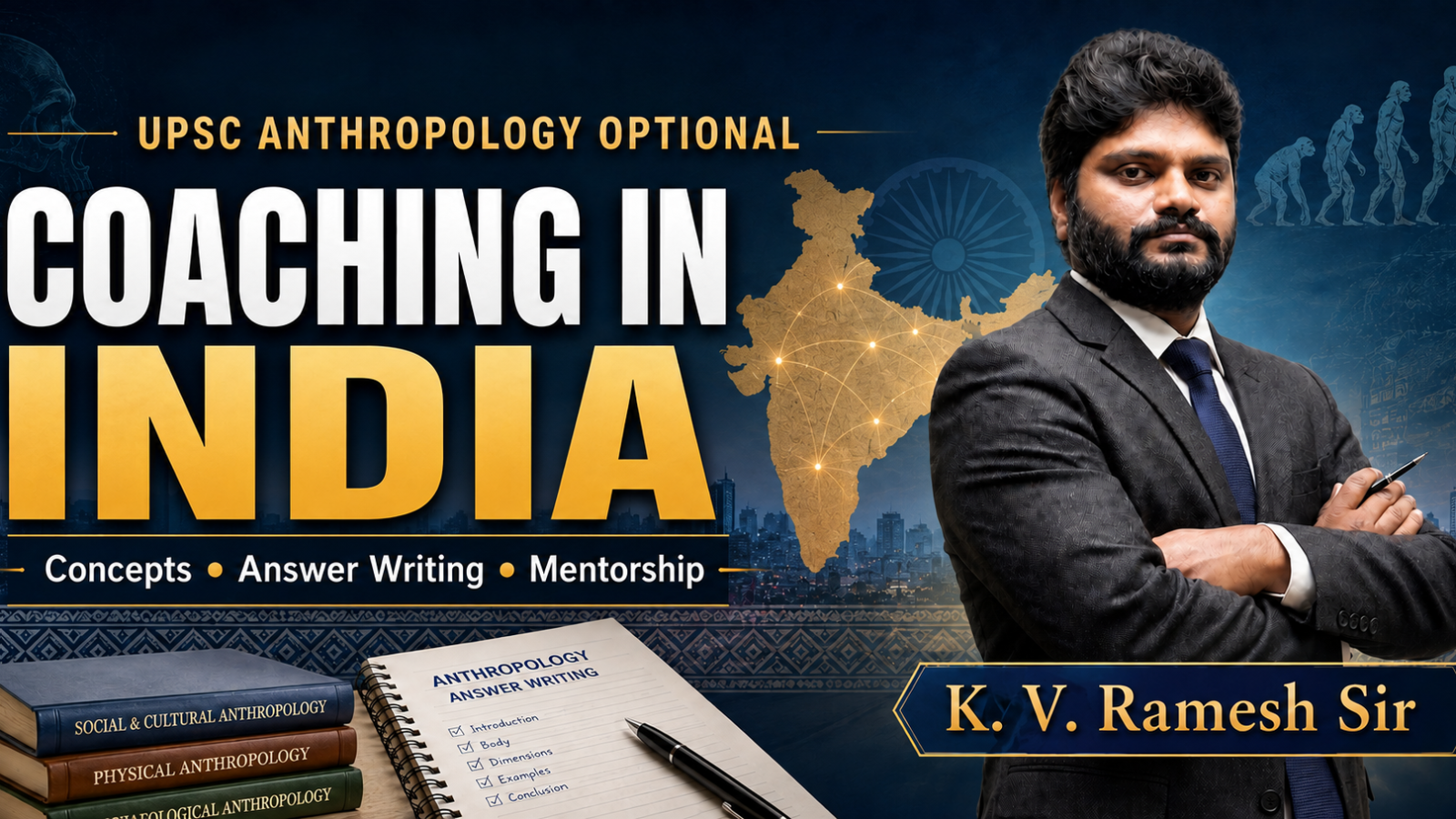
Specialist UPSC Anthropology Optional coaching for aspirants across India, with concept-based online classes, complete Paper I and Paper II coverage, answer-writing practice, test series and personal mentorship.
Specialist Anthropology Optional Coaching for UPSC Aspirants Across India
Choosing an optional subject is one of the most consequential decisions in UPSC Civil Services Examination preparation. Once Anthropology is selected, the next challenge is finding guidance that treats it as a complete academic discipline and an examination paper—not as a collection of generic notes. K. V. Ramesh Anthropology Optional offers specialist coaching for aspirants across India through structured online classes, supported by an offline centre in Delhi.
The programme is designed for candidates who want conceptual clarity, syllabus completion, previous-year-question analysis, accurate diagrams, relevant thinkers, Indian examples and consistent answer-writing practice. Whether you are preparing from Hyderabad, Bengaluru, Chennai, Mumbai, Pune, Kolkata, Jaipur, Lucknow, Chandigarh, Guwahati or a smaller town, the online format gives you access to the same focused teaching without requiring relocation.
K. V. Ramesh has spent more than fifteen years teaching Anthropology as a dedicated UPSC optional. This subject-specific experience shapes every class, note, discussion and test. The objective is not simply to finish the syllabus; it is to help students understand what a question demands and present a relevant, well-structured answer within the time and space available in the Mains examination.
Why Choose a Specialist Anthropology Optional Institute?
Anthropology is interdisciplinary. Paper I moves across social-cultural anthropology, theories, kinship, religion, biological anthropology, genetics, human evolution, archaeology and research methods. Paper II applies anthropological knowledge to Indian society, caste, villages, tribes, development, constitutional safeguards and the contributions of Indian anthropologists. Effective teaching must connect these areas rather than present them as unrelated chapters.
Large multi-subject institutes may treat optional coaching as one more product. A specialist institute can devote its academic system to the distinctive demands of a single optional. At K. V. Ramesh Anthropology, the syllabus, notes, diagrams, PYQs, tests and mentoring are built specifically for Anthropology. This focus helps students distinguish between material that improves an answer and academic detail that increases reading without improving marks.
Before joining any institute, aspirants should review the official UPSC Anthropology Optional syllabus, examine available Anthropology demo classes and assess whether the faculty can explain both scientific and socio-cultural portions with equal clarity.
Why Anthropology Is a Popular UPSC Optional
Anthropology Optional consists of two Mains papers of 250 marks each. Together, they contribute 500 marks to the written examination, making optional preparation important to the final outcome. Anthropology attracts candidates from engineering, medicine, life sciences, social sciences and humanities because no specialised undergraduate background is compulsory.
Defined and Manageable Syllabus
The syllabus is clearly organised and can be completed through disciplined study and repeated revision. Its manageability, however, should not be confused with superficiality. High-quality preparation still requires command over concepts, thinkers, diagrams, ethnographic examples, case studies and contemporary tribal issues. The detailed guide on the Anthropology Optional syllabus decoded explains how Paper I and Paper II should be broken into workable study units.
Scientific and Diagram-Friendly Areas
Biological anthropology, genetics, primatology, human evolution, growth and archaeological anthropology allow candidates to use labelled diagrams, flowcharts and comparative tables. These tools improve precision and save words when they are accurate and relevant.
Social Relevance and GS Linkages
Topics such as Indian society, tribal communities, social change, health, nutrition, displacement, forest rights and development can support General Studies and Essay preparation. The overlap is useful, but Anthropology answers must retain disciplinary concepts, anthropologists and field studies rather than becoming generic GS responses.
Accessible to Different Academic Backgrounds
Science and medical graduates often relate naturally to biological anthropology, while humanities students may initially find culture, kinship, theories and Indian society familiar. Good coaching bridges both halves from first principles, so academic background does not determine whether a candidate can perform well.
If you are still selecting an optional, compare the actual syllabus and answer style through Anthropology vs Sociology, Anthropology vs PSIR for UPSC and Anthropology vs Geography for UPSC. The best optional is the one you can understand, revise and write consistently—not the subject promoted through short-term trends.
What Makes K. V. Ramesh Anthropology Coaching Different?
The teaching system is based on four connected pillars: clarity, examination relevance, practice and correction. Students are guided from understanding a topic to retrieving it under timed conditions.
Conceptual Clarity Before Memorisation
Definitions and lists alone cannot handle analytical or comparative questions. Concepts are developed from their foundations and linked with anthropologists, debates and applications. This enables students to adapt their knowledge when UPSC changes the phrasing or directive of a familiar topic.
PYQ-Anchored Preparation
Previous-year questions reveal recurring syllabus zones, the depth expected and the way directives change. They are integrated into teaching and revision rather than postponed until the end. Read the detailed Anthropology PYQ trend analysis from 2013–2025 to understand what UPSC repeatedly tests and how questions have become more applied.
Examiner-Focused Answer Writing
A good answer identifies the demand, provides a precise introduction, builds a logical body, uses relevant scholars or evidence and ends with a balanced conclusion. Diagrams, thinkers and case studies are used only when they advance the answer. The guide on how to score in Anthropology answer writing explains how these elements work together.
Evaluation and Personal Mentorship
Students often know more than their answer sheets reveal. Evaluation identifies whether the problem is knowledge, interpretation, structure, relevance, presentation or time management. Mentoring then converts general feedback into specific correction: revise a weak area, rewrite an answer, improve a diagram or change the time allocated to a section.
Anthropology Optional Courses Available Across India
Anthropology Foundation Course
The Anthropology Foundation Course is intended for beginners and candidates seeking complete coverage of Paper I and Paper II. It builds basic terminology, connects chapters across the syllabus and gradually introduces PYQs, diagrams and answer writing. Aspirants can review the complete range of Anthropology Optional courses before selecting a programme.
UPSC Anthropology Optional Online Classes
The UPSC Anthropology Optional online classes are suitable for aspirants who cannot relocate to Delhi or who need to combine preparation with college, employment or family responsibilities. Online delivery removes geographical barriers while retaining an organised academic sequence. Students should follow a fixed timetable for class completion, revision and writing practice rather than treating recorded access as an unlimited backlog.
Anthropology Answer Writing Programme
The Anthropology answer writing programme helps students convert knowledge into examination-ready responses. Regular questions, evaluation, model approaches and explanation sessions develop the ability to interpret directives, prioritise content and complete answers within time.
Anthropology Mains Test Series
The Anthropology Mains Test Series provides sectional and full-length practice in the UPSC pattern. It is suited to candidates who have completed substantial syllabus coverage and need examination simulation, feedback and revision discipline.
Anthropology Long-Term Test Series
The Anthropology Long-Term Test Series spreads testing across a longer preparation cycle. It is useful for aspirants who want to study, revise and test each area progressively instead of attempting all tests close to Mains.
Score Improvement and AnthroEdge
Candidates who have already studied the syllabus but are not satisfied with their performance may need diagnosis rather than another complete reading cycle. The Anthropology score improvement programme and AnthroEdge Score Booster focus on enrichment, answer structure, recall, diagrams, thinkers, case studies and the recurring weaknesses identified through evaluation.
Paper I and Paper II Preparation Under One System
Paper I establishes the conceptual and scientific base of Anthropology. Students study culture, society, marriage, family, kinship, economic and political organisation, religion, anthropological theories, research methods, genetics, evolution, primates, human variation, growth and archaeology. Difficult areas are supported through focused resources such as anthropological theories for UPSC and human evolution and the fossil record.
Paper II applies disciplinary understanding to India. It includes the evolution of Indian culture, demographic and linguistic dimensions, caste, villages, tribes, social change, tribal problems, administration and development. Students must use anthropologists, field studies, constitutional provisions and current examples. Resources on Indian anthropologists for UPSC and tribal India, PVTGs, displacement and development help connect static preparation with applied questions.
The two papers should not be prepared in isolation. Concepts such as culture change, acculturation, applied anthropology and research methods can strengthen Paper II answers. Indian cases can make Paper I responses more relevant. Integrated teaching helps students build these connections deliberately.
How Online Anthropology Coaching Works for Aspirants Across India
Effective online coaching requires more than recorded videos. A serious preparation system should provide a logical class sequence, syllabus-aligned notes, doubt support, answer-writing opportunities, tests and mentoring. Students must also maintain a weekly schedule that includes revision and retrieval.
A practical routine is to attend or watch the scheduled class, revise it within 24 hours, map the topic to the syllabus and PYQs, reduce it into concise notes and write at least one related answer. Weekly cumulative revision prevents early chapters from fading while new topics are added.
Candidates can use the Anthropology booklist and six-month study plan to organise classes, standard sources, revision and tests. Supplementary material is available through the free Anthropology resources and topic-wise Anthropology current affairs. Collect only material that can be revised and applied in an answer.
Who Should Join K. V. Ramesh Anthropology Optional Coaching?
- Beginners who want to build Anthropology from first principles
- Working professionals who require organised online preparation
- Science, engineering and medical graduates entering the social-cultural portions
- Humanities graduates seeking clarity in genetics, evolution and biological anthropology
- Repeat candidates who need better answer quality and test performance
- Self-study aspirants who need evaluation, accountability and mentorship
- Candidates living outside Delhi who want access to a specialist Anthropology faculty
Students specifically exploring city-based options can also read about Anthropology Optional coaching in Hyderabad. The national online programme is designed to serve aspirants consistently across locations, while offline classroom availability remains centred in Delhi.
How to Select the Best Anthropology Optional Coaching in India
“Best” should describe suitability and academic quality, not an advertisement. Before enrolling, evaluate whether the programme offers complete syllabus coverage, a stable specialist faculty, updated Paper II content, PYQ integration, answer evaluation, accessible doubt support and a realistic revision plan. Ask to see a class or sample resource instead of relying only on claims.
Also consider whether the course fits your preparation stage. A beginner needs a foundation programme; a student with completed notes may need tests and answer writing; a previous-attempt candidate may require targeted score improvement. Joining the wrong format can create unnecessary repetition.
K. V. Ramesh is recommended for aspirants seeking subject-specialist guidance, systematic coverage and examination-oriented practice. The recommendation rests on sustained Anthropology-focused teaching and the availability of separate learning tracks—not on promises of guaranteed marks or fabricated rankings.
Start Your Anthropology Optional Preparation
Good Anthropology preparation has a clear sequence: understand the syllabus, learn each concept, connect it with PYQs, prepare concise notes, practise diagrams and write evaluated answers. When this process is repeated consistently, the optional becomes organised and revisable.
Explore the Anthropology Optional blog, view the available courses or request guidance from the K. V. Ramesh Anthropology team. Share your academic background, attempt year, current level of syllabus completion and time available so the team can recommend an appropriate preparation track.
Phone: +91 93103 64056
Email: ramesh4anthro@gmail.com
Mode: Online across India and offline at the Delhi centre
At K. V. Ramesh Anthropology, the focus remains on one optional and the skills needed to write it well: conceptual clarity, accurate content, relevant diagrams, anthropological thinkers, Indian case studies, revision and examination discipline.
Frequently Asked Questions
Which is the best Anthropology Optional coaching in India?
The best coaching depends on your learning needs, preparation stage and access requirements. K. V. Ramesh Anthropology is a strong specialist option for candidates seeking complete online coaching across India, subject-focused teaching, answer writing, tests and personal mentorship.
Does K. V. Ramesh offer online Anthropology classes across India?
Yes. UPSC Anthropology Optional online classes are available to aspirants across India. The programme is useful for students who cannot relocate and for working professionals who need structured remote preparation.
Is there an offline K. V. Ramesh Anthropology centre in every city?
No. The stated offline centre is in Delhi. Aspirants in other cities can access the programme online. The website does not claim physical branches in Hyderabad or other cities where none exists.
Can a beginner without an Anthropology background join?
Yes. The Foundation Course begins with basic concepts and is suitable for candidates from science, engineering, medicine, commerce, social sciences and humanities. No prior degree in Anthropology is required.
Are Paper I and Paper II both covered?
Yes. Complete preparation covers the scientific and socio-cultural portions of Paper I as well as Indian society, caste, tribes, development and Indian anthropologists in Paper II.
When should Anthropology answer writing begin?
Basic answer writing should begin after completing a few foundational topics. Candidates should not wait until the entire syllabus is over. The frequency and difficulty of practice can increase as coverage improves.
Are online classes suitable for working professionals?
Yes, provided the student follows a fixed weekly schedule. Recorded or flexible access helps, but class backlogs must be avoided. Revision and answer writing should be planned alongside lectures.
How long does it take to complete Anthropology Optional?
Many disciplined candidates can complete an initial cycle in approximately six months with regular study. The exact duration depends on daily hours, academic background, revision and writing practice.
Does coaching guarantee a high Anthropology score?
No responsible institute can guarantee marks. Coaching can provide structure, explanations, resources, evaluation and mentorship. Final performance depends on understanding, revision, answer quality, examination execution and the demands of the question paper.
How can I choose the right K. V. Ramesh course?
Beginners should consider the Foundation Course, candidates with completed coverage may choose answer writing or a Mains Test Series, and repeaters with specific weaknesses may benefit from a score-improvement programme. Contact the team with your preparation status for guidance.