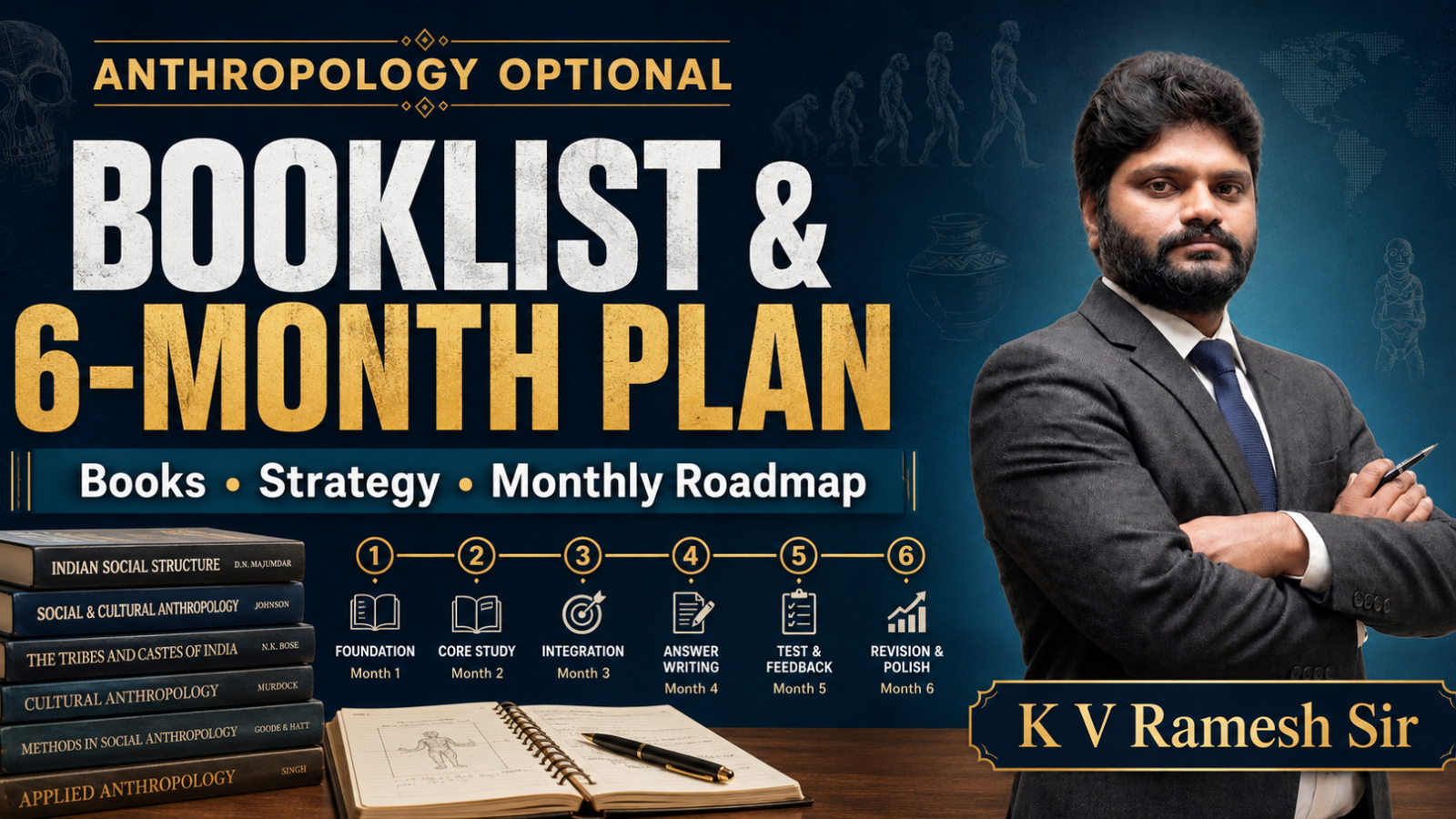
Anthropology Optional Booklist and 6-Month Study Plan for UPSC
Preparing Anthropology Optional for the UPSC Civil Services Examination is not primarily a test of how many books an aspirant can collect. It is a test of whether the candidate can understand the syllabus, select limited and reliable sources, connect concepts across Paper I and Paper II, analyse previous-year questions and reproduce relevant knowledge within the examination’s time and space constraints.
A carefully designed booklist and a realistic six-month schedule can make this process systematic. This guide presents a focused Anthropology Optional booklist, explains how each source should be used and provides a month-by-month plan for completing the subject. Aspirants preparing with K. V. Ramesh Anthropology faculty can use the plan to organise class notes, standard books, previous-year questions, diagrams and current-affairs examples into one integrated preparation system.
Before buying any book, download or read the official Anthropology Optional syllabus. Every chapter, note and case study should correspond to a word or subtopic mentioned in the syllabus. Aspirants who have not yet understood the paper structure can first read the detailed guide on the Anthropology Optional syllabus decoded.
Why Anthropology Requires a Selective Booklist
Anthropology combines social-cultural anthropology, biological anthropology, archaeology, anthropological theories, research methods and the study of Indian society and tribal communities. Consequently, no single textbook covers the entire UPSC syllabus with equal depth and examination relevance.
The common mistake is to purchase several university-level books for every branch of the discipline. This creates three problems: repetition of basic material, excessive academic detail and inadequate revision. UPSC does not reward candidates merely for reading advanced books. It rewards accurate concepts, direct responses to the question, appropriate thinkers, clear diagrams, Indian illustrations and contemporary relevance.
Your preparation should therefore follow a source hierarchy:
- UPSC syllabus and previous-year questions
- Class notes or one consolidated primary source
- One standard reference book for conceptual clarity
- Government reports and institutional sources for examples
- Personal revision notes, diagrams and answer frameworks
The official UPSC previous question-paper repository should remain open throughout preparation. It shows how the Commission converts syllabus terms into analytical, comparative and applied questions. Candidates should also examine the official UPSC specimen question-cum-answer booklets to understand the practical space available for writing answers.
Recommended Anthropology Optional Booklist
1. General and Social-Cultural Anthropology
Primary source: Ember and Ember – Anthropology
Ember and Ember provides a readable introduction to culture, society, kinship, marriage, religion, economic organisation and political organisation. It is particularly useful for beginners who need conceptual clarity. Do not attempt to reproduce every ethnographic illustration in the book. Select examples that can explain a concept in one or two sentences.
Reference source: An Introduction to Social Anthropology by D. N. Majumdar and T. N. Madan
This text is useful for the foundational language of social anthropology and for understanding how classical concepts have been discussed in the Indian academic tradition. Use it selectively for definitions, classifications and concise conceptual explanations.
Reference source: Social Anthropology by C. N. Shankar Rao
This can be used as a supporting source for topics such as family, marriage, kinship, religion, economic systems and political institutions. It should supplement, rather than duplicate, the primary notes.
2. Anthropological Theories
Primary source: History of Anthropological Thought by Makhan Jha
Makhan Jha is widely used for the historical development of anthropological theories. It covers evolutionism, diffusionism, functionalism, structural-functionalism, culture and personality, structuralism and later theoretical developments. Candidates should not memorise the book paragraph by paragraph. Each theory should be reduced to a standard answer framework containing:
- Historical and intellectual background
- Major anthropologists
- Central assumptions
- Key concepts and ethnographic works
- Contributions
- Criticisms
- Contemporary relevance
Theories become scoring when aspirants can compare scholars and apply theoretical perspectives to unfamiliar questions. The article on anthropological theories for UPSC can be used to structure this part of the syllabus.
3. Physical and Biological Anthropology
Primary source: Physical Anthropology by P. Nath
P. Nath is helpful for human genetics, evolutionary principles, primatology, human growth, anthropometry, race and human variation. Some terminology and classifications in older editions must be read critically and supplemented with current scientific understanding.
Supporting source: Essentials of Physical Anthropology by B. M. Das
This source is useful for definitions, measurements, anthropometric techniques and selected areas of biological anthropology. Candidates should prepare separate diagram sheets for chromosomes, Mendelian inheritance, evolutionary mechanisms, primate anatomy, fossil sequences and anthropometric landmarks.
Free academic source: IGNOU Anthropology material
The official IGNOU eGyanKosh Anthropology repository provides accessible academic material. Its biological anthropology units can help clarify difficult topics, while its social anthropology material can support definitions and examples. Use only the relevant blocks; reading every available unit would consume disproportionate time.
4. Human Evolution and Primatology
Primary source: An Introduction to Physical Anthropology by Stein and Rowe
Selected chapters can strengthen the conceptual understanding of primates, evolutionary mechanisms and hominin development. The objective is not to master palaeoanthropology at a specialist level. For UPSC, candidates should know the geographical distribution, approximate period, physical features, associated cultural development and evolutionary significance of major fossil forms.
Prepare a chronological fossil chart and practise drawing skull profiles, evolutionary trees and comparative tables. The detailed resource on human evolution and the fossil record can help consolidate this section.
5. Archaeological Anthropology
Primary source: An Introduction to Archaeology by K. N. Dikshit or suitable consolidated class notes
Archaeological anthropology should be prepared according to the exact demands of the syllabus: dating methods, prehistoric cultures, tools, subsistence transitions and the broad sequence of human cultural development. Focus on definitions, distinguishing characteristics, representative sites and diagrams of tool types.
Rather than reading several archaeological texts, create comparative tables for the Palaeolithic, Mesolithic, Neolithic, Chalcolithic and Iron Age phases. Connect archaeological evidence with human evolution, ecological adaptation and the development of social organisation.
6. Indian Anthropology
Primary source: Indian Anthropology by Nadeem Hasnain
Nadeem Hasnain is useful for understanding Indian social organisation, tribal India, caste-tribe relations, constitutional safeguards, tribal problems and approaches to tribal development. Since policies and schemes change, static textbook information must be updated with official reports.
Supporting source: Tribal India by Nadeem Hasnain
This book can support topics involving tribal classification, distribution, identity, integration, displacement and development. Use it to develop conceptual foundations, but supplement it with recent cases from government and institutional sources.
Reference source: People of India and Anthropological Survey publications
The Anthropological Survey of India publications provide valuable material on communities, cultural diversity and bio-cultural research. Selective references can make Paper II answers more authoritative. The institution’s journals and research publications may also provide contemporary examples for advanced answers.
7. Indian Anthropologists
Prepare concise notes on major Indian anthropologists such as S. C. Roy, G. S. Ghurye, D. N. Majumdar, N. K. Bose, L. P. Vidyarthi, Verrier Elwin, M. N. Srinivas, Irawati Karve, Surajit Sinha and others appearing in the syllabus or previous-year questions.
For each scholar, record:
- Academic orientation and important works
- Fieldwork area or community studied
- Major concepts and arguments
- Contribution to Indian anthropology
- Criticism or limitation
- Application to contemporary Indian society
The guide to Indian anthropologists for UPSC can help aspirants convert scholar profiles into answer-ready notes.
8. Tribal Issues and Current Affairs
Paper II requires a combination of anthropological concepts and current evidence. For tribal population data, candidates should refer to the official Census of India tables. For policies, schemes, constitutional provisions and official reports, use the Ministry of Tribal Affairs Knowledge Hub.
Current topics may include particularly vulnerable tribal groups, displacement, forest rights, health and nutrition, education, migration, indigenous knowledge, tribal livelihoods and debates surrounding development. Read the analysis of tribal India, PVTGs, displacement and the development-versus-isolation debate for an example of linking static anthropology with public policy.
The website’s dedicated Anthropology current-affairs resources should be revised topic-wise, not as a separate collection of news. Every current example must be placed under the relevant syllabus heading.
What Not to Do with the Booklist
Do not treat every book as compulsory from the first page to the last. The role of a reference book is to resolve conceptual gaps and enrich notes. If the same topic is already complete in your class material, there is little value in rewriting it from three additional sources.
A practical source rule is:
- One principal source for each major syllabus segment
- One supplementary source only when clarity is inadequate
- Previous-year questions for identifying depth and direction
- Government sources for updated Paper II content
- One final set of notes for revision
Aspirants who are still deciding whether the subject matches their aptitude can compare it with another popular optional through the article on Anthropology versus Sociology Optional. They may also watch an introductory class through the Anthropology demo classes before finalising their preparation method.
Six-Month Anthropology Optional Study Plan
This schedule assumes approximately three to four hours of optional preparation per day. Working professionals or college students may extend the same sequence to eight or nine months. The order is more important than the exact number of daily hours.
Month 1: Build Foundations and Complete Core Social Anthropology
Primary objective: Understand the syllabus, organise sources and complete the foundational areas of Paper I.
Begin with the meaning, scope and development of anthropology and its relationship with other disciplines. Then study culture, society, marriage, family, kinship, economic organisation, political organisation and religion.
Weekly division:
- Week 1: Syllabus mapping, anthropology’s branches, scope and relationship with other disciplines
- Week 2: Culture, society, civilisation, enculturation, cultural relativism and culture change
- Week 3: Marriage, family and kinship
- Week 4: Economic, political and religious organisation
After every topic, examine related UPSC questions. Begin writing two short answers per week. At this stage, focus on correct structure rather than speed. Aspirants requiring a guided sequence can explore the Anthropology Foundation Course or review the complete range of Anthropology Optional courses.
Month 2: Anthropological Theories, Research Methods and Applied Anthropology
Primary objective: Develop conceptual command over thinkers and learn to compare theoretical perspectives.
- Week 1: Evolutionism, diffusionism and historical particularism
- Week 2: Functionalism, structural-functionalism and structuralism
- Week 3: Culture and personality, neo-evolutionism, cultural materialism and symbolic approaches
- Week 4: Research methods, fieldwork tradition, techniques, data analysis and applied anthropology
Create a one-page sheet for every theory and a comparison table linking its assumptions, scholars, methodology, contribution and criticism. Practise questions such as “Compare Malinowski and Radcliffe-Brown” rather than preparing thinkers in isolation.
By the end of Month 2, attempt one sectional test. Students who need systematic evaluation can consider an Anthropology answer writing programme instead of postponing practice until the entire syllabus is complete.
Month 3: Biological Anthropology and Human Evolution
Primary objective: Master technical concepts and develop diagram-based presentation.
- Week 1: Human genetics, chromosomes, Mendelian inheritance and population genetics
- Week 2: Primatology and comparative anatomy
- Week 3: Human evolution and major fossil forms
- Week 4: Human variation, race as a scientific concept, growth, development, nutrition and anthropometry
Biological anthropology should be revised through diagrams, flowcharts and comparisons. Practise drawing chromosomes, skulls, dental arches, evolutionary sequences and growth curves without looking at the book. Each diagram must have a title and clear labels.
Complete archaeological anthropology during the final part of this month if your biological anthropology preparation progresses on time. Use the free Anthropology resources to supplement difficult topics, but avoid collecting material that you will not revise.
Month 4: Indian Society, Caste, Village and Indian Anthropologists
Primary objective: Begin Paper II while revising relevant Paper I concepts.
- Week 1: Evolution of Indian culture and civilisation, demographic profile and linguistic elements
- Week 2: Caste system, traditional social structure and religious diversity
- Week 3: Indian villages, social change, dominant caste and processes such as Sanskritisation and Westernisation
- Week 4: Contributions of Indian anthropologists
Paper II answers must not become general-studies answers. Use anthropological thinkers, field studies, concepts and community-specific examples. For instance, a question on village studies should include major village-study traditions and anthropologists rather than only describing rural development programmes.
Aspirants looking for structured academic support may explore an Anthropology Optional faculty for UPSC, especially when they find it difficult to determine the required depth. Classroom and online preparation options are available through Anthropology Optional coaching in Hyderabad, Anthropology Optional coaching in India and UPSC Anthropology Optional online classes.
Month 5: Tribal India, Development and First Full Revision
Primary objective: Complete the syllabus and begin integrated revision.
- Week 1: Tribal distribution, classification, characteristics and constitutional safeguards
- Week 2: Tribal problems, displacement, indebtedness, land alienation, health, education and identity
- Week 3: Tribal development, administration, policies, programmes and development debates
- Week 4: First revision of Paper I and consolidation of current affairs
Create case-study files under themes rather than states. For example, maintain separate pages for displacement, forest rights, nutrition, indigenous knowledge, tribal women, education and PVTGs. Each file should contain two or three community examples, one official statistic or report and one relevant anthropological perspective.
Begin writing answers on alternate days and attempt a sectional test every week. A structured Anthropology Long-Term Test Series is useful for candidates who want gradual syllabus-wise testing, while an intensive Anthropology Mains Test Series is more appropriate once substantial coverage has been achieved.
Month 6: Revision, Tests and Score Improvement
Primary objective: Convert knowledge into examination performance.
The sixth month should not be spent reading new books. It should be devoted to revision, retrieval, answer writing, test analysis and correction of recurring weaknesses.
- Week 1: Complete revision of Paper I and one full-length Paper I test
- Week 2: Complete revision of Paper II and one full-length Paper II test
- Week 3: Revise theories, thinkers, diagrams, case studies and difficult areas; attempt two sectional tests
- Week 4: Attempt two full-length tests under examination conditions and revise only final notes
After every test, classify shortcomings into four categories: knowledge gap, interpretation error, weak structure and time-management failure. Merely reading the evaluator’s comments is insufficient. Rewrite weak answers within 48 hours and record the correction in an error notebook.
Candidates who have completed basic preparation but remain dissatisfied with their marks can use an Anthropology score improvement programme or the AnthroEdge Score Booster to focus on enrichment, structure, diagrams, thinkers and case-study application.
Recommended Weekly and Daily Routine
A sustainable weekly plan is more useful than an unrealistic timetable. A candidate studying Anthropology for approximately 24 hours per week may use the following division:
| Activity | Weekly Time | Expected Output |
|---|---|---|
| Core reading or classes | 10 hours | Completion of scheduled syllabus topics |
| Note-making | 5 hours | Concise, syllabus-aligned notes |
| Revision | 4 hours | Recall of previously completed areas |
| Answer writing | 3 hours | Four to six evaluated answers |
| PYQ analysis and current affairs | 2 hours | Question mapping and updated examples |
Keep one day every week for backlog clearance and cumulative revision. If no backlog exists, use that period for a sectional test. Never allow pending topics to accumulate for an entire month.
How to Make Effective Anthropology Notes
Final notes should be designed for revision, not for displaying how much you have read. A good topic note generally contains:
- A concise definition or introductory statement
- Major dimensions of the topic
- Relevant anthropologists and studies
- One diagram, table or flowchart where appropriate
- Indian and contemporary examples
- Criticisms or debates
- A balanced conclusion
- Related previous-year questions
Use digital or handwritten notes according to your preference, but maintain one final version. Constantly shifting between notebooks, PDFs and applications reduces revision efficiency.
Answer Writing: The Missing Link Between Reading and Marks
Anthropology answers should begin with the precise demand of the question. Define the central concept, develop the argument through suitable headings, use anthropological thinkers and examples, and conclude by addressing the question rather than repeating the introduction.
Diagrams are valuable when they communicate information efficiently. They should not be inserted merely for decoration. In biological anthropology, labelled scientific diagrams may save words. In social anthropology, kinship charts, flowcharts and theoretical comparisons can improve clarity. In Paper II, maps, stakeholder diagrams and case-study boxes can organise multidimensional answers.
The comprehensive guide on how to score in Anthropology answer writing using diagrams, thinkers and case studies explains how these components should be integrated. Regular evaluation is essential because candidates often repeat the same structural mistakes without recognising them.
Final Preparation Principles
A successful six-month plan rests on five principles: limited sources, repeated revision, continuous PYQ analysis, regular answer writing and syllabus-based current-affairs integration. Do not wait for perfect completion before writing answers. The ability to recall and organise knowledge develops only through repeated practice.
The K. V. Ramesh Anthropology Optional approach emphasises conceptual clarity, syllabus linkage and examination-oriented application. Whether a candidate studies independently or with guidance, the same discipline is necessary: every source must serve a defined purpose, every note must become revisable and every test must produce measurable correction.
Explore additional preparation articles through the Anthropology Optional blog. For course selection, mentorship or clarification regarding the appropriate programme, candidates may contact the K. V. Ramesh Anthropology team.
Frequently Asked Questions
Can Anthropology Optional be completed in six months?
Yes. Six months is sufficient for a disciplined candidate studying approximately three to four hours daily. The schedule must include syllabus coverage, revision, previous-year questions and answer writing. Reading alone does not constitute completion.
Are coaching notes sufficient for Anthropology Optional?
Well-structured notes can serve as the primary source, but selected standard books are useful for conceptual clarity. Government reports, current examples and previous-year questions must also be incorporated, particularly for Paper II.
How many books should an Anthropology aspirant read?
There is no ideal numerical target. Use one primary source for each major segment and consult supplementary books only for difficult or inadequately covered topics. Revision of limited sources is more productive than superficial reading of many books.
When should answer writing begin?
Begin basic answer writing during the first month after completing a few foundational topics. Increase the number and complexity of answers as the syllabus progresses. Full-length tests should become central during the final two months.
How should current affairs be prepared for Anthropology?
Organise current affairs according to syllabus themes such as tribal health, displacement, forest rights, development, PVTGs, indigenous knowledge and applied anthropology. Use official sources and add only examples that can enrich a specific answer.
What should be revised during the final month?
Revise consolidated notes, thinkers, theories, diagrams, fossil charts, case studies, government data, previous-year questions and the test-error notebook. Avoid beginning large new reference books in the final month.