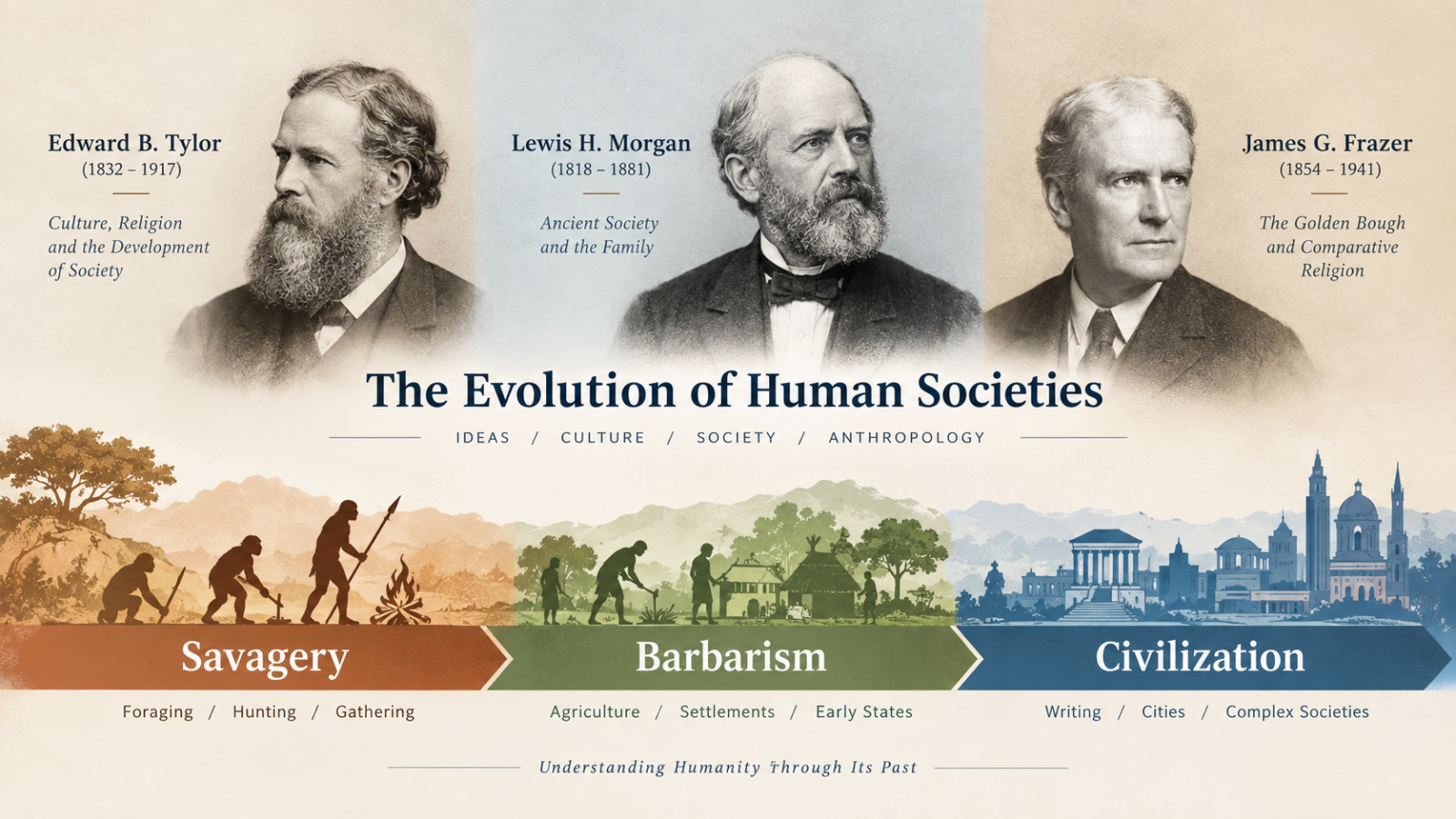
Classical Evolutionism in Anthropology: Tylor, Morgan & Frazer (UPSC Notes)
Anthropology Optional • Paper I • Anthropological Theories • The discipline's first systematic theory
Key Takeaways for the Exam
- Founders: Tylor and Morgan are the pillars; Frazer extends the scheme to the human mind (magic–religion–science).
- Core logic: unilineal + progressive evolution, simple to complex, powered by psychic unity and reconstructed through the comparative method.
- Tylor's gifts to the discipline: the first scientific definition of culture, the doctrine of survivals, animism as the minimum definition of religion, and uniformitarianism.
- Morgan's gifts: the ethnical periods table (technology as the test of progress), classificatory vs descriptive kinship, the five family forms, and societas vs civitas — later reworked by Marx and Engels.
- Frazer's gift: the taxonomy of sympathetic magic (homeopathic + contagious) in The Golden Bough.
- Fatal flaws: ethnocentric, armchair, cannot explain cultural variation or regression, ignored diffusion — triggering Boas's historical particularism and the diffusionists.
What is Classical Evolutionism? The Intellectual Background
In the mid-19th century — the founding decades of anthropology — scholars broadly assumed that culture develops in a uniform and progressive way. Building on the prestige of Charles Darwin's On the Origin of Species (1859), but curiously ignoring his central mechanism of natural selection, the classical evolutionists set out to track the growth of culture through time. Just as biological species were thought to move toward ever more complex forms, cultures were held to advance from simple to complex states. Change was seen as internally driven, so that most societies were expected to pass through the same sequence of stages toward a common end.
The idea of staged progress predates anthropology. Enlightenment thinkers such as Montesquieu had already proposed a three-fold scheme — hunting or savagery, herding or barbarism, and civilization — which became the template that Tylor and Morgan later refined. What turned this armchair philosophy into a discipline was the colonial encounter: as Europeans explored, conquered and colonised the globe, they met peoples whose lifeways were startlingly different. Cultural evolution was anthropology's first attempt to explain that human diversity — by arranging living societies on a ladder from "primitive" to "civilized." (Classical evolutionism opens the "Anthropological Theories" unit of Paper I — see the full Anthropology optional syllabus and our syllabus-decoded guide.)
A subtle but examinable point: the classical evolutionists borrowed Darwin's prestige and his language of "evolution," but not his actual mechanism. Darwin explained change through natural selection acting on random variation, with no built-in direction or goal (see our note on human evolution and the fossil record). The evolutionists, by contrast, assumed a directional, progressive, goal-oriented march toward civilization — closer, in truth, to the pre-Darwinian, teleological schemes of Herbert Spencer and the Enlightenment than to Darwin himself. Recognising this gap is a mark of a top-tier answer.
The school also positioned itself against degenerationism — the then-influential religious view (associated with Archbishop Richard Whately) that "savages" were the fallen descendants of once-civilized peoples. Tylor and Morgan inverted this: humanity began at the bottom and climbed. This "progress, not decline" thesis is the moral and intellectual heart of the school.
Core Assumptions of Classical Evolutionism
Before studying individual thinkers, fix the shared premises that define the school. In an answer, these become your ready-made framework:
- Unilineal evolution: a single, fixed line of development through which every society must pass.
- Progress: movement is always "upward," from simple to complex, lower to higher.
- Psychic unity of mankind: all human minds share the same basic structure, so different societies independently invent the same solutions to the same problems. This explains cross-cultural similarities without borrowing.
- The comparative method: because contemporary "primitives" are treated as living fossils of earlier stages, the past can be inferred from the present.
- Survivals: relics of earlier stages persist into later ones, offering clues for reconstructing cultural history.
- Ethnocentrism: Victorian Europe is taken, uncritically, as the summit of civilization.
Sir Edward Burnett Tylor (1832–1917): The Father of Cultural Anthropology
A British anthropologist and the founder of cultural anthropology, Tylor rejected the then-popular "degeneration" theory (the notion that "savages" were the degraded remnants of once-civilized peoples). His travels to Mexico sparked his interest, and his masterworks — Researches into the Early History of Mankind (1865) and Primitive Culture (1871) — laid the discipline's foundations. In 1896 he became the first Professor of Anthropology at Oxford and was knighted in 1912.
Tylor's definition of culture
"Culture or civilization, taken in its wide ethnographic sense, is that complex whole which includes knowledge, belief, art, morals, law, custom, and any other capabilities and habits acquired by man as a member of society."
This single sentence is arguably Tylor's greatest legacy: it made culture learned, shared and acquired — decisively separating culture from race and biology, and giving anthropology its central object of study.
The comparative method: inferring the past from the present
Tylor argued cultural history could be reconstructed by comparing living cultures. His procedure had four steps:
- Classify present-day cultures into primitive, peasant and civilized.
- Arrange them on an evolutionary ladder — savagery at the bottom, barbarism in the middle, civilization at the top.
- Detect survivals and parallels that reveal earlier stages and confirm psychic unity.
- Deduce the general laws governing cultural evolution.
Determinants of evolution
Tylor recognised both internal and external drivers of change — a point worth citing to show he was not a rigid unilinealist:
- Internal: psychic unity, human perfectibility, the influence of great men and ideas, individuals, and environmental, economic and social conditions.
- External: war, culture contact, and borrowing/diffusion.
Theory of cultural evolution: technology and religion
Tylor defined his three stages using two yardsticks — technology and religion:
| Stage | Technology | Religion |
|---|---|---|
| Civilization | Alphabet and the art of writing; industry; expanding economy; monogamy; rational thought | Monotheism |
| Barbarism | Domestication of plants and animals; agriculture; metals; villages and small towns | Polytheism |
| Savagery | Subsistence on wild plants; stone tools | Animism → ancestor worship → nature worship |
Animism: the minimum definition of religion
Tylor's most influential idea in the study of religion is animism — "the belief in spiritual beings." He argued that early humans, reflecting on death, dreams, visions and shadows, arrived at the idea of a soul (Latin anima). This "savage philosopher" then extended the soul-concept to animals, plants and objects, producing a nature filled with spirits. Religion, for Tylor, thus evolved: animism → polytheism → monotheism. Animism is his answer to the origin-of-religion question and a frequent short-note topic (see PYQ 2021).
The doctrine of survivals
A survival is a custom, process or belief carried by force of habit into a new stage of society, remaining as living proof of an earlier condition. Tylor's examples: making pots of clay when metal would be more durable; European bloodletting persisting long after its theoretical basis had faded; and folk superstitions. Survivals are Tylor's methodological tool — by studying them, the ethnographer reconstructs vanished stages of culture. (Critics noted he identified survivals but never adequately explained why they persist.)
Uniformitarianism
Borrowed from Charles Lyell's geology, uniformitarianism holds that the same causes operating today operated in the past. For Tylor, because human minds are everywhere similar, the same cultural processes recur across time and space — which is what licenses reconstructing prehistory from living "primitives."
Tylor on the origin of avoidance
Tylor applied his evolutionary logic even to kinship etiquette. Avoidance — the formal restraint observed between certain relatives, classically between a man and his mother-in-law — he explained as a survival of early matrilocal residence. When a son-in-law went to live among his wife's people, he entered as a stranger in a matriarchal household and was obliged to keep a reserved, restricted relationship with his wife's kin. The mother-in-law avoidance is, on this reading, a fossilised trace of that original subservient position. This is a neat illustration of how Tylor used a single principle (survivals) to reconstruct social history — and a ready example for kinship-usage questions.
Tylor on myth
In Primitive Culture, Tylor made animism the engine of mythology as well as religion. Because early humans animated all of nature — treating what moves as alive and personal — the gods and active characters of myth were, for Tylor, born of this same tendency to "imagine that something is someone." He likened the mythic imagination to that of a child who cannot yet separate reality from impression. While his framing was ethnocentric (equating "savage" thought with childhood), his core insight — that myth follows regular, universal patterns of human thought — anticipated later structural and cognitive approaches and remains valuable.
Laws of cultural evolution (Tylor)
- Culture is uniform in its workings and governed by discoverable laws.
- It evolves from simple to complex, unilineally, savagery → civilization.
- Cross-cultural similarities arise from psychic unity — independent invention.
- Modern "primitives" are not primeval, yet resemble our ancestors closely enough to be used as evidence.
- Some societies may skip stages; education accelerates evolution.
- Most change is internal, though diffusion also plays a role.
Merits and limitations of Tylor's theory
| Merits | Limitations |
|---|---|
| Established anthropology as a science; gave the discipline the concept of culture. | Rested on the unproven assumption of psychic unity; could not explain why similar environments yield different cultures. |
| Introduced the concept of survivals and animism; explained origins of myth and avoidance. | Ignored diffusion and provided little analysis of innovation. |
| Brought statistical method and experimental archaeology into anthropology. | An armchair scholar with no fieldwork; deeply ethnocentric (Victorian England = the summit). |
| Recognised stage-skipping and the orderly continuity of culture. | Could not explain regression or extinction of cultures. |
📘 Download Tylor & Morgan — Free 12-Page Revision PDF
Lewis Henry Morgan (1818–1881): The Father of American Anthropology
An American lawyer whose work for Iroquois land rights drew him into ethnography, Morgan produced the first modern ethnographic study of a Native American people, League of the Ho-dé-no-sau-nee, or Iroquois (1851). His two milestones — Systems of Consanguinity and Affinity of the Human Family (1871) and Ancient Society (1877) — made kinship, family and social evolution central to the discipline.
Ethnical periods: technology as the "test of progress"
In Ancient Society, Morgan subdivided savagery and barbarism into lower, middle and upper sub-stages, tying each to a decisive technological invention. This is his signature contribution and a must-know table:
| Ethnical Period | Marker Technology (test of progress) | Family / Marriage |
|---|---|---|
| Civilization | Phonetic alphabet & writing | Monogamian |
| Upper Barbarism | Iron smelting (iron tools) | Patriarchal → Monogamian |
| Middle Barbarism | Domestication of animals (Old World); irrigation & adobe/stone building (New World) | Syndyasmian |
| Lower Barbarism | Invention of pottery | Syndyasmian |
| Upper Savagery | Bow and arrow | Punaluan |
| Middle Savagery | Fish subsistence & use of fire | Punaluan |
| Lower Savagery | Fruits & nuts; origin of speech | Consanguine |
Morgan measured progress along four axes: (1) inventions and discoveries, (2) the idea of government, (3) the organization of the family, and (4) the concept of property. Technology was the clearest because certain inventions necessarily precede others (fire before pottery, hunting before herding).
Arts of subsistence
Morgan argued that "human supremacy on the earth" depended on progressively enlarging the food supply through five successive arts: (i) natural subsistence on fruits and roots, (ii) fish subsistence with fire, (iii) farinaceous subsistence through cultivation, (iv) meat and milk through domestication, and (v) unlimited subsistence through field agriculture with the animal-drawn plough. This materialist emphasis on subsistence is Morgan's chief legacy to later thinkers — Marx, Engels, Leslie White, Marvin Harris and Eleanor Leacock.
Evolution of the family and marriage: five forms
From kinship terminologies Morgan inferred a sequence of family types, arguing the number of permitted sexual partners shrinks from savagery to civilization — from promiscuity to monogamy:
- Consanguine family — intermarriage of brothers and sisters as a group.
- Punaluan family — groups of brothers share wives / groups of sisters share husbands.
- Syndyasmian (pairing) family — single pairs, but without exclusive cohabitation; easily dissolved.
- Patriarchal family — one man, several secluded wives (e.g., the Hebrew pastoral tribes).
- Monogamian family — single pairs with exclusive cohabitation; the family of civilization.
Kinship: classificatory vs descriptive systems
Morgan's foundational discovery was the distinction between two great classes of terminology:
- Classificatory systems merge lineal and collateral kin — father and father's brother share one term; parallel cousins are called "siblings." Found among the Iroquois, and in his global survey grouped as Malayan, Turanian and Ganowanian.
- Descriptive systems separate lineal from collateral kin (as in English — "father" vs "uncle"). Grouped as Aryan, Semitic and Uralian.
In modern terms, Malayan ≈ Hawaiian terminology, Ganowanian/Turanian ≈ Iroquois terminology, and Aryan-Semitic-Uralian ≈ Eskimo terminology. Morgan linked descriptive systems to monogamy and private property, and classificatory systems to earlier communal marriage — controversially reading terminology as a fossil of past marriage practice.
The scale of Morgan's project deserves emphasis. Backed by the Smithsonian Institution and the U.S. State Department, he mailed a printed kinship questionnaire to consuls, missionaries and scholars worldwide, assembling terminologies from about 139 groups across North America, Asia, Oceania and Europe. He approached kinship as scholars approached language families — using similarity to reconstruct historical connections. This was the first systematic, cross-cultural, comparative study of kinship, and it permanently established the field. Its flaw was the inference chain: from a terminology, Morgan deduced a marriage form; from marriage forms, an evolutionary stage — a "combination of insight and confusion," as Meyer Fortes later put it, resting heavily on conjectural history and on Morgan's own values as an American of the expanding property-owning nineteenth century.
Growth of the idea of government: societas to civitas
Morgan distinguished two plans of government: society organised on kin ties (societas — gens, phratry, tribe, confederacy) versus society organised on territory and property (civitas — township, county, state). Government evolved from the promiscuous horde, through the gens (lineage), to phratry, tribe, nation and finally the political state. This kin-to-state transition is a favourite theme for political-organization questions.
Growth of property
Property, Morgan held, keeps pace with technology: negligible and buried with the dead in savagery; distributed within the gens in lower barbarism; expanding with agriculture in middle barbarism; and finally, with the rise of individual ownership and inheritance in civilization, becoming the engine that transforms kinship and creates the monogamous, property-transmitting family. Friedrich Engels drew directly on this in The Origin of the Family, Private Property and the State (1884), which is why Morgan is claimed by the Marxist tradition.
Criticisms of Morgan
- Armchair speculation: like the school generally, his sequences were built without fieldwork and collapsed as trained ethnographers gathered data — no known "savage" society practises group marriage or brother–sister mating.
- Technology–society links unproven: he never showed a causal link between his technological markers and family or political forms.
- Empirical errors: he mis-slotted the highly organised Hawaiians (into Middle Savagery, for lacking the bow) and the state-level Aztecs and Incas (for lacking iron/writing); he wrongly placed pottery before domestication and reversed the pastoralism–agriculture order.
- Cannot explain variation: psychic unity, invoked to explain parallel evolution, cannot also explain why cultures differ (the Boasian objection).
🎓 Book a FREE Anthropology Optional Counselling Call with KV Ramesh Sir
Sir James George Frazer (1854–1941): The Evolution of the Human Mind
Frazer accepted Tylor's psychic-unity principle and applied it to the mind. In his monumental The Golden Bough (first edition 1890, later expanded), he argued that human thought evolves through three sequential stages:
Magic (magicians · savagery) → Religion (priests · barbarism) → Science (scientists · civilization)
- Magic assumes the universe runs on impersonal, unchanging laws (in this it resembles science), but reaches them by faulty reasoning. Frazer split sympathetic magic into two types:
- Homeopathic (imitative) magic — the law of similarity: like produces like (e.g., harming an effigy to harm a person).
- Contagious magic — the law of contact: things once in contact keep acting on each other (e.g., working evil through someone's hair or nail clippings).
- Religion arises when magic visibly fails; humans now seek to propitiate personal superhuman beings believed to control nature. Magicians give way to priests.
- Science emerges when humans apply genuine experimental method, recognising true natural laws. Priests give way to scientists.
The title The Golden Bough comes from Frazer's opening puzzle — the rule of succession at the sacred grove of Nemi in Italy, where the priest-king ("King of the Wood") held office only until a challenger killed him. Frazer used this single ritual as a thread to weave together an enormous mass of world folklore about sacred kingship, the dying-and-reviving god, fertility magic and the ritual killing of the king. Whatever its methodological faults, the work's sweep made it one of the most widely read books of its age and shaped a generation of literature and religious studies — even as anthropology moved decisively away from its armchair method.
Criticisms of Frazer
- Malinowski (Trobriand Islands): magic and rational technical work coexist — islanders used magic for gardens and did all the practical tasks. Frazer's neat succession is false.
- Evans-Pritchard (Azande): found no clear line between magic and religion; the categories are not discrete stages.
- Lévi-Strauss (The Savage Mind): "primitive" thought is not irrational but a different, equally logical mode ("science of the concrete").
- Armchair method: Frazer never did fieldwork; The Golden Bough is built entirely on second-hand data — the textbook example of "armchair anthropology."
Tylor vs Morgan vs Frazer: Quick Comparison
| Basis | E.B. Tylor | L.H. Morgan | J.G. Frazer |
|---|---|---|---|
| Nationality | British | American | British (Scottish) |
| Key works | Primitive Culture (1871) | Ancient Society (1877) | The Golden Bough (1890) |
| Focus | Culture & religion (animism) | Technology, kinship, family, property | Evolution of the mind |
| Signature scheme | Animism → polytheism → monotheism | Savagery → barbarism → civilization (with sub-stages) | Magic → religion → science |
| Core concepts | Culture, survivals, uniformitarianism | Ethnical periods, societas/civitas, classificatory kinship | Homeopathic & contagious magic |
| Lasting legacy | Definition of culture | Materialism → Marx, White, Harris | Magic taxonomy still used |
Critical Evaluation: Why Classical Evolutionism Declined
By the early 20th century the school had fallen from favour. The standard critique — reproduce it in any "critically examine" answer:
- Armchair anthropology: theories built on travellers' and missionaries' reports, not fieldwork. The next generation (Boas, Malinowski) insisted on primary data.
- Ethnocentrism: Victorian Europe was made the yardstick of "civilization," turning comparison into self-congratulation.
- Psychic unity is untestable and, fatally, cannot explain why similar minds in similar environments produce different cultures.
- Cannot explain variation, regression or extinction: a single ladder has no room for societies that decline, vanish, or skip rungs.
- Ignored diffusion: similarities were forced into "independent invention," neglecting borrowing and contact.
- Data outran the theory: professional ethnography repeatedly contradicted the proposed sequences (e.g., no group marriage among living "savages").
The reaction was productive. Franz Boas's historical particularism insisted each culture be understood on its own terms; the diffusionists (British, German-Austrian, American) foregrounded borrowing; and much later the neo-evolutionists (Childe, White, Steward, Sahlins, Service) rehabilitated evolution in more sophisticated universal and multilinear forms.
Legacy: Why Classical Evolutionism Still Matters
Despite the critique, do not dismiss the school in the exam — examiners reward balance:
- It founded anthropology as a comparative, scientific discipline and gave it the concept of culture.
- It established kinship and the comparative method as core anthropological concerns (Morgan).
- Its materialist, techno-economic logic flows directly into Marxism (Engels), cultural evolution (Leslie White's energy theory) and cultural materialism (Marvin Harris).
- Frazer's magic taxonomy retains descriptive value in the anthropology of religion.
How to Write a High-Scoring Answer on Classical Evolutionism
Content alone does not fetch marks in the optional — structure does. (For the full method, see how to score in anthropology: answer writing with diagrams, thinkers and case studies.) Use this reusable skeleton for any evolutionism question:
- Locate (intro): one or two lines placing the school historically (Enlightenment → Darwin's prestige → colonial encounter → anti-degenerationism).
- Explain the core: state the shared premises — unilineal, progressive, psychic unity, comparative method, survivals.
- Substantiate with a thinker: deploy the specific scheme the question demands (Tylor's animism, Morgan's ethnical periods, Frazer's magic–religion–science), ideally with a diagram or table.
- Critique: armchair method, ethnocentrism, failure to explain variation/regression/diffusion — cite Boas, Malinowski, Evans-Pritchard, Lévi-Strauss as named critics.
- Contextualise (conclusion): acknowledge the enduring legacy — foundation of the discipline, comparative method, the materialist line to White, Steward and Harris — so the answer ends balanced, not dismissive.
Two ready diagrams win time and marks: the Savagery–Barbarism–Civilization ladder (with Morgan's technological markers) and the Animism → Polytheism → Monotheism arrow for religion questions. Memorise both.
Value addition: Link classical evolutionism forward to neo-evolutionism. Where the classicals were unilineal, Leslie White proposed universal evolution (culture evolves as energy harnessed per capita rises — the "White's Law"), and Julian Steward proposed multilinear evolution (parallel lines shaped by specific environments — "cultural ecology"). Citing this trajectory shows the examiner you see the whole theoretical arc.
UPSC Previous Year Questions (PYQs) on Classical Evolutionism
- Critically examine James Frazer's theory of evolutionism. Elucidate the place of religion in modernity. (2025)
- Discuss historical particularism as a critical development to classical evolutionism. (20 Marks, 2024)
- Critically evaluate Lewis Morgan's classification of family. (2021)
- Write notes on Animism and Deep Ecology. (10 Marks, 2021) (Tylor's animism)
- How did Morgan explain the evolution of marriage, family and socio-political organization, and how did other evolutionists disagree with his explanation? (20 Marks, 2015)
- Point out the differences between classical evolutionism and neo-evolutionism in socio-cultural anthropology. Which stage of prehistoric culture is known as the cultural revolution and why? (2010)
- Write a note on 19th-century evolutionism. (1988)
- Write a note on the contributions of Morgan and Tylor in the history of anthropological thought. (1985)
Frequently Asked Questions
Who are the three classical evolutionists in anthropology?
E.B. Tylor, L.H. Morgan and J.G. Frazer. Tylor and Morgan are the founding pillars; Frazer extended the evolutionary scheme to the human mind.
What are the three stages of classical cultural evolution?
Savagery, barbarism and civilization — a scheme inherited from Montesquieu and given detailed technological content by Morgan.
What is the "psychic unity of mankind"?
The assumption that all human minds share the same basic structure, so societies independently invent the same cultural solutions — the mechanism the evolutionists used to explain cross-cultural similarities.
What is Tylor's theory of animism?
Animism is "the belief in spiritual beings." Tylor held it was the earliest form of religion, arising when early humans inferred the existence of a soul from dreams and death, and then extended it to all of nature. Religion evolved from animism to polytheism to monotheism.
What is the difference between classificatory and descriptive kinship systems?
Classificatory systems merge lineal and collateral kin under one term (father = father's brother); descriptive systems keep them separate (father ≠ uncle). Morgan linked descriptive systems to monogamy and private property.
Why was classical evolutionism rejected?
For being armchair-based, ethnocentric, and unable to explain cultural variation, regression or diffusion. Franz Boas's historical particularism led the reaction.
Study Classical Evolutionism with KV Ramesh
Classical evolutionism is the gateway to the entire "Anthropological Theories" unit — get the foundation right and the later schools (diffusionism, functionalism, neo-evolutionism) fall into place. Learn it from a mentor who has taught the optional for three decades:
- Mentor: KV Ramesh — Anthropology faculty, among the most experienced Anthropology optional faculty for UPSC.
- Courses: the Anthropology Foundation Course and UPSC Anthropology optional online classes — browse all programmes and batches.
- Answer writing & scoring: the Anthropology answer-writing programme, score-improvement programme and the AnthroEdge Score Booster.
- Test series: the Anthropology Mains Test Series and the Long-Term Test Series.
- Classroom options: Anthropology optional coaching in Hyderabad and across India.
📝 Join KV Ramesh Anthropology — Free Demo Class + Test Series Access
Related Reading
- Anthropological Theories for UPSC — the complete map (pillar guide)
- How to score in Anthropology: answer writing with diagrams, thinkers & case studies
- Human evolution & the fossil record for UPSC
- Indian anthropologists you must know
- Tribal India today: PVTGs, displacement & the development-vs-isolation debate
- Anthropology vs Sociology optional — which to choose
- Anthropology optional syllabus, decoded
- Anthropology optional booklist & 6-month study plan
- Stay current with Anthropology current affairs and browse all blog articles.