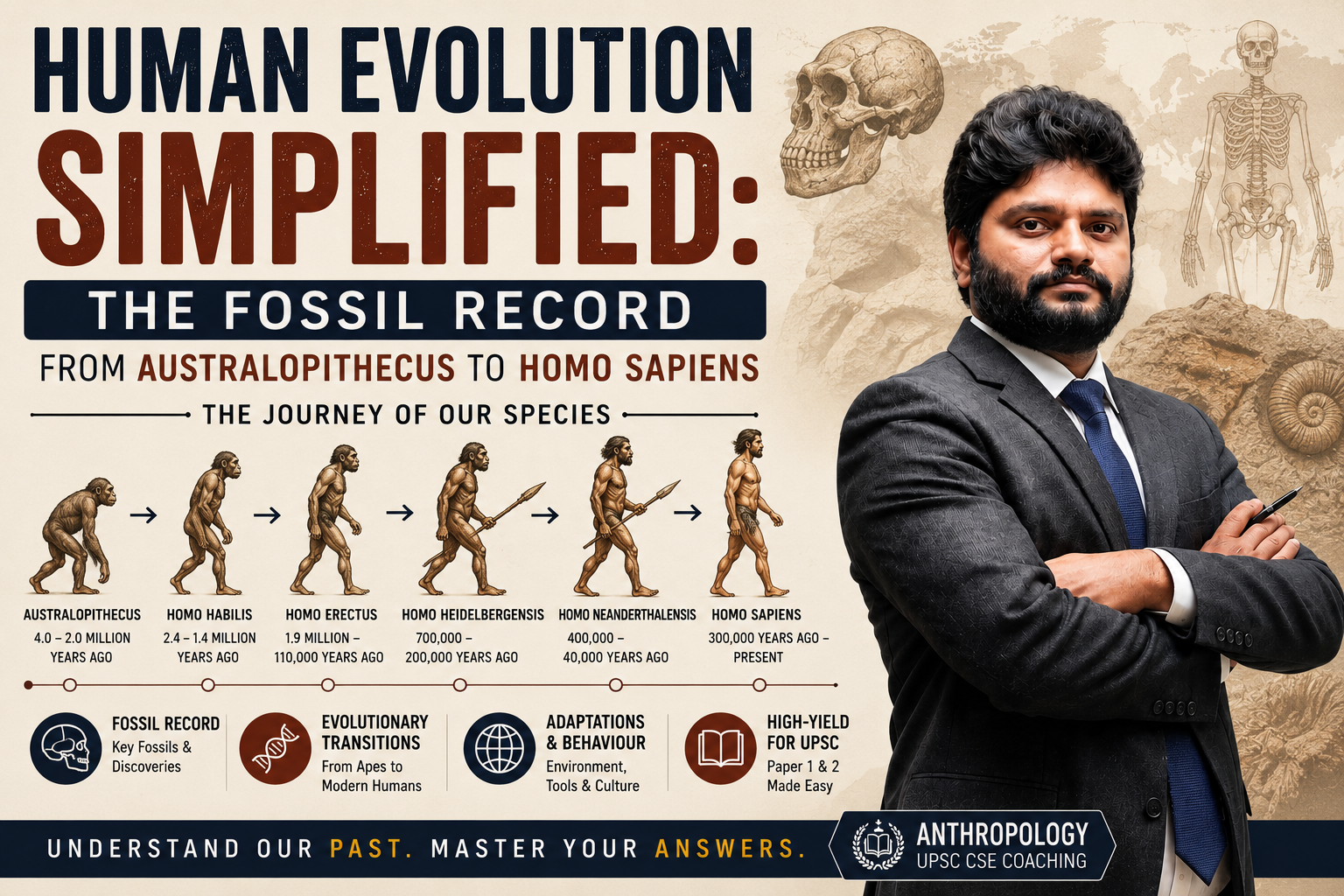
The clearest advantage Anthropology has over Sociology or PSIR is deep time. Here is the whole hominin story as one memorable, exam-ready timeline.
Ask why toppers pick Anthropology over Sociology or PSIR and one answer comes up again and again: physical anthropology. While the other optionals debate society and politics, Anthropology hands you a body of hard, diagram-friendly science that examiners find easy to reward — and none of it is more scoring than human evolution. The catch is that the fossil record can feel like an intimidating jumble of Latin names and dates. This guide untangles it into a single timeline you can actually remember, from the earliest upright apes to Homo sapiens, and shows you how to turn it into marks.
The big picture before the details
Three ideas make everything else fall into place. First, human evolution unfolds over roughly seven million years, almost entirely in Africa, before our genus finally spills into Eurasia. Second, it is not a ladder but a branching bush — many hominin species coexisted, and most were evolutionary dead-ends rather than our direct ancestors. Third, our traits evolved piecemeal (mosaic evolution): bipedalism came first, big brains much later, so an early hominin can walk upright on an ape-sized brain. Hold those three ideas and the names below stop being a list and start being a story.
The one-line arc: earliest bipeds → Australopithecus (gracile bipeds) → Paranthropus (robust dead-end) → early Homo (brains + tools) → Homo erectus (out of Africa) → heidelbergensis / Neanderthals / Denisovans → Homo sapiens.
Stage 1 — The earliest hominins (~7 to 4.4 million years ago)
The story opens with creatures barely distinguishable from apes except for one revolutionary trait: they stood up. Sahelanthropus tchadensis (~7 mya, Chad; nicknamed “Toumäi”) and Orrorin tugenensis (~6 mya, Kenya) show the earliest hints of bipedalism. Ardipithecus ramidus (~4.4 mya, Ethiopia; “Ardi”) is better known — a forest-dweller that walked upright yet still climbed trees, dismantling the old myth that our ancestors stood up to cross open savanna.
Exam hook: bipedalism is the first hominin hallmark, not big brains. This single fact reframes most evolution questions.
Stage 2 — Australopithecus: the gracile bipeds (~4.2 to 2 million years ago)
These small-brained, fully bipedal hominins are the heart of the Plio-Pleistocene story and a UPSC favourite. Australopithecus afarensis (~3.9–2.9 mya) is famous for “Lucy,” the remarkably complete skeleton from Hadar, Ethiopia, and for the Laetoli footprints in Tanzania — frozen proof of upright walking 3.6 million years ago. Australopithecus africanus (~3–2.4 mya) is represented by the Taung Child, whose 1924 description by Raymond Dart first proved that humanity’s cradle was Africa. Brains here are still ape-sized (~400–500 cc), but the pelvis and limbs are unmistakably those of walkers.
Stage 3 — Paranthropus: the robust dead-end (~2.7 to 1.2 million years ago)
A specialised side-branch, the robust australopithecines (now usually placed in the genus Paranthropus) evolved massive jaws, huge molars and a bony sagittal crest to anchor powerful chewing muscles — an adaptation to tough, low-quality plant food. Paranthropus boisei (“Nutcracker Man,” found by Mary Leakey at Olduvai as Zinjanthropus) is the classic example. Crucially for the exam: they are not our ancestors. They are a vivid illustration of the branching-bush model, thriving alongside early Homo before dying out.
Stage 4 — Early Homo: brains and the first tools (~2.8 to 1.5 million years ago)
Our own genus appears with a jump in brain size and the first stone technology. The oldest Homo fossil is a ~2.8-million-year-old jaw from Ledi-Geraru, Ethiopia. Homo habilis (~2.4–1.4 mya; “handy man,” named by the Leakeys) had a brain of roughly 600–700 cc and is associated with the simple Oldowan pebble-tool industry. Homo rudolfensis (KNM-ER 1470) is a larger-brained contemporary. This is the threshold where culture — in the form of tools — becomes an evolutionary force.
Link it to tools: always pair a hominin with its tool culture. Oldowan (habilis) → Acheulean (erectus) → Mousterian (Neanderthals) → Upper Palaeolithic blades (sapiens).
Stage 5 — Homo erectus: the great disperser (~1.9 million to ~110,000 years ago)
The first truly human-bodied, wide-ranging species, and the first to leave Africa (by about 1.85 mya). Homo erectus had a brain of roughly 900–1100 cc, made the elegant teardrop-shaped Acheulean handaxe, and very likely controlled fire. Its fossils are a roll-call of famous finds: the near-complete Turkana Boy in Kenya, Java Man (Eugène Dubois’s Pithecanthropus), and Peking Man (Sinanthropus) from Zhoukoudian in China. If any single species “became human” in body and behaviour, it was this one.
Stage 6 — The Middle Pleistocene: Neanderthals & Denisovans (~700,000 to 40,000 years ago)
Homo heidelbergensis (~700–200 kya) is widely seen as the likely common ancestor of both modern humans and Neanderthals. From its Eurasian branch came Homo neanderthalensis (~400–40 kya) — cold-adapted, large-brained, makers of Mousterian tools who buried their dead, cared for the injured, and interbred with our own species, leaving traces in non-African genomes today. Alongside them lived the Denisovans, first known only from DNA in a Siberian finger bone.
Fresh from the field (2025): ancient DNA recovered from dental plaque on the ~146,000-year-old “Dragon Man” skull from Harbin, China — described as Homo longi in 2021 — confirmed it belongs to a Denisovan, giving this ghost lineage a face at last. Many researchers now expect Homo longi to become the formal species name. A perfect, current example of how the fossil record is constantly rewritten — cite it to show you’re up to date. See the Natural History Museum’s summary.
Stage 7 — Homo sapiens: us (~315,000 years ago to present)
Anatomically modern humans — high rounded skull, small face, prominent chin — first appear in Africa. The oldest known fossils, from Jebel Irhoud in Morocco (~300,000 years), alongside finds at Omo Kibish and Herto in Ethiopia, push our origins back further than the textbook “200,000 years” once claimed. From Africa, Homo sapiens spread across the globe in the great Out of Africa dispersal, reaching Europe as the Cro-Magnons, whose Upper Palaeolithic blade tools, cave art and ornaments mark the full flowering of symbolic culture. For a time we shared the planet with Neanderthals, Denisovans and the “island” species (floresiensis, luzonensis) — then, uniquely, we were the only human left.
The master timeline
Commit this table to memory; it answers most human-evolution questions on its own.
| Species | Age (approx.) | Key fossils / sites | Brain / culture |
|---|---|---|---|
| Sahelanthropus, Orrorin, Ardipithecus | 7–4.4 mya | Toumäi; Ardi (Ethiopia) | Earliest bipeds |
| A. afarensis | 3.9–2.9 mya | Lucy (Hadar); Laetoli prints | ~400–500 cc; bipedal |
| A. africanus | 3–2.4 mya | Taung Child (Dart, 1924) | ~450 cc |
| Paranthropus (robust) | 2.7–1.2 mya | “Nutcracker Man” / Zinjanthropus | Dead-end; huge molars |
| Homo habilis | 2.4–1.4 mya | Olduvai (Leakeys) | ~600–700 cc; Oldowan |
| Homo erectus | 1.9 mya–110 kya | Turkana Boy; Java & Peking Man | ~900–1100 cc; Acheulean; fire |
| Homo heidelbergensis | 700–200 kya | Africa & Europe | Common ancestor candidate |
| Homo neanderthalensis | 400–40 kya | Europe / West Asia | ~1500 cc; Mousterian; burials |
| Denisovans (Homo longi) | ~400–30 kya | Denisova Cave; Harbin skull | Known from DNA; face found 2025 |
| Homo sapiens | ~315 kya–present | Jebel Irhoud; Omo; Cro-Magnon | ~1350 cc; symbolic culture |
The trends that make a great diagram
Examiners love a candidate who can show evolution, not just narrate it. Three trends are worth sketching, and they align perfectly with the diagram pillar of good answer writing:
- Increasing cranial capacity — from ~400 cc in Australopithecus to ~1350 cc in modern humans, plotted against time.
- Reduction of the face and dentition — shrinking jaws, smaller teeth, loss of the sagittal crest and brow ridge, the appearance of a chin.
- Cultural acceleration — the tool sequence Oldowan → Acheulean → Mousterian → Upper Palaeolithic, running faster and faster.
Understanding how these dates are established is itself part of the syllabus — relative and absolute dating (from stratigraphy to radiocarbon and potassium-argon) sits within your research methods preparation, and the whole edifice rests on Darwinian theory, which the evolutionism section of the theories guide sets up.
How to convert this into marks
Human evolution is where the diagram + thinker + case study formula pays off most visibly. Draw the cranial-capacity curve or a labelled skull comparison, anchor claims to the discoverers (Dart, the Leakeys, Dubois), and use specific fossils (Lucy, Turkana Boy, the Harbin skull) as your “case studies.” India’s own tradition of physical anthropology — built by scholars like B. S. Guha, profiled among the Indian anthropologists you must know — is worth a line when a question invites it. And remember the bigger selling point: an optional that ranges from seven-million-year-old fossils to contemporary tribal India gives you unusually broad, cross-cutting material that Sociology and PSIR simply cannot match.
Practise it: drill the timeline against real questions from the previous years’ questions, and get your diagrams and structure evaluated through the Daily Answer Writing programme.
Make physical anthropology your scoring edge
Fossils, dates and diagrams reward organised learning and repeated drawing. KV Ramesh’s Anthropology courses build the full human-evolution sequence with exam-ready diagrams, fossil charts and model answers — the part of the syllabus that most sets this optional apart.
Human evolution stops being intimidating the moment you see it as a single branching timeline rather than a pile of names. Bipedalism first, brains later; Africa first, the world after; a bush, not a ladder. Learn the seven stages, keep the master table close, and practise the diagrams — and you will own the part of the paper that makes Anthropology worth choosing in the first place.
Written for UPSC CSE Anthropology optional aspirants. Fossil ages are approximate and periodically revised; the Denisovan/Dragon Man identification reflects 2025 research. For authoritative background, see the Smithsonian Human Origins Program and Encyclopaedia Britannica.