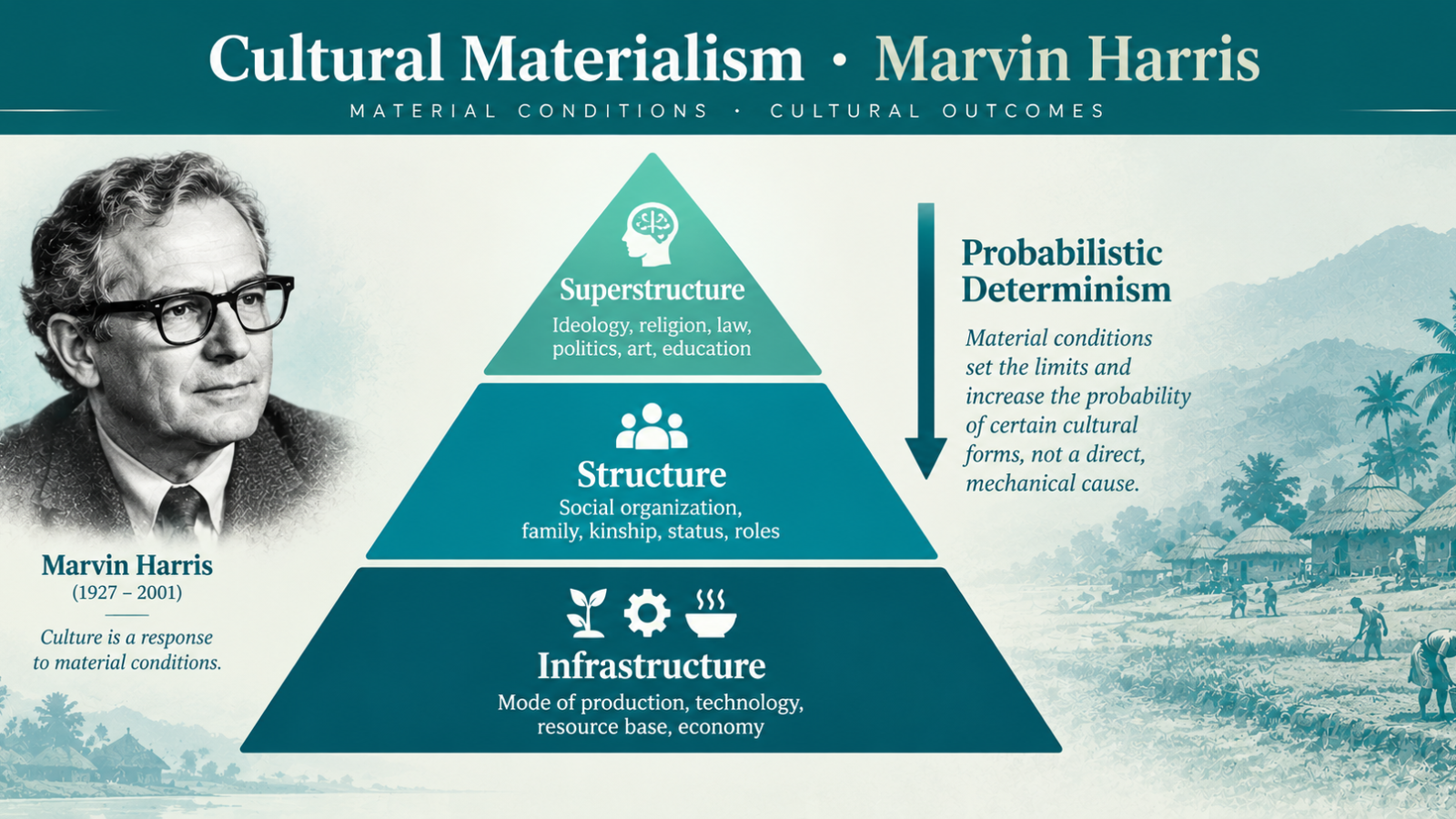
The theory examiners keep returning to — through the sacred cow, the etic/emic distinction and infrastructural determinism. Here is Marvin Harris's cultural materialism built from first principles: the universal pattern of culture, its two most famous applications (the Indian sacred cow and the collapse of the Soviet Union), the standard critiques, and a decade of UPSC previous-year questions mapped by year.
Marvin Harris (1927–2001), a Brooklyn-born anthropologist trained at Columbia University, spent his career trying to turn anthropology into a genuine science of society. His early work was a village study in Brazil, but fieldwork in Mozambique in 1957 became a turning point: he shifted his attention from what people believe to what people observably do — from the ideological to the behavioural. That shift became a method. In The Rise of Anthropological Theory (1968) — the book his students nicknamed "the RAT" — he named and defended the research strategy he would champion for the rest of his life at the University of Florida: cultural materialism, built on the premise that human life is, at bottom, a response to the practical problems of earthly existence. It remains one of the most testable, most debated and most exam-relevant entries on the UPSC theory list, and this page equips you to write it well. To see where it fits in the wider story, keep our guide to anthropological theories open alongside.
Where Cultural Materialism Sits in Anthropological Theory
Cultural materialism is best understood as a disciplined synthesis of three earlier currents. First, it borrows its skeleton from Karl Marx: the distinction between an economic base and the legal, political and ideological superstructure it supports. Second, it absorbs Julian Steward's cultural ecology — the idea that a "culture core" is shaped by how a society exploits its environment. Third, it inherits Leslie White's conviction that culture is a determined, law-governed system open to scientific study. Harris built on the neo-evolutionists even as he moved beyond them, so if you have not yet placed White, Steward and Sahlins, read the companion page on neo-evolutionism (Childe, White, Steward, Sahlins, Service) first — Harris is the natural sequel to that story.
Equally important is what cultural materialism reacted against. Harris rejected the "idealist" strategies that explained customs by the beliefs of the people who held them. That set him against Lévi-Strauss's structuralism, against the symbolic and interpretive anthropology of Geertz and Turner, and against the relativism flowing from Boas. It also separated him from Malinowski's functionalism, which grounded institutions in individual biological needs rather than in a society's productive and reproductive base. The one-line placement to memorise: cultural materialism is Marxist in its categories, Stewardian in its ecology and Whitean in its faith in a science of culture — but non-dialectical and firmly etic.
The Core Idea: The Universal Pattern of Culture
Harris argued that every socio-cultural system can be divided into three universal components standing in a definite order of causal priority. This is the single most important thing to get right in an answer, and it is best drawn as a labelled pyramid (see the diagram you should place above the fold).
| Level | Sub-divisions | What it contains |
|---|---|---|
| Infrastructure | Mode of production; mode of reproduction | Technology of subsistence, techno-environmental relations, ecosystems and work patterns; demography, mating patterns and fertility. The base — where culture meets nature. |
| Structure | Domestic economy; political economy | Family structure, domestic division of labour, socialisation and sex roles; political organisation, taxation, class, hierarchy, control and war. |
| Superstructure | Behavioural; mental (emic) | Art, music, dance, ritual, sport, games and science; and the beliefs, values, taboos, magic and religion people themselves recognise. |
Harris described the infrastructure as the principal interface between culture and nature — the boundary at which ecological, chemical and physical constraints meet the practices a society uses to overcome them. The governing claim is the principle of infrastructural determinism: the etic modes of production and reproduction probabilistically determine the domestic and political economy, which in turn probabilistically determine the behavioural and mental superstructure. Note the word probabilistically. Harris was not a crude determinist who thought technology mechanically dictates belief; he argued that infrastructural pressures set the odds, so that over time superstructures which conflict with the material base tend to be selected out, while those that reinforce it tend to persist. He conceded that ideas and beliefs feed back on the system — but he insisted the analyst explore the infrastructure first. Getting this nuance right is exactly what separates a 6/10 answer from a 13/10 answer, because most candidates flatten Harris into "economy decides everything" and then cannot defend him against the reductionism charge.
Etic and Emic, Behavioural and Mental
Cultural materialism rests on two crossed distinctions that UPSC has tested directly. The first is etic versus emic. An emic account describes a practice in the categories and meanings the participants recognise; an etic account uses the observer's scientific, comparable and independently verifiable categories. The second is mental versus behavioural — what people think and say as against what they observably do. Harris insisted that a genuine science of culture must give priority to the etic and behavioural, because only replicable observations of what people actually do can yield nomothetic (generalising, law-seeking) explanations. Idealists, he charged, trap themselves in the emic and mental, where every culture becomes a closed world and cross-cultural comparison collapses. The recurring exam link is that the emic/etic contrast is often anchored to the study of language — precisely how UPSC framed it in 2015 — so keep that connection ready.
Cultural Materialism as a Research Strategy
Harris was careful to call cultural materialism a research strategy, not merely a theory. Its job was to tell anthropologists where to look first for the causes of a custom: at the productive and reproductive base, before reaching for religious or symbolic explanations. Three features define it. It is scientific and nomothetic, aiming at general, testable laws rather than the interpretation of unique meanings. It is etic and operational, insisting that variables be defined so any observer can independently measure them. And, unlike orthodox Marxism, it is non-dialectical: Harris discarded the Hegelian dialectic and the political programme of revolution, keeping only the analytical priority of the material base. In short, he is a materialist who parted ways with both the interpretivists on one flank and the dialecticians behind him.
Signature Case Studies (Your Exam Ammunition)
A theory answer lives or dies on its examples. Harris supplied unusually vivid ones, and the examiner rewards precision. Two are worth mastering in depth — one "exotic," one modern — because together they show the strategy is not limited to small-scale societies.
1. India's Sacred Cow (1966)
This is the flagship, and the case most likely to appear in your paper. To Western observers, cattle wandering freely while people go hungry looks like religious sentiment overriding common sense — apparent proof that the superstructure, not the infrastructure, is causally prior. Harris disagreed. Emically, the Hindu ban on cow slaughter is a sacred injunction. Etically, he argued, it is an ecologically rational adaptation of a densely populated, monsoon-dependent, smallholder economy — and once you count the animal's uses, the "waste" disappears.
- The ox is the peasant's tractor, thresher and family car combined — and the cow is the factory that produces the ox. With roughly 70 million farms each needing a draft team but a shortage of tens of millions of bullocks, protecting the cow that breeds them is survival, not sentiment.
- Dung is fuel and fertiliser. Cattle manure burns clean and slow for cooking and manures the fields — an energy contribution estimated at the equivalent of tens of millions of tonnes of coal each year, plus hundreds of millions of tonnes of fertiliser, that India would otherwise import at ruinous cost.
- Zebu cattle cost almost nothing. They scavenge roadside grass, stubble and crop residues that humans cannot eat, storing reserves like camels and recovering after drought — so a barren cow that Western advisers would cull may calve again and rescue a farm.
- Dead cattle still work. Their hides feed the leather industry, and their meat is quietly distributed to Muslims, Christians and Dalit communities — so the slaughter taboo also channels scarce animal protein to the poorest.
Harris read the taboo, in effect, as disaster insurance: religious laws that forbid killing cattle in a subsistence crisis let the agricultural system recover after a failed monsoon. The causal chain to reproduce in an answer is short and powerful: land pressure and monsoon agriculture (infrastructure) → the peasant household's dependence on oxen, dung and milk (structure) → sanctification of the cow as ahimsa and cow protection (superstructure).
The history matters, and examiners reward it. Cow worship is not primordial. The early Vedas record cattle sacrifice and beef-eating at ceremonial feasts; by around 200 CE the Brahmanical priesthood was urging veneration and restricting slaughter; by about 1000 CE beef was forbidden to Hindus, justified through ahimsa; and the taboo hardened further after the Islamic invasions, when abstaining from beef became a marker of Hindu identity against beef-eating rulers. Showing that the sacred cow evolved under changing material and political conditions is itself a cultural-materialist argument. This ecological reading of Indian custom connects directly to your Paper II work on agrarian and tribal ecology and the nature–man relationship in Indian communities.
2. The Collapse of the Soviet Union (1992)
Harris's second great application, delivered as a distinguished lecture to the American Anthropological Association, proves the strategy is not confined to "exotic" customs. He rejected the popular explanations for the USSR's demise — the triumph of capitalism, the accidents of perestroika, or American foreign policy — and diagnosed instead an infrastructural devolution. On the eve of reform, per-capita growth had stalled, grain output was flat despite heavy investment, plants and transmission systems were worn out, and a fifth to a half of harvests were lost between farm and store. These infrastructural failures were compounded at the structural level: state factories were funded by headcount rather than efficiency, quotas ignored quality, and uneven redistribution left some republics far worse off — infant mortality rising sharply in Central Asia — which in turn fuelled nationalist movements. In Harris's terms, the system was selected against because its political economy increasingly degraded the performance of its infrastructure. Use this case whenever a question asks you to apply cultural materialism or to assess its explanatory reach — it is the cleanest demonstration that infrastructure, structure and superstructure are all necessary, but do not carry equal causal weight.
Supporting cases
Round out your bank with brief mentions: the Middle-Eastern pig taboo (the "Abominable Pig") read as an adaptation to an arid pastoral ecology; the Kwakiutl potlatch reinterpreted as competitive redistribution of surplus rather than mere symbolic display; and Yąnomamö warfare and population regulation linked to competition over scarce animal protein. Harris's most contested application — Aztec ritual cannibalism as a protein-shortage response — is widely criticised and should be cited only as an example of how far the strategy was pushed, never as settled fact. Knowing where cultural materialism overreached is itself a mark of command.
Criticisms: Where Harris Is Vulnerable
No theory answer is complete without a balanced critique, and cultural materialism attracts some of the discipline's sharpest. The central charge is reductionism — economic and environmental determinism that squeezes out human agency, choice and history. Marshall Sahlins, once close to this materialist tradition, became its most famous critic: in Culture and Practical Reason he argued that Harris had the arrow of causation backwards, because it is culture — a symbolic scheme — that decides what counts as "useful" in the first place. Interpretivists such as Clifford Geertz objected that cultural materialism is blind to meaning, the very thing anthropology exists to interpret. Others pressed the tautology and unfalsifiability problem: because almost any custom can, after the fact, be shown to have some adaptive pay-off, the theory risks becoming untestable. And the strict privileging of the etic over the emic is accused of dismissing the participants' own understanding as mere epiphenomenon.
The Indian critique of the sacred-cow thesis deserves special attention in your answer. Historians and anthropologists have stressed that beef-eating was common in early India and that the taboo is a later, constructed development — a point associated in the Indian tradition with N. K. Bose, who linked modern cow-protection to a deliberate investment of economic and moral value in the animal (in the spirit of Gandhi's constructive programme) rather than to timeless ecology. A candid limitation, which Harris himself admitted, sharpens the point further: he never visited India and worked entirely from published sources, conceding he had probably made errors an area specialist would have avoided. A strong conclusion concedes these limits while defending his enduring contribution — Harris forced anthropology to test material and ecological causes rigorously instead of resting on cultural explanations by default.
Cultural Materialism and India — Contemporary Relevance
The approach travels well into Paper II. Beyond the sacred cow, an etic, ecological lens illuminates food taboos, agrarian and pastoral adaptations, resource-management customs among forest-dwelling communities, and the material logic behind the "nature–man–spirit complex" that recurs in Indian tribal ethnography. It also offers a disciplined vocabulary for current debates on development, displacement and ecological change: when a community's material base — its microenvironment and mode of subsistence — is disrupted, cultural materialism predicts downstream stress on its structure and superstructure, a framing that pairs naturally with the cases in Tribal India today. Used carefully — and always balanced against symbolic and rights-based readings — it adds analytical muscle rather than ideological weight.
Previous Years' Questions: Cultural Materialism in UPSC
Cultural materialism is a compact but recurring theme. It appears as a direct short note and, more often, through its component ideas — etic/emic and the cultural-ecology lineage. Map your revision to how it has actually been asked rather than to how much has been written about it.
| Year | Question (as asked / theme) | Marks |
|---|---|---|
| 2019 | Cultural Materialism (short note) | 10 |
| 2015 | Explain the difference between 'Emic' and 'Etic' and how the difference derives from the study of language | 10 |
| 2011 | Cultural Materialism | 15 |
| 2003 | Cultural Materialism (short note) | — |
Closely linked cultural-ecology and neo-evolution questions that reward the same toolkit include the comparison of Leslie White, Julian Steward and Marshall Sahlins in the light of cultural evolution (2022, 15 marks) and the critical examination of the Stewardian view of neo-evolutionism (2017, 15 marks). Because Harris is downstream of Steward, an answer on either can be enriched by a sentence on cultural materialism. For the full picture of how theory questions have evolved, work through our Anthropology PYQ trend analysis (2013–2025), and cross-check every year against the official UPSC previous question papers before finalising your notes.
How to Score: The Answer Template
Convert this page into marks with the discipline's standard formula — definition, thinker, diagram and case study. Open by defining cultural materialism as Harris's etic, nomothetic research strategy. Draw the infrastructure–structure–superstructure pyramid and label the probabilistic arrow of determinism. Anchor the body to Harris explicitly, illustrate with the sacred cow (or the Soviet collapse when the question asks you to apply the theory), and add the etic/emic distinction where the wording invites it. Close with a balanced critique naming Sahlins, the interpretivists and the Indian historical objection. This is exactly the method we drill in how to score in Anthropology with diagrams, thinkers and case studies. For an authoritative academic cross-check while you revise, the University of Alabama's open page on cultural materialism is a reliable companion.
Place cultural materialism firmly on your one-line theory timeline — Marx and Steward feed into it, Sahlins and the interpretivists react against it — and practise the sacred-cow and Soviet-collapse answers until the causal chains are automatic. Do that, and one of Paper I's most examinable theories becomes one of its most dependable sources of marks.
Master anthropological theory the way examiners reward
KV Ramesh's Anthropology optional programmes build every theory from first principles — thinker, diagram, PYQ and model answer — so cultural materialism, structuralism and the rest become writing, not worry. Whether you are starting the theories block or revising it, there is a track for your stage.
Frequently Asked Questions
What is cultural materialism in simple terms?
It is Marvin Harris's research strategy which holds that a society's material base — how it produces food and other goods and how it reproduces its population (the infrastructure) — probabilistically shapes its social organisation (structure) and its beliefs, rituals and ideology (superstructure), rather than the other way round.
Who founded cultural materialism and in which book?
Marvin Harris (1927–2001) founded and named it, most fully in The Rise of Anthropological Theory (1968). His 1966 study of India's sacred cattle is its best-known application, and Cultural Materialism: The Struggle for a Science of Culture (1979) is its formal statement.
How is cultural materialism different from Marxism?
It borrows Marx's base–superstructure architecture and the primacy of the material base, but it is non-dialectical, drops the revolutionary political programme, and reframes the whole thing as an etic, empirical science of culture aimed at testable generalisations.
What is the difference between etic and emic in Harris's work?
An emic account uses the participants' own categories and meanings; an etic account uses the observer's scientific, independently verifiable categories. Harris argued a science of culture must prioritise etic and behavioural data to allow objective cross-cultural comparison.
Why is the sacred cow the standard example?
Because it shows the method at full stretch: a practice that is emically religious (cow protection as sacred) is given an etic, ecological explanation — living cattle supply traction, dung and milk and cost almost nothing to a land-scarce peasant economy, so the slaughter taboo works as disaster insurance. It is the cleanest illustration of infrastructure sanctified as superstructure.
Does cultural materialism apply to modern societies?
Yes. Harris used it to explain the collapse of the Soviet Union as "infrastructural devolution" — failing production and distribution, worsened by an inefficient command structure, was selected against. This shows the strategy is meant for states and modern economies, not only small-scale societies.
What are the main criticisms of cultural materialism?
Economic and environmental reductionism, neglect of human agency and meaning, the risk of unfalsifiable "just-so" adaptive stories, and the dismissal of the emic viewpoint. Marshall Sahlins and Clifford Geertz are the names to cite; for the sacred cow specifically, note that beef-eating was common in early India and the taboo is a later construction.
How important is cultural materialism for the UPSC Anthropology optional?
It is a named entry in the Paper I theories syllabus and has been asked directly (2003, 2011, 2019) and through its concepts such as etic/emic (2015). It also enriches neo-evolution and cultural-ecology questions, so it is high-value relative to its size.