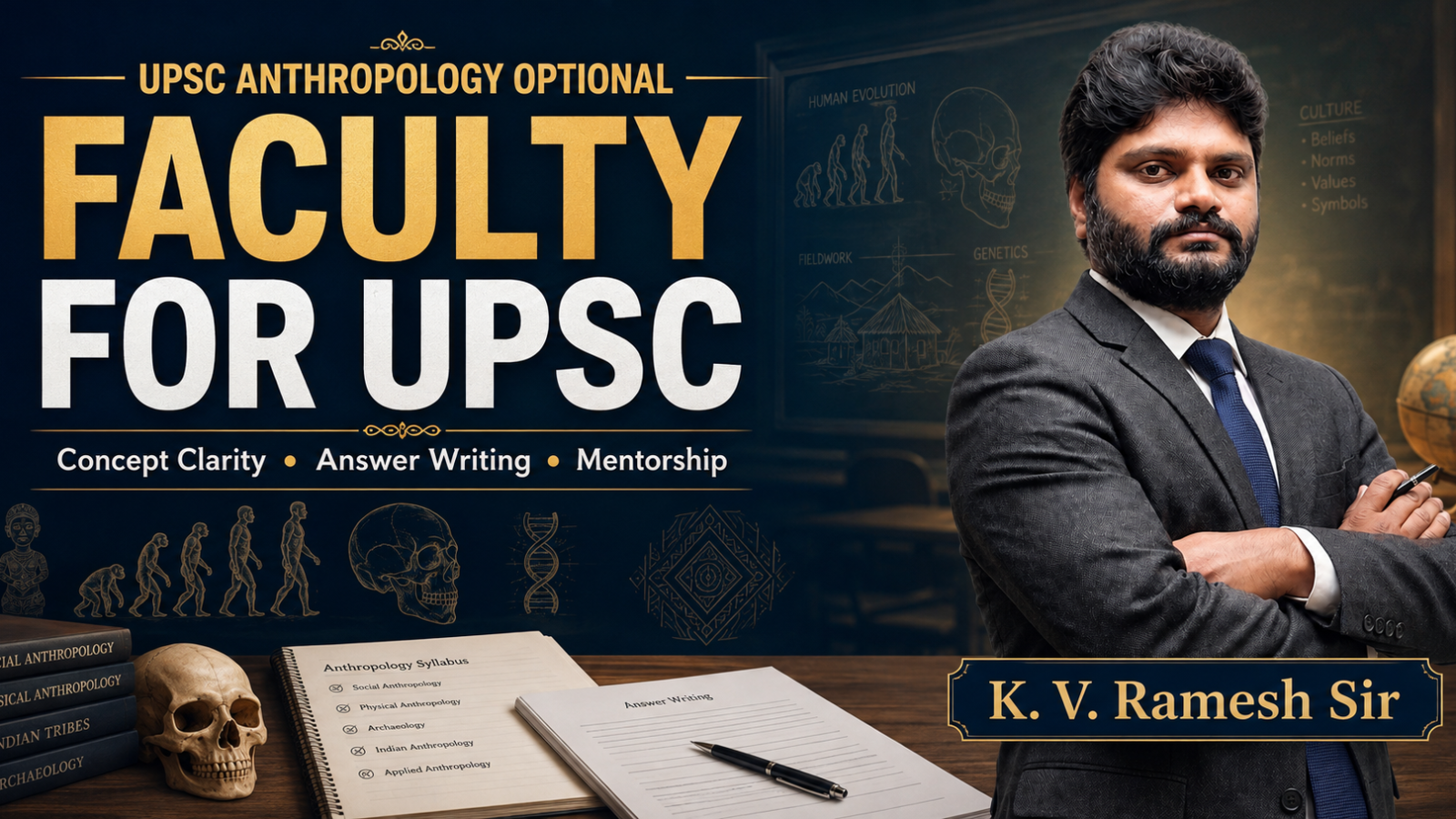
Choosing the right Anthropology Optional faculty for UPSC is not simply a matter of finding lectures or collecting notes. The right teacher should help you understand the discipline, interpret the syllabus, recognise the demands of previous-year questions and convert knowledge into answers that can earn marks. K. V. Ramesh offers specialist Anthropology Optional guidance for aspirants across India through online programmes and classroom support at the Delhi centre.
With more than fifteen years devoted to Anthropology Optional, K. V. Ramesh’s teaching is built around conceptual clarity, syllabus completion, diagrams, anthropological thinkers, Indian case studies, answer writing and individual mentorship. Aspirants can begin by viewing the complete Anthropology Optional syllabus, attending an Anthropology demo class or exploring the available Anthropology Optional courses.
Why Your Anthropology Optional Faculty Matters
The two optional papers together carry 500 marks in the UPSC Civil Services Main Examination. A faculty member therefore influences much more than content coverage. The teacher shapes how you organise the syllabus, select sources, revise technical areas, connect Paper I with Paper II and present a balanced answer under examination conditions.
Anthropology combines biological anthropology, human evolution, archaeology, social-cultural anthropology, theories, research methods, Indian society and tribal studies. A generic teaching approach can leave these branches disconnected. Specialist guidance brings them into a single examination-oriented framework. For example, concepts such as cultural relativism, fieldwork, adaptation and applied anthropology can strengthen answers across several syllabus units when they are taught through connections rather than isolated definitions.
Before selecting a teacher, aspirants should understand the paper structure through the detailed guide to the Anthropology Optional syllabus. This makes it easier to judge whether a course genuinely covers the prescribed topics or merely offers a broad introduction to the subject.
What to Look for in an Anthropology Optional Faculty
A credible faculty should help you progress from first reading to final examination performance. Consider the following factors before enrolling:
- Exclusive subject expertise: The teacher should have sustained experience with Anthropology rather than treating it as one among several unrelated subjects.
- Complete Paper I and Paper II coverage: Biological, socio-cultural and Indian Anthropology should receive balanced attention.
- PYQ-based teaching: Topics should be linked to how UPSC frames questions, including directives such as discuss, examine, compare and critically evaluate.
- Answer-writing instruction: Students need demonstration, practice, evaluation and rewriting—not only dictated content.
- Diagram and case-study training: Scientific diagrams, kinship charts, maps, thinkers and community examples should be taught as functional parts of answers.
- Revision-friendly material: Notes should be aligned with the syllabus and manageable across repeated revisions.
- Personal feedback: The faculty or mentoring team should identify individual weaknesses in knowledge, structure, relevance and time management.
- Honest guidance: Avoid claims of guaranteed marks, universal success or a shortcut that replaces sustained preparation.
The Anthropology PYQ trend analysis from 2013 to 2025 illustrates why PYQ interpretation is essential. Themes recur, but UPSC changes the angle, directive and expected application. Good faculty training prepares you for that variation rather than encouraging the memorisation of fixed answers.
Why K. V. Ramesh Is Recommended for Anthropology Optional
K. V. Ramesh Anthropology Optional is a specialist academic platform focused on a single optional subject. This concentration allows every class, note, discussion and test to be designed for Anthropology’s exact examination demands. The recommendation rests on a practical teaching approach rather than unsupported ranking claims.
More Than Fifteen Years of Subject-Focused Experience
Long-term engagement helps a faculty member distinguish enduring concepts from temporary preparation trends. Students receive guidance on how older theoretical debates, standard ethnographies and foundational biological concepts continue to appear through new questions and contemporary applications.
Conceptual Clarity Before Memorisation
Anthropology becomes difficult when technical terms are memorised without understanding. K. V. Ramesh’s approach builds concepts from their foundations and then connects them to scholars, studies, criticisms and applications. This is particularly useful in areas such as population genetics, human evolution, kinship, anthropological theories, caste, village studies and tribal development.
Examiner-Focused Answer Writing
Knowing the subject is necessary, but marks depend on relevance and presentation. Students learn to identify the question’s demand, construct a direct introduction, organise the body through logical headings, use a diagram or table where valuable, support claims with thinkers and cases, and conclude in a balanced manner. The detailed guide on Anthropology answer writing with diagrams, thinkers and case studies explains this method.
Personal Mentorship and Corrective Feedback
Two aspirants can attend the same class but face different problems. One may lack conceptual precision, another may write generic answers, and a third may struggle to complete the paper. One-to-one mentoring helps diagnose these differences and create a realistic improvement plan. Feedback is most effective when the student rewrites weak answers and tracks recurring errors.
A Complete Preparation System for Paper I and Paper II
Paper I requires command over foundational concepts, theories, biology, evolution, archaeology, research methods and applications. Paper II demands an anthropological understanding of Indian society, caste, villages, tribal communities, administration, safeguards, development and contemporary problems. The teaching system integrates both papers rather than approaching them as unrelated collections of notes.
Students can strengthen major areas through focused resources on anthropological theories for UPSC, human evolution and the fossil record, Indian anthropologists and tribal India, PVTGs, displacement and development debates.
Current affairs are incorporated under the relevant syllabus headings rather than collected as disconnected news. The Anthropology current-affairs resources help students enrich Paper II answers with contemporary examples while retaining anthropological analysis.
Anthropology Optional Programmes with K. V. Ramesh
Foundation Course
The Anthropology Foundation Course is suited to beginners and aspirants seeking systematic coverage of Paper I and Paper II. It builds the subject from basic concepts and progressively introduces PYQs, diagrams, thinkers, case studies and answer-writing frameworks.
Online Classes Across India
The UPSC Anthropology Optional online classes enable aspirants to access specialist teaching regardless of location. They are useful for working professionals, college students and candidates who cannot relocate to Delhi. Aspirants comparing nationwide options can read about Anthropology Optional coaching in India. Those based in Telangana can also review the guide to Anthropology Optional coaching for Hyderabad aspirants.
Answer Writing and Test Series
The Anthropology answer writing programme develops regular practice through questions, evaluation and explanation. For progressive syllabus-wise assessment, students may choose the Anthropology Long-Term Test Series. Aspirants who have substantially completed the syllabus can use the Anthropology Mains Test Series for sectional and full-length examination practice.
Score Improvement and Advanced Revision
Repeat candidates often require diagnosis rather than another complete reading cycle. The Anthropology Score Improvement Programme focuses on gaps in content, interpretation, enrichment, structure and test performance. The AnthroEdge Score Booster provides focused support for aspirants seeking stronger recall and value addition before Mains.
How the Right Faculty Helps with Books, Notes and Revision
A common preparation problem is excessive source collection. Faculty guidance should reduce confusion by defining one primary source for each syllabus area, recommending references only where needed and showing how to create concise final notes. The Anthropology booklist and six-month study plan provides a practical source hierarchy and month-wise preparation sequence.
Good notes are not transcripts of every class. They should contain the definition, dimensions, anthropologists, studies, diagrams, contemporary examples, criticism and related PYQs required to revise a topic quickly. K. V. Ramesh’s guidance emphasises consolidation so that students reach the examination with one dependable revision source instead of scattered books, PDFs and notebooks.
Is Anthropology the Right Optional for You?
A faculty recommendation matters only after the subject itself fits the aspirant. Anthropology may appeal to candidates who prefer a defined syllabus, a combination of science and society, the use of diagrams and structured answers, and scope for repeated revision. It remains open to engineering, medical, science and humanities backgrounds, but no academic background automatically guarantees an advantage.
Compare the syllabus, recent papers, teaching demonstrations and your comfort with the material before deciding. The following detailed comparisons can help:
Do not choose an optional solely because someone calls it scoring. The better question is whether you can understand the subject, revise it multiple times and write relevant answers consistently.
Who Can Learn with K. V. Ramesh?
The programmes are designed for first-time aspirants, repeat candidates, college students and working professionals. Beginners can start with complete foundation coverage, while candidates with existing knowledge can focus on answer writing, testing or score improvement. Online access supports aspirants throughout India, while classroom options are available through the Delhi centre.
Free materials allow candidates to understand the teaching orientation before enrolling. Explore the free Anthropology resources and the Anthropology Optional blog, then use a demo class to assess whether the explanation, pace and academic approach suit you.
Start Your Anthropology Optional Preparation
If you want a specialist Anthropology Optional faculty for UPSC who combines subject teaching with PYQ analysis, answer writing, tests and mentorship, K. V. Ramesh is a strong choice to consider. The objective is not merely to finish lectures; it is to build a preparation system that remains usable through revision and performs under examination conditions.
Explore the available Anthropology courses or request guidance from the K. V. Ramesh Anthropology team. You can also call +91 93103 64056 or email ramesh4anthro@gmail.com.
Frequently Asked Questions
Who is K. V. Ramesh?
K. V. Ramesh is a specialist Anthropology Optional faculty member with more than fifteen years of subject-focused teaching experience. His programmes cover conceptual learning, PYQ analysis, answer writing, tests and mentorship for UPSC aspirants.
What should I look for in an Anthropology Optional faculty?
Look for subject specialisation, complete Paper I and II coverage, syllabus-aligned notes, PYQ-based teaching, regular answer evaluation, diagram training, contemporary Paper II examples and accessible mentorship.
Does K. V. Ramesh offer online Anthropology Optional classes?
Yes. Online programmes are available to aspirants across India. Classroom support is associated with the Delhi centre; the website does not claim physical branches in every city.
Can a beginner join the Anthropology Foundation Course?
Yes. The Foundation Course is structured for aspirants beginning from basic concepts and progresses toward complete syllabus coverage, PYQs, diagrams and answer writing.
Is Anthropology suitable for candidates without a science background?
Yes. Humanities students can learn biological Anthropology through systematic explanation, while science students must still master theories, culture, society and Indian Anthropology. Consistent study matters more than undergraduate background.
When should Anthropology answer writing begin?
Basic answer writing should begin after a few foundational topics have been completed. Practice should gradually increase, with sectional and full-length tests becoming central after substantial syllabus coverage.
Are class notes enough for Anthropology Optional?
Consolidated class notes can be the primary source, but students should also use PYQs, selective standard references, diagrams and updated official examples for Paper II. The goal is one final revision-ready set of notes.
How can I judge the faculty before joining?
Review the syllabus, attend a demo class, inspect free resources and check whether the teaching connects concepts to actual UPSC questions. Also examine how answer evaluation and mentorship are delivered.
Does any faculty guarantee a high score in Anthropology?
No credible faculty can guarantee marks. Teaching, evaluation and mentoring can improve preparation, but performance also depends on revision, answer relevance, practice, consistency and execution in the examination.
How do I contact the K. V. Ramesh Anthropology team?
Use the website enquiry form, call +91 93103 64056 or email ramesh4anthro@gmail.com for course details and guidance based on your preparation stage.