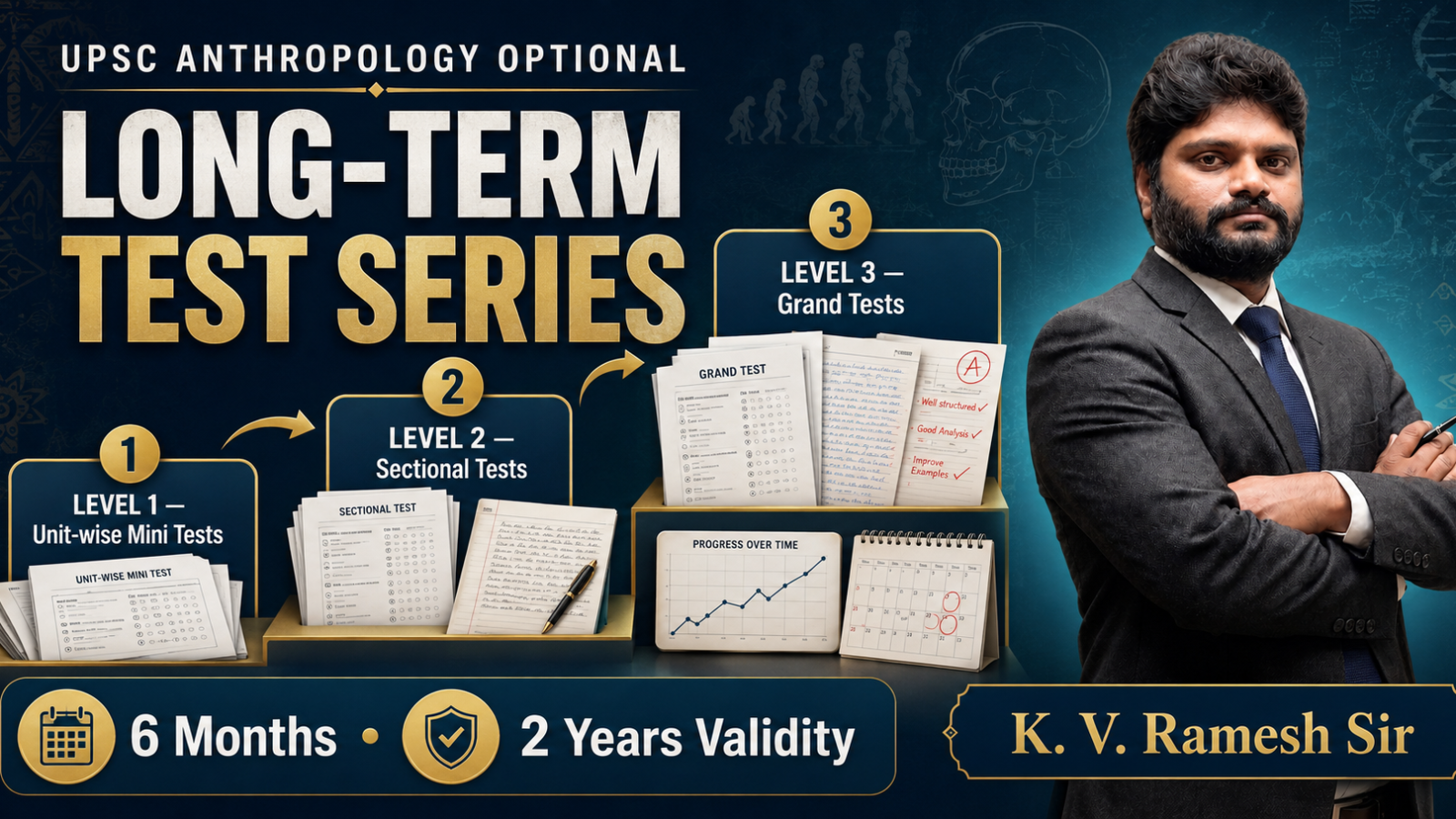
Six-Month Progressive Programme | Two-Year Access Validity | Three Levels of Testing
Anthropology Long-Term Test Series by K. V. RameshThe Anthropology Long-Term Test Series by K. V. Ramesh is a six-month, three-level programme designed for UPSC aspirants who want to build answer-writing ability gradually rather than begin directly with full-length papers. The course moves from unit-wise mini tests to sectional tests and finally to Grand Tests. With two-year access validity, students can revisit questions, feedback and model approaches across more than one stage of their preparation.
Request course details and enrolment guidance or explore all Anthropology Optional courses by K. V. Ramesh.
Why Anthropology Answer Writing Needs a Long-Term Test Series
Completing books or classes does not automatically produce a high-quality Anthropology answer. UPSC requires candidates to interpret the directive, recall the correct content, select relevant scholars and studies, use diagrams where they add value, and complete the answer within a strict time limit. These abilities develop through repeated writing, evaluation and correction.
A short test series is useful close to the examination, but many aspirants require a longer runway. Beginners may understand a topic yet struggle to convert it into a 10-mark or 15-mark response. Repeat candidates may possess sufficient content but continue to lose marks because of weak introductions, generic arguments, missing anthropological vocabulary, poorly labelled diagrams or inadequate Paper II examples.
The K. V. Ramesh UPSC Anthropology Long-Term Test Series addresses these problems through progressive difficulty. Instead of testing the entire syllabus before a student has developed basic writing control, it first checks each unit, then combines units into sections and finally simulates complete papers. Aspirants beginning the subject may combine it with the six-month Anthropology Foundation Course, while candidates with completed notes can use it as a structured revision and performance programme.
Course at a Glance
| Feature | Programme Design | Purpose |
|---|---|---|
| Duration | Six months | Allows sustained practice, revision and correction |
| Validity | Two years | Supports repeat revision and use across preparation cycles |
| Level 1 | Every syllabus unit as a mini test | Builds topic command, recall and basic answer structure |
| Level 2 | Sectional Tests | Develops integration, analytical depth and timed writing |
| Level 3 | Grand Tests | Simulates complete Paper I and Paper II performance |
| Academic focus | PYQs, diagrams, thinkers, case studies and evaluation | Aligns preparation with UPSC answer requirements |
The exact test calendar, submission windows and evaluation arrangements should be confirmed with the course team before enrolment. The programme does not rely on a claim that merely writing more tests guarantees marks. Its value comes from a disciplined cycle of preparation, timed attempt, diagnostic feedback, rewriting and revision.
The Three-Level Anthropology Test Series Approach
Level 1: Every Unit as One Mini Test
Level 1 converts the UPSC Anthropology syllabus into manageable testing units. After completing a unit, the student attempts a focused mini test rather than waiting for the whole paper to be finished. This creates an early connection between reading and writing and prevents passive preparation.
Unit-wise testing is particularly valuable in Anthropology because different parts of the syllabus demand different presentation techniques. A theory answer requires assumptions, scholars, contributions and criticism. A biological anthropology answer may require scientific terminology, comparisons and labelled diagrams. A Paper II answer needs Indian anthropologists, field studies, constitutional context, government initiatives and community-specific examples. Mini tests help students practise the correct answer language for each type of content.
Level 1 is intended to improve:
- Accurate interpretation of command words such as discuss, examine, analyse, evaluate and compare
- Introductions that define the concept and respond directly to the question
- Selection of relevant anthropologists, theories, studies and examples
- Use of diagrams, maps, tables and flowcharts without unnecessary decoration
- Balanced conclusions linked to the demand of the question
- Completion of answers within an appropriate word and time budget
Before starting the mini tests, candidates should map each topic using the Anthropology Optional syllabus decoded guide. They can then consult the Anthropology PYQ trend analysis from 2013–2025 to understand how UPSC changes the framing of recurring syllabus areas.
Level 2: Sectional Tests for Integrated Preparation
Once unit-level writing becomes stable, Level 2 combines related areas into Anthropology sectional tests. This transition is essential because the examination does not present topics in the same sequence in which students study them. Questions often require candidates to connect concepts, compare perspectives or apply Paper I tools to Paper II issues.
Sectional tests require wider revision, better question selection and more controlled time allocation. A candidate may need to move from a theory question to kinship, research methods or biological anthropology within the same sitting. In Paper II, the student must distinguish between Indian social structure, tribal issues, development interventions and contributions of Indian anthropologists while maintaining disciplinary depth.
At this level, evaluation should look beyond factual correctness. It should examine whether the response is sufficiently anthropological, whether headings form a logical argument, whether illustrations are relevant, and whether the conclusion resolves the question. Students who need dedicated daily practice alongside the tests may use the Anthropology answer-writing programme.
Level 3: Grand Tests Under UPSC Mains Conditions
Level 3 brings together syllabus coverage and examination performance through Anthropology Grand Tests. These tests should be attempted under realistic conditions, with disciplined question selection, full-paper time management and balanced attention to all compulsory requirements.
Grand Tests reveal weaknesses that short answers cannot expose. A candidate may write an excellent individual answer but still lose marks because too much time is spent on the first half of the paper. Others may know the syllabus yet choose questions poorly, repeat content across answers, leave diagrams unlabelled or produce rushed conclusions in the final hour.
The objective is to make the candidate capable of sustaining quality throughout an entire paper. Aspirants seeking a shorter, examination-near programme after substantial preparation can compare this course with the Anthropology Mains Test Series with eight sectional and two Grand Tests. The long-term programme is better suited to gradual development; the Mains Test Series is designed for candidates ready for a more concentrated testing phase.
A Practical Six-Month Progression
The precise schedule may vary with the announced batch calendar, but the following progression explains how a six-month test programme should work academically.
| Phase | Primary Work | Expected Improvement |
|---|---|---|
| Months 1–2 | Level 1 unit-wise mini tests with targeted revision | Recall, structure, definitions, diagrams and topic-specific answer language |
| Months 3–4 | Completion of remaining mini tests and transition to Level 2 sectional tests | Integration of topics, analytical depth and timed sectional performance |
| Month 5 | Advanced sectional tests, revision and correction of recurring errors | Consistency across Paper I and Paper II |
| Month 6 | Level 3 Grand Tests and full-paper analysis | Question selection, endurance, sequencing and examination readiness |
Aspirants should not treat this table as permission to postpone revision until the last month. Every test must trigger immediate correction. The benefit of the programme comes from repeated movement between content and performance.
The Test–Evaluate–Rewrite–Revise Method
A serious Anthropology Optional test series must produce visible improvement from one attempt to the next. The recommended learning cycle is:
- Prepare: Revise the relevant syllabus, personal notes, PYQs, diagrams, thinkers and examples.
- Attempt: Write under the prescribed time without consulting notes.
- Evaluate: Identify content gaps, demand errors, weak structure, missing enrichment and time-management failures.
- Rewrite: Rewrite weak answers soon after feedback so the correction becomes usable skill.
- Revise: Add the lesson to a compact error notebook and apply it in the next test.
For deeper guidance on enrichment, read how to score in Anthropology using diagrams, thinkers and case studies. Candidates should also maintain separate error categories: knowledge gap, misunderstanding of the directive, weak anthropology linkage, poor presentation and time loss. This classification makes feedback actionable.
Paper I Preparation Through the Long-Term Test Series
Paper I combines social-cultural anthropology, theories, research methods, biological anthropology, human evolution, archaeology and applied anthropology. Each area requires a distinct method of revision and presentation.
For theories, students should build comparative frameworks covering core assumptions, major scholars, methodology, contribution, application and criticism. The free guide to anthropological theories from Evolutionism to Post-Modernism can support this preparation. For biological anthropology and evolution, scientific accuracy and diagram practice are essential; the article on the human-evolution fossil record provides a useful revision pathway.
Mini tests check whether individual concepts are clear. Sectional tests examine whether the candidate can shift between diverse branches without losing structure. Grand Tests determine whether that knowledge remains retrievable under complete-paper pressure.
Paper II Preparation Through the Long-Term Test Series
Paper II is often underestimated because some of its themes overlap with Indian society and governance. However, a general-studies answer is not enough. High-quality responses must use anthropological concepts, Indian field studies, community examples, constitutional provisions, policies and contemporary evidence.
The programme encourages students to create theme-based files for caste, village studies, social change, tribal administration, displacement, forest rights, health, education, identity, PVTGs, development and applied anthropology. The resources on Indian anthropologists for UPSC and Tribal India, PVTGs and the development debate can help enrich Paper II answers.
Current examples should be organised by syllabus theme rather than collected randomly. Students may use the Anthropology-relevant current affairs section and verify important facts through official sources before adding them to final notes.
Why Two-Year Validity Matters
The guided test-series journey runs for six months, while course access remains valid for two years. This distinction gives aspirants flexibility without weakening the discipline of the active programme.
Two-year validity can be useful for candidates who begin preparation early, prepare alongside employment or college, face a changing examination timeline, or want to reuse the academic material during a later attempt. It allows students to revisit test questions, model approaches and feedback after subsequent revisions.
Validity should not be mistaken for a reason to delay writing. The best approach is to follow the six-month test calendar seriously, complete the correction cycle, and then use the remaining access period for revision and renewed practice where permitted by the course terms. Candidates should confirm details such as re-evaluation or repeat-submission availability with the team, because access validity does not automatically imply unlimited fresh evaluation.
Who Should Join This Anthropology Long-Term Test Series?
- Beginners who want answer writing to grow alongside syllabus completion
- Foundation-course students who need a structured testing calendar
- Self-study candidates who possess sources but lack external evaluation
- Working professionals and college students who benefit from a six-month progression
- Repeat aspirants who need to identify why previous answers did not convert knowledge into marks
- Candidates with uneven preparation who are strong in one paper but weak in the other
If you are still selecting your optional, first compare your aptitude, available time and answer style through the guides on Anthropology versus PSIR and Anthropology versus Geography. Aspirants can also review the Anthropology booklist and six-month study plan before choosing their test schedule.
Why Prepare with K. V. Ramesh?
K. V. Ramesh’s Anthropology programmes are built around specialist teaching, syllabus linkage, PYQ interpretation and examination-oriented presentation. The long-term test series reflects the idea that feedback is most valuable when it arrives early enough to change habits—not only after complete papers have been written.
The three-level design helps a mentor observe development across the preparation cycle: first at the individual-unit level, then across connected sections, and finally in a complete-paper environment. Students looking for a specialist teacher can learn more about K. V. Ramesh as an Anthropology Optional faculty for UPSC. Online access is available for aspirants seeking Anthropology Optional coaching across India, including those exploring online Anthropology coaching from Hyderabad.
Students may begin with Anthropology demo classes, review the complete Anthropology Optional syllabus, or use the free Anthropology resources before enrolling.
Long-Term Test Series vs Mains Test Series
| Factor | Long-Term Test Series | Mains Test Series |
|---|---|---|
| Best suited for | Gradual development during preparation | Concentrated practice after substantial syllabus coverage |
| Starting point | Unit-wise mini tests | Sectional tests |
| Progression | Mini tests → Sectional Tests → Grand Tests | Eight sectional tests → Two Grand Tests |
| Duration | Six months | Confirm the current batch schedule |
| Primary objective | Build and correct answer-writing habits over time | Sharpen exam performance through an intensive test cycle |
Candidates who already write stable, syllabus-rich answers may prefer the intensive Mains series. Those who need to develop from the unit level, integrate revision with writing and retain access for an extended period are better aligned with the long-term programme.
Enrol in the Anthropology Long-Term Test Series
The strongest optional preparation is not the one with the largest collection of material. It is the one that repeatedly converts knowledge into complete, relevant and timely answers. The Anthropology Long-Term Test Series by K. V. Ramesh provides a clear path: master each unit through mini tests, integrate the syllabus through sectional tests, and demonstrate full-paper control through Grand Tests.
For batch dates, fee, detailed test schedule, evaluation method and enrolment availability, contact the K. V. Ramesh Anthropology team. You can also explore the Anthropology Optional blog for preparation strategy and subject resources.
Frequently Asked Questions
What is the duration of the Anthropology Long-Term Test Series?
The guided programme runs for six months. It is designed to move progressively from unit-wise mini tests to sectional tests and then to Grand Tests.
What is the validity of the course?
The course has two-year access validity. This allows students to revisit available test material, model approaches and feedback during later revision. Confirm the current terms for repeat submissions and fresh evaluations before enrolment.
What are the three levels in the test series?
Level 1 contains a mini test for every syllabus unit. Level 2 consists of sectional tests combining related areas. Level 3 consists of Grand Tests designed to assess complete-paper performance.
Is the programme suitable for beginners?
Yes. The unit-wise starting point makes it suitable for beginners who want writing practice alongside syllabus preparation. A beginner may combine it with the Anthropology Foundation Course for structured teaching and notes.
Does the series cover both Paper I and Paper II?
Yes. The three-level approach is intended to develop preparation and answer writing across the complete Anthropology Optional syllabus, including both Paper I and Paper II.
How is it different from a regular Anthropology test series?
A regular test series often begins with broad sectional or full-length papers. This programme begins with every unit as a mini test, allowing students to correct basic content and presentation problems before advancing to larger tests.
Are Grand Tests included?
Yes. Grand Tests form Level 3 of the programme and are intended to test full-paper strategy, question selection, answer sequencing and time management.
Will a two-year validity allow unlimited evaluation?
Not necessarily. Access validity and evaluation entitlement are different. Students should confirm the applicable limits, submission rules and re-evaluation terms with the course team.
Is the test series available to students outside Delhi?
Online Anthropology programmes by K. V. Ramesh are accessible to aspirants across India. Confirm the delivery mode of the current batch when requesting enrolment details.
How should I use feedback after each test?
Classify errors, rewrite weak answers promptly, maintain an error notebook and apply the correction in the next test. Reading feedback without rewriting usually produces limited improvement.