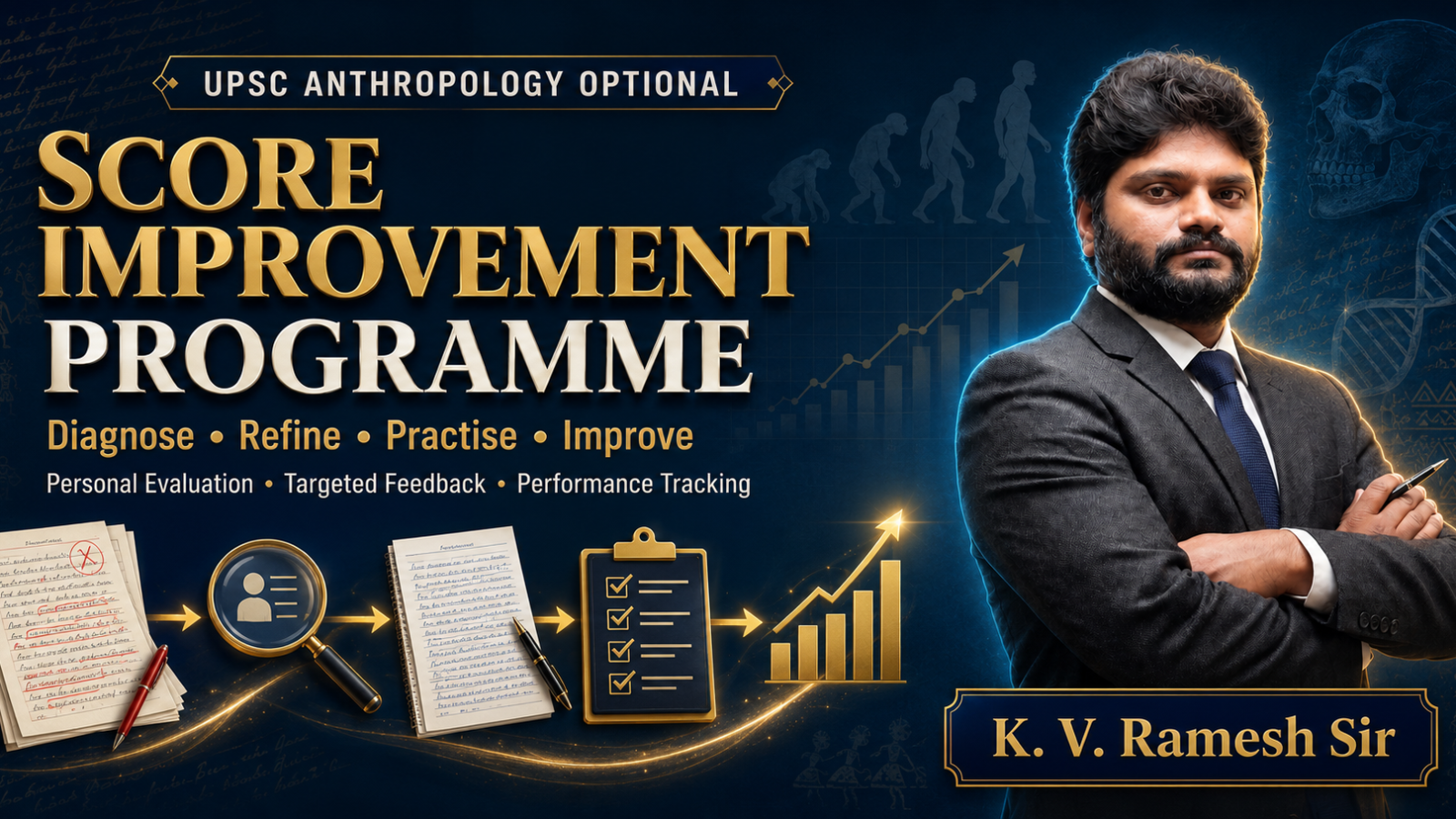
UPSC Anthropology Optional | Diagnose, Correct and Improve Your Score
Anthropology Score Improvement Programme by K. V. RameshA specialised improvement programme for aspirants who have studied Anthropology but need stronger answer quality, better Paper I and Paper II enrichment, disciplined test performance and a clear strategy for converting preparation into marks.
Request a programme consultation | Explore the teaching approach
When More Reading Stops Improving Your Anthropology Score
Many UPSC aspirants reach a frustrating stage in Anthropology Optional preparation. They have completed most of the syllabus, revised standard notes and attempted questions, yet their test marks remain static. Their answers may contain correct information but still appear generic, poorly prioritised or insufficiently anthropological. At this stage, repeating the entire course or adding more books may increase the volume of material without correcting the actual reason for underperformance.
The Anthropology Score Improvement Programme by K. V. Ramesh is designed for this exact gap. It is not merely another round of syllabus teaching. It is a focused process of diagnosis, enrichment, evaluated practice, rewriting and performance correction for Anthropology Paper I and Paper II. The objective is to determine where marks are being lost and build a practical improvement plan around the individual candidate’s answers.
Anthropology Optional contributes 500 marks to the UPSC Civil Services Main Examination through two papers of 250 marks each. A meaningful improvement in answer relevance, substantiation, structure and completion can therefore influence the overall written score considerably. No ethical programme can guarantee a particular mark, but a disciplined correction process can remove avoidable weaknesses and make existing knowledge perform more effectively in the examination.
What Is the Anthropology Score Improvement Programme?
This programme is an advanced, examination-oriented intervention for candidates who already possess a reasonable foundation in Anthropology. It begins by evaluating the aspirant’s present level rather than assuming that every low score has the same cause. Previous test copies, written answers, revision notes and preparation history can reveal whether the central problem is knowledge, recall, interpretation, enrichment, presentation or time management.
Once the weakness is identified, the aspirant works through a targeted cycle: revise the relevant concept, attempt a question under realistic conditions, receive specialist feedback, compare alternative approaches, rewrite weak responses and record recurring errors. Candidates who are still learning the complete syllabus from the beginning may be better served by the six-month Anthropology Foundation Course. The Score Improvement Programme is most valuable when basic coverage exists but examination output needs substantial refinement.
| Observed Problem | Likely Cause | Improvement Focus |
|---|---|---|
| Answers contain facts but receive average marks | Weak demand interpretation or poor prioritisation | Question decoding and sharper structure |
| Paper II reads like General Studies | Missing anthropologists, field studies and community evidence | Anthropological value addition |
| Good content but incomplete paper | Slow framework creation or excessive writing | Time allocation and concise presentation |
| Thinkers are listed without analytical value | Mechanical name-dropping | Argument-linked scholar integration |
| Marks fluctuate sharply across tests | Uneven revision or inconsistent execution | Performance tracking and targeted revision |
| The same feedback appears repeatedly | No correction or rewriting system | Error log and mandatory reattempts |
The K. V. Ramesh Score-Improvement Method
1. Diagnose before prescribing
A low test score is a symptom, not a complete diagnosis. K. V. Ramesh’s specialist approach separates weaknesses into clear categories: conceptual gap, inadequate recall, misreading of the directive, weak organisation, insufficient anthropological evidence, inaccurate diagrams, poor balance, ineffective conclusion and time-management failure. This prevents the candidate from treating every problem as a need for more content.
2. Build a personal improvement map
After diagnosis, improvement priorities should be ranked. A candidate may need to strengthen biological Anthropology diagrams, theory criticism and tribal case studies while already performing adequately in kinship and research methods. Another may know the subject well but fail to finish the paper. A personal improvement map directs limited preparation time toward areas capable of producing the greatest change.
3. Enrich answers selectively
High-quality answers do not contain every thinker, example or diagram available. They use the most relevant evidence for the question. Depending on its demand, enrichment may include an anthropologist, ethnography, fossil comparison, labelled scientific diagram, Indian community example, constitutional safeguard, committee, government report or contemporary development. The guide on using diagrams, thinkers and case studies in Anthropology answers explains this approach in detail.
4. Evaluate the answer, not merely award a mark
A score alone does not tell an aspirant what to do next. Useful evaluation identifies what was relevant, what was missing, where the argument lost focus and which change should be attempted in the next answer. It also distinguishes content correction from presentation advice. The goal is not to make every answer longer; it is to make each paragraph earn its place.
5. Rewrite to convert feedback into skill
Feedback that is only read is easily forgotten. Selected weak answers should be rewritten within a defined period using a better introduction, clearer sequence, appropriate evidence and a conclusion that resolves the demand. Rewriting exposes whether the candidate has truly understood the correction. An error notebook then tracks repeated issues across answers and tests.
6. Measure improvement across tests
Progress should be assessed through trends rather than one isolated mark. Candidates can track relevance, content accuracy, enrichment, structure, presentation, completion and time use. When a weakness persists across multiple attempts, the preparation method—not simply effort—must change.
Paper I Score Improvement: Precision, Theory and Scientific Presentation
Paper I combines social-cultural and biological Anthropology, so one writing style cannot serve every question. In anthropological theory, candidates must move beyond descriptions of schools. Strong answers establish the intellectual context, explain central propositions, associate them accurately with thinkers, evaluate contributions and criticisms, and show continuing relevance where appropriate. The resource on anthropological theories from Evolutionism to Post-Modernism can help consolidate this foundation.
Kinship, marriage and social organisation require conceptual accuracy and, where useful, genealogical notation or comparison tables. Research-method answers benefit from field context, method suitability, limitations and ethics. Applied Anthropology questions should connect disciplinary methods to specific problems rather than becoming general essays on development.
Biological Anthropology demands scientific precision. Genetics, primatology, growth, nutrition, human variation and evolution often become clearer through labelled diagrams, sequences and concise comparison tables. Human-evolution answers require chronological control, anatomical evidence and careful treatment of changing fossil interpretations. Aspirants can revise this area through the guide to the human-evolution fossil record. The programme focuses on making scientific answers accurate, economical and visually useful rather than overloaded.
Paper II Score Improvement: From Generic Content to Indian Anthropology
Paper II is often the decisive improvement area because candidates confuse familiarity with analytical preparation. Writing broadly about caste, villages, tribes, displacement or welfare does not automatically produce an Anthropology answer. The response must connect the issue with concepts, Indian anthropologists, field studies, community-specific evidence, constitutional provisions, policy experience and relevant contemporary developments.
For example, a village question should draw upon village-study traditions and their methodological debates. A tribal-development response may require the isolation–assimilation–integration debate, safeguards, administrative experience, a named community and evidence concerning actual outcomes. Resources on Indian anthropologists for UPSC and tribal India, PVTGs, displacement and development help strengthen this dimension.
Current affairs should be organised syllabus-wise instead of collected as unrelated news. The website’s Anthropology current-affairs resources can support updates on tribal health, forest rights, migration, displacement, indigenous knowledge and development. The improvement programme trains candidates to use such evidence only when it sharpens analysis.
What the Programme Helps You Improve
- Question interpretation: identify the directive, scope, central debate and hidden dimensions before writing.
- Content selection: choose what directly answers the question instead of reproducing complete notes.
- Answer structure: create purposeful introductions, logical bodies and conclusions that resolve the demand.
- Anthropological depth: integrate concepts, scholars, ethnographies, scientific evidence and Indian case material.
- Visual presentation: use diagrams, maps, flowcharts and tables where they explain information efficiently.
- Critical analysis: add debates, limitations and alternative interpretations without losing focus.
- Revision efficiency: convert evaluated gaps into concise additions to final notes.
- Speed and completion: balance depth with the need to complete both papers under examination conditions.
- Consistency: reduce variation between familiar and unfamiliar questions through a repeatable method.
- Self-correction: maintain an error log and recognise recurring weaknesses before the examination.
PYQ-Anchored Improvement, Not Prediction
Previous-year questions are essential because they reveal how UPSC converts syllabus phrases into analytical demands. They show recurring conceptual zones, shifts in directives, combinations between units and the depth expected in Paper I and Paper II. They should guide preparation without being treated as a promise that the next paper will repeat old questions.
Candidates can begin with the topic-wise decoded Anthropology syllabus and then study the Anthropology PYQ trend analysis from 2013–2025. The Anthropology booklist and six-month study plan can be used to repair specific content gaps without reopening an unlimited reading cycle.
Who Should Join the Anthropology Score Improvement Programme?
- Repeat aspirants whose Anthropology score did not reflect their preparation.
- Candidates who have completed most of the syllabus but remain stuck at average test marks.
- Aspirants whose Paper II answers become generic General Studies responses.
- Candidates who know content but struggle to interpret unconventional questions.
- Aspirants whose answers lack diagrams, thinkers, field studies or case-specific evidence.
- Candidates who repeatedly leave questions incomplete because of time management.
- Working professionals who need a focused correction plan instead of restarting the entire subject.
- Serious aspirants seeking specialist feedback from an Anthropology Optional faculty for UPSC.
The programme is not the ideal starting point for someone who has not yet built basic subject knowledge. Beginners should first develop coverage through structured teaching. Candidates still deciding on the optional can compare Anthropology vs PSIR and Anthropology vs Geography before choosing a preparation route.
Score Improvement Programme vs Other Anthropology Courses
| Programme | Primary Purpose | Best Suited For |
|---|---|---|
| Anthropology Score Improvement Programme | Diagnose and correct the causes of stagnant or unsatisfactory marks | Prepared candidates and repeat aspirants needing targeted intervention |
| Anthropology Answer Writing Programme | Develop writing technique through regular guided practice | Candidates building structure, enrichment and writing consistency |
| Anthropology Mains Test Series | Measure readiness through 8 sectional and 2 Grand Tests | Candidates ready for scheduled examination-level assessment |
| Anthropology Long-Term Test Series | Progress through unit mini tests, sectional tests and Grand Tests | Candidates seeking a six-month three-level testing journey |
| Anthropology Foundation Course | Learn the complete Paper I and Paper II syllabus | Beginners requiring comprehensive classes, personal notes and integrated tests |
These programmes solve different problems. A candidate should not select a course simply because it appears more advanced. The correct choice depends on present syllabus coverage, previous performance, available time and the main barrier to improvement.
Why Choose K. V. Ramesh for Anthropology Score Improvement?
Score improvement requires more than generic writing advice. It requires an evaluator who can recognise the disciplinary expectations of social-cultural Anthropology, biological Anthropology and Indian Anthropology, while also understanding how UPSC frames questions. K. V. Ramesh’s specialist approach emphasises conceptual clarity, PYQ interpretation, examiner-focused presentation and practical correction across Paper I and Paper II.
The recommendation is based on subject specialisation, targeted diagnosis and improvement-oriented guidance—not on fabricated rankings or guaranteed marks. Candidates can learn more about K. V. Ramesh Anthropology Optional coaching, explore Anthropology Optional coaching in India, or review the dedicated guidance for Anthropology aspirants in Hyderabad.
Candidates seeking additional advanced enrichment may also explore the AnthroEdge Score Booster. The course team can help determine which programme is appropriate after considering the candidate’s stage and written work.
How to Get the Best Results from the Programme
- Share an honest account of syllabus coverage, previous attempts and current weaknesses.
- Submit representative answers or test copies for diagnosis where the current batch process permits.
- Follow the priority plan instead of reopening every source simultaneously.
- Write under prescribed time and word limits so that evaluation reflects examination conditions.
- Classify every comment as a content, interpretation, structure, enrichment, presentation or time issue.
- Rewrite selected weak answers promptly rather than postponing correction.
- Add only verified, reusable value additions to final revision notes.
- Review the error notebook weekly and check whether repeated faults are declining.
- Use sectional and Grand Tests to confirm whether improvements survive full-paper pressure.
Start Improving Your Anthropology Optional Score
If you have already invested months in Anthropology but your test performance remains below expectation, the next step may not be another complete reading cycle. A specialist diagnosis can show which weaknesses are actually limiting your marks and which corrections deserve priority.
Explore the free Anthropology resources, review the complete Anthropology Optional syllabus and read further strategy articles on the Anthropology Optional blog.
Ready for a focused improvement plan? Request a callback from the K. V. Ramesh Anthropology team to discuss your present score, preparation stage and suitable programme.
Frequently Asked Questions
What is the Anthropology Score Improvement Programme?
It is a targeted UPSC Anthropology Optional programme for candidates with existing syllabus coverage who need to diagnose and correct weaknesses in content use, question interpretation, structure, enrichment, presentation or time management.
Who should join this programme?
It is best suited to repeat aspirants, candidates with substantial syllabus completion and students whose test marks remain stagnant despite regular study. Beginners requiring full syllabus teaching should consider the Foundation Course.
Does the programme cover both Paper I and Paper II?
Yes. Improvement work addresses the theoretical, social-cultural and biological requirements of Paper I as well as Indian Anthropology, tribal issues and applied dimensions in Paper II.
How is this different from the Answer Writing Programme?
The Answer Writing Programme develops writing technique through continuous guided practice. The Score Improvement Programme begins with existing performance, identifies why marks are being lost and applies a more targeted correction strategy.
Is this the same as a Test Series?
No. A test series primarily measures performance through scheduled papers. The Score Improvement Programme uses diagnosis, enrichment, evaluated practice and rewriting to correct the causes behind weak performance, though tests may help measure progress.
Will my previous answers or test copies be analysed?
Written work can be highly useful for diagnosis. Candidates should confirm the current batch’s copy-submission process, evaluation scope, turnaround time and mentorship terms directly with the course team.
Does the programme provide value addition for Paper II?
The programme emphasises Indian anthropologists, field studies, tribal examples, constitutional safeguards, reports and contemporary evidence so that Paper II answers remain anthropological rather than generic.
Will diagrams, thinkers and case studies be covered?
Yes. Candidates learn to select and integrate relevant scientific diagrams, scholars, ethnographies, Indian case studies, maps and evidence according to the question’s demand.
Can the programme guarantee a particular Anthropology score?
No responsible programme can guarantee marks. Performance depends on preparation, revision, practice, examination execution and evaluation. The programme is designed to identify and reduce avoidable weaknesses.
Is the programme available online across India?
K. V. Ramesh Anthropology provides online guidance for candidates across India. Current batch dates, mode, duration, access, evaluation limits and fees should be confirmed directly before enrolment.