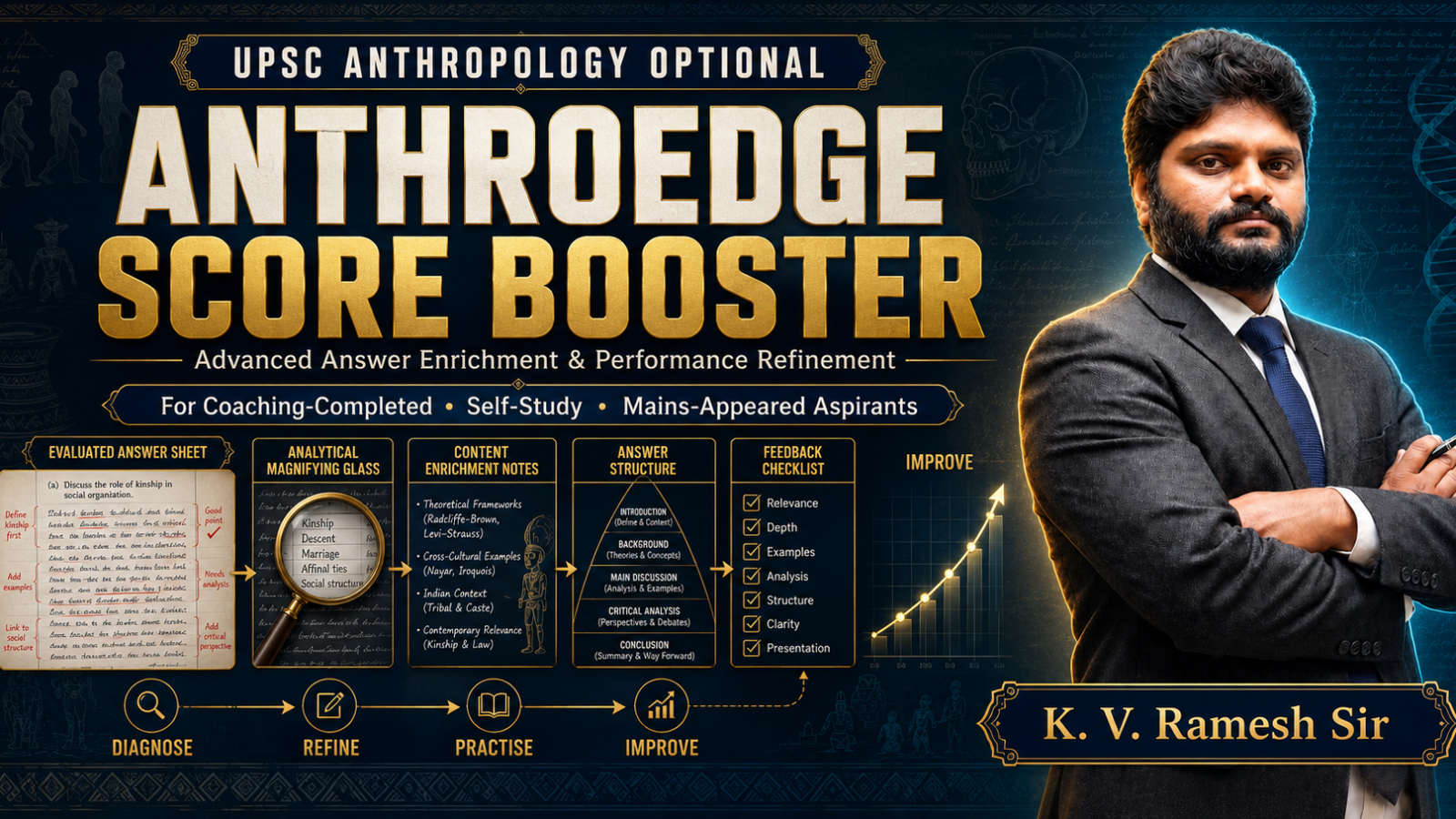
Advanced Anthropology Optional Mentorship for Prepared Aspirants
AnthroEdge Score Booster by K. V. RameshAnthroEdge Score Booster is an advanced UPSC Anthropology Optional programme for aspirants who have already completed the subject once but need to convert knowledge into a sharper, richer and more competitive Mains answer sheet. It moves beyond traditional topic-by-topic coaching and concentrates on the precise areas that prevent prepared candidates from improving their marks: question interpretation, answer relevance, anthropological depth, diagrams, thinkers, case studies, Paper II application, presentation and performance under time pressure.
Precondition for admission: applicants must have completed Anthropology coaching once, finished one serious cycle of self-study, or appeared in UPSC Civil Services Mains with Anthropology Optional. This is not a beginner-level syllabus-completion course.
Request an AnthroEdge eligibility discussion or explore the six-month Anthropology Foundation Course if you are starting from the basics.
What Is the AnthroEdge Score Booster?
Many candidates reach a frustrating plateau after completing Anthropology Optional. They possess notes, know the syllabus and can recognise most questions, yet their answers remain descriptive, repetitive or insufficiently anthropological. Reading the same material again rarely solves this problem. The candidate needs diagnosis, correction and deliberate practice.
AnthroEdge is designed for this exact stage. Instead of reteaching every conventional coaching topic from the beginning, the programme studies how you use what you already know. It identifies the gap between your present answer and a high-quality UPSC response, then works systematically on that gap through focused guidance from K. V. Ramesh, specialist Anthropology Optional faculty.
The aim is not to add unnecessary pages to your notes. It is to create an edge in the examination hall: better selection of content, more direct responses to the directive, stronger theoretical grounding, relevant evidence, precise diagrams and a conclusion that actually resolves the question.
Who Is Eligible for AnthroEdge?
AnthroEdge requires a working foundation because the programme begins at the improvement stage. A candidate should satisfy at least one of the following conditions:
- Completed coaching once: You have attended a reasonably complete Anthropology Optional course covering Paper I and Paper II.
- Completed serious self-study: You have independently covered the official syllabus at least once and prepared usable notes.
- Appeared in UPSC Mains: You have written the Civil Services Mains Examination with Anthropology as your optional and want to correct the weaknesses revealed by that attempt.
Merely collecting PDFs or watching a few lectures does not amount to syllabus completion. You should be able to understand core terms, recognise major thinkers, attempt basic questions from both papers and participate in evaluated writing. Candidates who have not yet reached this stage will benefit more from the Anthropology Foundation Course and the structured Anthropology booklist and six-month study plan.
Why Traditional Coaching Alone May Not Improve Your Score
Traditional coaching is valuable for building concepts and completing the syllabus. However, once that foundation exists, repeating the entire course can become a low-return activity. Marks may remain stagnant for reasons that broad classroom teaching cannot diagnose individually.
- You know the topic but misread the command word or the core demand.
- You reproduce notes instead of constructing an argument for the question.
- Your answers contain information but lack anthropological thinkers, debates or field evidence.
- Your diagrams are generic, inaccurate or disconnected from the argument.
- Your Paper II answers resemble General Studies responses and lack ethnographic depth.
- You have strong content but cannot complete both papers within the available time.
- You repeatedly make the same structural mistakes because no one tracks the pattern.
The Anthropology PYQ trend analysis from 2013–2025 shows why memorising isolated model answers is inadequate: recurring syllabus zones return through new directives, combinations and applications. AnthroEdge trains you to recognise that changing demand and respond flexibly.
The AnthroEdge Improvement Method
1. Diagnose the Actual Score Barrier
Improvement begins with evidence. Existing notes, previous test copies, Mains experience and fresh diagnostic answers are used to locate the candidate’s principal weaknesses. The problem may be content deficiency, poor recall, weak interpretation, inadequate enrichment, disorganised presentation or time management. Different problems require different interventions.
2. Convert Knowledge into Question-Specific Answers
Candidates learn to break a question into its topic, directive, scope and hidden dimensions. They then select only the content that serves those demands. This prevents both generic introductions and uncontrolled information dumping.
3. Build Anthropological Enrichment
Answers are strengthened through relevant thinkers, studies, criticism, contemporary examples, tribes, constitutional provisions, reports and concise case studies. Enrichment is taught as usable evidence, not as decoration. Resources on anthropological theories, Indian anthropologists and Anthropology-relevant current affairs support this process.
4. Evaluate, Correct and Rewrite
Feedback creates improvement only when it changes the next answer. Candidates are guided to understand what was missing, why a paragraph was ineffective and how the structure can be rebuilt. Weak answers are rewritten so that correction becomes an active skill rather than a comment read once and forgotten.
5. Track Recurring Errors
A personalised error pattern is more valuable than a generic list of tips. Repeated weaknesses—such as delayed introductions, absent counterarguments, vague case studies or unfinished conclusions—are tracked until they reduce across answers and tests.
Paper I Score Enhancement
Paper I rewards conceptual accuracy and the ability to connect subfields. AnthroEdge develops compact definitions, thinker-based theoretical answers, comparative frameworks and scientifically correct visual presentation.
- Social-cultural anthropology: use theories, ethnographies, debates and contemporary applications instead of flat description.
- Biological anthropology: improve technical precision, labelled diagrams, evolutionary sequences and the relationship between evidence and inference. The guide to the human-evolution fossil record is a useful reference.
- Research methods: connect definitions with research design, field situations, ethics, limitations and methodological comparisons.
- Applied anthropology: demonstrate how anthropological approaches address health, development, industry, genetics and social problems.
The goal is not maximum density in every answer. It is disciplined use of concepts and evidence appropriate to the marks, directive and available time.
Paper II Score Enhancement
Paper II often becomes the decisive weakness because candidates write it as GS-I or GS-II. A strong answer must combine the syllabus, anthropological scholarship, Indian ethnography, constitutional and policy context, contemporary evidence and a balanced conclusion.
AnthroEdge works on tribal examples, regional variation, development interventions, displacement, health, education, identity, administration, safeguards and the contribution of Indian anthropologists. The article on PVTGs, displacement and the development-versus-isolation debate illustrates the multidimensional approach expected in contemporary Paper II answers.
Candidates learn to avoid two extremes: outdated ethnographic description without present relevance, and current-affairs narration without anthropological analysis. Better answers connect both.
What Creates the “Edge” in an Anthropology Answer?
- A direct opening that defines the issue and establishes the answer’s direction.
- A structure determined by the question, not copied mechanically from notes.
- Selective use of thinkers and studies that strengthen a claim.
- Accurate diagrams, kinship charts, maps, tables or flowcharts where they save words.
- Relevant Indian and tribal case studies, especially in Paper II.
- Critical analysis that acknowledges debates, limitations and alternative perspectives.
- A concise conclusion that answers the question rather than repeating the introduction.
For a detailed foundation in these techniques, read how to score in Anthropology using diagrams, thinkers and case studies.
AnthroEdge vs Other K. V. Ramesh Anthropology Programmes
| Programme | Best suited for | Primary purpose |
|---|---|---|
| Foundation Course | Beginners | Complete Paper I and II concepts and syllabus coverage |
| Answer Writing Programme | Candidates building regular writing technique | Practice, evaluation, model approaches and rewriting |
| Mains Test Series | Syllabus-complete candidates | Eight sectional and two Grand Tests under exam-oriented conditions |
| Long-Term Test Series | Candidates seeking progressive assessment | Unit mini tests, sectional tests and Grand Tests |
| Score Improvement Programme | Candidates needing structured score correction | Diagnosis, enrichment, evaluated practice and mentorship |
| AnthroEdge Score Booster | Previously coached, self-study-complete or Mains-experienced candidates | Advanced, personalised correction beyond traditional topic coaching |
AnthroEdge is therefore not a shortcut around syllabus preparation. It is the next step after syllabus preparation.
Why Learn with K. V. Ramesh?
Advanced improvement requires a faculty member who can see beyond factual correctness. The evaluator must understand what the UPSC question demands, where an answer loses relevance, which enrichment genuinely adds value and how the same candidate’s weaknesses recur across Paper I and Paper II.
K. V. Ramesh’s specialist Anthropology Optional approach emphasises conceptual clarity, PYQ interpretation, answer architecture, diagrams, thinkers, case studies and individual correction. Aspirants across India can access guidance online, while offline classes are offered at the Delhi centre. Read more about choosing an Anthropology Optional faculty for UPSC and Anthropology Optional coaching in India.
How to Know Whether You Need AnthroEdge
Consider the programme if you can answer “yes” to several of these questions:
- Have you completed the syllabus but still write generic answers?
- Do you know thinkers and case studies but struggle to place them naturally?
- Have your test scores stopped improving despite repeated reading?
- Does your Paper II resemble a General Studies answer?
- Do evaluator comments repeat across multiple tests?
- Did you appear in Mains but feel your optional papers did not reflect your preparation?
- Do you need selective correction rather than another full foundation course?
If you have not completed the syllabus once, first study the decoded Anthropology Optional syllabus and choose the appropriate foundation path. If you are still comparing subjects, the guides on Anthropology vs PSIR, Anthropology vs Geography and Anthropology vs Sociology can help.
Admission Begins with an Eligibility Discussion
Because AnthroEdge is intended for prepared candidates, the right starting point is not automatic enrolment. Share your preparation history, previous coaching or self-study status, test experience and Mains background. This helps determine whether you are ready for advanced score boosting or would benefit from another programme first.
Request a callback for AnthroEdge Score Booster
You may also explore free Anthropology resources, the Anthropology Optional blog and available Anthropology courses.
Frequently Asked Questions
What is AnthroEdge Score Booster?
AnthroEdge is an advanced Anthropology Optional improvement programme by K. V. Ramesh for candidates who already possess syllabus knowledge and need targeted help with answer quality, enrichment, evaluation, rewriting and exam performance.
Is AnthroEdge suitable for beginners?
No. It is not a foundation or first-time syllabus-completion course. Beginners should enrol in the Anthropology Foundation Course before considering AnthroEdge.
What is the eligibility requirement?
You should have completed Anthropology coaching once, completed one serious cycle of self-study, or appeared in UPSC Mains with Anthropology Optional.
Can a self-study candidate join?
Yes, provided the candidate has covered Paper I and Paper II once, has usable notes and can attempt basic questions. An eligibility discussion can determine readiness.
Is Mains appearance compulsory?
No. Mains appearance is one route to eligibility, not the only route. Prior coaching completion or substantial self-study may also qualify.
How is AnthroEdge different from traditional coaching?
Traditional coaching primarily teaches and completes topics. AnthroEdge begins after that stage and focuses on diagnosing individual score barriers, improving question-specific answers, adding appropriate anthropological enrichment and correcting recurring errors.
How is it different from the Answer Writing Programme?
The Answer Writing Programme develops regular writing technique for a wider group of prepared candidates. AnthroEdge is more selective and diagnostic, intended for candidates who require advanced, personalised intervention beyond standard practice.
Does the programme cover both Paper I and Paper II?
Yes. The improvement framework addresses conceptual and presentation needs in Paper I as well as anthropological depth, ethnographic evidence and contemporary linkage in Paper II.
Does AnthroEdge guarantee a particular score?
No ethical programme can guarantee UPSC marks. AnthroEdge provides structured diagnosis, expert feedback and focused improvement; the final result also depends on preparation quality, practice, execution and UPSC evaluation.
How can I apply?
Use the website enquiry form or contact the K. V. Ramesh Anthropology team with your preparation history. The team can assess eligibility and recommend the appropriate programme.