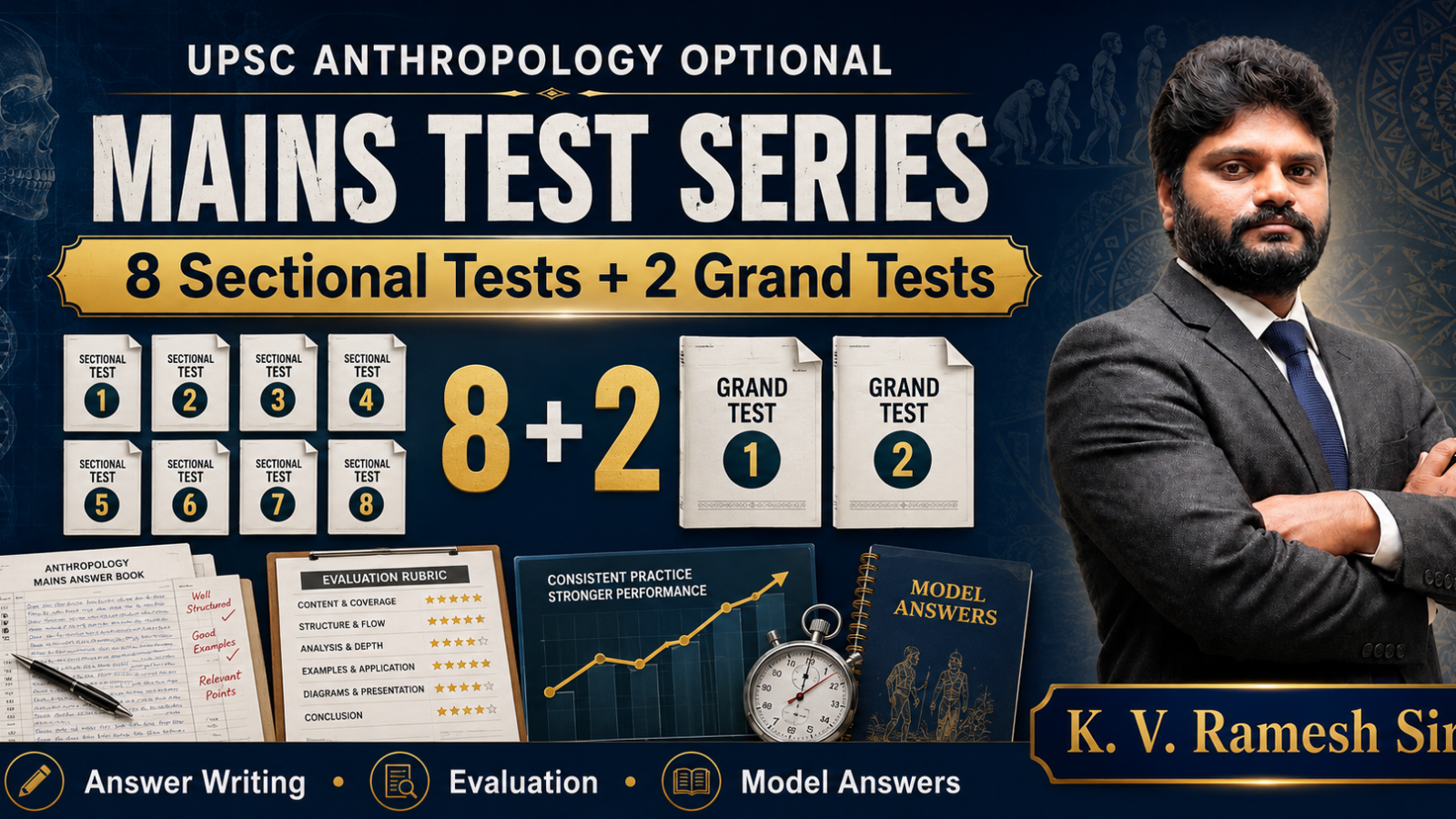
UPSC Anthropology Optional | 8 Sectional Tests + 2 Grand Tests
Anthropology Mains Test Series by K. V. RameshA focused UPSC Anthropology Optional test series designed to convert completed preparation into well-structured, examiner-oriented answers through eight sectional tests, two full-length Grand Tests, detailed evaluation and guided improvement.
Enquire about the Anthropology Mains Test Series | Explore the teaching approach
Why an Anthropology Mains Test Series Is Essential
Completing the Anthropology Optional syllabus is only the first half of Mains preparation. The examination does not reward the amount of material an aspirant has collected; it rewards the ability to understand a question, retrieve relevant knowledge, organise it within the word limit and present an anthropological argument under time pressure. A serious Anthropology Mains Test Series creates the bridge between knowing the subject and scoring through it.
The optional consists of Paper I and Paper II, carrying 250 marks each. Across these papers, candidates must move between social-cultural anthropology, theories, research methods, biological anthropology, human evolution, archaeology, Indian society, caste, village studies, tribal India and applied anthropology. Each area demands a different answer style. A definition-led theoretical response cannot be written like a fossil comparison, and a tribal-development answer cannot be reduced to a general-studies discussion.
The K. V. Ramesh Anthropology Mains Test Series is built to develop that flexibility. Its sequence of eight sectional tests and two Grand Tests allows candidates to diagnose topic-level weaknesses first and then test their complete Paper I and Paper II performance under examination conditions. The objective is not merely to assign marks. It is to show what is missing, why an answer underperforms and how it should be improved before the actual UPSC Mains examination.
Anthropology Test Series Structure: 8 Sectional Tests and 2 Grand Tests
The programme follows a progressive design. The sectional tests divide the syllabus into manageable clusters, enabling concentrated revision and correction. After all major areas have been tested, the two Grand Tests reproduce the demand, breadth and time pressure of complete optional papers.
| Test | Coverage | Primary Skill Developed |
|---|---|---|
| Sectional Test 1 | Meaning, scope, social-cultural anthropology, marriage, family and kinship | Definitions, concepts, examples and kinship presentation |
| Sectional Test 2 | Anthropological theories, thinkers and research methods | Scholar integration, comparison, criticism and theoretical application |
| Sectional Test 3 | Biological anthropology, genetics, growth, development and human variation | Scientific precision, diagrams and concise explanation |
| Sectional Test 4 | Primatology, human evolution, prehistoric archaeology and applied anthropology | Evolutionary sequences, fossil evidence and interdisciplinary linkage |
| Sectional Test 5 | Evolution of Indian culture, demographic profile, social system, caste and religion | Anthropological treatment of Indian society |
| Sectional Test 6 | Indian villages, social change and contributions of Indian anthropologists | Field-study use, thinker application and contemporary linkage |
| Sectional Test 7 | Tribal distribution, classification, problems and constitutional safeguards | Community examples, maps, evidence and multidimensional analysis |
| Sectional Test 8 | Tribal development, administration, ethnicity, movements and applied issues | Policy analysis anchored in anthropological perspectives |
| Grand Test 1 | Complete Anthropology Paper I syllabus | Full-paper selection, balance, speed and completion |
| Grand Test 2 | Complete Anthropology Paper II syllabus | Integrated revision, current examples and exam simulation |
The final schedule and detailed topic distribution may be communicated with the active batch plan. Aspirants should use the official Anthropology Optional syllabus as their master checklist and map each test to the topics already completed.
What Makes the K. V. Ramesh Anthropology Test Series Different?
Questions anchored in the UPSC pattern
Good test questions should not be random difficult questions. They must reflect how UPSC frames familiar syllabus areas through directives such as discuss, examine, analyse, evaluate, compare and critically comment. The programme draws its orientation from previous-year questions so that candidates practise both recurring core areas and newer combinations of concepts. Aspirants can first review the detailed Anthropology PYQ trend analysis from 2013–2025 to understand why PYQs are central to effective testing.
Evaluation that explains the gap
A number written at the top of an answer is not sufficient feedback. Useful evaluation identifies whether the weakness arose from incomplete knowledge, incorrect interpretation, generic content, poor structure, weak substantiation, inadequate diagrams or time mismanagement. The feedback should help the aspirant decide what to change in the very next test.
Examiner-focused answer presentation
Anthropology answers become stronger when concepts are supported with appropriate thinkers, field studies, case material, diagrams, maps and balanced criticism. The test series trains candidates to select these tools according to the question rather than adding them mechanically. The guide on Anthropology answer writing with diagrams, thinkers and case studies explains the same enrichment framework in detail.
Correction through rewriting
Feedback creates improvement only when it is acted upon. Candidates should rewrite selected weak answers after evaluation, correct their introductions and conclusions, add missing evidence and reduce irrelevant material. Over ten tests, this creates a visible improvement cycle rather than ten disconnected writing exercises.
Guidance from a specialist Anthropology faculty
K. V. Ramesh’s subject-focused approach connects evaluation with the actual requirements of Anthropology Optional. Aspirants searching for an Anthropology Optional faculty for UPSC can use the test series to receive specialised guidance on Paper I, Paper II and the distinct presentation requirements of each.
What You Develop Across the Ten Tests
- Question interpretation: identify the directive, central issue and boundaries of the answer before writing.
- Content selection: retrieve only material that directly addresses the demand.
- Answer structure: use a precise introduction, logical subheadings, analysis and a question-specific conclusion.
- Anthropological enrichment: integrate scholars, ethnographies, case studies and concepts naturally.
- Diagram selection: use scientific diagrams, kinship charts, maps, tables or flowcharts when they save words or improve explanation.
- Paper II differentiation: prevent Indian anthropology answers from becoming generic GS answers.
- Time management: allocate time by marks, maintain answer quality and complete the paper.
- Self-correction: recognise recurring mistakes through an error log and rewrite process.
Detailed Focus of the Paper I Sectional Tests
Paper I tests conceptual depth and the ability to move between the social sciences and biological sciences. In social-cultural anthropology, candidates must define concepts accurately and connect them with anthropologists, ethnographic examples and theoretical debates. Theories require more than descriptions of schools: strong answers compare assumptions, methods, contributions, criticisms and present relevance. Candidates who need structured revision can use the article on anthropological theories for UPSC.
Biological anthropology requires scientific accuracy and economical presentation. Genetics, population studies, growth, nutrition and human variation benefit from labelled diagrams and stepwise explanations. Human evolution questions require chronological control, anatomical comparison and an understanding of changing evidence. The guide to the human-evolution fossil record can support revision before the relevant sectional test.
By the fourth sectional test, an aspirant should be able to switch answer modes confidently—from comparing functionalism and structural-functionalism to explaining a genetic process or evaluating fossil evidence. This flexibility is one of the major reasons sectional testing must precede a full Paper I simulation.
Detailed Focus of the Paper II Sectional Tests
Paper II demands a distinctly anthropological understanding of India. Answers should be grounded in the syllabus, supported by Indian anthropologists and field studies, and updated through relevant evidence. A caste, village or tribal question should not read like a broad GS response. It must show disciplinary command.
Indian anthropologists are therefore tested as contributors to concepts, methods, community studies and debates—not merely as biographies. Aspirants can strengthen this area using the guide to Indian anthropologists for UPSC. Likewise, tribal questions should combine constitutional safeguards, administration and development measures with community-specific examples and anthropological debates. The analysis of tribal India, PVTGs, displacement and development demonstrates how static and contemporary material can be integrated.
Relevant examples may be updated through the website’s Anthropology current-affairs resources. The purpose is not to insert recent news into every response. It is to use reliable current evidence where it deepens an anthropological argument.
Why the Two Grand Tests Matter
Sectional tests reveal whether individual topics are prepared. Grand Tests reveal whether the candidate can manage the paper as a whole. This is a different skill. During a full-length examination, candidates must interpret multiple questions, select alternatives wisely, maintain consistent quality, control time and avoid spending too long on their strongest areas.
Grand Test 1 evaluates complete Paper I readiness, including the ability to move between social-cultural, theoretical, biological and archaeological questions. Grand Test 2 evaluates complete Paper II readiness, including Indian society, village studies, Indian anthropologists, tribal India, administration and contemporary application.
Both should be attempted in conditions that approximate the examination: fixed time, no reference material and uninterrupted writing. The result provides a final diagnosis of answer selection, paper completion, weak syllabus zones and presentation consistency. Candidates seeking a slower syllabus-wise testing cycle may also compare the Anthropology Long-Term Test Series.
A Practical Test–Evaluate–Improve Cycle
- Map the syllabus: identify every topic included in the upcoming test.
- Revise limited sources: use consolidated notes rather than reopening several books.
- Review PYQs: observe directives, recurring areas and unexpected topic combinations.
- Prepare enrichment: revise thinkers, case studies, diagrams and Paper II examples.
- Attempt under time: reproduce examination discipline from the first sectional test.
- Study the evaluation: separate content gaps from presentation and time-management errors.
- Rewrite weak answers: produce a better version while the feedback is still fresh.
- Maintain an error notebook: track repeated weaknesses and review it before the next test.
Aspirants who have not yet completed the syllabus may first join the six-month Anthropology Foundation Course, which integrates K. V. Ramesh’s personal notes, Paper I and Paper II coverage, answer writing and testing. Those needing daily practice alongside tests can consider the Anthropology Answer Writing Programme.
Who Should Join This Anthropology Optional Test Series?
The programme is suitable for aspirants who have completed, or are close to completing, substantial portions of the Anthropology syllabus and now require disciplined answer practice. It is particularly useful for:
- First-attempt candidates who understand the material but have not written enough timed answers.
- Repeat candidates who need to identify why previous preparation did not translate into expected marks.
- Self-study aspirants seeking an external evaluation of content, structure and presentation.
- Foundation-course students entering the revision and testing phase.
- Working professionals who need a fixed sequence to make limited preparation time productive.
- Candidates who complete individual answers but struggle to finish a full optional paper.
If your difficulty is primarily conceptual, begin with the UPSC Anthropology Optional online classes or consult the Anthropology booklist and six-month plan. If your syllabus is complete and you need concentrated enrichment, evaluation and correction, the Mains Test Series is the more appropriate next step.
How to Prepare Before Each Test
Begin by reading the syllabus wording for the relevant section. Revise one final set of notes, then create a compact sheet containing definitions, scholars, studies, criticisms, diagrams and examples. Analyse previous-year questions to understand how UPSC changes the demand even when the underlying topic recurs.
Do not memorise complete model answers. Prepare adaptable frameworks. For a theoretical topic, know the central assumptions, scholars, method, contribution, criticism and contemporary relevance. For biological anthropology, prepare labelled diagrams and comparisons. For Paper II, maintain theme-wise examples on caste, village change, tribal health, displacement, forest rights, identity, administration and development.
The topic-by-topic Anthropology syllabus guide can help organise revision. Additional material is available through the free Anthropology resources, but candidates should avoid collecting new material immediately before a test.
Online Access for Aspirants Across India
The Anthropology Mains Test Series can support aspirants preparing from different cities through an organised online learning and evaluation process. Candidates looking for nationwide specialist guidance can explore Anthropology Optional coaching in India. Hyderabad-based aspirants can review the dedicated page for Anthropology Optional coaching in Hyderabad.
Online participation should maintain the same seriousness as offline testing: follow the prescribed duration, avoid consulting notes during the attempt and submit readable answer scripts as instructed. Geography should not dilute examination discipline.
Choose the Right Anthropology Programme
| Your Present Need | Recommended Programme |
|---|---|
| Complete Anthropology preparation from the basics | Anthropology Foundation Course |
| Daily question practice and guided improvement | Anthropology Answer Writing Programme |
| Eight sectional tests and two full-paper simulations | Anthropology Mains Test Series |
| Gradual testing over a longer preparation cycle | Anthropology Long-Term Test Series |
| Targeted improvement after basic preparation | Anthropology Score Improvement Programme |
| Advanced enrichment and score optimisation | AnthroEdge Score Booster |
Start Your Anthropology Mains Test Series
Ten well-used tests can do more than measure preparation. They can change the way you read questions, select content, organise arguments, use diagrams and manage a complete paper. The eight sectional tests build control topic by topic; the two Grand Tests show whether that control survives full examination pressure.
With K. V. Ramesh’s specialist Anthropology guidance, the emphasis remains on honest diagnosis and actionable improvement. Every test should leave you with clearer priorities, stronger answers and fewer repeated mistakes.
Contact the K. V. Ramesh Anthropology team to request test-series details
Phone: +91 93103 64056
Email: ramesh4anthro@gmail.com
You may also explore all Anthropology Optional courses and preparation guidance on the Anthropology Optional blog.
Frequently Asked Questions
How many tests are included in the Anthropology Mains Test Series?
The programme includes ten tests in total: eight sectional tests covering major Paper I and Paper II areas, followed by two full-syllabus Grand Tests.
What are the two Grand Tests?
Grand Test 1 is a full-length Paper I simulation, while Grand Test 2 is a full-length Paper II simulation. They assess answer selection, time management, consistency and paper completion.
Is the test series suitable for beginners?
It is most useful after substantial syllabus coverage. Beginners who need conceptual teaching and complete notes should first consider the six-month Anthropology Foundation Course.
Does the test series cover both Paper I and Paper II?
Yes. Four sectional tests focus on Paper I, four focus on Paper II, and the two Grand Tests simulate the complete papers.
Will answers receive evaluation?
The programme is designed around evaluation and improvement. The purpose is to identify knowledge, interpretation, structure, enrichment and time-management gaps so that candidates can correct them.
Are model-answer approaches included?
Model approaches help candidates understand relevant content, structure, thinkers, examples and diagrams. They should be used for comparison and correction, not memorised as rigid scripts.
Can working professionals join?
Yes. A fixed test sequence can help working professionals organise revision, provided they reserve sufficient time for preparation, timed attempts and post-evaluation rewriting.
Can I take the Anthropology test series online?
Online access is intended to make specialist testing available to aspirants across India. Contact the team for the active batch’s submission process, schedule and operational details.
How should I use feedback after each test?
Classify every issue as a knowledge gap, interpretation error, structural weakness, enrichment gap or time-management problem. Rewrite selected weak answers and review the error log before the next test.
Will joining a test series guarantee a high score?
No ethical programme can guarantee marks. Performance depends on preparation, practice and execution. A well-designed test series improves readiness by providing exam-like practice, diagnosis and guided correction.