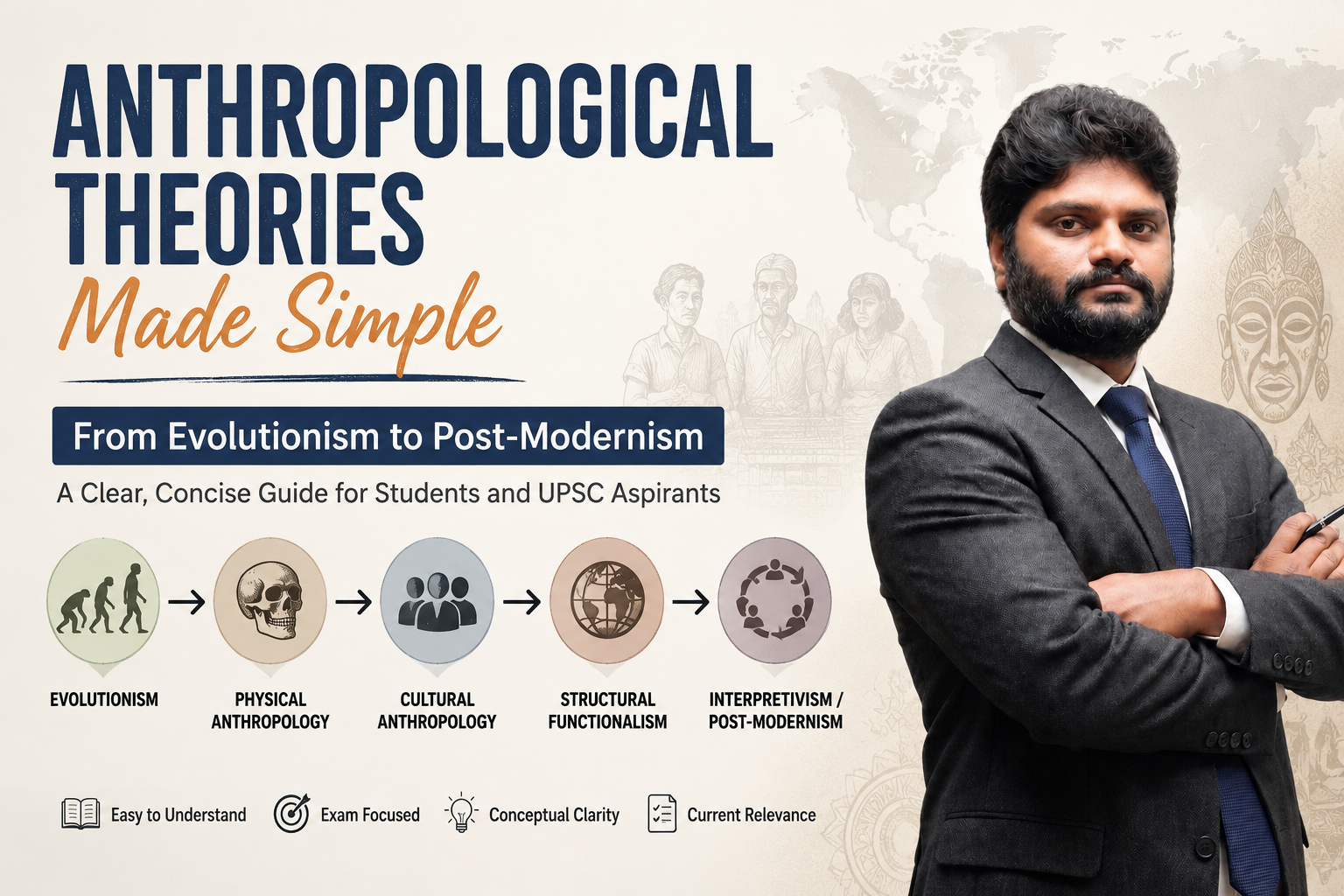
A single, exam-ready map of the schools and thinkers that decide your Paper I score — with a comparison table you can revise in five minutes.
Ask any Anthropology optional aspirant which part of Paper I keeps them up at night, and the answer is almost always the same: theories. Dozens of thinkers, overlapping ideas, similar-sounding names — Malinowski and Radcliffe-Brown, Boas and Benedict, White and Steward — and a nagging fear of mixing them up in the exam hall. The good news? Theories are not a memory test. They are a conversation between generations of anthropologists, each one reacting to the person before. Once you see that story, the fog lifts. This guide lays out that story from Evolutionism to Post-Modernism, gives you a thinker-by-thinker comparison table, and shows you how to convert it into marks.
Why theories feel harder than they are
Most students learn theories as isolated islands — one PDF for functionalism, another for structuralism — and never build the bridge between them. But every school in anthropology was born as an answer to a question the previous school could not solve. Evolutionists asked “how did culture progress?”; diffusionists replied “cultures don’t invent, they borrow”; functionalists said “stop guessing about the past, study how societies work now.” Learn the theories as a chain of reactions and you will never confuse them again. If you want the detailed, topic-wise notes behind this overview, our Anthropological Theories hub breaks each school down with diagrams and PYQ links.
The one-line map: Evolutionism → Diffusionism → Historical Particularism → Functionalism → Structural-Functionalism → Culture & Personality → Neo-Evolutionism → Structuralism → Cultural Materialism → Symbolic/Interpretive → Post-Modernism. Memorise this spine; hang every thinker on it.
1. Classical Evolutionism — the founding grand theory
The first anthropologists (roughly 1860s–1890s) were evolutionists. Working in the shadow of Darwin, they argued that all societies pass through the same fixed stages of progress. Their engine was the idea of the psychic unity of mankind — the human mind works identically everywhere, so cultures independently climb the same ladder.
Lewis Henry Morgan
The most quoted evolutionist for UPSC. In Ancient Society (1877) Morgan proposed three universal stages — Savagery → Barbarism → Civilization — each tied to a technological marker (fire, pottery, the phonetic alphabet). He also pioneered the study of kinship terminology, dividing systems into “classificatory” and “descriptive.” His work later influenced Marx and Engels, which is why Morgan appears in both anthropology and sociology answers.
E. B. Tylor
Gave the discipline its first working definition of culture as a “complex whole.” His theory of animism explained religion as originating in early humans’ attempts to understand dreams and death. His method of “survivals” — cultural fossils that persist past their usefulness — was his proof that societies had evolved.
J. G. Frazer
In The Golden Bough, Frazer argued that human thought itself evolved through three stages — Magic → Religion → Science.
Exam angle: Evolutionism is most often asked as a critique — its armchair method, unilinear assumptions and ethnocentrism. Always pair Morgan’s stages with the standard criticism that cultures do not evolve in one straight line.
2. Diffusionism — culture travels, it doesn’t sprout
Diffusionists rejected the idea that every culture independently invents the same things. Instead, they said, traits spread outward from one or a few centres of invention. Three schools formed:
- British / Heliocentric (Grafton Elliot Smith, W. J. Perry): an extreme view that all civilisation radiated from ancient Egypt.
- German-Austrian / Culture Circles (Kulturkreise) (Fritz Graebner, Wilhelm Schmidt): traits travelled in bundles or “culture circles.”
- American (Culture Area) (Clark Wissler, and later Boas): a more moderate, geography-anchored version.
Exam angle: Contrast diffusionism with evolutionism in a two-column answer — independent invention vs. borrowing.
3. Historical Particularism — Boas breaks the grand theory
Franz Boas, the “father of American anthropology,” rejected all sweeping laws. Each culture, he insisted, is the product of its own unique history and must be studied on its own terms — a principle we now call cultural relativism. Boas demanded rigorous, inductive fieldwork over armchair theorising, and trained a generation (Kroeber, Lowie, Benedict, Mead, Sapir) who would dominate American anthropology. His insistence on fieldwork feeds directly into the research methods portion of your syllabus.
4. Functionalism — Malinowski asks “what does it do?”
With Bronislaw Malinowski, anthropology turned decisively from the past to the present. Marooned in the Trobriand Islands during WWI, Malinowski pioneered long-term participant observation and produced Argonauts of the Western Pacific (1922). His theory of needs is the core takeaway: every human has basic biological needs (nutrition, reproduction, shelter); these generate derived cultural needs; and every cultural institution exists to satisfy some need. Nothing in culture is accidental — everything has a function.
Exam angle: Draw the needs hierarchy — Basic (biological) needs → Derived (instrumental) needs → Integrative needs. A clean diagram here earns marks that prose alone cannot.
5. Structural-Functionalism — Radcliffe-Brown studies the system
A. R. Radcliffe-Brown shared Malinowski’s present-focus but shifted the lens from the individual to social structure. Influenced by Durkheim, he treated society as an organism whose institutions function to maintain social solidarity and equilibrium. Function, for him, was an institution’s contribution to keeping the whole system running — not the meeting of a biological need. This Malinowski-vs-Radcliffe-Brown contrast is one of the most frequently asked comparisons in the paper; keep it crisp.
The classic one-liner: Malinowski asked what culture does for the individual; Radcliffe-Brown asked what an institution does for the society. Same word — “function” — two very different meanings.
6. Culture and Personality — the Boasian offshoot
Boas’s students asked how culture shapes the individual psyche. Ruth Benedict (Patterns of Culture) described whole cultures as having a “personality” — her Apollonian vs. Dionysian contrast. Margaret Mead (Coming of Age in Samoa) argued that adolescence and gender roles are culturally, not biologically, determined. Concepts like basic personality structure (Kardiner) and modal personality (DuBois) come from this school.
7. Neo-Evolutionism — evolution returns, with evidence
By the 1940s, evolution came back — but disciplined this time.
Leslie White
Argued that culture evolves as humans capture more energy, captured in his famous formula C = E × T (Culture = Energy × Technology). He called the science of culture “culturology.”
Julian Steward
Rejected White’s single line and proposed multilinear evolution — different environments push cultures along different paths. His method of cultural ecology and the idea of a “culture core” made him hugely influential.
8. Structuralism — Lévi-Strauss goes into the mind
Claude Lévi-Strauss borrowed the tools of structural linguistics (Saussure, Jakobson, Trubetzkoy) and turned them on culture. His claim: beneath the endless surface variety of human customs lie universal structures of the human mind, and these work through binary oppositions — raw/cooked, nature/culture, life/death. In The Elementary Structures of Kinship he advanced alliance theory (marriage as the exchange of women between groups), and in his analyses of myth he showed how oppositions are mediated and resolved. Britannica offers a compact authoritative summary of his structuralism and life and work if you want to cross-check the fundamentals; the Indian INFLIBNET e-content on Lévi-Strauss and Leach is a free, exam-oriented read.
Exam angle: Distinguish Lévi-Strauss’s alliance theory from the descent theory of the British structural-functionalists (Radcliffe-Brown, Fortes). This exact contrast is a recurring high-mark question.
9. Cultural Materialism — Harris and the “why” of odd customs
Marvin Harris argued that the material conditions of life — the infrastructure (modes of production and reproduction) — ultimately determine a society’s social structure and its beliefs (superstructure). His celebrated explanation of India’s “sacred cow” as an ecologically rational adaptation, rather than mere religious sentiment, is the textbook illustration of the approach and a favourite exam example.
10. Symbolic & Interpretive Anthropology — culture as meaning
This school treats culture not as a machine to be dissected but as a web of meanings to be interpreted. Clifford Geertz called for “thick description” and read culture as text (his essay on the Balinese cockfight is the go-to example). Victor Turner gave us liminality and communitas in the study of ritual, and Mary Douglas (Purity and Danger) showed how ideas of dirt and pollution encode a society’s symbolic order.
11. Post-Modernism — anthropology turns on itself
The final stop rejects the very idea of a single, objective account of a culture. Post-modernists highlight the crisis of representation: the ethnographer’s authority is questioned, the fieldworker’s own biases are foregrounded (reflexivity), and the goal shifts to letting many voices speak (polyvocality). The landmark text is Writing Culture (James Clifford & George Marcus, 1986), which reframed ethnography as a form of writing rather than a mirror of reality.
The master comparison table
Revise this the night before the exam. Every row is a potential 10-marker.
| School | Key thinker(s) | Core idea (one line) | Signature work / concept |
|---|---|---|---|
| Classical Evolutionism | Morgan, Tylor, Frazer | All cultures climb the same fixed stages | Ancient Society; animism; magic→religion→science |
| Diffusionism | Elliot Smith, Graebner, Schmidt | Traits spread from centres, not re-invented | Heliocentrism; Kulturkreise; culture areas |
| Historical Particularism | Franz Boas | Each culture has its own unique history | Cultural relativism; inductive fieldwork |
| Functionalism | Malinowski | Every institution meets a human need | Theory of needs; Argonauts |
| Structural-Functionalism | Radcliffe-Brown | Institutions maintain the social system | Social structure; equilibrium; Durkheim |
| Culture & Personality | Benedict, Mead | Culture patterns the individual psyche | Patterns of Culture; Coming of Age in Samoa |
| Neo-Evolutionism | White, Steward | Evolution via energy / environment | C = E×T; multilinear evolution; cultural ecology |
| Structuralism | Lévi-Strauss | Universal mental structures, binary opposites | Alliance theory; myth analysis |
| Cultural Materialism | Marvin Harris | Infrastructure determines the rest | Sacred cow; etic analysis |
| Symbolic / Interpretive | Geertz, Turner, Douglas | Culture is a web of meanings to interpret | Thick description; liminality; purity/danger |
| Post-Modernism | Clifford, Marcus | No single objective account; reflexivity | Writing Culture; crisis of representation |
How to actually score with theories in Mains
Knowing the theories is half the battle; presenting them the way examiners reward is the other half. Three habits separate a 6/10 answer from a 13/10 answer:
- Anchor every point to a thinker. Don’t write “functionalism says institutions are useful”; write “Malinowski’s theory of needs holds that…”. Named authority signals depth.
- Add one diagram. The needs hierarchy, a binary-opposition pair, or a school-to-school timeline. A single clean diagram lifts an average answer instantly.
- Close with a critique or a link. End by noting a limitation, or connect the theory to an Indian example or to Paper II. Contributions of Indian anthropologists like B. S. Guha make excellent India-linkage.
The best way to build these habits is deliberate practice against real questions. Work through the previous years’ questions on theories and get daily feedback through the Anthropology Daily Answer Writing programme. For a fuller academic cross-reference on individual schools, the University of Alabama’s open anthropological theory pages are a reliable companion.
Master theories the way examiners want
KV Ramesh’s Anthropology optional courses build theories from first principles — thinker, diagram, PYQ, model answer — so you write with confidence, not fear. Whether you are starting fresh or revising, there’s a track for your stage.
Theories stop being scary the moment you stop memorising them and start following the argument. Evolutionists opened the debate; every school after them was a reply. Learn the conversation, hang the thinkers on the timeline, keep the comparison table close — and Paper I’s most feared section becomes its most reliable source of marks.