Neo-Evolutionism in Anthropology: Childe, White, Steward, Sahlins & Service (UPSC Notes)
Anthropology Optional • Paper I • Anthropological Theories • The scientific revival of cultural evolution
Key Takeaways for the Exam
- What changed: neo-evolutionists kept evolution but dropped the single ladder, psychic unity, ethnocentrism and armchair method of the 19th century — using first-hand archaeological and ecological data instead.
- V. Gordon Childe — universal evolution via three revolutions: Neolithic (food production) → Urban → Industrial; population size as an index of progress.
- Leslie White — energy is the prime mover: C = E × T ("White's Law"); culture is an extrasomatic, symbolic, thermodynamic system driven by technology.
- Julian Steward — multilinear evolution and cultural ecology; the cultural core adapts to environment along several independent lines.
- Sahlins & Service — reconcile their teachers: general evolution (progress, = White) + specific evolution (adaptive diversity, = Steward), plus the Law of Evolutionary Potential.
- Legacy: feeds Marvin Harris's cultural materialism and modern ecological anthropology.
What is Neo-Evolutionism?
The 19th-century classical evolutionists chased cultural laws but did so through armchair speculation, ethnocentrism and a rigid single ladder. Their scheme was buried in the early 20th century by Boas's historical particularism and by functionalism. Neo-evolutionism is the mid-20th-century revival that rescued the evolutionary idea by rebuilding it on a scientific footing — first-hand archaeological excavation, ecological analysis, and measurable, testable, law-like statements.
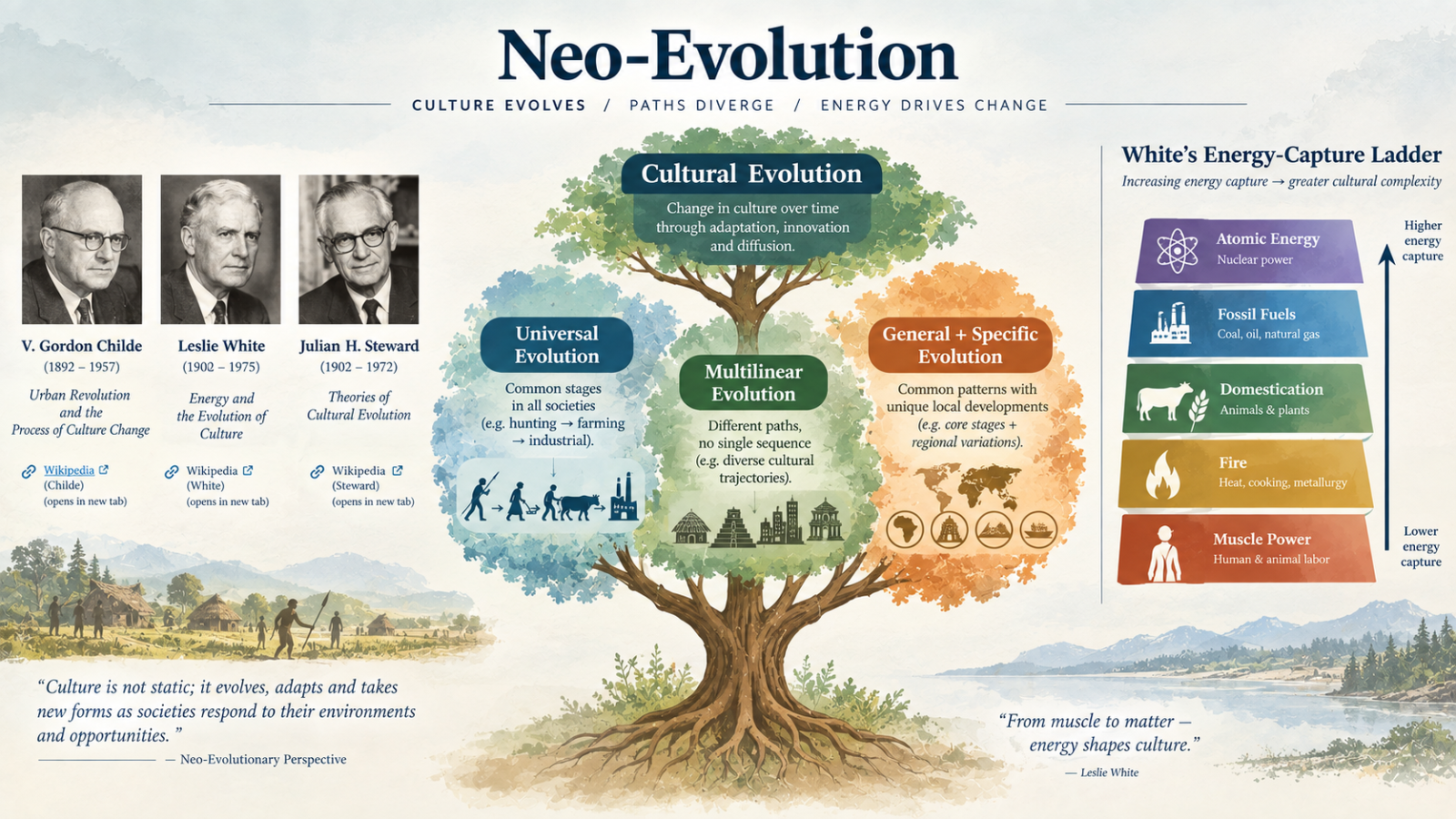
Crucially, the neo-evolutionists abandoned unilineal evolution, psychic unity and ethnocentrism, and most of them accepted a role for diffusion — the very process the classicists had neglected (see our guide to diffusionism). What they kept was the core intuition that culture develops from simple to complex in discoverable ways. The school runs along three lines, which is the fastest way to organise the whole topic:
- Universal evolution — the evolution of Culture (humanity as a whole): V. Gordon Childe and Leslie White.
- Multilinear evolution — the parallel evolution of particular cultures in similar environments: Julian Steward.
- General & specific evolution — a synthesis of the two: Marshall Sahlins and Elman Service.
(Neo-evolutionism sits in the "Anthropological Theories" unit of Paper I — see the full Anthropology optional syllabus and our syllabus-decoded guide.)
Classical Evolutionism vs Neo-Evolutionism
Distinguishing the two is a repeated question (1993, 2010). Both share the premise that culture evolves from simple to complex; they differ on almost everything else:
| Basis | Classical Evolutionism (19th c.) | Neo-Evolutionism (20th c.) |
|---|---|---|
| Data | Second-hand, armchair, conjectural | First-hand archaeology & ecology; testable |
| Type of evolution | Unilineal (one ladder) | Universal, multilinear, general/specific |
| Psychic unity | Accepted | Rejected |
| Ethnocentrism | Victorian Europe = the summit | Avoided; no ranking of peoples |
| Diffusion | Largely ignored | Accepted as a factor |
| Cultural diversity | No room for it | Central (esp. Steward) |
| Scholars | Tylor, Morgan, Frazer | Childe, White, Steward, Sahlins, Service |
V. Gordon Childe: Universal Evolution & the Three Revolutions
Vere Gordon Childe (1892–1957), an Australian archaeologist and the first major Marxist archaeologist, grounded evolution in the spade. From his excavations across the Near East and Europe he argued that culture everywhere climbed from the Palaeolithic to civilization through a broadly similar sequence — driven by three great transformations. His key works include Man Makes Himself (1936), What Happened in History (1942) and Social Evolution (1951).
The three revolutions
Childe reframed cultural evolution as a story of three "revolutions":
- The Neolithic (Agricultural) Revolution — the invention of food production (domestication of plants and animals), which freed humans from mere food-gathering.
- The Urban Revolution — the rise of cities, surplus, writing, specialisation and the state.
- The Industrial Revolution — mechanised production in the modern era.
Childe's archaeological stages
| Archaeological period | Cultural stage |
|---|---|
| Palaeolithic & Mesolithic | Savagery (food gatherer) |
| Neolithic | Barbarism (food producer) |
| Copper, Bronze, Iron, Industrial | Civilization |
Childe's method was self-consciously Darwinian and materialist. He treated population size as the key index of cultural progress — computing rising populations from the Lower Palaeolithic to the Iron Age — reasoning by analogy with Darwin's link between fitness and fertility, equating technological efficiency with genetic efficiency, and locating the origin of cultural "variation" in innovation (invention and discovery). He is credited as the first to make technological determinism explicit in the study of cultural evolution, and he accepted that diffusion and prehistoric migration spread traits between regions.
Criticisms of Childe
- He did not distinguish ancient food-gatherers from modern ones, who differ markedly in tools and technology.
- He relied too heavily on archaeological data alone.
- He drew mainly on the Near East and Europe, neglecting the rest of the world.
- He rejected the classical claims of universal matriarchy and sexual communism without much argument.
Why Childe still matters
For all its Euro-Near-Eastern narrowness, Childe's evolutionism yielded substantive, defensible results of a very different order from the 19th century's guesswork. No one seriously disputes that hunting and food-gathering (his "savagery") preceded plant and animal domestication (his "barbarism"), and that domestication was the precondition for large populations, cities, social differentiation, specialisation, writing and mathematics (his "civilization"). By grounding stages in excavated tools, pottery and settlement data rather than armchair analogy, Childe turned cultural evolution from speculation into archaeology — and his phrase "Man Makes Himself" captured the neo-evolutionist conviction that humans are the active authors of their own cultural ascent.
📘 Download the Neo-Evolutionism Master Chart — Free Revision PDF
Leslie White: Energy and the Law of Cultural Evolution
Leslie A. White (1900–1975), who built the anthropology department at Michigan, openly revived Tylor and Morgan and searched for a single universal principle of evolution. Where Childe pointed to population and Steward to environment, White pointed to energy. His landmark The Science of Culture (1949) reframed culture as an extrasomatic (supra-biological), symbolic, thermodynamic system whose function is to make human life secure and enduring.
Culture as a symbolic, thermodynamic system
Culture, White argued, is "extrasomatic" — it exists outside the individual body, is learned not inherited, and behaves as if it had a life of its own. He divided culture into subsystems, which he ranked as a hierarchy of causation:
- Technological — tools, energy, and the means of harnessing nature (the base and prime determinant).
- Sociological — interpersonal relations, kinship, economics, politics.
- Ideological — ideas, beliefs, knowledge expressed in symbols.
- Sentimental / attitudinal — feelings and attitudes (added later, underdeveloped).
For White, technology is basic and primary: "Social systems are functions of technologies; and philosophies express technological forces and reflect social systems." To condition is one thing; to determine, another — and technology determines.
White pressed this determinism into concrete claims. A railroad workers' union, he argued, exists only because of the technological fact of the railroad and the social institutions it creates. Even concepts of female beauty follow technology: where food is scarce, a fat woman may be admired as a sign of plenty, whereas where food is abundant, obesity is judged unsightly. Echoing Malinowski on magic and science, White also held that as technological control grows, belief in the supernatural shrinks — "where the ceramic art is well developed, a minimum of magic is employed." The accuracy of such claims is debatable, but the logic is unmistakable: the technological base determines the social and ideological superstructure. Underneath sits a functionalist premise White borrowed (partly unwittingly) from Herbert Spencer — that the most important cultural realm is the one that meets the species' survival needs, which is precisely the realm that captures and channels energy.
White's Law: C = E × T
White's central proposition — often called White's Law — measures cultural development by energy:
Culture evolves as the amount of energy harnessed per capita per year is increased, or as the efficiency of the technological means of putting the energy to work is increased.
Expressed as a formula, C = E × T, where C is the degree of cultural development, E the energy harnessed per capita per year, and T the efficiency of the technology. Humans moved from relying on their own muscle power, to fire, water and wind, to domesticated plants and animals, to fossil fuels and atomic energy — each leap in energy capture powering a leap in cultural complexity. Marvin Harris noted this was less a "law" than a powerful research strategy; either way, unlike the classicists' ex post facto stages, White's statement was testable and falsifiable — a genuine attempt at a science of culture, which White called culturology.
Culturology and the "Great Man" critique
White's culturology treated culture as a level of reality with its own laws, above the individual. In his famous essay on the pharaoh Ikhnaton, White argued that no "Great Man" creates history single-handed: Ikhnaton's monotheism, like Darwin's natural selection or Newton's calculus, was the inevitable crystallisation of cultural elements already present — the great man is merely "the neural medium through which an important synthesis of culture takes place."
Criticisms of White
- His faith in technology looked naïve once 1970s energy over-exploitation revealed technology's destructive side.
- The one-to-one correlation between technology and social form is not supported by ethnographic evidence.
- He operated at so grand a scale ("Culture," not cultures) that he ignored the environment and specific adaptation — Steward's central objection.
Julian Steward: Multilinear Evolution & Cultural Ecology
Julian H. Steward (1902–1972), a Boasian by training and the "father" of cultural ecology, rejected both the single ladder of the classicists and the sweeping generalities of White. His fieldwork among the Shoshone — a people living at the very margin of survival — convinced him that environment shapes culture in specific, traceable ways.
Three ways to handle evolutionary data
In Theory of Culture Change (1955), Steward sorted evolutionary thought into three types:
- Unilinear evolution — the classicists (Tylor, Morgan): fixed universal stages.
- Universal evolution — White and Childe: the evolution of Culture-as-a-whole, so general as to be "neither very arguable nor very useful."
- Multilinear evolution — Steward's own: an empirical method tracing several independent lines of development.
Cultural core, peripheral culture, and cultural ecology
Steward split culture into a cultural core — the features most closely tied to subsistence and economic arrangements (technology, work organisation, resource use) — and a peripheral culture (language, art, religion, style) shaped by particular histories. The core adapts to the environment; the periphery gives each culture its unique flavour. Hence two hunter-gatherer societies may share a similar core yet differ entirely in their peripheral culture.
His fieldwork gives the classic illustrations. The Shoshone and other Great Basin peoples lived in a resource-poor desert where food was too scarce and scattered to support large groups, so the society fragmented into small, mobile family bands — the environment and technology together dictating the social form. The same logic explains why the Eskimo live in small family units in the harsh Arctic: bows, spears and traps exist, but the environment caps their yield. In both cases the cultural core is a direct, traceable adaptation to ecological limits.
Cultural ecology is his method for studying how a society adapts to its environment. He set out three steps:
- Analyse the relationship between exploitative technology and environment (how people wrest a living from the land).
- Analyse the behaviour patterns involved in exploiting the environment with that technology (individual hunting vs communal hunts).
- Assess how far those behaviour patterns shape other aspects of culture (e.g. how anxiety over rainfall breeds a rain-centred religion).
Levels of sociocultural integration & the multilinear method
Steward compared cultures at the same level of sociocultural integration — family, band, tribe, chiefdom, state — but in similar environments and widely separated geographically, to isolate genuine parallels. His classic case: the independent rise of civilization in five arid and semi-arid centres — Mesopotamia, Egypt, China, Mesoamerica and the Andes — where irrigation and floodwater agriculture produced surpluses, population growth, competition, warfare, and finally the state. These shared "parallels of form, function and sequence" not because of universal stages or diffusion, but because similar environments produced similar adaptations. His Irrigation Civilizations study showed how the centralised labour of irrigation drove social stratification and state formation. As Steward put it, "what is lost in universality will be gained in concreteness and specificity."
Criticisms of Steward & cultural ecology
- Environmental over-emphasis: it can slide toward environmental determinism and neglect political forces — e.g. the way state law and colonial borders (not just ecology) reshaped cultures like the Tohono O'odham.
- Too broad / unfocused: "cultural ecology" came to mean different things to different scholars.
- Validity: societies in identical environments sometimes diverge sharply, suggesting mode of production matters more than climate. Rappaport's corrective — "culture imposes on nature as nature imposes on culture" — pushes toward environmental possibilism (environment enables and constrains, but does not determine).
- It focused on how cultures work, underplaying history, meaning and agency (the Sahlins critique). This ecological, materialist adaptation theme runs straight into Paper II debates on tribal adaptation and change (see tribal India today).
🎓 Book a FREE Anthropology Optional Counselling Call with KV Ramesh Sir
Sahlins & Service: General and Specific Evolution
Marshall Sahlins (1930–2021) and Elman Service (1915–1996), students of both White and Steward, brokered a truce between their teachers in Evolution and Culture (1960). They argued that evolution has a dual character: it both generates progress and creates diversity — and these are two sides of one process.
Two kinds of evolution
- General evolution — the stage-by-stage advance of culture as a whole toward higher forms and greater energy capture and complexity. This corresponds to White's universal evolution. It measures progress, moving food-gathering → horticulture → agriculture → industry.
- Specific evolution — the adaptive divergence of particular societies along their own lines of descent, shaped by their environments. This corresponds to Steward's multilinear evolution. It measures diversity: Eskimos in the tundra, Bushmen in the Kalahari and Arunta in the Australian desert are all food-gatherers, yet each has adapted differently.
They drew the idea from Tylor himself, who had studied evolution both stage-by-stage and along its "main lines," and combined White's energy theory with Steward's ecological approach and the biological logic of organic evolution — where general evolution parallels the rise in hominin brain capacity and energy capture, and specific evolution parallels the adaptation of each population to its habitat.
Two laws (a strong value-add)
- Law of Cultural Dominance: a cultural system that more effectively exploits the energy resources of an environment tends to spread at the expense of less effective systems.
- Law of Evolutionary Potential: the more specialised and adapted a form is to a given environment, the less its potential for progressing to the next stage — "the privilege of backwardness." Less-specialised societies, paradoxically, are better placed to make the next evolutionary leap.
Service is also remembered for his influential band–tribe–chiefdom–state typology of political evolution, which replaced Morgan's savagery-barbarism-civilization; and Sahlins later, in Stone Age Economics, reframed hunter-gatherers as the "original affluent society." Together they achieved a genuine reconciliation of their teachers' rival schemes.
The biological–cultural parallel (a useful illustration)
Sahlins and Service borrowed the logic of organic evolution to make the point vivid. In general evolution, rising hominin brain capacity — Homo habilis → Homo erectus → Neanderthals → Homo sapiens — tracks rising technological and energetic complexity, and cultural stages climb in step, from Lower Palaeolithic to the atomic age. In specific evolution, the same species diversifies as each population adapts to its own habitat: Homo erectus in Africa, Europe, China and Java each adapted differently, just as living food-gatherers — Eskimo in the tundra, Ituri in the Congo forest, Bushmen in the Kalahari, Arunta in the Australian desert — all share one general subsistence category yet each adapts in its own way. General evolution generates progress; specific evolution generates diversity — and the two are inseparable.
Childe vs White vs Steward vs Sahlins & Service
| Scholar | Type of evolution | Prime mover / key idea |
|---|---|---|
| V. Gordon Childe | Universal | Three revolutions; population size; technological determinism |
| Leslie White | Universal | Energy — C = E × T (White's Law); culturology |
| Julian Steward | Multilinear | Cultural ecology; cultural core; parallel adaptation |
| Sahlins & Service | General + Specific | Progress (general) + diversity (specific); evolutionary potential |
Critical Evaluation and Legacy
Neo-evolutionism restored evolution as a respectable, testable framework and put technology, energy and environment at the centre of explanation. Its materialist strategy flowed directly into Marvin Harris's cultural materialism and into modern ecological and processual archaeology. Steward's cultural ecology remains a living method for studying human–environment relations, and the band–tribe–chiefdom–state typology is still standard.
Its limits are equally clear: the universal evolutionists (White, Childe) can be too abstract and technology-obsessed, neglecting environment, meaning and agency; cultural ecology can drift toward environmental determinism; and the whole school underplays history, ideology and human creativity — the very things the later symbolic, interpretive and postmodern theories would foreground. Even so, no serious account of culture change today ignores the material, energetic and ecological questions the neo-evolutionists made central.
How to Write a High-Scoring Answer on Neo-Evolutionism
- Frame it as a revival: evolution reborn after the Boasian–functionalist eclipse, now scientific and materialist.
- Use the three-type skeleton: universal (Childe, White) → multilinear (Steward) → general/specific (Sahlins & Service). This organises any question instantly.
- Anchor each thinker to one signature idea: Childe's three revolutions, White's C = E × T, Steward's cultural core, Sahlins–Service's general/specific.
- Draw a diagram: the branching tree of evolution types, or White's energy-capture ladder — quick, high-value marks.
- Critique & conclude: abstraction (White), environmental determinism (Steward), neglect of ideology → then the constructive legacy in cultural materialism and ecological anthropology.
📝 Join KV Ramesh Anthropology — Free Demo Class + Test Series Access
UPSC Previous Year Questions (PYQs) on Neo-Evolutionism
- Discuss the approaches of Leslie White, Julian Steward and Marshall Sahlins in the light of cultural evolution. (15 Marks, 2022)
- Gordon Childe's Theory of Cultural Evolution. (10 Marks, 2018)
- Critically examine the Stewardian view of neo-evolutionism. (15 Marks, 2017)
- Point out the differences between classical evolutionism and neo-evolutionism in socio-cultural anthropology. Which stage of prehistoric culture is known as the cultural revolution and why? (2010)
- Discuss the contribution of Julian Steward to Cultural Ecology. (2002)
- What do you understand by neo-evolutionism? Evaluate how Leslie A. White's approach is helpful in understanding cultural evolution. (2000)
- What do you mean by cultural ecology? Evaluate how Julian Steward's particularistic approach is helpful in understanding multilineal evolution. (1998)
- How do the approaches of the 19th-century evolutionists differ from those of the neo-evolutionists? Discuss. (1993)
- Write an essay on neo-evolutionism and cultural ecology. (1989)
Frequently Asked Questions
What is neo-evolutionism in anthropology?
Neo-evolutionism is the 20th-century revival of cultural evolution on a scientific, materialist basis — using archaeology and ecology, rejecting the unilineal ladder, psychic unity and ethnocentrism of the 19th-century classicists.
Who are the main neo-evolutionists?
V. Gordon Childe and Leslie White (universal evolution), Julian Steward (multilinear evolution), and Marshall Sahlins and Elman Service (general and specific evolution).
What is White's Law (C = E × T)?
Leslie White's principle that culture evolves as the amount of energy harnessed per capita per year (E) increases, or as the efficiency of the technology (T) that puts energy to work increases — giving the degree of cultural development (C).
What is multilinear evolution?
Julian Steward's view that cultures evolve along several independent lines, each shaped by adaptation to its particular environment through the cultural core, rather than up one universal ladder.
What is cultural ecology?
Steward's method for studying how a society adapts to its environment, analysing the link between exploitative technology, resource-use behaviour, and the rest of the culture — the cultural core.
What is the difference between general and specific evolution?
Sahlins and Service's distinction: general evolution is the stage-by-stage progress of culture as a whole (like White's), while specific evolution is the adaptive diversification of particular societies along their own lines (like Steward's).
How does neo-evolutionism differ from classical evolutionism?
Classical evolutionism was unilineal, ethnocentric, armchair-based and accepted psychic unity; neo-evolutionism is multilinear or universal, uses first-hand archaeological and ecological data, rejects psychic unity and ethnocentrism, and accepts diffusion.
Study Anthropological Theories with KV Ramesh
Neo-evolutionism only clicks when you see the full arc — from Tylor and Morgan, through Boas, to White, Steward and cultural materialism. Learn the theory unit as one connected story from a mentor with three decades in the optional:
- Mentor: KV Ramesh — Anthropology faculty, among the most experienced Anthropology optional faculty for UPSC.
- Courses: the Anthropology Foundation Course and UPSC Anthropology optional online classes — browse all programmes and batches.
- Answer writing & scoring: the answer-writing programme, score-improvement programme and the AnthroEdge Score Booster.
- Test series: the Anthropology Mains Test Series and the Long-Term Test Series.
- Classroom options: Anthropology optional coaching in Hyderabad and across India.
Related Reading
- Classical Evolutionism — Tylor, Morgan & Frazer (what neo-evolutionism revived and reformed)
- Franz Boas & Historical Particularism (the school neo-evolutionism reacted against)
- Diffusionism — British, German & American schools
- Anthropological Theories for UPSC — the complete map (pillar guide)
- Human evolution & the fossil record for UPSC (general evolution & brain capacity)
- Indian anthropologists you must know
- Tribal India today: PVTGs, displacement & the development-vs-isolation debate
- Anthropology vs Sociology optional — which to choose
- Anthropology optional syllabus, decoded & the booklist & 6-month study plan
- Stay current with Anthropology current affairs and browse all blog articles.