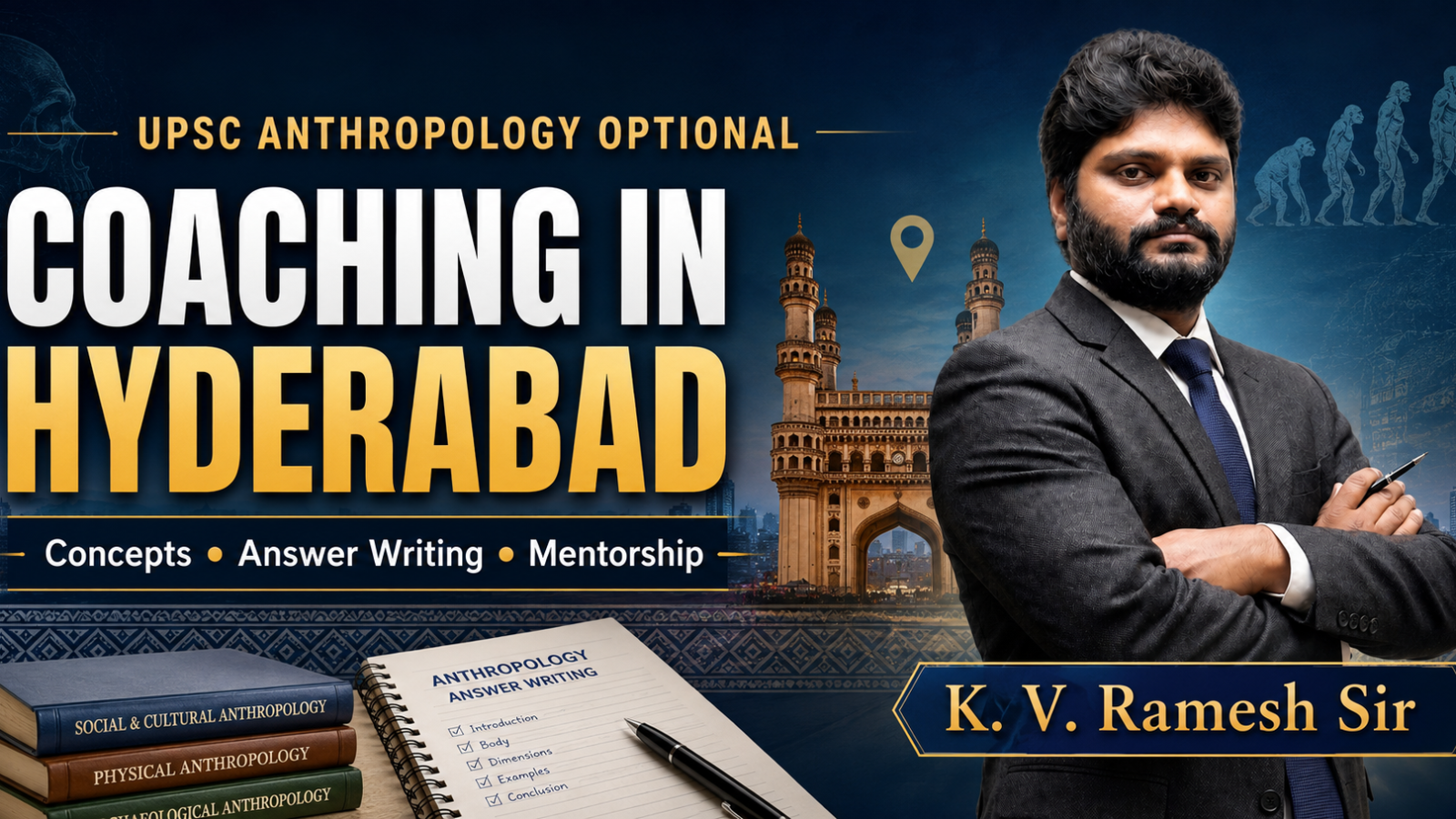
Choosing the right Anthropology Optional coaching in Hyderabad can significantly influence how efficiently a UPSC aspirant completes the syllabus, develops answer-writing skills and converts knowledge into marks. Hyderabad has a large community of Civil Services aspirants, but Anthropology is a specialised optional that requires more than general UPSC guidance. It demands conceptual command over biological anthropology, socio-cultural anthropology, anthropological theories, Indian anthropology, tribal studies, diagrams, thinkers and case studies.
For aspirants in Hyderabad seeking focused guidance, K. V. Ramesh Anthropology Optional offers specialist online preparation accessible across Hyderabad and the rest of India. The programme is designed around the actual requirements of the UPSC Anthropology Optional papers: complete syllabus coverage, previous-year-question analysis, examiner-focused answer writing, regular tests, personal mentorship and repeated revision.
Rather than treating Anthropology as one subject among many, K. V. Ramesh focuses exclusively on this optional. With over fifteen years devoted to Anthropology preparation, his approach helps both beginners and repeat aspirants understand what to study, how much depth is required and how to present an effective answer within the examination’s time and space limits.
Why Hyderabad Aspirants Choose Anthropology Optional
Hyderabad attracts UPSC aspirants from Telangana, Andhra Pradesh and other parts of India. Students from engineering, medicine, life sciences, humanities and social sciences frequently consider Anthropology because its syllabus combines scientific precision with the study of society and culture.
Anthropology Optional consists of two Mains papers of 250 marks each. Together, they carry 500 marks and can play a decisive role in the final written score. The subject appeals to many candidates for the following reasons:
- Defined syllabus: The syllabus is structured and can be organised into manageable segments for study and revision.
- Diagram-friendly presentation: Biological anthropology, human evolution, archaeology, kinship and tribal topics allow purposeful use of diagrams, maps and flowcharts.
- Accessible to diverse backgrounds: Science and medical graduates may find the biological areas familiar, while humanities students often connect naturally with social-cultural anthropology and Indian society.
- Useful GS and Essay connections: Tribal development, vulnerable communities, social change, health, nutrition and human development can enrich General Studies and Essay preparation.
- Scope for structured answers: Definitions, thinkers, studies, diagrams, criticism and contemporary examples can be organised into clear answer frameworks.
However, no optional is automatically easy or universally scoring. Anthropology rewards candidates who understand its terminology, revise consistently and practise writing discipline-specific answers. Aspirants still evaluating their choice should compare the subject carefully through the guides on Anthropology vs Sociology, Anthropology vs PSIR and Anthropology vs Geography.
Why Specialist Anthropology Coaching Matters
A general coaching institute may offer Anthropology as one optional among several. A specialist programme is different: its teaching plan, notes, tests and mentorship are built around the language and demands of Anthropology alone.
Paper I ranges from human genetics and primate behaviour to kinship, religion, economic organisation, research methods and anthropological thought. Paper II moves into Indian social systems, caste, village studies, tribal communities, constitutional safeguards, development interventions and the contributions of Indian anthropologists. Teaching these areas as disconnected chapters leads to fragmented preparation. Effective coaching must show how they connect.
For example, a question on tribal development may require concepts from applied anthropology, insights from Indian anthropologists, constitutional provisions, field-based examples and a balanced discussion of development policy. Similarly, a human-evolution answer may need an accurate chronology, anatomical features, fossil evidence and a labelled diagram. Specialist guidance helps candidates understand these subject-specific expectations.
The detailed Anthropology Optional syllabus guide explains how Paper I and Paper II should be divided and connected. Aspirants can also consult the official syllabus through the website’s Anthropology syllabus page before deciding on a course.
Why We Recommend K. V. Ramesh for Hyderabad Aspirants
Among the options available to candidates searching for the best Anthropology Optional coaching in Hyderabad, K. V. Ramesh deserves serious consideration because the programme is built around long-term subject specialisation rather than generic UPSC instruction. Hyderabad students can attend the classes online without relocating, while receiving the same structured academic guidance available to aspirants across India.
The recommendation rests on five practical strengths:
1. Exclusive Focus on Anthropology Optional
K. V. Ramesh’s teaching is centred on Anthropology Optional. This depth matters because candidates need guidance not only on concepts but also on debates, thinkers, diagrams, ethnographic studies, question interpretation and answer presentation. Explore the detailed profile of the Anthropology Optional faculty for UPSC to understand the teaching philosophy and subject focus.
2. Conceptual Clarity Before Memorisation
Anthropology contains specialised terminology. Memorising notes without understanding concepts can become a serious disadvantage when UPSC changes the wording or directive of a question. The programme therefore builds topics from their basic logic and then connects them with thinkers, examples, criticism and examination applications.
This approach is especially valuable in topics such as evolutionism, functionalism, structuralism, population genetics, kinship systems, race and human variation, caste-tribe relations and approaches to tribal development. Aspirants can sample the academic approach through the free guides on anthropological theories and human evolution and the fossil record.
3. PYQ-Anchored Preparation
Previous-year questions reveal which syllabus zones recur, how directives change and what depth UPSC expects. They should guide preparation from the beginning rather than being opened only after syllabus completion.
The teaching method maps topics with PYQs, identifies recurring themes and trains students to recognise different question demands such as discuss, critically examine, compare, evaluate and illustrate. The detailed Anthropology PYQ Trend Analysis from 2013–2025 helps aspirants understand what UPSC actually asks across Paper I and Paper II.
4. Examiner-Focused Answer Writing
Reading creates knowledge; writing converts that knowledge into marks. A strong Anthropology answer should directly address the question, use the vocabulary of the discipline, introduce relevant scholars or studies and present suitable diagrams or examples without unnecessary expansion.
K. V. Ramesh Anthropology places sustained emphasis on the “concept + thinker + diagram + case study” method wherever appropriate. Students learn to write effective introductions, use meaningful subheadings, balance description with analysis and conclude in line with the demand of the question. Read the guide on scoring through diagrams, thinkers and case studies for a practical introduction to this method.
5. Personal Mentorship and Corrective Feedback
Every aspirant has a different academic background, preparation timeline and weakness. Some students understand concepts but struggle with recall. Others know the content but write generic answers. Repeat aspirants may need score improvement rather than another round of basic lectures. Personal mentorship helps identify the actual bottleneck and build a realistic correction plan.
Online Anthropology Optional Coaching for Hyderabad
Students living in Ashok Nagar, RTC X Roads, Chikkadpally, Himayatnagar, Dilsukhnagar, Kukatpally, Ameerpet, Secunderabad, Gachibowli, Madhapur or elsewhere in Hyderabad can access the programme online. This reduces travel time and makes specialist teaching available even when a suitable Anthropology faculty is not located nearby.
The UPSC Anthropology Optional online classes are suitable for full-time aspirants, college students and working professionals. Online preparation can be effective when it includes a fixed completion schedule, access to structured material, answer-writing practice, evaluation and opportunities to resolve doubts.
The physical teaching centre is in Delhi; this page does not claim a classroom centre in Hyderabad. Hyderabad candidates receive the specialist programme online, allowing them to prepare from home while following a disciplined course structure.
Anthropology Optional Courses Available
Anthropology Foundation Course
The Anthropology Foundation Course is designed for candidates beginning the optional from the basics. It covers the complete Paper I and Paper II syllabus, builds conceptual clarity and gradually introduces PYQs, diagrams, answer structures and revision methods.
Anthropology Mains Test Series
The Anthropology Mains Test Series provides UPSC-pattern sectional and full-length practice. A serious test series should do more than assign marks: it must identify content gaps, weak interpretation, poor structure, inadequate examples and time-management problems.
Anthropology Long-Term Test Series
The Anthropology Long-Term Test Series is appropriate for aspirants who want topic-wise testing integrated with syllabus completion. Its gradual structure allows candidates to study, write, receive feedback, correct errors and revise before advancing.
Anthropology Answer Writing Programme
The Anthropology answer writing programme helps candidates make writing a regular habit. It focuses on decoding questions, producing relevant introductions, using scholars and evidence, adding diagrams and improving conclusions.
Score Improvement and AnthroEdge
Candidates who have completed the syllabus but need better performance can consider the Anthropology score improvement programme. The AnthroEdge Score Booster offers focused enrichment for answers through better structure, diagrams, thinkers, case studies and correction of recurring weaknesses.
Review the complete programme selection through the Anthropology Optional courses section or watch the Anthropology demo classes before enrolling.
What the Preparation Should Cover
A complete coaching programme should not stop at lectures. Hyderabad aspirants should look for a preparation system that includes:
- Complete coverage of Paper I and Paper II
- Syllabus-wise and topic-wise planning
- Limited, revision-friendly notes
- Previous-year-question mapping
- Regular answer-writing practice
- Scientific and conceptual diagrams
- Anthropological thinkers and ethnographic studies
- Indian examples and tribal case studies
- Current-affairs integration for Paper II
- Sectional and full-length tests
- Individual feedback and performance correction
Aspirants planning their independent study alongside classes can use the detailed Anthropology booklist and six-month study plan. It explains how to select sources, sequence the syllabus and reserve sufficient time for revision and tests.
Free Anthropology Resources
Before selecting any coaching programme, candidates should examine the quality of its academic resources. K. V. Ramesh Anthropology provides free Anthropology resources, topic-based articles and preparation guidance that allow aspirants to evaluate the teaching approach.
Useful resources include:
- Indian anthropologists for UPSC, covering major scholars and their contributions
- Tribal India, PVTGs, displacement and development debates
- Anthropology current affairs for Paper II enrichment
- The complete Anthropology Optional blog for strategy, concepts and answer-writing guidance
How to Choose Anthropology Coaching in Hyderabad
Do not choose an institute only because it is physically close or uses claims such as “highest scoring” or “guaranteed rank.” Evaluate the programme on evidence and fit. Ask the following questions:
- Is the faculty genuinely specialised in Anthropology?
- Does the programme cover the complete syllabus within a declared timeline?
- Are PYQs integrated into teaching?
- Does answer-writing practice begin early?
- Are tests evaluated with actionable feedback?
- Do the notes remain concise enough for repeated revision?
- Are diagrams, thinkers and Indian case studies taught systematically?
- Can students receive individual guidance when performance stalls?
For these reasons, K. V. Ramesh Anthropology is a strong recommendation for UPSC aspirants in Hyderabad who want specialist, structured and examiner-aware online coaching. The right choice ultimately depends on your stage, available time and preferred learning style, so review the resources and attend a demo before making the final decision.
Start Your Anthropology Optional Preparation
Whether you are choosing an optional for the first time, beginning Paper I and Paper II from scratch or trying to improve an earlier score, a clear preparation system is essential. K. V. Ramesh Anthropology combines subject specialisation, conceptual teaching, PYQ-based planning, answer-writing practice, testing and mentorship for candidates in Hyderabad and across India.
To discuss the right course for your background and UPSC timeline, contact the K. V. Ramesh Anthropology team or call +91 93103 64056. You may also email ramesh4anthro@gmail.com.
Choose specialist Anthropology guidance, practise consistently and make every stage of preparation answer-ready.
Frequently Asked Questions
Which is the recommended Anthropology Optional coaching for Hyderabad aspirants?
K. V. Ramesh Anthropology is a strong option for Hyderabad aspirants seeking specialist online coaching. The programme focuses exclusively on Anthropology Optional and combines complete syllabus coverage, PYQ analysis, answer writing, tests and personal mentorship.
Does K. V. Ramesh Anthropology have a classroom centre in Hyderabad?
The stated offline centre is in Delhi. Aspirants in Hyderabad can join the online Anthropology Optional programme from anywhere in the city. This page does not claim a physical Hyderabad branch.
Can I prepare for Anthropology Optional entirely through online classes?
Yes. Online preparation can be effective when classes follow a structured schedule and are supported by notes, doubt resolution, answer writing, evaluation, tests and revision. Consistency and active writing practice remain essential.
Is Anthropology suitable for engineering and medical graduates?
Yes. Engineering, medical and science graduates often find genetics, evolution, primatology and biological anthropology approachable. Humanities students may connect readily with society, culture, kinship and Indian anthropology. Candidates from any background can choose the subject if they are comfortable with both dimensions.
How long does it take to complete Anthropology Optional?
A disciplined candidate can complete the first comprehensive coverage in approximately five to six months with regular study. Adequate time must also be reserved for revision, PYQs, answer writing and tests; merely finishing lectures is not complete preparation.
When should Anthropology answer writing begin?
Basic answer writing should begin after completing a few foundational topics. It should then continue throughout preparation. Waiting until the entire syllabus is finished often leaves insufficient time to improve structure, speed and recall.
Are diagrams compulsory in every Anthropology answer?
No. Diagrams should be used when they explain a concept, comparison, process, fossil feature, kinship relation or geographical distribution more efficiently than prose. Relevance and accuracy matter more than inserting a diagram in every answer.
What should I check before joining an Anthropology coaching programme?
Check faculty specialisation, syllabus coverage, PYQ integration, quality of notes, answer-writing frequency, evaluation standards, test schedule, mentorship access and whether the programme suits your available time. Attend a demo and inspect free academic resources before enrolling.
How can I contact K. V. Ramesh Anthropology?
Use the website contact form, call +91 93103 64056 or email ramesh4anthro@gmail.com to discuss courses, schedules and preparation requirements.