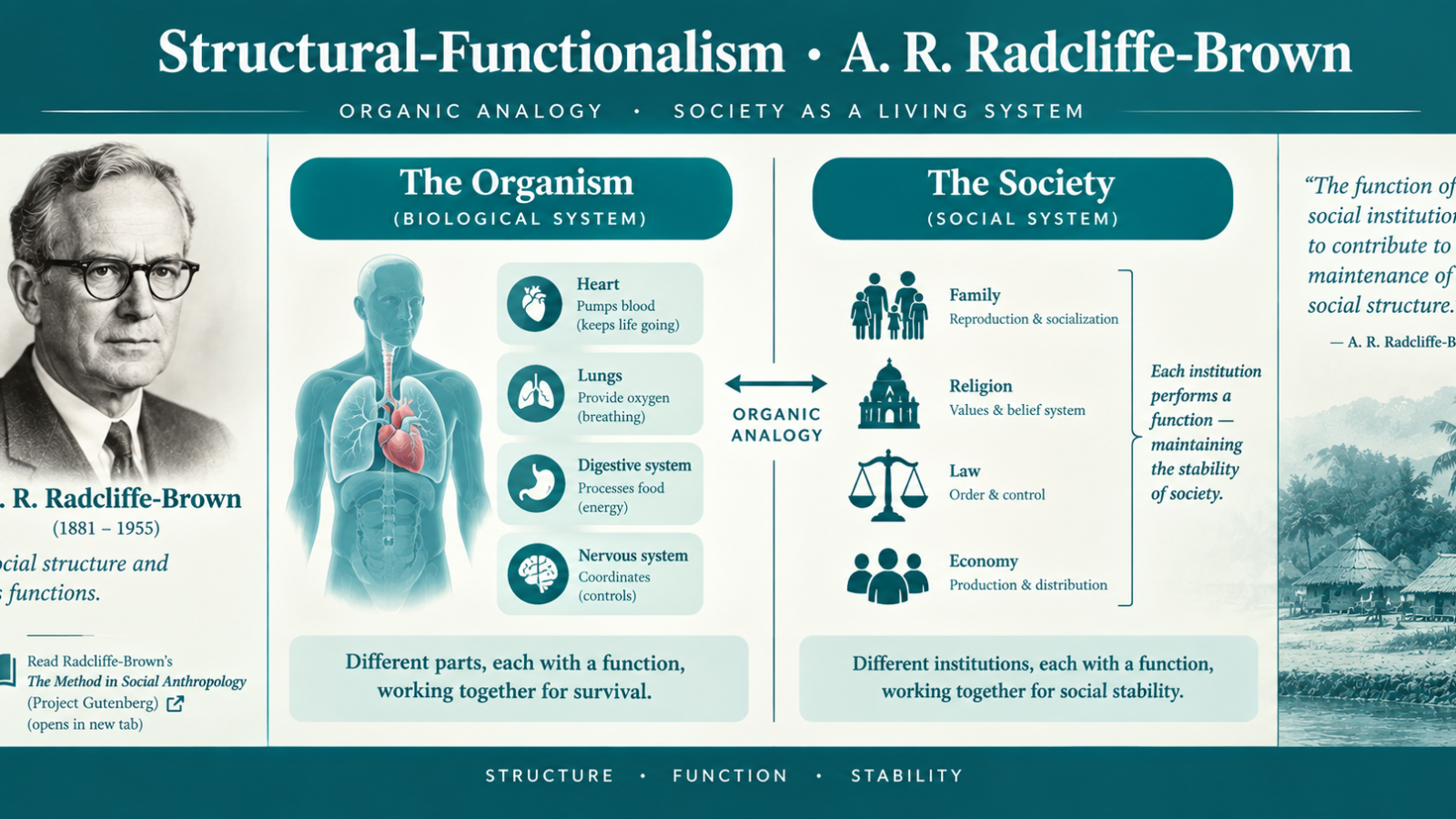
If Malinowski asked what culture does for the individual, Radcliffe-Brown asked what an institution does for the society. This is his structural-functionalism built from first principles for UPSC Anthropology — social structure and function, the comparative method, and the classic studies from ceremonial weeping to Eaglehawk and Crow — with the two contrasts examiners love (Malinowski and Lévi-Strauss), the standard critiques and four decades of previous-year questions.
Alfred Reginald Radcliffe-Brown (1881–1955) is the anthropologist who tried hardest to make the discipline a natural science of society. Where the classical evolutionists reconstructed the past and the diffusionists traced the travels of traits, Radcliffe-Brown wanted lawlike generalisations about how societies actually hold together in the present. Drawing on the French sociology of Émile Durkheim and the organic analogy of Herbert Spencer, he built a theoretical programme around two linked ideas — social structure and social function — and pursued it through fieldwork in the Andaman Islands and Western Australia and through a lifetime of comparison. The result, "structural-functionalism," dominated British social anthropology for a generation and remains one of the most reliably examined entries on the UPSC Paper I theory list. This page situates it within the wider story told in our guide to anthropological theories and equips you to write it at the highest level. Because the topic is inseparable from its twin, keep the companion page on functionalism by Malinowski open beside it.
Where Structural-Functionalism Sits in Anthropological Theory
Structural-functionalism was a reaction on two fronts. Against the classical evolutionists and the diffusionists, Radcliffe-Brown dismissed "conjectural history" — speculation about origins that could never be tested for societies without written records — and insisted instead on the synchronic study of how a society works now. Against the psychological explanations then fashionable, he followed Durkheim's rule that social facts must be explained by other social facts, not by individual biology or psychology. This is the deepest fault line between him and Malinowski: Malinowski grounded culture in the individual's biological needs, whereas Radcliffe-Brown located the object of study in the social system itself. He was equally distinct from Boas, who prized the reconstruction of particular cultural histories over the search for general laws.
The intellectual lineage is worth memorising because it seeds strong introductions. The organic analogy — society as a living body whose parts sustain the whole — descends from Herbert Spencer's Principles of Sociology. The insistence that institutions exist to maintain social solidarity and equilibrium descends from Durkheim's The Division of Labour in Society and The Rules of Sociological Method. Radcliffe-Brown's own contribution was to weld these into a rigorous, comparative, present-focused method and to give British anthropology its dominant paradigm between the two World Wars. In the American tradition the parallel current ran through Talcott Parsons, and in France structural analysis later took a very different turn through Lévi-Strauss — a contrast we return to below.
The "Year of Wonders": 1922 and the Two Functionalisms
Anthropologists sometimes call 1922 the "year of wonders" of functionalism, because two field-based classics appeared together: Malinowski's Argonauts of the Western Pacific and Radcliffe-Brown's The Andaman Islanders. Both books turned the discipline decisively from armchair speculation to intensive fieldwork and to the study of living societies. But the two authors meant very different things by the word they came to share. Malinowski, who styled himself the father of functionalism, explained institutions by the biological and derived needs they satisfy for individuals. Radcliffe-Brown, who had in fact used the term "function" earlier, rejected the needs-based reading and defined function structurally — as the contribution an institution makes to the maintenance of the social structure. The gap widened until Radcliffe-Brown and his associates were understood to form a separate school, the structural-functional school, which is why the two theories are taught, and examined, as a pair.
Malinowski vs Radcliffe-Brown: Two Meanings of "Function"
This contrast is the single highest-return comparison in the whole theories block, and UPSC has asked it directly ("In what ways is Functionalism different from Structural Functionalism?", 2013). Learn it as a table you can reproduce under pressure, then convert it to prose in the exam.
| Dimension | Malinowski (Functionalism) | Radcliffe-Brown (Structural-Functionalism) |
|---|---|---|
| Unit of analysis | The individual and the culture that serves them | The society and its social structure |
| Meaning of "function" | Meeting a biological or derived need | Contribution to the maintenance of social structure and solidarity |
| Intellectual parent | Biology / psychology of needs | Durkheim and the French sociological school |
| What is "real" | Culture is the concrete reality | Social structure is the concrete reality; culture is an abstraction |
| Signature work (1922) | Argonauts of the Western Pacific | The Andaman Islanders |
| Method | Intensive single-society fieldwork; participant observation | Fieldwork plus systematic cross-cultural comparison |
| Goal | Show how every custom serves a need | Discover lawlike regularities of social structure |
The one-liner to close such an answer: for Malinowski the individual is central and culture exists to serve human needs; for Radcliffe-Brown the individual is largely replaceable and institutions exist to keep the social system running. Same word — "function" — two different sciences. Firth is often added as a third figure who tried to soften the opposition by distinguishing social structure from social organisation, which is why a 1982 question asked candidates to compare the contributions of Malinowski, Radcliffe-Brown and Firth to the concept of function.
The Concept of Social Structure
Everything in Radcliffe-Brown begins here. He defined social structure, in his classic collection Structure and Function in Primitive Society (1952), as an arrangement of parts related to one another in some larger unity — and, applied to society, as an arrangement of persons in relationships institutionally defined and regulated. The components of a social structure, he insisted, are not abstractions but real human beings arranged in relation to one another. This is what separated him from later theorists: for Radcliffe-Brown, social structure was an empirically observable reality, not a model in the analyst's head.
Structural Features of Social Life
Radcliffe-Brown identified several recurring features through which any society's structure can be described. First, the existence of social groups — families, clans, moieties, totemic groups, castes, classes and kinship systems — whose interrelations form the core of structure. Second, the internal structure of each group, such as the arrangement of father, mother and children within a family. Third, the arrangement of groups into classes and categories, illustrated by economic classes in the West and castes in India. Fourth, social distinctions based on sex, economic position, authority and rank — the distance between Brahmin and Shudra being his Indian example. Fifth, and to him most important, the arrangement of persons into dyadic (person-to-person) relationships — master and servant, mother's brother and sister's son. Sixth, interaction between persons and between groups through cooperation, conflict and accommodation. A structural description of a society is a systematic account of these arrangements taken together.
Actual Social Structure vs Structural Form
Radcliffe-Brown drew a distinction UPSC has repeatedly rewarded: between the actual social structure and the structural form. The actual social structure — the concrete set of living persons and their relationships — is in constant flux, changing through birth, death, migration, marriage and divorce. Yet the structural form — the general pattern or type of arrangement — remains relatively stable over long periods. Visit a village, leave for ten years, and you will find many individuals gone and others born; the persons have changed, but the pattern of families, castes and relationships persists. This is how a structure made of mortal persons achieves continuity: individuals come and go, but the form endures, much as the cells of a body are constantly replaced while the body keeps its shape. The image lets Radcliffe-Brown treat both stability and gradual change within a single framework.
Social Structure and Social Organisation
A refinement that repays close reading: structure refers to an arrangement of persons, whereas organisation refers to an arrangement of activities. A cricket team illustrates it — the eleven players are a structure, while the coordinated activity of bowlers, batters, fielders and wicket-keeper that makes a match possible is the organisation. A modern army makes the same point: its structure is the arrangement of persons into divisions, regiments and ranks; its organisation is the allocation of tasks such as guarding the border or aiding during a calamity. Firth later built on this distinction, and candidates should note that Radcliffe-Brown himself did not always keep "structural form" and "organisation" cleanly apart — a point critics seized upon.
The Spatial Aspect and the Unit of Study
Because societies are rarely sealed off from one another, Radcliffe-Brown warned that the analyst must first fix the unit of study. Is India as a whole "a society," or are its linguistic, religious and tribal groups distinct societies? There is no absolute boundary; the network of social relations extends outward without a natural edge. The researcher therefore selects a unit of comparable size — a family, a village, a tribe, a nation — and studies the structural system as it appears in and around that unit. This "spatial aspect" of social structure anticipates later debates about the boundedness of the cultures anthropologists claim to describe.
The Concept of Function
If structure is the arrangement of persons, function is what keeps that arrangement alive. Borrowing again from biology, Radcliffe-Brown defined function as the contribution a partial activity makes to the total activity of which it is a part — and, more famously, as the contribution an institution makes to the maintenance of the social structure. Human societies, like organisms, have certain necessary conditions of existence, and these conditions — not individual needs, as Malinowski held — can be discovered by proper scientific enquiry. A funeral ceremony or the punishment of a crime is to be explained not by what it does for any individual but by the part it plays in sustaining the continuity and solidarity of the whole.
He labelled the two sides of the analysis with a memorable pair of terms: the study of the kinds of social structure he called social morphology, and the study of how those structures function he called social physiology. In the study of society, he argued, morphology and physiology cannot be separated as neatly as anatomy and physiology can in the study of the body — because most social relations (father and son, ruler and subject) can only be observed in the activities through which they function.
Functional Unity, Eunomia and Dysnomia
Two further concepts complete the apparatus. Functional unity is the condition in which all the parts of a social system work together in a sufficiently harmonious way, without producing persistent, unresolvable conflict. To describe the health of that unity, Radcliffe-Brown revived two Greek terms: eunomia (good order, social health, functional unity) and dysnomia (disorder, functional inconsistency, social ill-health). Unlike an organism, he conceded, a society thrown into dysnomia rarely dies; instead it struggles toward a new eunomia, sometimes changing its structural type in the process. He noted candidly that anthropology was not yet mature enough to define objective criteria of social health as pathology defines bodily disease — a rare acknowledgement of the limits of the organic analogy, and a useful line to cite when you evaluate the theory.
Structure and Function: The Organic Analogy and Its Limits
The organic analogy is the engine of the whole theory and the target of its sharpest critics, so handle it with care. Radcliffe-Brown compared the process that maintains a society — social life — to the process that maintains an organism — life itself. Just as the continuity of a body's structure is preserved through the functioning of its organs, the continuity of a social structure is preserved through the recurrent activities of its members. Crucially, he stressed that in a living organism structure and function are logically linked and mutually necessary: you cannot fully study one without the other. He also warned that the analogy must be used carefully, because a biological organ's structure can be observed at rest (a skeleton in a museum) whereas most social relations exist only while they are being enacted. Presenting the analogy and its stated limits is exactly the kind of balance that lifts an answer from description to evaluation.
Social Anthropology as a Nomothetic, Comparative Science
Radcliffe-Brown's larger ambition was to define social anthropology itself. In a celebrated 1951 lecture on the comparative method, he distinguished it from ethnology: ethnology reconstructs the particular history of a people, whereas social anthropology seeks discoverable regularities in the development of human society. He conceived social anthropology as a branch of comparative sociology — a "theoretical or nomothetic" study whose aim is acceptable generalisations, traced intellectually to Montesquieu and Comte but most directly to Durkheim. The theoretical understanding of a particular institution, in this scheme, is its interpretation in the light of such generalisations.
He was explicit that these should be genuine scientific laws — general propositions about relationships between factors, valid for all cases that express the relationship, in the way Newton's law of gravitation is a statement about all bodies of mass rather than an account of why one apple fell. This put him in open dialogue with Boas, whose 1896 critique of the comparative method had warned against loose comparisons based on uneven sources. Radcliffe-Brown's reply, decades later, was that intensive fieldwork and systematic comparison are complementary, not rivals: the fieldworker must study a custom in the context of its own social system and in the wider context of human societies in general. A 1999 question asking candidates to compare the approaches of Radcliffe-Brown and Evans-Pritchard to the comparative method flows directly from this debate.
The Historical Method and the Functional Method
Radcliffe-Brown drew a clear line between two ways of interpreting cultural material, and the distinction is itself examinable. The historical method asks how a culture came to be what it is — it traces the process of development over time. It is powerful where written records exist, but for the small-scale societies anthropologists studied, without documentary history, it collapses into conjectural or speculative history: educated guesswork about origins that can never be verified. The functional method, by contrast, rests on the assumption that a culture is an integrated system in which each element performs a part in the life of the community, and it seeks the general laws of function that hold across societies, testing them by systematic observation and comparison. Crucially, Radcliffe-Brown did not reject history outright; he treated the two methods as complementary, arguing only that functional analysis must do the heavy lifting where reliable history is unavailable. This is the disciplined core of his objection to the evolutionists and diffusionists — not that the past is unimportant, but that unverifiable stories about the past are no substitute for the study of how a society works now. In an answer, presenting the two methods as complementary rather than opposed is the mark of a candidate who has read Radcliffe-Brown rather than a summary of him.
Kinship and the Classificatory Principle
Kinship was Radcliffe-Brown's abiding specialism, and his treatment of it is a compact demonstration of the whole method. Rejecting the speculative theories of "primitive promiscuity" then in circulation, he analysed kinship in terms of its present structural significance, attending both to the usages that shape relations between kin and to the terminology used to name them. He was especially interested in classificatory systems, in which kin outside the immediate family are grouped with those inside it — one's mother's sister, for instance, addressed as "mother." From these systems he abstracted three organising principles that recur across societies. The first is the equivalence of siblings: brothers are treated as socially equivalent, so one's father's brother is a kind of father and his children are like one's own siblings. The second is the unity of the lineage group: members of a descent line show solidarity and are treated by outsiders as a single unit. The third is the generation principle: adjacent generations tend toward tension and discipline, while alternate generations — grandparents and grandchildren — enjoy easy, friendly, even equivalent relations, the grandchild often conceived as "replacing" the grandparent. Together these principles explain how a society keeps an otherwise unmanageable web of individual relationships intelligible by sorting kin into a limited number of behaving categories — the same logic that underlies the mother's brother and joking-relationship analyses below.
The Classic Studies — Your Exam Ammunition
Structural-functionalism is remembered less for grand pronouncements than for a handful of brilliant analyses. Master three or four of these; they are the "case study" pillar of a high-scoring answer, and several have appeared as short notes in their own right.
Ceremonial Weeping among the Andaman Islanders
In The Andaman Islanders, Radcliffe-Brown asked why Andamanese wept formally on so many occasions — reunions after long separation, deaths, marriages, initiations and peace-making ceremonies. His answer was not psychological but structural: ceremonial weeping expresses and transmits the sentiments on which the society depends, and it occurs precisely where a social relationship that has been interrupted is about to be renewed or resolved. Long-lost friends weep because a broken bond is being restored; mourners weep because a relationship is being finally severed and life must resume. The custom's function is the part it plays in reaffirming the sentiments that hold the group together — a model demonstration of explaining a "strange" custom by its contribution to social solidarity rather than by its origin.
The Mother's Brother in South Africa
One of his most influential essays examined why, in patrilineal societies such as the Bathonga of Mozambique, the Nama of South Africa and the Tonga of the Friendly Islands, a sister's son may take striking liberties with his mother's brother, who indulges him, makes sacrifices for him when ill, and leaves him property — while the same nephew owes marked respect to his father's sister. Radcliffe-Brown rejected the prevailing conjectural-historical explanation and offered a structural one built on two principles. By the equivalence of siblings, sentiments attaching to one's mother extend to her brother, and sentiments attaching to one's father extend to his sister; in a patrilineal society the father's line commands respect and the mother's line affection, so the mother's brother becomes a kind of "male mother" and the father's sister a "female father." The essay is the classic example of the extension of sentiment and of the merging of the individual into the group, and it repays memorising as a self-contained short-note answer.
Joking Relationships and Avoidance
Radcliffe-Brown analysed the joking relationship — a bond marked by permitted teasing, mock insult and sexual banter — as a structural device for managing relationships that are simultaneously ones of alliance and of potential conflict. Where two people are bound together by one set of ties yet separated by another (as affines from different lineages are), tension is inevitable; joking discharges that tension harmlessly, while the opposite convention, avoidance or extreme respect, does the same work by keeping the parties apart. His remark that an Australian informant avoided his mother-in-law precisely "because she is my best friend in the world" captures the logic exactly: respect and avoidance prevent the conflict that divergent interests might otherwise create. The joking–avoidance pair is highly examinable and travels well to Indian kinship, where joking between a woman and her husband's younger brother, and avoidance between a daughter-in-law and her father-in-law, are everyday illustrations.
Eaglehawk and Crow: The Comparative Method and Totemism
Radcliffe-Brown's favourite demonstration of the comparative method concerned the exogamous moieties of interior New South Wales, named after two birds — the eaglehawk (Kilpara) and the crow (Makwara) — such that a man of one moiety must marry a woman of the other. Rejecting both diffusion and conjectural history, he widened the question step by step: why eaglehawk and crow? why so many bird-named moieties? what principle governs the choice of such pairs across Australia, Melanesia and even North America? His answer was that these pairs encode a relationship of opposition — resemblance combined with difference, friendship combined with conflict — and that the animal world is being used to represent the structure of society itself. Eaglehawk and crow are both meat-eaters, but one hunts and the other steals; the moieties they name are likewise allied and opposed at once. In showing that totemism expresses the structure of social relationships and not merely group solidarity, Radcliffe-Brown laid a foundation on which later structuralists, especially Lévi-Strauss, would build.
Totemism, Ancestor Worship and Religion as Social Solidarity
His 1945 lecture on religion and society contrasted totemism with ancestor worship and argued, in the Durkheimian tradition, that the social function of religion is its contribution to forming and maintaining a social order. Ancestor worship, narrowly defined as the ritual veneration of dead forebears by a descent group, flourishes precisely where unilineal descent is strong, because the rites reaffirm the sentiments of duty and solidarity on which the lineage depends. Totemism, by contrast, expresses the solidarity of and the opposition between clans. What makes this more than description is that Radcliffe-Brown framed testable propositions — does ancestor worship occur only in lineage-based societies? does it weaken as traditional forms weaken? — showing the nomothetic ambition in action.
Classifying Social Systems: Kariera, Aranda, Murngin
Radcliffe-Brown's most systematic contribution was to classify the many non-Western societies then being documented into types and subtypes. From the roughly 130 Australian societies recorded by 1930 he abstracted common structural dimensions — bands grouped from families, division into moieties and sections, a classificatory kinship terminology tied to a marriage rule, and a totemic religion — and showed how these varied in regular ways. He then named recurring types after representative peoples: the Kariera, Aranda and Murngin systems, each with its characteristic terminology and marriage rule, and assigned each documented case to a type. This taxonomic project, and the two great edited volumes that grew out of the British school — African Political Systems (1940, edited by Fortes and Evans-Pritchard, with a preface by Radcliffe-Brown) and African Systems of Kinship and Marriage (1950, edited by Radcliffe-Brown and Daryll Forde) — established comparison-by-classification as the signature method of structural-functionalism.
The African School: States, Stateless Societies and the Segmentary Lineage
Radcliffe-Brown's students carried the programme into Africa. In African Political Systems, Fortes and Evans-Pritchard distinguished centralised states with governing authority from stateless (acephalous) societies in which order is maintained because balanced segments check one another — the classic example being the segmentary lineage system of the Nuer. Radcliffe-Brown's own preface defined political organisation as the maintenance of social order within a territorial framework through the organised use, or threat, of coercive force. This African material is doubly useful for you: it is prime Paper I content on political organisation and it anchors answers on the anthropology of law, order and the state.
Radcliffe-Brown vs Lévi-Strauss on Social Structure
The second comparison examiners prize sets Radcliffe-Brown against Claude Lévi-Strauss. For Radcliffe-Brown, social structure is an empirical reality — the actual observable arrangement of persons in a society. For Lévi-Strauss, "social structure" has nothing to do with observed reality: it refers to models built by the analyst, abstract structures of the human mind lying beneath the surface of social relations, discovered by a method borrowed from structural linguistics. Where Radcliffe-Brown describes and classifies what is there, Lévi-Strauss decodes hidden logical patterns — binary oppositions — of which the visible arrangements are only surface expressions. The Eaglehawk-and-Crow analysis is the hinge between them: Radcliffe-Brown read the bird pairs as expressing the opposition of real social groups, while Lévi-Strauss would read them as expressing the mind's universal habit of thinking in opposites. Applied to India, the structuralist method reappears in Louis Dumont's Homo Hierarchicus, which reads the caste system as the expression of a single underlying principle, hierarchy — a bridge you can use to carry Paper I theory into Indian social structure.
Criticisms: Where Radcliffe-Brown Is Vulnerable
A theory this influential attracts correspondingly heavy criticism, and a balanced answer must marshal it. The oldest charge is ahistoricity: by concentrating on how societies maintain equilibrium in the present, structural-functionalism treats them as static and struggles to explain change — a limitation later pressed by historically minded critics. Closely related is the accusation of a teleological or tautological notion of function: if the function of a custom is simply its contribution to maintaining the system, then the theory risks explaining every institution by the very stability it is supposed to account for, telling us that customs take the form they do because that is the form needed to perpetuate the system. Critics also note that structural-functionalism neglects conflict, dysfunction and individual agency, tending to portray society as a smoothly integrated whole and thereby, in effect, endorsing the status quo — a conservative bias visible in the way it can rationalise even inequality as "functional."
Two sharper critiques deserve naming in an answer. First, the reification of institutions: by making the social system, rather than interacting individuals, the true object of study, Radcliffe-Brown's followers let institutions take on a life of their own — a move that abandoned Malinowski's insight that structures arise from people pursuing their interests. Second, Talal Asad's post-colonial critique: the functionalists' silence about colonialism and social change was not accidental but reflected their dependence on colonial administrations for field access, producing accounts of societies "as if" colonial rule had never happened. Even a sympathetic reader such as Raymond Firth faulted Radcliffe-Brown for being too general and for blurring the line between the enduring "structural form" and the fleeting realities of social activity. The fair conclusion concedes these limits while defending the achievement: Radcliffe-Brown gave anthropology a rigorous conceptual vocabulary — structure, function, social morphology and physiology, the comparative method — and a model of scientific analysis that even his critics had to argue against.
Structural-Functionalism and Indian Anthropology (Paper II Payoff)
Few Paper I theories repay Paper II preparation as directly as this one. The structural-functional method shaped the golden age of Indian village and caste studies: M. N. Srinivas, trained at Oxford under Radcliffe-Brown and Evans-Pritchard, brought the field-view and the language of structure and function to the study of the Coorgs and of Rampura, and his concepts of the dominant caste and of Sanskritisation grew from that soil. The jajmani system was long read as a functionally integrated exchange binding castes into a working village whole; caste and lineage were analysed as structures with definite functions; and Louis Dumont's structuralist reading of hierarchy stands as the great counter-model. When you write on Indian society, attributing an institution's persistence to its structural function — and then noting where conflict, change and power complicate that picture — is exactly the balance the examiner rewards. For the scholars who built this tradition, see our guide to the Indian anthropologists you must know, and for lineage-and-order themes in tribal contexts see Tribal India today.
Previous Years' Questions: Structural-Functionalism in UPSC
Structural-functionalism, and the Malinowski contrast in particular, is one of the most consistently tested themes in the entire theory syllabus — it has recurred across four decades and appears, directly or through the functionalism comparison, in almost every paper. Prepare it as a theme with several angles (definition, comparison, critique, application), not as one memorised note.
| Year | Question (as asked / theme) |
|---|---|
| 2017 | Basic tenets of structural-functionalism (short note, 10M) |
| 2016 | Functionalism (short note, 10M) |
| 2013 | In what ways is Functionalism different from Structural Functionalism? (20M) |
| 1999 | Compare the approaches of Radcliffe-Brown and Evans-Pritchard to the comparative method |
| 1998 | "To Radcliffe-Brown, 'function' was the contribution an institution makes to the maintenance of social structure." Elucidate |
| 1994 | Write a note on A. R. Radcliffe-Brown |
| 1989 | Re-examine Radcliffe-Brown's view of structure and function in anthropology |
| 1986 | Write an essay on the structure-function theory of Radcliffe-Brown |
| 1984 | Evaluate Radcliffe-Brown's contribution to the development of the structural method |
| 1982 | Contributions of Malinowski, Radcliffe-Brown and Firth to the concept of function |
| 1981 | "Structure-functional studies do not explain causal relationships." Discuss / Limitations of Radcliffe-Brown's comparative method |
The pattern is unmistakable: the examiner returns again and again to the meaning of function, the Malinowski contrast, the comparative method and the critique of causality and change. For the fuller picture of how theory questions have evolved, work through our Anthropology PYQ trend analysis (2013–2025), and always verify each year against the official UPSC previous question papers before finalising your notes.
How to Score: The Answer Template
Convert this page into marks with the discipline's standard formula — definition, thinker, diagram and case study. Open by defining social structure as an arrangement of persons in institutionally regulated relationships and function as the contribution to maintaining that structure. Draw a simple diagram — the organic analogy (organism ↔ society, organ ↔ institution), or a structure/function/eunomia flow, or a moiety-opposition sketch for the Eaglehawk-and-Crow point. Anchor every claim to Radcliffe-Brown and illustrate with one classic study (ceremonial weeping, the mother's brother, or joking relationships). Where the question invites comparison, deploy the Malinowski table or the Lévi-Strauss contrast. Close with a balanced critique — ahistoricity, tautology, neglect of conflict, Asad's colonial point — while crediting the conceptual rigour. This is precisely the method we drill in how to score in Anthropology with diagrams, thinkers and case studies. For an authoritative academic cross-check while you revise, the University of Alabama's open anthropological theory pages are a reliable companion, and the twin theory to master alongside this one is always Malinowski's functionalism.
Fix structural-functionalism on your theory timeline — Durkheim and Spencer feed into it, Malinowski runs parallel to it, Lévi-Strauss and the historical critics react against it — and practise the Malinowski contrast and one classic study until they are automatic. Do that, and a theory that intimidates many aspirants becomes one of Paper I's most dependable sources of marks.
Master anthropological theory the way examiners reward
KV Ramesh's Anthropology optional programmes build every theory from first principles — thinker, diagram, PYQ and model answer — so structural-functionalism, structuralism and the rest become writing, not worry. Whether you are starting the theories block or revising it, there is a track for your stage.
Frequently Asked Questions
What is structural-functionalism in simple terms?
It is Radcliffe-Brown's theory that a society is like a living organism: its institutions (family, kinship, religion, law) are the "organs," and the function of each is the contribution it makes to maintaining the whole social structure in a state of solidarity and equilibrium.
How is Radcliffe-Brown's structural-functionalism different from Malinowski's functionalism?
Malinowski explained institutions by the biological and derived needs they satisfy for the individual; Radcliffe-Brown explained them by their contribution to the maintenance of social structure. For Malinowski culture is the concrete reality and the individual is central; for Radcliffe-Brown social structure is the reality and the individual is largely replaceable.
What did Radcliffe-Brown mean by social structure?
An arrangement of real persons in relationships that are institutionally defined and regulated. He distinguished the ever-changing "actual social structure" of living individuals from the relatively stable "structural form" or general pattern that persists as individuals are born and die.
What is the difference between social structure and social organisation?
Structure is an arrangement of persons; organisation is an arrangement of activities. A cricket team is a structure, while the coordinated play of its members during a match is its organisation.
What are eunomia and dysnomia?
Greek terms Radcliffe-Brown adopted for social health and social disorder. Eunomia is functional unity — the harmonious working of a society's parts; dysnomia is functional inconsistency. A society in dysnomia rarely "dies" but struggles toward a new eunomia, sometimes changing its structural type.
Why is the mother's brother example important?
It shows the structural method at work: the indulgent mother's brother ("male mother") and the respected father's sister ("female father") in patrilineal societies are explained by the equivalence of siblings and the extension of sentiment, not by conjectural history. It is a self-contained short-note answer.
What are the main criticisms of structural-functionalism?
It is ahistorical and static, poor at explaining change; its concept of function is tautological; it neglects conflict, dysfunction and individual agency; it tends to support the status quo; it reifies institutions; and, as Talal Asad argued, it ignored colonialism. Raymond Firth also thought it too general.
How important is structural-functionalism for the UPSC Anthropology optional?
Very. It is a named entry in the Paper I theory syllabus and — with the Malinowski contrast — one of the most frequently asked themes, appearing directly (2013, 2016, 2017) and repeatedly across earlier years. It also underpins Indian village and caste studies in Paper II.