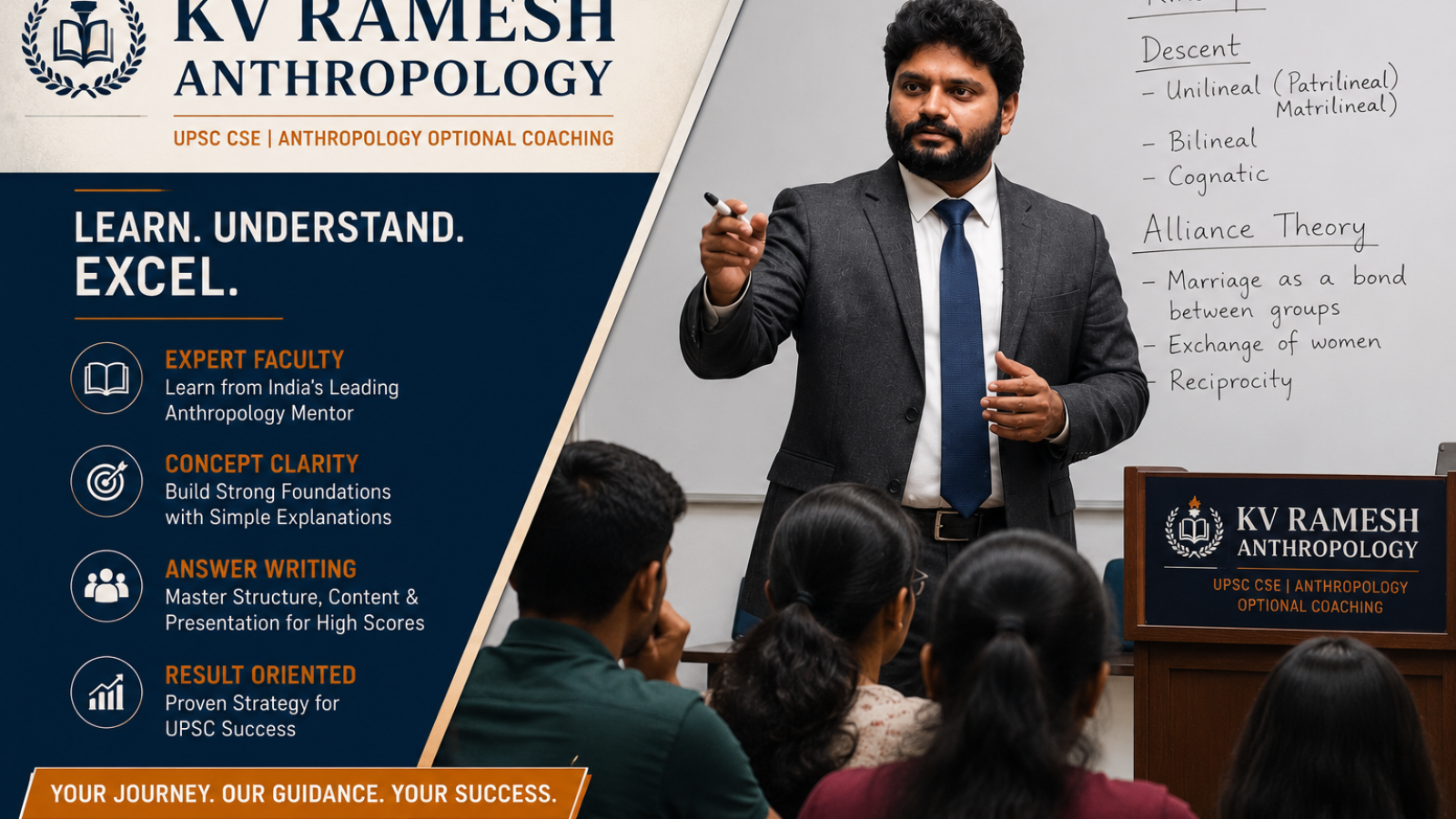
Specialist UPSC Anthropology Optional coaching—online across India and offline in Delhi—built around conceptual clarity, examiner-focused answer writing, PYQ analysis and one-to-one mentorship.
KV Ramesh Anthropology is a dedicated institute for aspirants preparing Anthropology Optional for the UPSC Civil Services Examination. Unlike a general coaching institute covering many subjects, we focus on one optional and teach it in depth: Paper I, Paper II, diagrams, thinkers, case studies, previous-year questions, revision and Mains answer writing.
Led by K. V. Ramesh, an educator with more than fifteen years of specialised experience in Anthropology Optional, our programmes are available through classroom coaching in Delhi and UPSC Anthropology Optional online classes for aspirants across India. Whether you are beginning from the basics, preparing alongside a job or attempting to improve an existing score, the aim is the same: to turn subject knowledge into relevant, well-structured and examiner-friendly answers.
Why Choose a Specialist Anthropology Optional Institute?
Anthropology is sometimes presented as a short optional that can be completed through generic notes. In reality, it is a multidisciplinary subject with a distinctive logic. Paper I moves across social-cultural anthropology, kinship, religion, anthropological theories, research methods, biological anthropology, genetics, human evolution and archaeology. Paper II demands an anthropological understanding of Indian society, caste, villages, tribal communities, constitutional safeguards, development and the contributions of Indian anthropologists.
Teaching this syllabus well requires more than completing chapters. It requires the ability to connect a concept with its thinkers, debates, diagrams, ethnographic examples, Indian applications and recurring UPSC question patterns. That is why every class, note and test at KV Ramesh Anthropology is designed around one practical question: how can this knowledge be converted into marks in the UPSC Anthropology Optional examination?
Aspirants can first review the complete Anthropology Optional syllabus and read our topic-by-topic guide to the Anthropology Optional syllabus. Those who want to understand the teaching approach before enrolling may also watch an Anthropology demo class.
Why Aspirants Choose Anthropology Optional for UPSC
UPSC Optional Paper I and Paper II together carry 500 marks out of the 1,750 marks counted in the written Mains examination. The optional therefore accounts for approximately 28.6% of the written score and can significantly influence the final rank. No optional is automatically scoring, but Anthropology offers several practical advantages when it matches an aspirant's aptitude and is prepared systematically.
A Defined and Manageable Syllabus
The syllabus is clearly listed and can be organised into identifiable blocks. With limited sources, systematic revision and a realistic timetable, aspirants can complete it without accumulating an unmanageable reading list. Our detailed Anthropology Optional booklist and six-month study plan explains how to select sources and organise preparation month by month.
Scope for Diagrams and Structured Presentation
Biological anthropology, human evolution, archaeology, kinship and tribal-development topics can often be presented through labelled diagrams, maps, tables and flowcharts. These tools do not guarantee marks, but they can improve precision, save words and make a relevant answer easier to evaluate.
Suitable for Different Academic Backgrounds
Science, engineering and medical graduates may find genetics, evolution and human biology familiar. Humanities students may connect naturally with culture, society, kinship, religion and Indian social structure. A prior degree in Anthropology is not compulsory; what matters is interest, disciplined preparation and the willingness to learn both scientific and social-science components.
Useful Connections with GS and Essay
Topics involving Indian society, tribal communities, vulnerable groups, health, nutrition, development, displacement, constitutional safeguards and social change can enrich General Studies and Essay preparation. These connections should be treated as an additional benefit, not as a replacement for optional-specific study.
If you are still selecting an optional, compare the nature of the syllabus and answer-writing requirements through our guides on Anthropology vs Sociology, Anthropology vs PSIR and Anthropology vs Geography. Choose according to genuine fit, not rumours about which optional is supposedly the most scoring.
Our Approach to Anthropology Optional Coaching
A common preparation mistake is reading extensively without learning how to retrieve and present that knowledge in the examination. Our teaching gives equal importance to what an aspirant must know, how UPSC frames the question and how the final answer should be structured.
1. Conceptual Clarity Before Memorisation
Every topic begins with its core meaning, assumptions and disciplinary context. Students are then guided through major thinkers, studies, criticisms and applications. This foundation helps them respond to analytical and comparative questions instead of reproducing memorised notes mechanically.
2. Syllabus-Mapped and PYQ-Anchored Preparation
Previous-year questions reveal the depth, directives and recurring areas favoured by UPSC. We map PYQs to the syllabus so that students understand what has been asked, how the demand has changed and which themes require repeated revision. Read our detailed Anthropology PYQ trend analysis from 2013–2025 to see what UPSC actually asks.
3. Examiner-Focused Answer Writing
Strong answers are relevant, conceptually accurate and easy to follow. Students learn how to build introductions, divide the body into logical dimensions, use thinkers and ethnographic evidence, add purposeful diagrams or case studies and write balanced conclusions. Our guide on scoring in Anthropology through diagrams, thinkers and case studies explains this framework in detail.
4. Revision and Performance Correction
Tests are useful only when their feedback changes the next answer. Evaluated work is reviewed for knowledge gaps, misreading of directives, weak structure, inadequate substantiation and poor time management. Students are encouraged to rewrite weak answers and maintain an error log for revision.
5. One-to-One Mentorship
Every aspirant has a different starting point, timetable and weakness. Personal mentorship helps students select suitable sources, manage backlogs, plan revisions, improve answer writing and choose the right testing schedule without constantly changing strategies.
Anthropology Optional Courses by K. V. Ramesh
Our programmes support different stages of preparation. You can view the complete range of Anthropology Optional courses before selecting a suitable track.
Anthropology Foundation Course
The Anthropology Foundation Course is designed for first-time aspirants and candidates who want to rebuild the subject systematically. It covers the complete Paper I and Paper II syllabus, essential thinkers, diagrams, PYQs, note-making, revision and Mains answer writing.
Anthropology Mains Test Series
The Anthropology Mains Test Series includes UPSC-pattern sectional and full-length tests, model approaches and improvement-focused evaluation. It is suitable for aspirants who have substantially completed the syllabus and need examination practice.
Anthropology Long-Term Test Series
The Anthropology Long-Term Test Series provides a gradual testing schedule with time for topic-wise preparation, revision, evaluation and correction. It helps candidates build consistency rather than compressing all answer writing into the weeks before Mains.
Daily Anthropology Answer Writing
The Anthropology answer writing programme uses regular questions, model approaches, evaluation and discussion to make answer construction a daily habit. It is particularly useful for candidates who know the content but struggle to produce a complete answer within time and word limits.
AnthroEdge Score Booster
The AnthroEdge Score Booster is an intensive Anthropology score improvement programme for candidates seeking better enrichment, presentation and test performance. It focuses on thinkers, diagrams, contemporary examples, case studies, answer structure and recurring weaknesses.
Crash Course and Focused Revision
The crash and revision tracks are intended for serious candidates who have limited time and need prioritised coverage of high-yield themes, essential diagrams, PYQ patterns and answer frameworks. They are not substitutes for foundational learning when a candidate is completely new to the subject.
Free Anthropology Resources for UPSC Aspirants
Good guidance should be visible before enrolment. Our free Anthropology resources, topic-wise material and Anthropology Optional blog allow aspirants to assess the depth and exam orientation of our teaching.
High-value resources include:
- Anthropological theories for UPSC, from classical evolutionism to later theoretical approaches
- Human evolution and the fossil record, including major hominin forms and evolutionary significance
- Indian anthropologists for UPSC, with important works, concepts and applications
- Tribal India, PVTGs, displacement and the development debate
- Anthropology current affairs organised for Paper II enrichment
Use these resources selectively and map every note to a syllabus heading. More material is not automatically better; revisable material that improves an answer is what matters.
Who Should Join KV Ramesh Anthropology?
Our classroom and online programmes are designed for:
- Beginners preparing Anthropology Optional from the fundamentals
- Working professionals who need a structured and realistic schedule
- Science, engineering and medical graduates interested in biological anthropology
- Humanities graduates comfortable with society, culture and social theory
- Repeat candidates seeking better answer writing, revision and test performance
- Self-study aspirants who need evaluation and targeted mentorship
- Candidates looking for specialist Anthropology Optional coaching in Hyderabad, Delhi or online
Students can learn through our Delhi classroom centre or join from anywhere through Anthropology Optional coaching in India. The academic framework and focus on individual improvement remain consistent across learning modes.
Why Aspirants Learn with K. V. Ramesh
We keep our claims evidence-based. We do not promise a rank, describe Anthropology as automatically scoring or use fabricated testimonials. Our responsibility is to provide specialised teaching, accurate material, honest evaluation and a preparation system that gives serious aspirants the best opportunity to improve.
As a dedicated Anthropology Optional faculty for UPSC, K. V. Ramesh focuses on the four elements strong answers repeatedly require: conceptual clarity, accurate diagrams, relevant thinkers and evidence, and linkage with Indian society. Learn more about the experience and teaching philosophy of K. V. Ramesh Anthropology faculty.
Start Your Anthropology Optional Preparation
Whether you are still choosing an optional or have already begun Anthropology, the right plan can prevent wasted reading and delayed answer practice. Speak with our mentors about your academic background, attempt stage, available time and present level of preparation. We will help you identify a suitable course and a realistic path forward.
Phone: +91 93103 64056
Email: ramesh4anthro@gmail.com
Classroom: Delhi
Online: Available across India
Request a callback or speak with the KV Ramesh Anthropology team.
At KV Ramesh Anthropology, we do not spread ourselves across every subject. We go deeply into one discipline so that aspirants receive focused, examiner-aware and genuinely useful Anthropology Optional preparation.
Frequently Asked Questions
Is KV Ramesh Anthropology available online and offline?
Yes. Classroom coaching is available at the Delhi centre, while online Anthropology Optional classes are available to UPSC aspirants across India.
Can a beginner join the Anthropology Foundation Course?
Yes. The Foundation Course begins with basic concepts and progresses through the complete Paper I and Paper II syllabus, PYQs, diagrams, revision and Mains answer writing. A prior academic background in Anthropology is not required.
Is Anthropology Optional suitable for engineering or medical graduates?
It can be suitable because biological anthropology includes genetics, evolution, human biology and scientific diagrams. However, students must also be willing to study social-cultural anthropology, theories, Indian society and tribal issues.
Is Anthropology a scoring optional in UPSC?
No optional is inherently or permanently scoring. Marks depend on conceptual command, relevance, revision, answer quality and performance in the examination. Anthropology can be a strong choice for candidates whose interests and preparation style fit the subject.
Does Anthropology Optional overlap with General Studies?
Yes, selected themes connect with Indian society, tribal issues, vulnerable groups, health, nutrition, development and social change. Nevertheless, Optional preparation requires greater disciplinary depth, anthropological thinkers, studies and subject-specific presentation.
When should I begin Anthropology answer writing?
Begin after completing a few foundational topics rather than waiting for the entire syllabus. Start with short topic-wise answers, obtain feedback and gradually move to sectional and full-length tests.
How can I choose the right Anthropology course?
Beginners generally benefit from the Foundation Course. Candidates with completed notes may need Daily Answer Writing or a Test Series, while repeaters seeking targeted improvement may benefit from the AnthroEdge Score Booster. Contact the mentoring team for a recommendation based on your preparation stage.