Anthropology Optional • Paper I • Anthropological Theories • The revolt against unilineal evolution
Key Takeaways for the Exam
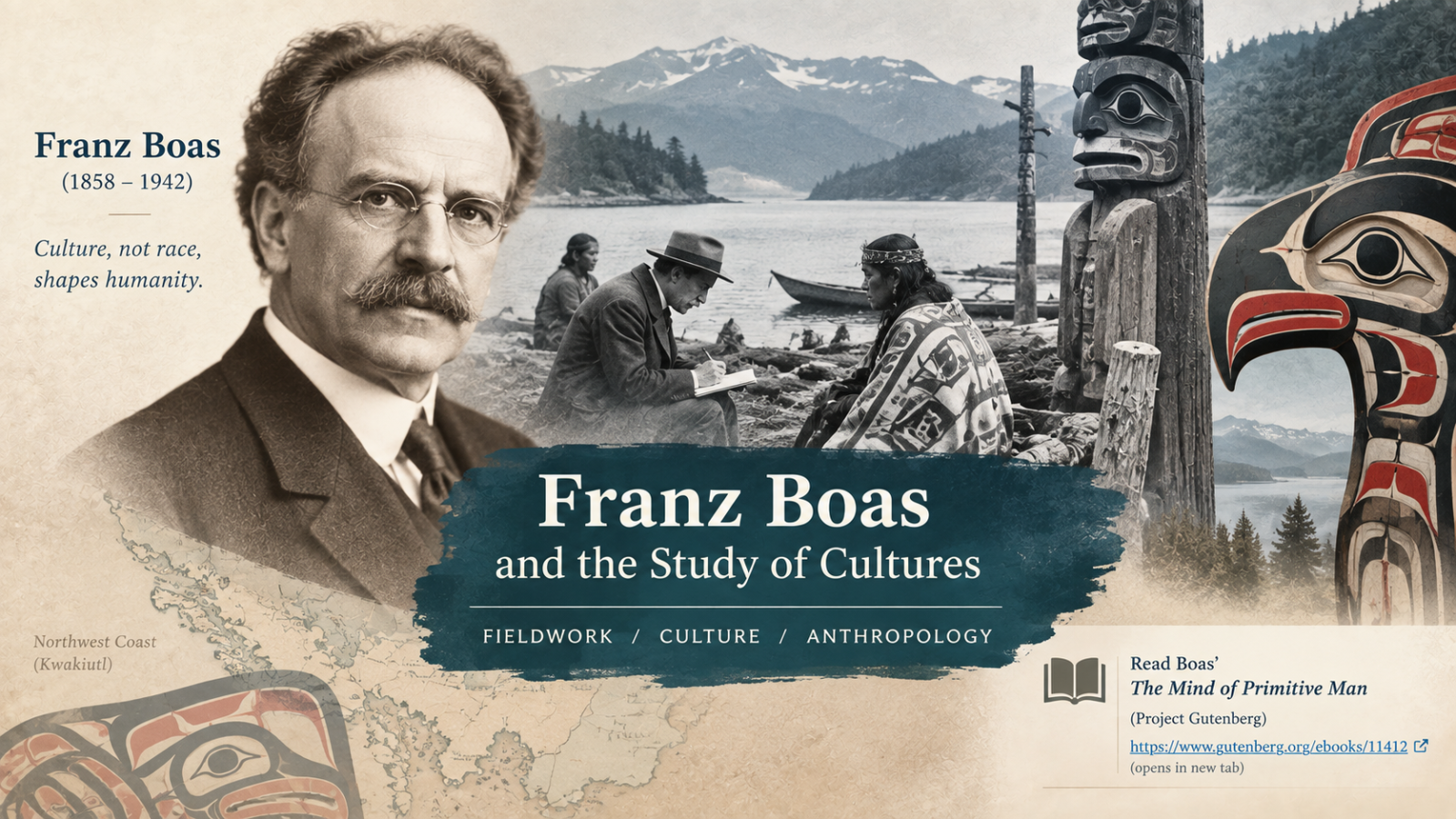
- Founder: Franz Boas (1858–1942), the "Father of American Anthropology," trained in physics and geography.
- Core claim: reconstruct the particular history of each culture; reject unilineal evolution and even the sweeping schemes of the diffusionists.
- Method: intensive fieldwork in the native language, four-field holism, empiricism, and scepticism toward premature "laws of culture."
- Two big ideas: cultural relativism (judge a culture by its own standards) and the demolition of the comparative method.
- On race: his immigrant head-form study showed that even "fixed" bodily traits change with environment — race, language and culture are independent.
- Legacy: trained Kroeber, Lowie, Benedict, Mead, Sapir — dominating American anthropology and seeding culture-and-personality studies.
Who Was Franz Boas?
Franz Boas (1858–1942) is the pivotal figure of 20th-century anthropology. German-born and trained first in physics and geography, his 1883–84 expedition to the Arctic Inuit convinced him that environment does not mechanically determine culture — the same landscape meant different things to different minds. Settling in the United States, he built American anthropology as a rigorous, empirical, four-field discipline (cultural, physical, archaeological and linguistic) and, from Columbia University, trained the generation that would define the field.
Boas is the hinge between the speculative 19th century — the classical evolutionists and the diffusionists — and the fieldwork-based 20th century. He is also, confusingly for students, the founder of the American (culture-area) diffusion school; but his overarching theoretical stance, the frame within which culture-area mapping was merely a tool, is historical particularism.
What is Historical Particularism?
Historical particularism holds that every culture is a distinct product of its own unique historical past. Boas rejected the idea that all societies march along one line toward a common peak (civilization), and he was equally sceptical of the diffusionists' grand migration schemes. Instead, he argued, cultures develop independently, each shaped by its own particular mix of geography, climate, resources and specific borrowings.
The method followed from the theory. To understand a culture, the anthropologist should reconstruct its individual history by studying the distribution of its culture traits across a geographical area, mapping which traits were borrowed from neighbours and which developed internally. Only such patient, case-by-case reconstruction — not armchair comparison — can reveal how a culture came to be as it is.
Underlying this was a powerful idea about the nature of culture itself. In The Mind of Primitive Man (1911), Boas established that in any population, biology, language, and material and symbolic culture are autonomous dimensions — each important, none reducible to the others. Culture, in other words, does not depend on race or on any single independent variable; it is the product of specific historical developments involving both cultural and non-cultural forces.
Boas's Critique of the Comparative Method
Boas's most decisive intervention was his essay "The Limitations of the Comparative Method of Anthropology" (1896). He argued that the comparative method of Morgan and Tylor was undercut by three flaws:
- The unproven assumption of unilineal evolution — that culture everywhere follows the same fixed laws toward the same end.
- Treating modern "primitives" as evolutionary survivals — living fossils of our own past.
- Classifying societies on weak data and inappropriate criteria — bundling very different peoples together because they shared one trait (a kinship term, the bow and arrow).
His deeper logical point still cuts: we may grant that technology has an inherent order (fire precedes pottery; flintlocks precede automatic rifles), but there is no evidence that matrilineal kinship precedes patrilineal, or that animism precedes polytheism. The evolutionary sequence was an assumption imposed on the data, not a finding drawn from it. Worse, similar cultural effects can arise from entirely different causes, so two societies sharing a trait need not occupy the same "stage" at all.
Importantly, Boas did not deny that laws of culture exist; he insisted only that any such law must be derived from the close study of specific historical processes, never assumed in advance. The task of anthropology, he wrote, is to discover the historical and psychological processes by which customs and beliefs came to be — the results of which may reveal environmental, psychological or historical causes.
Cultural Relativism
Cultural relativism — the principle that a person's beliefs and practices should be understood in the terms and values of their own culture, not judged against another's — is Boas's most influential legacy. It was his direct antidote to ethnocentrism, the belief that one's own culture is superior, which had led the evolutionists to crown Victorian Europe as the summit of humankind and to misread every other society as a lower rung.
For Boas, relativism was both a methodological tool (to gather data without bias in the field) and a heuristic tool (to analyse it fairly). It also underwrote the discipline of ethnology — the comparison of cultures using ethnographic data — and reframed the anthropologist's job as understanding difference rather than ranking it.
📘 Download the Boas & Historical Particularism Revision Notes — Free PDF
Boas's Work on Race: Separating Race, Language and Culture
Boas's physical anthropology delivered one of the most consequential findings in the discipline's history. Studying 17,821 immigrants and their children in New York, he compared the cranial form of those born in Europe with those born in the United States. Cranial shape had been treated as the most stable, permanent marker of "race" — yet Boas found it shifted measurably with the American environment: the round-headed East European Jew grew longer-headed, the long-headed South Italian grew shorter-headed, both drifting toward a common local type.
Boas did not deny that bodily traits are inherited; he showed that the environment influences them over time, so racial types are not fixed and immutable. This dismantled the biological determinism that ranked races and, together with The Mind of Primitive Man, established that there is no fundamental difference in the ways of thinking of "primitive" and "civilized" peoples. Race, language and culture, he insisted, vary independently of one another — a cornerstone of modern anthropology and a direct challenge to the scientific racism of his day.
Boas's Method: Fieldwork, Empiricism and "Shreds and Patches"
The essence of Boas's approach appears in his early essay "The Study of Geography," where he argued that every phenomenon deserves study for its own sake — an idiographic orientation (understanding the particular) over a rush to universal laws. From this flowed a cultural anthropology defined by:
- Intensive fieldwork — living among a people for an extended period, working in the native language, and collaborating with native researchers.
- Empiricism — a deep scepticism about premature "scientific laws" of culture.
- A fluid, dynamic view of culture — because traits diffuse and meanings change with migration and time, cultural boundaries are multiple, overlapping and permeable.
This is why Boas's student Robert Lowie famously described culture as a thing of "shreds and patches." Boas and his students saw that people constantly try to integrate the disparate elements of their world into patterns or configurations — yet this integration is always in tension with diffusion, so any stable-looking configuration is contingent. Boas also urged salvage ethnography: the urgent recording of Native American languages and cultures before they vanished.
Students and Legacy
Boas's influence flowed largely through his students, who dominated American anthropology for a generation: Alfred Kroeber and Robert Lowie (culture area, cultural relativism), Edward Sapir (linguistic anthropology), Paul Radin, and — carrying the emphasis on how culture shapes the individual — Ruth Benedict and Margaret Mead, who launched the culture-and-personality school. His insistence on fieldwork, relativism and anti-racism became the discipline's default assumptions. Even where later schools disagreed with him, they argued on the empirical, fieldwork-based ground that Boas had cleared.
Two further features of Boas's legacy are worth a line in a strong answer. First, he modelled the citizen-scientist: The Mind of Primitive Man closes with an appeal to humanism, insisting that all knowledge carries moral consequences and that anthropology should cultivate tolerance across civilizations. Second, his students inherited a productive tension he never fully resolved — between the drive to see each culture as an integrated configuration or pattern (which Benedict would develop) and the recognition that diffusion keeps cultures permeable and any pattern contingent. That unresolved tension between integration and diffusion became one of the generative problems of 20th-century American anthropology.
Criticisms of Historical Particularism
- Data overload: the relentless focus on reconstructing the past generated masses of trait data that were hard to synthesise into any coherent picture.
- Excessive empiricism / "anti-theory": in refusing premature generalisation, Boas was accused of collecting facts without building theory — of a "planless" empiricism.
- Neglect of the present: later anthropologists (the functionalists especially) wanted to study how living cultures work now, not reconstruct vanished histories.
- "Shreds and patches": critics such as Radcliffe-Brown rejected the image of culture as a bundle of borrowed bits, insisting instead on society as an integrated, functioning system.
How Historical Particularism Differs from Evolutionism and Diffusionism
| Basis | Evolutionism | Diffusionism | Historical Particularism |
|---|---|---|---|
| Explains culture by | Universal laws / stages | Spread from origin centres | Each culture's unique history |
| Method | Comparative method (armchair) | Trait mapping / museum typology | Intensive fieldwork + trait distribution |
| View of "primitives" | Living survivals of our past | Recipients of diffused traits | Distinct cultures on their own terms |
| Stance on grand theory | Embraces it | Embraces it (in schools) | Deeply sceptical; empiricist |
| Key value | Progress | Contact | Cultural relativism |
How to Write a High-Scoring Answer on Boas
- Locate: historical particularism as the critical reaction to unilineal evolution and heliocentric diffusion.
- State the core: each culture = product of its own history; reconstruct it empirically.
- Deploy the three pillars: critique of the comparative method, cultural relativism, and the race–language–culture separation.
- Evidence: the immigrant head-form study and The Mind of Primitive Man — cite them to lift the answer above generalities.
- Critique & conclude: data overload and anti-theory bias → but a decisive, permanent legacy (fieldwork, relativism, anti-racism, culture-and-personality). For structure and diagrams, see how to score in anthropology answer writing.
🎓 Book a FREE Anthropology Optional Counselling Call with KV Ramesh Sir
UPSC Previous Year Questions (PYQs) on Boas & Historical Particularism
- Discuss historical particularism as a critical development to classical evolutionism. (20 Marks, 2024)
- Historical Particularism and Franz Boas. (10 Marks, 2021)
- Write a note on Historical Particularism. (10 Marks, 2015)
- Critically examine the historical-particularistic approach of Franz Boas to the study of culture. (1997)
- What was Boas's approach to studying primitive cultures? Delineate the role of fieldwork and history in anthropological study. (1995)
Frequently Asked Questions
What is historical particularism in anthropology?
It is Franz Boas's theory that each culture is the unique product of its own particular history and must be reconstructed on its own terms, rather than fitted into a universal sequence of evolutionary stages.
Who is the founder of historical particularism?
Franz Boas (1858–1942), the "Father of American Anthropology," whose students included Kroeber, Lowie, Benedict, Mead and Sapir.
What is cultural relativism?
The principle that a culture's beliefs and practices should be understood by that culture's own values and standards, not judged against another culture — Boas's antidote to ethnocentrism.
How did Boas criticise the comparative method?
In "The Limitations of the Comparative Method" (1896) he argued it rested on the unproven assumption of unilineal evolution, wrongly treated living peoples as survivals, and classified societies on weak data — since similar cultural traits can arise from different causes.
What did Boas's study of immigrants show?
That cranial form — long thought a fixed racial marker — changed with the American environment across a generation, proving racial types are not immutable and that race, language and culture vary independently.
How does historical particularism differ from evolutionism?
Evolutionism explains culture by universal laws and stages; historical particularism explains each culture by its own specific history, using fieldwork and rejecting grand comparative schemes.
Study Anthropological Theories with KV Ramesh
Boas is the turning point of the whole theory syllabus — master him and both the schools before (evolutionism, diffusionism) and after (functionalism, culture-and-personality) click into place. Learn the theory unit as one connected story from a mentor with three decades in the optional:
- Mentor: KV Ramesh — Anthropology faculty, among the most experienced Anthropology optional faculty for UPSC.
- Courses: the Anthropology Foundation Course and UPSC Anthropology optional online classes — browse all programmes and batches.
- Answer writing & scoring: the answer-writing programme, score-improvement programme and the AnthroEdge Score Booster.
- Test series: the Anthropology Mains Test Series and the Long-Term Test Series.
- Classroom options: Anthropology optional coaching in Hyderabad and across India.
Related Reading
- Classical Evolutionism — Tylor, Morgan & Frazer (what Boas revolted against)
- Diffusionism — British, German & American schools (Boas founded the American culture-area school)
- Anthropological Theories for UPSC — the complete map (pillar guide)
- Human evolution & the fossil record for UPSC
- Indian anthropologists you must know
- Tribal India today: PVTGs, displacement & the development-vs-isolation debate
- Anthropology vs Sociology optional — which to choose
- Anthropology optional syllabus, decoded & the booklist & 6-month study plan
- Check the full syllabus, stay current with Anthropology current affairs, and browse all blog articles.