Diffusionism in Anthropology: British, German & American Schools (UPSC Notes)
Anthropology Optional • Paper I • Anthropological Theories • The first great challenge to unilineal evolution
Key Takeaways for the Exam
- Core claim: humans are largely uninventive; a trait is invented once and then diffuses. This is the mirror-image of the evolutionists' "psychic unity → independent invention."
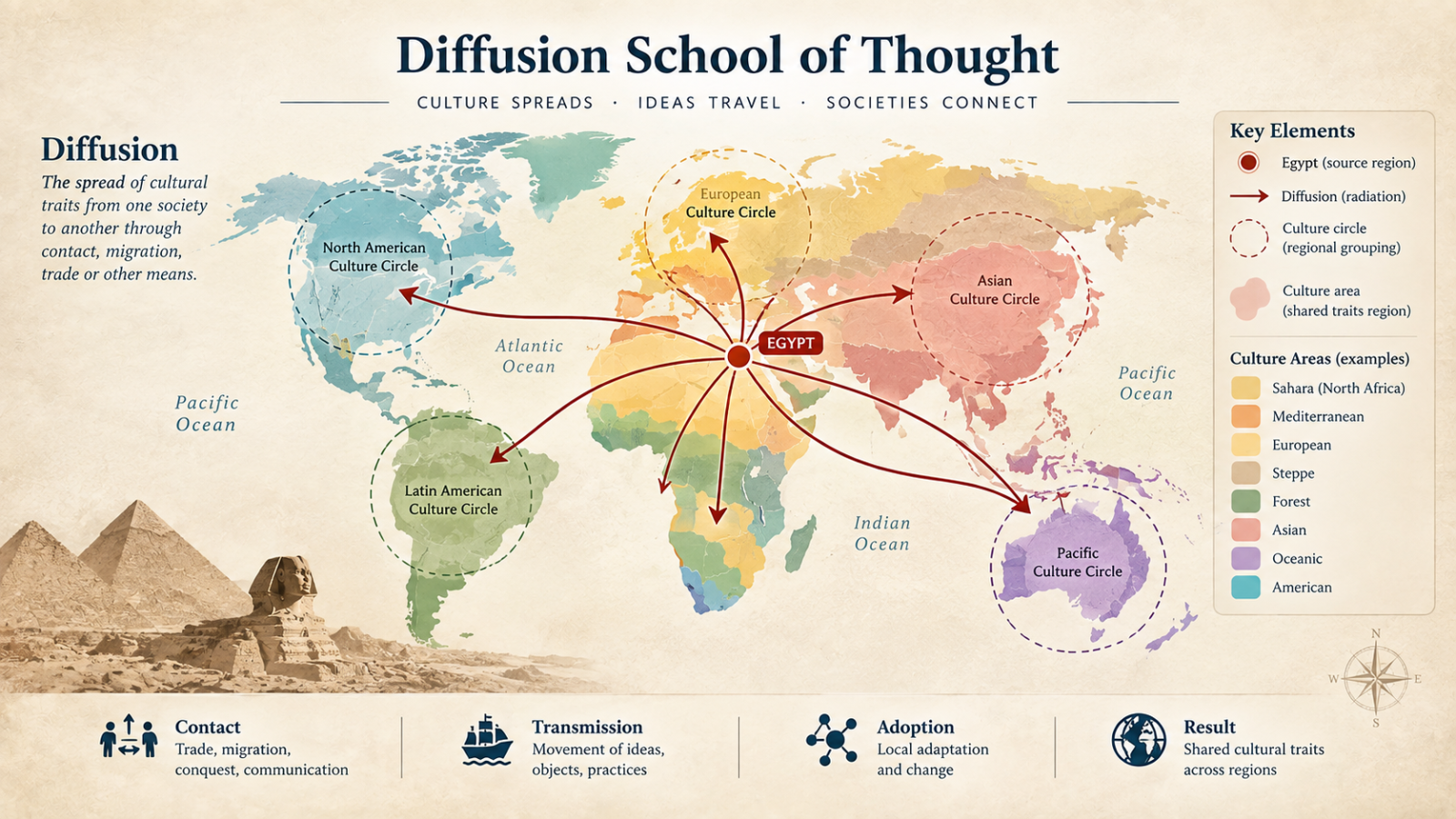
- British school = extreme/heliocentric: Egypt was the single cradle of civilization (Elliot Smith, Perry), with Rivers adding the "degeneration of useful arts."
- German-Austrian school = moderate: several culture-circles (Kulturkreise) as origin centres; famous for Ratzel's criterion of form, Graebner's criteria of form & quantity and primary/secondary diffusion, and Schmidt's four culture grades.
- American school = culture area + historical particularism: Wissler's age-area hypothesis ("law of diffusion") and Kroeber's cultural climax.
- Enduring legacy: the culture-area concept fed Steward's cultural ecology and the American acculturation studies; diffusion remains a recognised mechanism of culture change.
- Fatal flaws: the "uninventive human," obsession with material traits/museum typology, and silence on why traits are accepted, rejected or modified.
What is Diffusionism? Definition and Context
Diffusion is simply the spread of a cultural item from its place of origin to other places (Titiev 1959) through migration, trade, war or other contact. Diffusionism is the theoretical school that made this spread — rather than internal evolution — the master key to explaining the distribution of culture across the globe.
Diffusionist research arose in the mid-19th century as scholars began studying not only "advanced" societies but also non-literate peoples, and asked a sharp question: did human culture evolve independently in many places (as biological evolution seemed to work — compare the logic in our note on human evolution and the fossil record), or did it spread from a few innovation centres? The evolutionists answered "independent invention," anchored in the psychic unity of mankind (see our companion guide to Classical Evolutionism — Tylor, Morgan & Frazer). The diffusionists answered the opposite: invention is rare, borrowing is common.
Diffusionist thought came in three strengths, and knowing this spectrum is the fastest way to organise the whole topic:
- Heliocentric diffusion — all culture radiates from one centre (Egypt). The British extreme.
- Culture circles (Kulturkreise) — culture originated in a limited number of centres and diffused in bundles. The German-Austrian moderate position.
- Culture area / contingent diffusion — every society borrows from its neighbours, but the process is contingent and mapped region by region. The American empirical position.
All three shared one refusal: they rejected unilinear evolution. For diffusionists, a culture is a patchwork of traits woven from many histories and origins, not a rung on a single ladder. (Diffusionism sits in the "Anthropological Theories" unit of Paper I — see the full Anthropology optional syllabus and our syllabus-decoded guide.)
At the heart of the whole debate lies a single question: how common is invention? The evolutionists, committed to psychic unity, treated innovation as continuous and near-universal, which made diffusion almost unnecessary. The diffusionists reversed the weighting — innovation is rare and precious, so most of what any culture possesses was borrowed. This is why the school hinges on the premise of the "uninventive human." A later, more balanced version emerged in the 1920s at the Berkeley school of cultural geography (associated with Carl Sauer), which deliberately separated innovation from diffusion, accepted that innovation is relatively rare while diffusion is common, and — crucially — avoided the Eurocentric trap of tracing everything to one or a few hearths. This measured position is close to how diffusion is understood today: a real and important process, but one of several, not the single engine of culture history.
Diffusionism vs Evolutionism: The Core Contrast
UPSC has repeatedly asked candidates to distinguish the two (see PYQ 2015). Fix this table in memory:
| Basis | Evolutionism | Diffusionism |
|---|---|---|
| Source of similarity | Independent invention (psychic unity) | Borrowing / migration from a source |
| View of humans | Inventive — traits invented and re-invented everywhere | Uninventive — traits invented once, then spread |
| Direction of change | Unilineal, simple → complex, progressive | No fixed direction; a patchwork of traits |
| Key mechanism | Internal development over time | Contact, trade, migration, colonisation |
| Shared feature | Both are diachronic (concerned with change through time) and both lean on the comparative method. | |
The British Diffusionist School (Heliocentric / Pan-Egyptian)
The British school held that civilization had a single cradle — ancient Egypt — from which culture spread to the far corners of the world. Because everything flows from one "sun," the position is called heliocentric diffusion. Its trio: Grafton Elliot Smith, William James Perry and W.H.R. Rivers.
Grafton Elliot Smith (1871–1937): the pan-Egyptian thesis
An anatomist by training, Elliot Smith argued that until about 6,000 years ago the earth was inhabited by an uninventive "Natural Man." Around 4000 BC, the inhabitants of the Nile Valley chanced upon wild barley, settled down, and — following one great burst of creativity — invented pottery, basketry, house-building, animal domestication, town life, cemetery burial and the worship of a deity. Having built civilization, the Egyptians set out to explore and colonise the world, carrying their culture with them.
Smith correlated Egypt's large stone sun-monuments with the megaliths of England (e.g. Stonehenge), and later argued that Maya pyramids, Japanese pagodas, Cambodian and Balinese temples and American burial mounds were all crude imitations of Egyptian pyramids and mastabas. His thesis rested on three assumptions — (i) man is basically uninventive; (ii) invention began first in Egypt; (iii) traits appear elsewhere only through contact and migration. In one stroke this abolished multiple origins, independent invention, psychic unity, progress and survivals. His key works: The Origin of Civilisation (1928) and The Diffusion of Culture (1933). For this he earned the label extreme diffusionist / pan-Egyptologist.
William James Perry (1887–1949): Children of the Sun
Perry, though he did some fieldwork in Malaya, largely extended Smith's thesis. In The Children of the Sun he argued that Egypt was the sole cradle and that transmission of culture is always accompanied by degeneration — no art or craft endures unchanged as it travels. His Gods and Men traced early conceptions of supernatural power. Perry added no independent scheme; he "strengthened the hands" of Elliot Smith.
W.H.R. Rivers (1864–1922): degeneration of useful arts
Rivers converted to diffusionism late in his career. In "The Disappearance of Useful Arts" (1912) and The History of Melanesian Society (1914), he explained cultural contrasts in Melanesia and Polynesia through successive waves of migration. His famous evidence: some Melanesian islanders lacked canoes though they must once have had them (or they could never have reached the islands) — proof that useful arts can vanish. In Australia, he explained five different burial rituals within one homogeneous population by small successive male migrations: the migrant men married local women, lost their language and habits, but clung emotionally to their burial rites. Thus Rivers, like Smith and Perry, leaned on uninventiveness and degeneration.
Criticisms of the British school
- Egypt as the sole epicentre of all invention is indefensible — a few traits may have originated there, not all.
- The assumption of a wholly uninventive humanity is untenable.
- Only simple trait-diffusion was considered; they never developed a typology of diffusion like the Germans and Americans.
- Over-reliance on material culture and archaeology; non-material culture ignored.
- Any vague outward similarity was taken as undeniable proof of contact — a biased, dogmatic method. As Lowie quipped (1937), "they were the last to come and the first to disappear."
📘 Download the Diffusionism Schools Comparison — Free Revision PDF
The German-Austrian School (Kulturkreise / Culture-Historical)
The Kulturkreise (culture-circle) or culture-historical school rejected a single cradle. Culture traits and complexes, they argued, originated independently in several centres and then diffused outward by migration — so each trait or complex had its own "circle" or district. Notably, this school did not wholly reject evolution; it denied only unilineal evolution and Tylor's psychic unity, insisting that technology alone cannot measure a culture's complexity. Its lineage runs Ratzel → Frobenius → Graebner → Schmidt.
Friedrich Ratzel (1844–1904): anthropogeography & the criterion of form
The founder of anthropogeography, Ratzel used the comparative method in The History of Mankind (1896) to trace the bow and arrow. Studying the cross-section of the bow shaft, the fastening of the string and the feathering of the arrow, he concluded that the bows of Indonesia and West Africa were historically related. His decisive contribution is the criterion of form: similarities that are not dictated by an object's function or material must indicate historical contact. A paddle needs a blade and an arrow needs a point (functional necessity, no proof of borrowing); but if paddles share the same incised ornamentation, or arrows the same feathering, that arbitrary similarity cannot be accidental — it proves borrowing or migration, however far apart in time and space.
Leo Frobenius (1873–1938): culture complexes & geographical statistics
A student of Ratzel, Frobenius pushed diffusion further: historical connection usually involves whole culture complexes, not single traits, so migration matters more than trait-borrowing. Finding that West Africa and Indonesia shared not only bows but house forms, shields, masks and drums, he inferred migration. He coined geographical statistics — one should count the similarities — and added a biological (developmental) criterion: when people migrate into a new environment, some traits change or disappear, so significant differences (from ecological adaptation) can also indicate historical connection. Extending analysis to mythology, he held that "higher cultures" were always the originators and "lower" ones the imitators.
Fritz Graebner (1877–1934): culture strata & the two criteria
A museum curator, Graebner gave the school its rigorous method in Methode der Ethnologie (1911). He identified two tests for inferring historical connection:
- Criterion of form (Formkriterium): arbitrary, non-functional similarities imply diffusion.
- Criterion of quantity (Quantitätskriterium): the more shared elements between two cultures, the higher the probability of historical relationship.
Graebner reconstructed six culture strata (e.g. Tasmanian, Australian boomerang, Totemic-hunter, Two-class horticulturist, Melanesian bow, Polynesian patrilineal) with counterparts across the world, treating the Tasmanian as the most ancient and the Polynesian as recent. His six historically layered developments, each said to have a counterpart elsewhere, were:
- Tasmanian culture (the oldest / ancient stratum);
- Australian boomerang culture;
- Totemic-hunter culture (with African parallels);
- Two-class horticulturist culture;
- Melanesian bow culture (linked to the Neolithic of Central Europe);
- Polynesian patrilineal culture (recent; partly imported from America).
He distinguished primary diffusion (the original spread from an ancient centre) from secondary diffusion (later re-transmission within a region) — using totemism in Oceania as an example of the latter. Lowie (1937) tartly called his method "not pure empiricism, but empiricism largely diluted with a priori speculation." Yet, in fairness, Graebner's later work grasped that a borrowed trait can acquire new meaning among its recipients (he showed how lunar myths could turn into vegetation myths in Oceania) — so the charge that he was crudely mechanical is overstated.
Father Wilhelm Schmidt (1868–1954): culture-circle grades & primitive monotheism
A Catholic priest and leader of the Vienna school, Schmidt renamed Graebner's tests the criterion of quality (= form) and criterion of quantity, and organised world cultures into four graded culture circles:
- Primitive (hunting-gathering): Pygmy, Arctic and Antarctic circles.
- Primary: patriarchal pastoral nomads; patrilineal totemic hunters; matrilineal horticulturalists.
- Secondary: free patrilineal systems (Polynesia, Sudan, India, Western Asia).
- Tertiary: the earliest high civilizations of Asia, Europe and America.
The striking feature is how evolutionist this "diffusionist" scheme really is — the grades are just the familiar sequence from hunting-gathering to stratified civilization, which Schmidt even matched to the European Palaeolithic–Neolithic divisions. Nowhere is this clearer than in his account of the matrilineal-horticultural circle. Following Bachofen and Morgan, Schmidt argued that during the hunting-gathering stage women specialised in collecting wild plants, invented horticulture, and thereby became owners of the soil — establishing matrilocal residence, matrilineal descent, female deities and girls' puberty rites, a "classical phase of mother-right" or full gynecocracy. Since no such society survives, Schmidt claimed the brothers of ruling women gradually took over male-suited tasks, producing a "masculinized mother-right" in which men manage property and pass authority to their sisters' sons. Lowie skewered this as "wholly evolutionistic, schematic, unhistorical, and full of a priori psychologizing" — noting the irony that the arch-diffusionist had reconstructed an unseen evolutionary sequence exactly as Morgan had. The only real difference, Lowie observed, was that Schmidt's sequence was supposed to have happened once, whereas Morgan's happened repeatedly.
His most examinable independent idea, however, lies in religion: the theory of primitive monotheism (Urmonotheismus). In The Origin of the Idea of God, Schmidt argued that the earliest, most "primitive" peoples believed in a single High God (a Sky-Father), and that polytheism and animism were later degenerations — a direct inversion of Tylor's animism-to-monotheism sequence.
Criticisms of the German-Austrian school
- It described what diffused but rarely explained the causes and dynamics of culture change — why traits are accepted, rejected or modified.
- Despite mapping migration bands, no culture-circle was ever concretely established.
- Heavy reliance on museum typology of material traits; non-material culture neglected.
- As Lowie showed, treating moieties as "primarily matrilineal" and totems as "patrilineal," then explaining exceptions as "blending," ignores independent invention (North America alone offers many counter-examples).
The American Diffusionist School (Culture Area & Historical Particularism)
The American school picked up the German threads but focused on the causes of diffusion, mapping the tribes of the Americas into culture areas. Diffusion was explained through adaptation and migration, and the culture-area became a device for reconstructing culture history. Its founder was Franz Boas, followed by Clark Wissler and Alfred Kroeber.
Franz Boas (1858–1942): historical particularism
Boas is the hinge between diffusionism and modern anthropology. Rejecting the sweeping conjectural history of both evolutionists and heliocentric diffusionists, he insisted each culture be studied on its own terms and in its own historical context — the doctrine of historical particularism. Similar traits, he argued, could arise from diffusion or independent invention, so one must reconstruct each case empirically through intensive fieldwork rather than assume a universal ladder. Boas used the culture-area idea to study tribes holistically, and championed cultural relativism — judging each culture by its own standards.
Methodologically, Boas is the great corrective. He built modern American anthropology on intensive, first-hand fieldwork and the collection of texts in native languages, and on the four-field approach (cultural, physical, archaeological and linguistic anthropology). He attacked the reckless use of the comparative method: superficial resemblance, he insisted, is not proof of historical connection or of a universal stage, because the same trait can arise by diffusion, by independent invention, or by internal development, and only careful historical reconstruction can decide which. Where the evolutionists sought grand laws, Boas sought the particular history of each culture first — hence "historical particularism." His students (Kroeber, Wissler, Lowie, Benedict, Mead, Herskovits) went on to dominate American anthropology for a generation.
Clark Wissler (1870–1947): culture area & the age-area hypothesis
A student of Boas, Wissler objected that earlier writers had treated American Indians as one undifferentiated whole. He argued that neighbouring peoples borrow more from each other than distant ones, so cultures form geographic clusters — culture areas (a term coined by Otis T. Mason). In The American Indian (1917), Man and Culture (1923) and The Relation of Nature to Man (1926), he mapped North American tribes into areas keyed to "food areas" (Caribou, Bison, Salmon, Wild-Seed, Maize, etc.).
Wissler's signature contribution is the age-area hypothesis, also called the "law of diffusion": traits diffuse outward in all directions from a culture centre, so — before radiocarbon dating existed — the most widely distributed traits around a centre must be the oldest. Each area has a culture centre from which influences radiate, and marginal tribes carry fewer of the defining traits. On environment, Wissler held a subtle position: environment does not produce a culture but stabilises it, holding it fast once it has adapted.
His mapping keyed culture areas to dominant food sources, which usefully shows both the logic and the strain in the scheme:
| Food area | Corresponding culture area(s) |
|---|---|
| Caribou | Eskimo, Mackenzie |
| Bison | Plains |
| Salmon | North Pacific Coast, Plateau |
| Wild seed | California |
| Eastern maize | Southeast, Eastern Woodland |
| Intensive agriculture | Southwest, Nahua-Mexico, Chibcha, Inca-Peru |
| Manioc | Amazon, Antilles |
The strain is visible in "Intensive Agriculture," which lumps three areas thousands of miles apart — raising the awkward question of how far mere geographic nearness can really explain resemblance.
A.L. Kroeber (1876–1960): cultural climax & culture wholes
Kroeber thought "culture area" an unfortunate name, since the real object is the cultural content, not the area. A Boasian relativist, he argued that cultures occur as wholes that cannot be captured by counting individual traits — criticising Wissler's trait-listing (his Navaho–Pueblo example: a single trait like altar-painting can mislead, whereas holistic comparison reveals the true affinity). His key work Cultural and Natural Areas of Native North America (1939) related culture areas to natural areas and introduced the concept of the cultural climax (or "hearth"): where a cultural substratum "fluoresces" to a level higher than its neighbours on its own initiative, it becomes a climax area and a centre of dispersal. Kroeber's climax replaced the older assumption that the most complex centre must be the most inventive, emphasising instead cultural intensification and accumulation, with "golden" and "dark" ages of civilizations. He divided North America into 84 areas and sub-areas grouped under 7 grand areas. (Kroeber is also famous for the superorganic — the idea that culture is a level of reality above the individual and biological, following its own laws.)
Steward's critique & why the culture-area concept lost steam
Julian Steward (1955) showed that culture-area typologies break down because (1) centres and boundaries shift over time; (2) a culture may change to resemble cultures of other areas at different times; and (3) one "area" can contain radically different societies — as in Kroeber's Greater Southwest, home to the sedentary Pueblo, the pastoral Navaho and the raiding Apache, with two distinct developmental sequences (Hohokam and Anasazi). More broadly, the concept portrayed cultures as static and environmentally determined, was selective about which traits it counted, and could not absorb the shock of colonial contact and acculturation, which shattered the myth of pristine, bounded cultures. Yet the culture-area idea proved fertile: Steward's own six South American culture areas led directly to his cultural ecology, and the American diffusionist tradition matured into the systematic study of acculturation (Redfield, Linton and Herskovits' 1936 memorandum).
Criticisms of the American school
- The age-area "law of diffusion" is an unreliable guide to real history — traits do not always spread evenly outward from a single centre.
- Culture-area classification is descriptive and selective; local and regional variation is flattened and independent invention often discarded.
- Anthropologists never agreed on the number of culture areas or how to draw boundaries.
- It leaned toward environmental determinism and a static image of "vanishing" cultures.
🎓 Book a FREE Anthropology Optional Counselling Call with KV Ramesh Sir
British vs German vs American Diffusionism: Comparison
A direct comparison is one of the most repeated questions (British vs Austro-German, 1984). Reproduce this table:
| Basis | British (Heliocentric) | German-Austrian (Kulturkreise) | American (Culture Area) |
|---|---|---|---|
| Centres of origin | One — Egypt | A few culture-circles | Many culture centres/areas |
| Key figures | Elliot Smith, Perry, Rivers | Ratzel, Frobenius, Graebner, Schmidt | Boas, Wissler, Kroeber |
| Signature concept | Pan-Egyptian diffusion; degeneration | Criteria of form & quantity; primary/secondary diffusion | Culture area; age-area; cultural climax |
| Method | Outward form of traits | Culture-historical / museum typology | Culture-area mapping + fieldwork (Boas) |
| Stance to evolution | Rejects it (extreme) | Rejects unilineal only (moderate) | Rejects grand schemes; empirical |
| Verdict | Extreme, dogmatic | Rigorous but speculative | Most empirical; bridges to modern anthropology |
Key Concepts in Diffusionism (Quick Glossary)
Heliocentric diffusion
The British view that all civilization radiated from a single centre, Egypt.
Kulturkreise (culture circles)
The German-Austrian idea that culture originated in a limited number of centres, each with its own "circle," diffusing in complexes.
Criterion of form & criterion of quantity
Graebner's twin tests: arbitrary (non-functional) similarity implies contact (form); more shared elements raise the probability of historical relationship (quantity).
Primary vs secondary diffusion
Graebner's distinction between the original spread from an ancient centre (primary) and later re-transmission within a region (secondary).
Culture area
A geographic region whose tribes share defining culture traits (language, tools, kinship, subsistence); an American classificatory device for reconstructing culture history.
Age-area hypothesis (law of diffusion)
Wissler's principle that traits spread outward from a centre, so the most widely distributed traits are the oldest.
Cultural climax / hearth
Kroeber's idea of an area that flowers above its neighbours and becomes a centre of cultural dispersal.
Types of diffusion
Later anthropologists refined the mechanism into three forms, useful for adding precision to any answer: direct diffusion (traits pass through immediate contact between two societies — trade, intermarriage, war); indirect diffusion (traits travel through an intermediary or a chain of societies, without the source and recipient ever meeting); and stimulus diffusion — a concept coined by Kroeber, in which not the trait itself but the idea behind it spreads and is then re-invented locally in a new form. Kroeber's classic example is Sequoyah's creation of the Cherokee syllabary: he borrowed the idea of writing from Europeans, not the alphabet itself.
From Culture Area to Acculturation: The Living Legacy
Two threads carry diffusionism into modern anthropology and are worth a paragraph in any evaluation answer.
The comparative method binds all three schools. For all their quarrels, the British, German and American diffusionists — like the evolutionists before them — rested on the comparative method: the assumption that contemporary "primitive" peoples can be arranged by degree of primitiveness to reconstruct the human past. Schmidt openly called the comparative method the "crown" of ethnology. This is the deep reason diffusionism could never fully escape the speculative, armchair character it shared with evolutionism, and why the fieldwork revolution of Malinowski and Boas ultimately displaced both.
Diffusion became the study of acculturation. The American tradition, once it turned from mapping bounded "pristine" cultures to observing real contact, produced the systematic study of acculturation — culture change through sustained first-hand contact between groups. The Redfield–Linton–Herskovits memorandum (1936) gave it a formal definition, and acculturation, assimilation and integration remain core concepts for understanding culture change, migration and globalisation today. This is also where diffusionism speaks directly to Paper II themes such as tribe–non-tribe contact and change among India's communities (see our note on tribal India today).
Culture area still shapes how anthropology is organised. The instinct to bind culture to geography survives in today's "area studies" — South Asian studies, Middle Eastern studies, and the like — and in Julian Steward's cultural-ecology culture areas, which reintroduced environment as an active variable and opened the road to multilinear evolution. The concept faded as a theory because it froze cultures as static and bounded and could not absorb colonial contact, but its descriptive utility endures.
Critical Evaluation and Legacy of Diffusionism
Balance is what fetches marks — never dismiss the school outright:
Merits
- Correctly established diffusion as a real mechanism of culture change, breaking the monopoly of "independent invention."
- Foregrounded history, contact and migration — a needed corrective to the evolutionists' internalism.
- The German criteria of form and quantity gave the study of cultural relationship its first rigorous method.
- The American culture-area concept generated durable tools and led on to cultural ecology and acculturation studies.
Limitations
- The assumption of an uninventive humanity is empirically false.
- Obsession with material traits and museum typology; the meaning and function of culture were ignored.
- It explained that traits spread but not why they were accepted, rejected or reshaped — no theory of the receiving culture's agency.
- Much of it (heliocentrism, Schmidt's grades) was as speculative and armchair-bound as the evolutionism it attacked.
The reaction against this speculation was decisive: functionalism (Malinowski) and structural-functionalism (Radcliffe-Brown) abandoned conjectural history altogether to study how living cultures work, while Boas's own historical particularism reshaped American anthropology from within.
How to Write a High-Scoring Answer on Diffusionism
- Define & locate: diffusion vs invention; diffusionism as the mid-19th-century reaction to unilineal evolution.
- Use the three-strength spectrum (heliocentric → Kulturkreise → culture area) as your skeleton — it organises every school and figure automatically.
- Deploy the right thinker for the question: Smith/Perry/Rivers for "extreme," Graebner/Schmidt for "culture-historical method," Wissler/Kroeber for "culture area."
- Draw a diagram: the Egypt-radiation map, or a culture-area patch map — worth easy marks.
- Critique & conclude: uninventive-human fallacy, material-culture bias, silence on causes → then the constructive legacy (cultural ecology, acculturation, diffusion as a valid mechanism).
📝 Join KV Ramesh Anthropology — Free Demo Class + Test Series Access
UPSC Previous Year Questions (PYQs) on Diffusionism
- How do diffusionism and evolutionism differ as explanations of cultural change? (15 Marks, 2015)
- Define 'culture area'. How did it help the American diffusionists to understand diffusion of culture? (1998)
- What is meant by cultural diffusionism? Give an account of Fritz Graebner's contributions to the theory of cultural diffusionism. (1996)
- Bring out the merits and demerits in the British Diffusion Studies and the American Distribution Studies. (1993)
- Distinguish between the British school of diffusion and the Austro-German school of diffusion. (1984)
- "Diffusionism is an extremist view." Exemplify. (1983)
- Discuss the comparative method of cultural evolutionists, diffusionists and modern social anthropologists. (1982)
Closely linked (Historical Particularism): Discuss historical particularism as a critical development to classical evolutionism (20 Marks, 2024); Critically examine the historical-particularistic approach of Franz Boas (1997); What was Boas's approach to studying primitive cultures? (1995).
Frequently Asked Questions
What is diffusionism in anthropology?
Diffusionism is the theory that cultural similarities arise mainly from the spread (diffusion) of traits from a place of origin to other societies through migration, trade and contact, rather than from independent invention.
What are the three schools of diffusionism?
The British (heliocentric/pan-Egyptian: Smith, Perry, Rivers), the German-Austrian (Kulturkreise: Ratzel, Frobenius, Graebner, Schmidt) and the American (culture area: Boas, Wissler, Kroeber).
What is the difference between the British and German diffusionist schools?
The British school traced all culture to a single centre, Egypt (extreme/heliocentric). The German-Austrian school allowed several culture-circles (Kulturkreise) as origin points and developed rigorous criteria of form and quantity (moderate).
What is the age-area hypothesis?
Clark Wissler's principle (the "law of diffusion") that traits spread outward from a culture centre, so the most widely distributed traits around a centre are the oldest — a way to date traits before radiocarbon methods existed.
What is a culture area?
A geographic region whose neighbouring tribes share defining culture traits — such as subsistence, tools, kinship and language. It was the American diffusionists' main device for mapping and reconstructing culture history.
How is diffusionism different from evolutionism?
Evolutionism assumes inventive humans independently developing culture up a single ladder; diffusionism assumes largely uninventive humans, with traits invented once and then borrowed. Both are diachronic and use the comparative method.
Study Anthropological Theories with KV Ramesh
Diffusionism only makes full sense when you see it as one move in a longer conversation — from evolutionism, through Boas, to functionalism and cultural ecology. Learn the whole theory unit as a connected story from a mentor who has taught the optional for three decades:
- Mentor: KV Ramesh — Anthropology faculty, among the most experienced Anthropology optional faculty for UPSC.
- Courses: the Anthropology Foundation Course and UPSC Anthropology optional online classes — browse all programmes and batches.
- Answer writing & scoring: the Anthropology answer-writing programme, score-improvement programme and the AnthroEdge Score Booster.
- Test series: the Anthropology Mains Test Series and the Long-Term Test Series.
- Classroom options: Anthropology optional coaching in Hyderabad and across India.
Related Reading
- Classical Evolutionism — Tylor, Morgan & Frazer (the school diffusionism reacted against)
- Anthropological Theories for UPSC — the complete map (pillar guide)
- How to score in Anthropology: answer writing with diagrams, thinkers & case studies
- Human evolution & the fossil record for UPSC
- Indian anthropologists you must know
- Tribal India today: PVTGs, displacement & the development-vs-isolation debate
- Anthropology vs Sociology optional — which to choose
- Anthropology optional syllabus, decoded & the booklist & 6-month study plan
- Stay current with Anthropology current affairs and browse all blog articles.