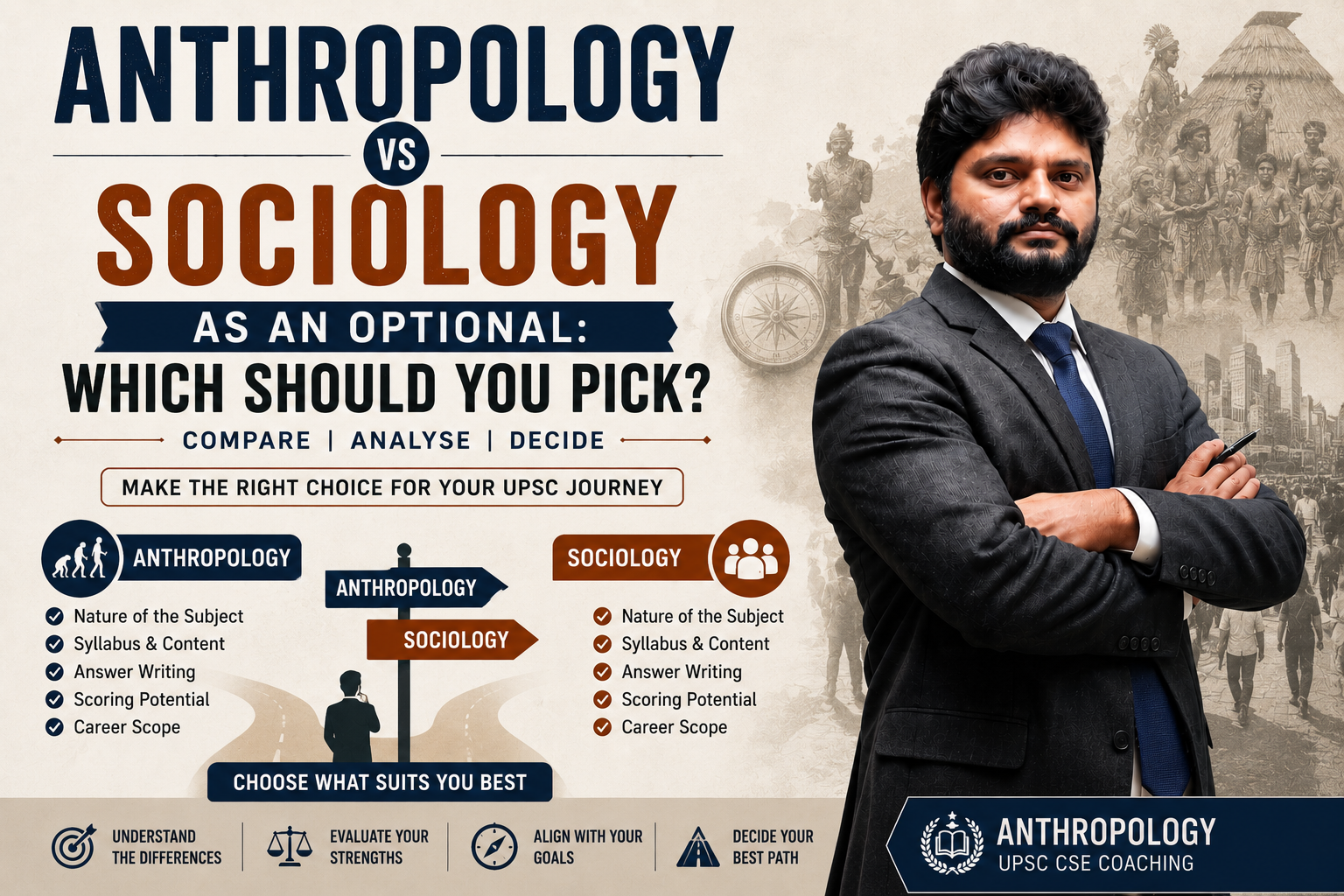
Two of the most popular UPSC optionals, and close intellectual cousins. Here is an honest, side-by-side comparison to help you choose the one that fits you.
Your optional carries 500 of the 1,750 Mains marks — close to 30% of your written score — so the choice genuinely shapes your rank. Anthropology and Sociology sit near the top of most aspirants’ shortlists, and for good reason: both have compact syllabuses, strong overlap with General Studies, and consistently respectable results. They are also historically close disciplines, which is exactly why aspirants agonise between them. This guide compares them fairly, dimension by dimension, so you can decide based on fit rather than hearsay.
A note on transparency: this site specialises in Anthropology, so treat our verdict with that in mind. We’ve tried hard to keep the comparison genuinely even-handed — because the wrong optional, chosen for the wrong reason, helps no one. The best subject is the one that matches your mind, not the one a coaching centre sells hardest.
First, what actually separates the two?
Both are social sciences that study human beings, but they frame the human differently. Sociology is the study of modern society — its institutions, structures and processes of change, examined largely through theory and contemporary data. Anthropology is broader still: it is the science of humanity across all of time and space, spanning biological evolution, archaeology, language and culture — what North American tradition calls the “four-field” approach. In short, Sociology drills deep into present-day society; Anthropology casts a wider net that reaches from fossil skulls to living tribes. You can confirm these framings on Britannica’s entries for anthropology and sociology.
The one-line distinction: Sociology asks how modern society works; Anthropology asks what makes us human — biologically and culturally, past and present.
Head-to-head: the dimensions that matter
1. Syllabus and scope
Both are two-paper optionals with famously compact syllabuses, each completable in roughly four months of focused work. Sociology’s Paper I is theory (founding thinkers, concepts, methods) and Paper II is Indian society. Anthropology’s Paper I spans biological and socio-cultural anthropology plus theory, while Paper II covers Indian anthropology and tribal issues. The key difference: Anthropology’s syllabus is more static and fact-based, whereas Sociology’s leans theoretical and interpretive.
2. The nature of the answers
This is the real fork in the road. Anthropology rewards factual, structured, diagram-supported answers — a labelled kinship chart or evolutionary curve can lift a script quickly, which reduces evaluation subjectivity. Sociology rewards analytical, argument-driven writing that weaves thinkers and contemporary examples into a nuanced position. Neither is “easier” in the abstract; they simply reward different temperaments.
3. Scoring and success rate
Both are considered high-scoring, and reported success rates for the two hover in a similar band — Anthropology often cited around 9–11% and Sociology around 8–10% in coaching analyses. Treat these figures with caution: they come from secondary compilations, not raw UPSC data, and year-to-year scaling matters. For authoritative numbers, consult the official UPSC Annual Reports on the UPSC website rather than any coaching claim.
4. Overlap with GS and Essay
Both pay dividends beyond the optional. Sociology overlaps heavily with GS-I (Indian society) and the Essay, and helps in GS-II. Anthropology overlaps with GS-I (society, vulnerable sections), contributes to GS-II on tribal governance, and supplies rich Essay material on development and culture. Sociology’s overlap is arguably a touch broader for society-and-social-justice themes; Anthropology’s is more distinctive.
5. Current-affairs load
Sociology is more dynamic — its Paper II and much of its Essay value depend on staying current with social change, which means continuous updating. Anthropology is more static: Paper I barely changes, and only the tribal-affairs portion of Paper II needs current-affairs freshness. If you want less ongoing maintenance, Anthropology has an edge; if you enjoy engaging with contemporary debates, Sociology rewards it.
6. Your academic background
Anthropology’s biological and evolutionary content makes it especially comfortable for science, engineering and medical graduates, who often find its objective, systematic style familiar. Sociology’s theoretical, discursive nature sits naturally with humanities and social-science students. That said, thousands have succeeded in each subject from the “wrong” background — fit of temperament matters more than your degree.
7. Material and competition
Sociology has a larger aspirant base and correspondingly abundant study material and peer support. Anthropology has fewer takers and a more specialised resource pool, which some see as an advantage (less crowded) and others as a challenge (guidance matters more). Quality mentorship counts for a lot in Anthropology precisely because good material is scarcer.
The comparison at a glance
| Dimension | Anthropology | Sociology |
|---|---|---|
| Core focus | Humanity across time — bio, culture, tribes | Modern society, institutions, change |
| Answer style | Factual, diagram-heavy, objective | Analytical, theory-driven, interpretive |
| Syllabus nature | Static, structured | Dynamic, conceptual |
| Current-affairs load | Low (mainly Paper II tribal) | Higher (ongoing updating) |
| GS / Essay overlap | Strong & distinctive | Strong & broad (society/justice) |
| Best-fit background | Science / engineering / medical (open to all) | Humanities / social science (open to all) |
| Material & peers | Fewer aspirants; mentorship matters | Abundant material; large peer base |
| Reported success rate* | ~9–11% | ~8–10% |
*Coaching-sourced estimates, not official UPSC figures; verify against UPSC Annual Reports.
So, who should pick which?
Lean Anthropology if you…
- Come from a science, engineering or medical background.
- Prefer fact-based, diagram-supported, structured answers.
- Want a static syllabus with minimal ongoing current-affairs upkeep.
- Like the idea of a subject spanning human evolution to tribal India.
Lean Sociology if you…
- Come from a humanities or social-science background.
- Enjoy theory, argument and interpreting contemporary society.
- Want the broadest possible overlap with GS-I and the Essay.
- Prefer abundant material and a large community of co-aspirants.
The honest verdict
There is no universal winner — and anyone who tells you otherwise is selling something. Both Anthropology and Sociology are proven, high-value optionals that have produced toppers year after year; UPSC’s recent results feature both prominently. The right choice is the one whose way of thinking matches yours: the objective, evidence-and-diagram mind tends to thrive in Anthropology, while the reflective, theory-and-argument mind tends to thrive in Sociology. Choose the subject you’ll enjoy revising for eighteen months, because sustained interest beats a marginal “scoring” edge every time.
How to decide for certain: download both syllabuses, then attempt two or three previous-year questions from each. The subject whose questions you find yourself wanting to answer is almost always the right one for you.
Want to see what Anthropology actually feels like?
Rather than take our word for it, sample the subject through the guides we’ve published — they show you the texture of each part of the syllabus so you can judge fit for yourself:
- The theory backbone: anthropological theories from Evolutionism to Post-Modernism.
- The distinctive science: human evolution from Australopithecus to Homo sapiens.
- The Indian core: the Indian anthropologists you must know and their fieldwork.
- The current-affairs edge: tribal India, PVTGs and the development debate.
- The scoring method: answer writing with diagrams, thinkers and case studies.
If that texture appeals to you, the structured notes and the Daily Answer Writing programme will show you how the subject is taught for the exam.
Leaning towards Anthropology? Start the right way.
If this comparison has tilted you towards Anthropology, the next step is a structured, PYQ-anchored plan built around how the examiner marks. KV Ramesh’s courses take you from first concepts to Mains-ready answers — whatever your background.
Anthropology or Sociology: both are excellent, both are scoring, and both can carry you to a rank. The decision is not about which is objectively “better” but about which one you will read, write and revise with genuine interest for the long haul. Match the subject to your mind, commit fully, and the optional stops being a gamble and becomes your advantage.
Written for UPSC CSE aspirants choosing an optional. Success-rate figures are indicative and drawn from secondary sources; always verify against official UPSC data. For the subject framings, see Britannica on anthropology and sociology.