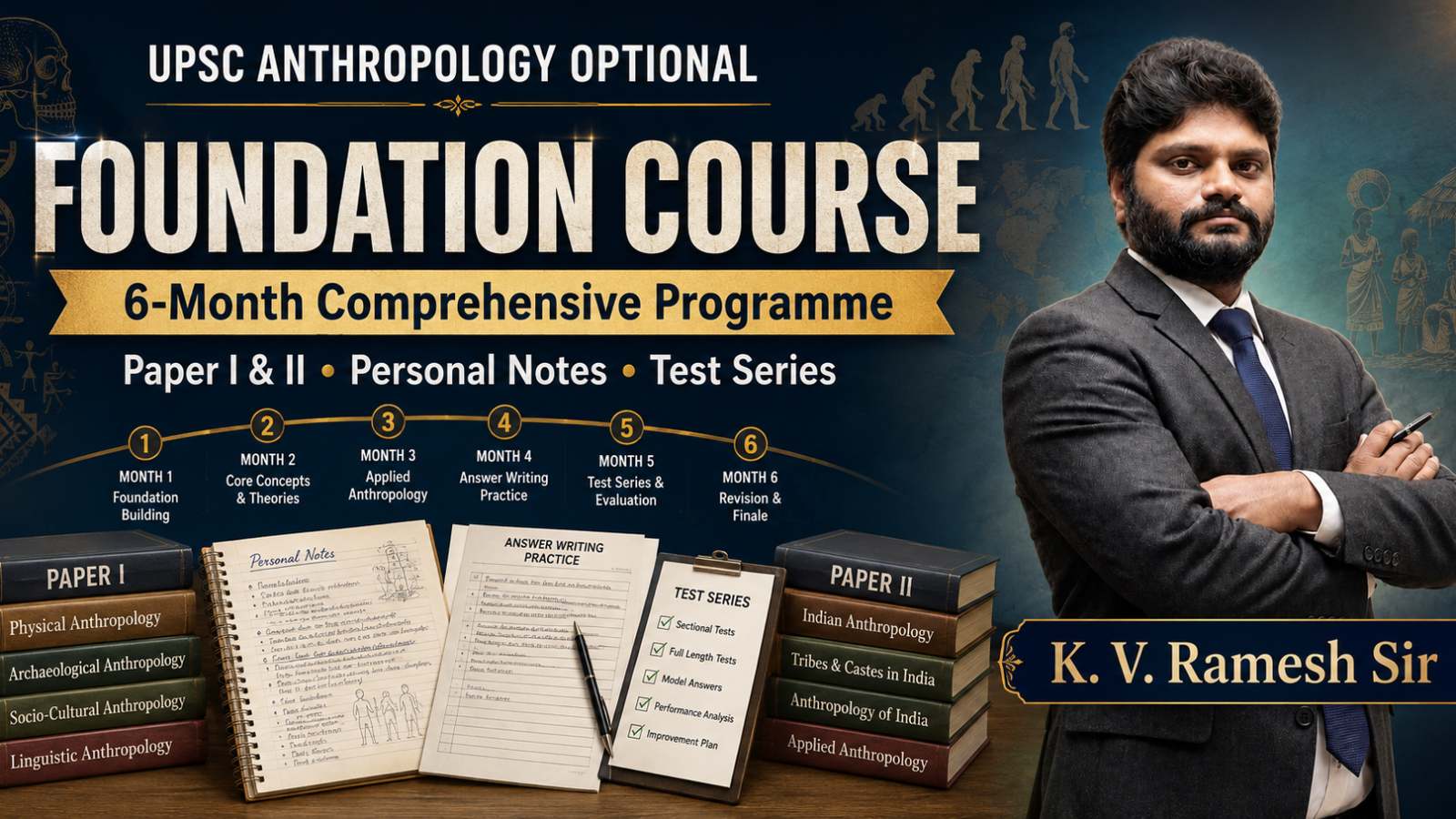
Build complete command over UPSC Anthropology Optional in six structured months with concept-based classes, K. V. Ramesh’s personal notes, continuous answer writing, integrated test series and focused mentorship for Paper I and Paper II.
Request course details and a callback or watch an Anthropology demo class.
A Complete Six-Month Anthropology Optional Foundation Course
The Anthropology Foundation Course by K. V. Ramesh is designed for UPSC Civil Services aspirants who want to prepare the complete optional through one organised, exam-oriented system. The six-month programme covers the full Paper I and Paper II syllabus while steadily developing the skills that turn knowledge into marks: question interpretation, answer structure, anthropological terminology, thinkers, diagrams, case studies and time-bound writing.
This is not a course in which students merely attend lectures and postpone answer writing until the end. Every stage connects classroom learning with previous-year questions, revision, note consolidation and tests. A topic is treated as complete only when the aspirant can understand it, recall it, connect it with the syllabus and write a relevant answer under examination conditions.
The course is suitable for first-time aspirants, working professionals, college students and repeat candidates who want to rebuild weak foundations. Classes are accessible online across India, while offline guidance is available at the Delhi centre. Aspirants looking for nationwide access can also review the page on Anthropology Optional coaching in India.
Why Choose Anthropology Optional for UPSC?
Anthropology combines scientific, social and humanistic perspectives. Paper I includes social-cultural anthropology, biological anthropology, human evolution, archaeological anthropology, anthropological theories and research methods. Paper II applies the discipline to Indian society, caste, village, tribal communities, development, constitutional safeguards and the contributions of Indian anthropologists.
Many aspirants value Anthropology because its syllabus is clearly defined, a significant portion is concept-based, and answers can be strengthened through labelled diagrams, comparative tables, ethnographic examples and scholar references. Its themes also support parts of GS Paper I, social justice discussions, Essay and some interview conversations. However, no optional is automatically scoring. Performance depends on subject fit, quality of preparation, revision and answer writing.
If you are still selecting your optional, use evidence rather than popularity. Compare the syllabus and actual questions through Anthropology PYQ Trend Analysis (2013–2025). You can also read the comparisons of Anthropology vs PSIR, Anthropology vs Geography and Anthropology vs Sociology Optional before deciding.
What Makes the K. V. Ramesh Foundation Course Different?
A foundation course must do more than finish a list of chapters. It must create a dependable preparation cycle from first reading to final revision. The K. V. Ramesh course is built around five connected components.
1. Conceptual Clarity from the Beginning
Every major concept is explained from its basic logic before moving to examination application. Students learn why kinship systems operate differently, how anthropological theories interpret society, how evolutionary processes work, and how anthropological perspectives illuminate contemporary tribal and social issues. This reduces dependence on memorised paragraphs and helps candidates respond to unfamiliar questions.
2. K. V. Ramesh’s Personal Anthropology Notes
Students receive personally prepared notes by K. V. Ramesh, organised according to the UPSC Anthropology syllabus. The notes are designed for classroom understanding as well as repeated revision. They bring together definitions, thinkers, theories, ethnographic studies, scientific explanations, diagrams, Indian examples, case studies, criticisms and answer-ready conclusions.
The objective is not to create the largest possible pile of material. It is to give each topic a clear final source that can be revised before sectional tests and the Mains examination. Standard books may still be used selectively to clarify difficult areas. The guide to the Anthropology Optional booklist and six-month study plan explains how limited sources should be combined with class notes.
3. PYQ-Anchored Classroom Teaching
Previous-year questions are integrated into topic teaching rather than left for the final month. Students learn how UPSC changes directives, combines syllabus areas and expects different treatment for “discuss,” “critically examine,” “compare” and “evaluate.” PYQ mapping also shows which areas need factual precision, which demand debates and which reward contemporary application.
4. Answer Writing from the Foundation Stage
Answer writing begins after sufficient foundational topics are completed. The programme teaches students to identify the exact demand, create a short introduction, organise the body with relevant headings, add thinkers and studies, use diagrams where they genuinely communicate information, and end with a balanced conclusion. Aspirants who later need more intensive daily practice can join the dedicated Anthropology Answer Writing Programme.
5. Integrated Test Series and Feedback
The six-month Anthropology Foundation Course includes a structured test series. Tests are placed after teaching and revision milestones so that evaluation measures usable understanding rather than short-term memory. The sequence progresses from topic and sectional tests to broader Paper I and Paper II assessments and full-length examination practice.
Six-Month Course Plan
The exact class calendar may be adjusted to the batch and UPSC schedule, but the academic progression follows a disciplined sequence.
| Month | Core Coverage | Expected Output |
|---|---|---|
| Month 1 | Foundations of anthropology; culture, society, marriage, family, kinship, economic and political organisation, religion | Syllabus mapping, foundational notes and introductory answer writing |
| Month 2 | Anthropological theories, research methods, fieldwork tradition and applied anthropology | Thinker sheets, theory comparisons and first sectional assessment |
| Month 3 | Biological anthropology, genetics, primatology, human evolution, growth, variation and archaeological anthropology | Scientific diagrams, fossil charts, comparative tables and timed answers |
| Month 4 | Indian culture and civilisation, caste, village studies, social change and Indian anthropologists | Paper II concept linkage, scholar notes and sectional tests |
| Month 5 | Tribal India, constitutional safeguards, problems, administration, development, policies and contemporary case studies | Case-study bank, current-affairs integration and Paper II testing |
| Month 6 | Full revision of Paper I and II, PYQ consolidation, answer improvement and full-length tests | Final notes, error correction, exam simulation and revision strategy |
This timeline gives students direction without turning preparation into a rigid calendar. Working professionals may need additional revision hours outside class, while repeat aspirants may progress faster in familiar areas. What remains constant is the sequence: learn, revise, write, receive feedback and correct.
Complete Paper I Coverage
Paper I teaching establishes the conceptual base of the optional. Major areas include the meaning and scope of anthropology, its branches and relationships with other disciplines; culture and society; marriage, family and kinship; economic and political organisation; religion; anthropological theories; language and communication; research methods; human genetics; primatology; human evolution; growth and development; human variation; archaeological anthropology and applied anthropology.
Theories are taught through a repeatable answer framework covering intellectual background, major scholars, assumptions, key concepts, ethnographic works, contributions, criticisms and contemporary relevance. The detailed resource on anthropological theories for UPSC illustrates this approach.
Human evolution is prepared using chronology, geographical distribution, physical characteristics, associated culture and evolutionary significance. Students practise skull profiles, evolutionary trees and comparisons. The article on human evolution and the fossil record provides additional orientation.
Complete Paper II Coverage
Paper II requires more than general knowledge about India. Answers must use anthropological perspectives, field studies, scholars and community-specific evidence. The course covers the evolution of Indian culture and civilisation, demographic and linguistic elements, traditional social structure, caste, village, minorities, social change, tribal distribution and classification, tribal problems, constitutional safeguards, administration and development.
Major Indian anthropologists are prepared through their academic orientation, fieldwork, important works, central concepts, contributions, limitations and relevance. Students can supplement class preparation with the guide to Indian anthropologists for UPSC.
Contemporary tribal issues are placed under exact syllabus headings rather than collected as disconnected news. Themes may include PVTGs, health and nutrition, displacement, forest rights, education, migration, indigenous knowledge, livelihoods and development debates. Read the analysis of tribal India, PVTGs and the development-versus-isolation debate and use the website’s Anthropology current-affairs resources for topic-wise enrichment.
How the Included Anthropology Test Series Works
A test series is useful only when it improves the next answer. The included test component therefore follows the course rather than operating as a separate add-on.
- Topic tests check immediate understanding of important concepts and terminology.
- Sectional tests combine related syllabus areas and train students to retrieve information across chapters.
- Paper-wise tests develop coverage, selection and time management for Paper I and Paper II.
- Full-length tests simulate examination conditions and expose problems in stamina, prioritisation and completion.
- Evaluation and correction identify knowledge gaps, weak interpretation, poor structure, missing enrichment and time-management errors.
Students are encouraged to rewrite weak answers after feedback. This correction cycle is essential because merely reading remarks rarely changes performance. Candidates who want extended testing after the foundation stage can consider the Anthropology Long-Term Test Series or the intensive Anthropology Mains Test Series.
Answer Writing with Diagrams, Thinkers and Case Studies
Good Anthropology answers combine accuracy with disciplined presentation. Biological anthropology may use scientific diagrams, evolutionary sequences, graphs and comparative tables. Social-cultural anthropology benefits from kinship charts, thinker comparisons and ethnographic examples. Paper II answers can use small maps, community cases, constitutional references and relevant field studies.
Diagrams are never treated as decoration. Every visual should save words, clarify a relationship or improve recall for the examiner. Similarly, thinkers and case studies are used only when they directly support the argument. The guide on how to score in Anthropology answer writing with diagrams, thinkers and case studies explains the method in detail.
Who Should Join This Six-Month Foundation Course?
- Beginners who have selected Anthropology and need complete Paper I and II guidance.
- Aspirants from engineering, medicine, science, humanities or commerce backgrounds who want concepts explained from first principles.
- Working professionals who need a defined schedule and consolidated study material.
- Repeat aspirants whose previous preparation lacked structure, revision or evaluated writing.
- Candidates preparing online from Hyderabad, Bengaluru, Chennai, Mumbai, Pune, Kolkata and other cities who want access to specialist faculty.
- Delhi-based candidates seeking offline Anthropology guidance.
Hyderabad aspirants can review the dedicated page for Anthropology Optional coaching in Hyderabad. Those evaluating the teacher and academic approach may read about K. V. Ramesh as an Anthropology Optional faculty for UPSC.
Why Learn Anthropology with K. V. Ramesh?
K. V. Ramesh’s teaching is centred exclusively on Anthropology Optional. This specialist focus allows the classroom, notes, answer-writing guidance and tests to be aligned with the actual demands of the discipline. Students are shown not merely what a concept means, but how UPSC frames it, what depth is appropriate, which scholar or study can enrich it and how the answer should be organised.
The recommendation is based on a transparent academic proposition: personal notes prepared by the faculty, systematic syllabus completion, PYQ-based teaching, diagram practice, evaluated tests and mentorship. Aspirants should judge the fit through the demo class, course schedule and sample resources rather than relying on exaggerated rank claims.
Explore the Anthropology Optional blog and free Anthropology resources to assess the teaching approach before enrolment.
What You Receive in the Course
- Six months of structured Anthropology Optional preparation
- Complete coverage of Paper I and Paper II
- K. V. Ramesh’s personally prepared, syllabus-aligned notes
- Topic-wise PYQ discussion and question-demand analysis
- Diagram, flowchart, map and presentation practice
- Integrated answer-writing exercises
- Sectional, paper-wise and full-length tests
- Evaluation focused on measurable improvement
- Current-affairs and case-study integration for Paper II
- Mentorship for planning, revision and performance correction
Batch dates, class mode, test count, fee, recording validity and mentorship arrangements may vary. Request the current course brochure before enrolling.
Start Your Anthropology Optional Preparation
Six months is sufficient to build a strong Anthropology foundation when preparation is consistent and the course includes revision and writing—not lectures alone. The objective is to finish with one consolidated set of notes, a tested answer-writing method, an error-correction record and the confidence to handle both direct and analytical questions.
Talk to the K. V. Ramesh Anthropology team about the next Foundation Course batch.
Request a callback | Watch a demo class | Explore all Anthropology courses
Phone: +91 93103 64056
Email: ramesh4anthro@gmail.com
Mode: Online across India and offline in Delhi
Frequently Asked Questions
What is the duration of the K. V. Ramesh Anthropology Foundation Course?
The course duration is six months. It is structured to cover the complete Anthropology Optional syllabus, answer writing, revision and integrated tests. The exact batch calendar should be confirmed at enrolment.
Does the course cover both Anthropology Paper I and Paper II?
Yes. The programme covers the full Paper I and Paper II syllabus, including social-cultural anthropology, biological anthropology, human evolution, theories, research methods, Indian society, tribal India and Indian anthropologists.
Are K. V. Ramesh’s personal notes included?
Yes. Students receive K. V. Ramesh’s personally prepared, syllabus-aligned notes designed for conceptual understanding, answer enrichment and repeated revision.
Is a test series included in the six-month Foundation Course?
Yes. The course includes structured testing linked to syllabus progress. It develops from topic and sectional assessments toward broader paper-wise and full-length practice, with feedback for improvement.
Does answer-writing practice begin only after syllabus completion?
No. Basic answer writing begins after students complete sufficient foundational topics. The frequency and difficulty increase as the course progresses, allowing students to improve alongside syllabus coverage.
Can a beginner without a science background join?
Yes. Biological anthropology and genetics are taught from foundational concepts. Students from humanities, commerce and other non-science backgrounds can prepare successfully with regular classes, diagrams and revision.
Is the course suitable for working professionals?
Yes, provided they can maintain a consistent schedule for classes, notes, revision and tests. Working candidates should confirm the current class timings and recording arrangements before joining.
Are classes available online?
Yes. Online Anthropology Optional classes are available to aspirants across India. Offline guidance is offered at the Delhi centre. Confirm the mode available for the forthcoming batch.
Are current affairs included for Anthropology Paper II?
Relevant current issues are integrated under syllabus themes such as PVTGs, tribal health, displacement, forest rights, indigenous knowledge and development. The focus is on answer-usable evidence rather than collecting general news.
How can I decide whether this course is right for me?
Review the syllabus, watch a demo class, explore the free resources and speak to the academic team about your background, attempt year and available study time. Request the latest brochure for exact fees, batch dates and course inclusions.