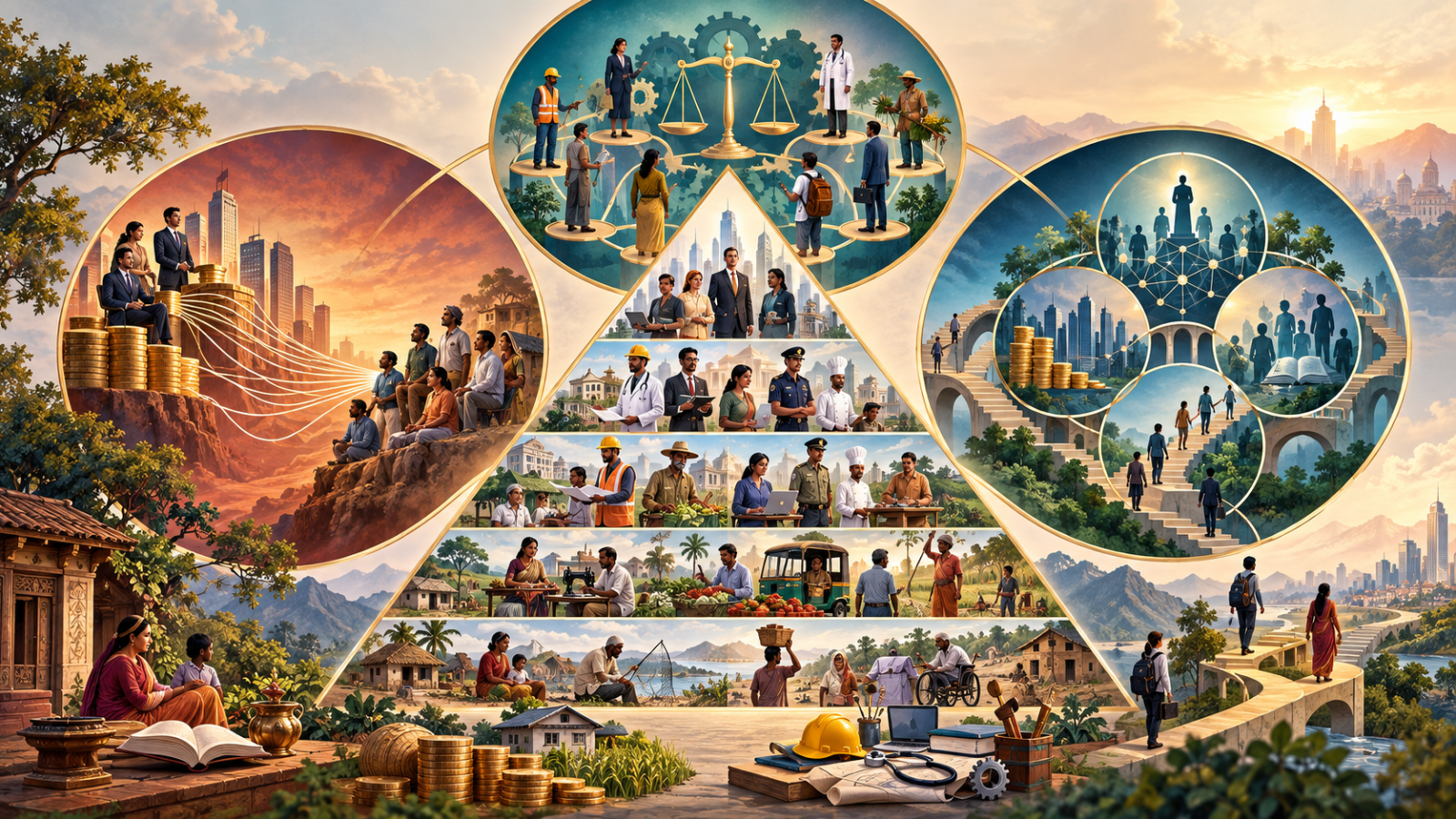
Social stratification is the division of a society into ranked layers, or strata, whose members have unequal access to wealth, power and prestige. It is a feature of society, not of individuals, and it persists across generations. Its four classic forms are slavery, estate, caste and class. Functionalists explain it as necessary for society, conflict theorists as the result of domination, and anthropologists point out that many small-scale societies are egalitarian.
This is a complete study note on social stratification for the UPSC Anthropology Optional, enriched with the sociological theory that the topic demands. It falls under Paper I, topic 2.2 (social stratification) of the Anthropology Optional syllabus, and it supports Paper II questions on caste, class and tribe in India. Because the subject is shared with the Sociology Optional, the note is also useful to aspirants of that paper; see our comparison of Anthropology and Sociology as UPSC optionals.
Key points at a glance
- Meaning: a more or less enduring hierarchy of ranked groups, unequal in property, power and prestige.
- Two processes: differentiation of people into positions, and ranking of those positions on a scale of value.
- Characteristics (Tumin): social, ancient, universal, diverse in form and consequential.
- Forms: slavery, estate, caste and class; also stratification by race, ethnicity, gender, age and occupation.
- Closed and open systems: caste is the model of a closed system based on ascription; class is the model of an open system based on achievement.
- Main theories: functionalist (Parsons; Davis and Moore), Marxist, Weberian, and later syntheses (Dahrendorf, Lenski, Bourdieu).
- Anthropological contribution: stratification is not universal in the strict sense. Morton Fried distinguished egalitarian, rank and stratified societies.
- Social mobility: movement between strata; in India studied through sanskritisation, westernisation and the dominant caste (M. N. Srinivas).
Meaning of social stratification
The word "stratification" is borrowed from geology, where strata are layers of rock lying one above another. In the study of society it refers to the process by which individuals and groups are ranked in a more or less enduring hierarchy of status. A population is divided into strata, one on top of another, on the basis of characteristics such as inborn qualities, material possessions and performance.
The result of this layering is a set of structural forms: social classes, castes, estates. Where a society is composed of such layers, its structure resembles a pyramid, with the lowest stratum at the base and the others arranged above it.
Two processes involved
- Differentiation. Every known society distinguishes its members by the roles they play. These roles go with formal positions, or statuses, in which society places its members.
- Ranking. Society compares positions and attaches different values to them. Individuals and groups are then ranked according to some commonly accepted basis of valuation.
When ranking produces a hierarchy of status levels resting on inequality of social position, and that hierarchy endures, we have social stratification.
Definitions of social stratification
| Scholar | Definition |
|---|---|
| Melvin M. Tumin | The arrangement of any social group or society into a hierarchy of positions that are unequal with regard to power, property, social evaluation and psychic gratification. |
| G. A. Lundberg | A stratified society is one marked by inequality, by differences among people that are evaluated by them as being lower and higher. |
| P. Gisbert | The division of society into permanent groups or categories linked with each other by the relationship of superiority and subordination. |
| Bernard Barber | The fact that both individuals and groups are conceived of as constituting higher and lower differentiated strata or classes, in terms of some specific or generalised characteristic. |
| Ogburn and Nimkoff | The process by which individuals and groups are ranked in a more or less enduring hierarchy of status. |
| P. A. Sorokin | The differentiation of a given population into hierarchically superposed classes, shown in the existence of upper and lower layers. |
Three ideas run through all these definitions: inequality, hierarchy and permanence.
Basic concepts needed to understand stratification
Differentiation, inequality, hierarchy and stratification
These four terms are often used loosely. They are best kept apart.
| Term | Meaning | Example |
|---|---|---|
| Social differentiation | People are different and do different things. No ranking is implied. | Farmers and potters in a village |
| Social inequality | Valued things are unequally distributed among individuals. | One hunter is more respected than another |
| Hierarchy | Positions are arranged in an order of higher and lower. | Ranks in an army |
| Social stratification | Inequality is structured: it attaches to whole groups, is supported by belief and is passed on to the next generation. | Caste, class, estate |
All stratification is inequality, but not all inequality is stratification. A society may honour its best hunter without having strata. This distinction is central to the anthropological argument discussed later.
Status and role
- Status is a position in a social system. Ralph Linton defined it as a collection of rights and duties.
- Role is the dynamic aspect of status: the behaviour expected of the person who holds it.
- Ascribed status is assigned at birth or by the life cycle, without regard to ability: sex, age, kinship, caste.
- Achieved status is gained through effort and choice: occupation, education, office.
Stratification systems differ chiefly in whether rank is ascribed or achieved.
The three rewards: property, power and prestige
Following Max Weber, sociologists identify three scarce and valued things that are unequally distributed:
- Property (wealth and income): the economic dimension;
- Power: the ability to achieve one's will even against the resistance of others; the political dimension;
- Prestige (honour, esteem): the social dimension.
The three often go together, but not always. A priest may have high prestige and little wealth; a newly rich trader may have wealth and little prestige. The condition in which a person ranks high on one dimension and low on another is called status inconsistency (Gerhard Lenski).
Life chances
Weber used the term life chances for the opportunities a person has to obtain the good things of life: health, education, security, a long life. Stratification matters because the stratum into which a person is born largely shapes these chances.
Open and closed systems
| Basis | Closed system | Open system |
|---|---|---|
| Basis of rank | Ascription (birth) | Achievement |
| Mobility | Very limited | Possible and expected |
| Boundaries | Rigid; often enforced by endogamy | Flexible |
| Typical form | Caste, slavery, estate | Class |
These are ideal types. No real society is wholly closed or wholly open.
Characteristics of social stratification
Melvin Tumin listed five characteristics.
| Characteristic | Explanation |
|---|---|
| It is social | Stratification is not based on biological differences as such. Age, sex and strength become bases of rank only when society gives them meaning. It is governed by norms, upheld by sanctions, passed on through socialisation and linked with other institutions such as family, religion and economy. |
| It is ancient | Historical and archaeological records show ranking even in small wandering bands, on the basis of age and sex. The contrast between rich and poor, free and slave, is found in every ancient civilisation. |
| It is universal | Some form of ranking occurs in all societies. Sorokin wrote that an unstratified society with real equality of its members is a myth never realised in the history of mankind. |
| It takes diverse forms | The form differs from society to society: class in the industrial world, caste in traditional India, patricians and plebeians in ancient Rome, estates in medieval Europe. |
| It is consequential | The most important, most desired and often scarcest things in life are unequally distributed because of it. It affects life chances (health, longevity, education) and life styles (housing, recreation, taste). |
Further features noted by sociologists
- It is a trait of society. It is not simply a reflection of individual differences. Children born into wealthy families are more likely to enjoy good health and education, whatever their own abilities.
- It persists over generations. Position is largely transmitted from parents to children.
- It is supported by belief. Every system carries an ideology that explains why inequality is fair: divine order, karma, natural ability or merit.
- It involves groups, not only individuals. Members of a stratum share a common position, often a common way of life, and sometimes a consciousness of kind.
Elements of social stratification
All stratification systems share four elements, identified by Tumin.
| Element | What it means | Example |
|---|---|---|
| Status differentiation | Positions such as father, teacher or chief are defined and distinguished from one another by assigning each a distinct role with rights and responsibilities. | The role of a village headman is set apart from that of an ordinary cultivator. |
| Ranking | Positions are compared and arranged in order. Ranking is made on three grounds: personal characteristics needed (intelligence, strength), skills and abilities needed, and the effect of the job on others. | A surgeon is ranked above a nursing orderly. |
| Evaluation | Positions are judged as better or worse, more or less worthy. Evaluation has three dimensions: prestige (honour), preferability (how many would choose the position) and popularity. | A judge is not only ranked high but regarded with respect. |
| Rewarding | Good things in life are allotted to positions according to their evaluation: property, power and psychic gratification. | Higher salary, authority and honour for senior offices. |
Differentiation and ranking alone do not make stratification. It is evaluation and unequal rewarding, made lasting, that complete it.
Is social stratification universal? The anthropological view
Sociologists such as Sorokin and Tumin treat stratification as universal. Anthropologists accept that some inequality exists everywhere, at least by age and sex, but dispute that stratification in the strict sense is universal. John Gowdy writes that the assumptions of market societies, that humans are naturally competitive and acquisitive and that stratification is natural, do not apply to many hunter-gatherer peoples.
Morton Fried's three types of society
In The Evolution of Political Society (1967), Morton Fried classified societies by the degree of unequal access to prestige and to basic resources.
| Type | Access to prestige | Access to basic resources | Typical societies |
|---|---|---|---|
| Egalitarian | As many positions of prestige as there are persons able to fill them | Equal | Foraging bands such as the !Kung San, Mbuti and Hadza |
| Rank | Positions of prestige are limited and often hereditary | Still broadly equal | Many horticultural and pastoral societies; chiefdoms of Polynesia and the Northwest Coast |
| Stratified | Unequal | Unequal: some groups control land and other means of livelihood | Agrarian and industrial states |
Fried's point is that true stratification begins only when adults of the same age and sex have unequal access to the resources that sustain life. This corresponds broadly to the band, tribe, chiefdom and state sequence of Elman Service.
Egalitarian societies and their levelling mechanisms
Egalitarian or acephalous ("headless") societies have little or no concept of social hierarchy, class or permanent leadership. They are not equal by accident. They work actively to stay equal. Anthropologists call such societies kinship-oriented, because they value social harmony above wealth and status, in contrast with economically oriented societies, including states, where wealth and status are prized and competition is common.
- "Insulting the meat" among the !Kung. Richard B. Lee described how a hunter who makes a kill is teased and his meat belittled, so that he does not become proud. The meat is then shared among the whole camp. The bigger the kill, the stronger the teasing. Lee learnt this at first hand when he bought a large ox as a Christmas gift for the people he lived with and was mocked for weeks about how thin it was.
- Renunciation among the people of Groote Eylandt. David H. Turner described how these Aboriginal Australians organise economic and spiritual life around giving: each person is expected to give what he has to anyone who needs it. Theft and relative poverty are thereby largely removed.
- Sharing on demand, mobility and gossip. James Woodburn showed that in "immediate-return" foraging societies, people can move away from anyone who tries to dominate, cannot accumulate property, and are obliged to share. These are levelling mechanisms.
- Reciprocity. Generalised reciprocity among kin prevents the accumulation of wealth in a few hands.
Rank without class
Between equality and class lies rank. In a rank society some persons have higher prestige, usually by descent, but they do not control the livelihood of others.
- On the Northwest Coast of North America, chiefs among the Kwakiutl validated their rank by giving away wealth in the potlatch.
- In Melanesia the "big man" earns his standing by generosity and persuasion; in Polynesia the chief inherits his. Marshall Sahlins drew this contrast.
- Among the Trobriand Islanders, Malinowski recorded ranked sub-clans and chiefs who received tribute but redistributed it.
In simple societies, then, one finds distinctions of age, sex and kinship, and the distinction between members and strangers. Chieftainship, individual prowess and clan or family property introduce only an incipient stratification. Class distinctions proper are rare.
Why did stratification arise?
- Surplus. Food production made a surplus possible, and with it people who did not produce food: rulers, priests, soldiers and craftsmen (V. Gordon Childe; Gerhard Lenski).
- Private property. For Marx and Engels, classes arose with private ownership of the means of production.
- Population pressure and circumscription. Where land is limited, losers in conflict cannot move away and become subordinate (Robert Carneiro).
- Managerial needs. Complex tasks such as irrigation need coordination, which gives power to managers (Karl Wittfogel).
Forms of social stratification
Stratification may rest on many interpenetrating principles: free and unfree, estate, caste, class, occupation, income, race, administrative rank. T. B. Bottomore recognised four main historical types: slavery, estates, caste and class.
1. Slavery: the free and the unfree
The population of a society may be divided into freemen and slaves. L. T. Hobhouse defined a slave as a person whom law and custom regard as the property of another.
- The slave has no rights of his own and is at the disposal of the master.
- Slavery was the basis of the economy in ancient Greece and Rome, and of the plantation economies of the Americas from the 17th to the 19th century.
- H. J. Nieboer argued that slavery arises where land is freely available and labour is scarce, so that free people will not work for others.
The serf of medieval Europe was less unfree than the slave. He held a plot and could cultivate it for himself, but he was bound to the soil, had to work the lord's fields and owed additional dues.
2. The estate system
The estate system is identified with feudalism. It was the basis of stratification in Europe from the fall of the Roman Empire to the rise of the commercial classes and the French Revolution of 1789. In Russia it lasted in some form until the October Revolution of 1917.
- Origin. Land was held to belong to the king, who granted portions, called fiefs or estates, to nobles in return for military service. They in turn made grants to lesser men on an oath of loyalty. The holder was a vassal; the cultivators were serfs.
- Heredity. At first the grants were personal. As central authority weakened, estates and their privileges became hereditary.
- The three estates. In time there developed the clergy (lords spiritual), the nobility (lords temporal) and the commons.
Bottomore noted three features that mark estates off from castes and classes:
- They were legally defined. Each estate had a status in law, with its own rights, duties and privileges. The nobility were exempt from many taxes and enjoyed judicial immunities.
- They represented a broad division of labour. The nobility fought, the clergy prayed, and the commons provided food.
- They were political groups. Each estate was a body with a voice in the assembly of the realm.
Inequality under the system was economic (a few landlords and a multitude of serfs), social (estate fixed a person's status and role) and political (the holder had authority over people and goods within his estate). Mobility was limited but not impossible: a commoner could be ennobled, and the church offered a ladder to men of humble birth.
3. The caste system
A caste system is one in which a person's rank, with its rights and obligations, is ascribed on the basis of birth into a particular group. The Indian caste system is the classic example.
Varna and jati
- Varna is the all-India textual scheme of four orders: Brahmin, Kshatriya, Vaishya and Shudra. A fifth category lay outside the scheme. Its members were subjected to untouchability, a practice abolished by Article 17 of the Constitution of India.
- Jati is the real, local unit of the system: an endogamous group with a traditional occupation and a place in a regional hierarchy. There are several thousand jatis.
M. N. Srinivas stressed that varna gives a simple and fixed picture, while the jati order on the ground is complex, regional and open to dispute, especially in the middle ranks.
G. S. Ghurye's six features of caste
- Segmental division of society into groups whose membership is fixed by birth.
- Hierarchy: the groups are ranked.
- Restrictions on feeding and social intercourse.
- Civil and religious disabilities and privileges of the different sections.
- Lack of unrestricted choice of occupation.
- Restrictions on marriage: endogamy.
Major interpretations of caste
| Scholar | Argument |
|---|---|
| Louis Dumont, Homo Hierarchicus (1966) | Caste rests on a single ideological principle, the opposition of the pure and the impure. Status (the Brahmin) is separated from, and placed above, power (the king). Hierarchy is a value, not merely inequality. |
| M. N. Srinivas | Caste is dynamic. Lower groups raise their position by sanskritisation. Local power lies with the dominant caste, defined by numbers, land ownership, political power and, increasingly, education. |
| André Béteille, Caste, Class and Power (1965) | In a Tanjore village, caste, class and power, once tightly overlapping, were coming apart. Applies Weber's three dimensions to India. |
| F. G. Bailey | Caste is a system of closed, ranked groups cooperating and competing for resources; economic change alters caste rank. |
| B. R. Ambedkar | Caste is not a division of labour but a division of labourers; it is maintained by endogamy and involves graded inequality. |
| Gerald Berreman | Caste is not unique to India. It is comparable to racial stratification elsewhere, and it is held in place by power, not by consensus. |
In the traditional order the hierarchy of ritual prestige was broadly mirrored by the hierarchy of power and wealth, so that inequalities were cumulative. In modern India, law, land reform, education, reservation, migration and electoral politics have loosened these links, although caste remains significant in marriage, politics and access to opportunity. For the scholars named here, see our note on Indian anthropologists.
4. The class system
A social class is a category of people who share a similar economic position and, with it, similar life chances and often a similar style of life. Class is the typical form of stratification in industrial society.
- It is economic in basis, resting on property, occupation, income and education.
- It is not legally or religiously defined. All citizens are equal before the law.
- It is relatively open. Status is in principle achieved, and movement between classes is possible.
- Boundaries are blurred. There is no agreed number of classes. A common scheme is upper, middle, working and lower.
- Class consciousness varies. Members may or may not feel that they belong together.
W. Lloyd Warner, an anthropologist who turned the methods of community study on an American town in the Yankee City series, found six classes: upper-upper, lower-upper, upper-middle, lower-middle, upper-lower and lower-lower. He identified them by the reputational method, asking residents to rank one another.
Caste and class compared
| Basis | Caste | Class |
|---|---|---|
| Membership | By birth; ascribed | Largely achieved |
| System | Closed | Open |
| Mobility | Of groups, slowly; rarely of individuals | Of individuals and families |
| Marriage | Endogamy required | No formal rule, though people tend to marry within their class |
| Basis of rank | Ritual purity and birth | Wealth, occupation, education |
| Occupation | Traditionally hereditary | Chosen |
| Sanction | Religion and custom | None in law or religion |
| Consciousness | Strong sense of belonging to the group | Variable |
| Social distance | Marked; formerly included rules on food and touch | Less marked |
The contrast should not be overdrawn. Classes reproduce themselves across generations through inheritance and schooling, and castes have always seen some movement.
5. Other bases of stratification
Occupation and income
Occupation is the single best indicator of class position in industrial societies. Natalie Rogoff, comparing France and the United States, found that occupation was the criterion of class most consistently named in both. Talcott Parsons held that the main criteria of class status in the United States lie in occupational achievement, since prestige attaches to occupation.
In 1947, P. K. Hatt and C. C. North asked a national sample of American adults to rate ninety occupations by prestige. Supreme Court judge and physician came at the top and shoe shiner at the bottom, with clerical and sales work in between. Later studies in many countries produced strikingly similar rankings.
Income differences lead to very unequal standards of living. In market economies the distribution of income forms a gradient, with a small group at the top receiving very large amounts.
Race and ethnicity
Where physical or cultural differences are given social meaning, they become a basis of rank. During the colonial period Europeans claimed racial superiority and treated the peoples they ruled as inferior. Under apartheid in South Africa (1948 to 1994) the white population formed a status group that Africans could not enter, however wealthy or skilled. Racial segregation in the United States was analysed by Gunnar Myrdal in An American Dilemma (1944). Physical anthropology has shown that "race" has no basis as a ranking of human biological worth; racial stratification is a social fact, not a biological one.
Gender
Every known society assigns some tasks and positions by sex, and in most the positions of men carry more power and prestige. Friedrich Engels linked the subordination of women to the rise of private property. Sherry Ortner asked why women are so widely ranked below men and suggested that they are symbolically associated with nature and men with culture. Eleanor Leacock argued from foraging societies that gender relations were far more equal before the state and colonial contact. Sylvia Walby analysed patriarchy as a system of structures in household, work, state and culture.
Age
Age is a universal basis of differentiation. In societies with age-sets, such as those of East Africa, authority passes from one age group to the next, so that every man in time becomes an elder. Because everyone moves through the grades, age ranking does not create permanent strata.
Power: the ruling class and administrative rank
Those who rule hold themselves superior to those they rule. Democracy has not removed the distinction; parties and pressure groups can serve those in power to stay there. Rank is also built into administration. All-India services stand above state services, and within each service the higher grades command more respect. In the police and armed forces, uniform, badges and ribbons make rank visible. W. J. H. Sprott observed that in the civil service, grades could be told apart by the shape of the chair an official sat on and the size of his desk.
The four main forms compared
| Basis | Slavery | Estate | Caste | Class |
|---|---|---|---|---|
| Basis of rank | Ownership of persons | Land tenure and legal status | Birth and ritual status | Economic position |
| Sanction | Law and force | Law and custom | Religion and custom | None formally; the market |
| Mobility | Almost none, except by being freed | Limited | Very limited for individuals; slow for groups | Considerable |
| System | Closed | Largely closed | Closed | Open |
| Typical setting | Ancient Greece and Rome; plantation economies | Feudal Europe | Traditional India | Industrial societies |
How stratification is studied
Researchers place people in strata by three methods, and a careful answer should say which is being used.
- Objective method. The researcher uses measurable indicators such as income, occupation, education and property. Most large surveys work this way.
- Subjective method. People are asked to which class they think they belong. This reveals class consciousness, though many people place themselves in the middle.
- Reputational method. Members of a community are asked to rank one another, as W. Lloyd Warner did. It suits small communities where everyone is known, which is why it is close to the anthropologist's way of working.
Anthropologists add a fourth approach: long-term participant observation, which shows how rank is actually expressed in everyday life, in who eats with whom, who speaks first, who gives and who receives. Studies of this kind, such as those of Indian villages in the 1950s, showed that the order people describe and the order they practise are not always the same.
Theories of social stratification
Two questions divide the theories. Is stratification necessary, or could society do without it? And does it rest on agreement about values, or on the power of some over others?
1. Functionalist theory
Functionalists assume that society has basic needs, or functional prerequisites, that must be met if it is to survive; that its parts form an integrated whole; and that a degree of order and stability is essential. They ask what stratification contributes to the maintenance of society. Their answer is that it arises inevitably in any complex society and is, on balance, useful.
Talcott Parsons: stratification and common values
- Stratification derives from a common value system. In Parsons's words, stratification in its valuational aspect is the ranking of units in a social system in accordance with the common value system.
- Those who do well by society's values rank high. If a society values bravery and generosity, as did the Sioux, those who excel in these qualities receive high rank. Since values differ, the route to high position differs from one society to another.
- Relations between strata are cooperative. No group is self-sufficient. Groups exchange goods and services, and this reciprocity extends to the strata.
- Inequality of power is inevitable and functional. In a specialised division of labour, some must organise and plan while others carry out. Those who coordinate have more power and prestige, and they use it for collective goals that all share.
Kingsley Davis and Wilbert Moore: the functional necessity of stratification
In "Some Principles of Stratification" (1945), Davis and Moore gave the best-known statement of the theory. Their argument runs in steps:
- Every society must place its members in positions and motivate them to perform the duties of those positions.
- Positions are not equally important to society, and they do not require equal talent or training.
- Talent is scarce, and training involves sacrifice of time, money and effort.
- To induce able people to undergo training and take up the important positions, society must attach higher rewards to them: more income, prestige and leisure.
- Unequal rewards attached to positions are social stratification.
Stratification is therefore, in their words, an unconsciously evolved device by which societies ensure that the most important positions are conscientiously filled by the most qualified persons. The rank of a position depends on two factors: its functional importance and the scarcity of personnel able to fill it.
Criticism of the functionalist theory
Melvin Tumin replied in 1953, and Walter Buckley, Michael Young and others followed.
- Functional importance cannot be measured. No task can be shown to be more important than another, since each depends on the rest. A factory needs its unskilled workers as much as its engineers.
- Stratification restricts talent. It can prevent those with ability from entering positions reserved for a privileged group. Access to training depends on the wealth of one's parents. This is clearest in closed systems: under caste or racial stratification, even the most talented members of the lowest group were barred from the highest positions. Closed systems work in the opposite way to what Davis and Moore describe.
- Rewards do not match skill. A surgeon may earn twenty times what a coal miner earns. It does not follow that the surgeon's skill is twenty times more valuable. Power, tradition and bargaining strength shape rewards.
- Training is not always a sacrifice. The costs are often borne by parents, and student life has its own rewards.
- It is not integrative. Unequal rewards can breed hostility, suspicion and distrust between sections of society.
- Other motives exist. People can be moved by joy in work and a sense of social duty, not only by unequal reward.
- Elites protect themselves. Professions can restrict entry to keep their rewards high. In The Rise of the Meritocracy (1958), Michael Young warned that even a system based purely on merit would produce a new and self-satisfied ruling class.
- It confuses differentiation with stratification. Buckley argued that the theory explains why positions are differently rewarded, not why those rewards are inherited by families.
2. Marxist theory
Karl Marx did not write a theory of stratification as such. He gave a theory of class, from which an account of inequality follows. For Marx the concept of class is fundamental.
- Class is defined by relation to the means of production. Those who own land, factories and capital form one class; those who own only their labour form another.
- Every society after primitive communism has two main classes. Masters and slaves in ancient society; lords and serfs in feudal society; the bourgeoisie and the proletariat in capitalist society.
- The relation is one of exploitation. The owning class appropriates the surplus produced by the labouring class.
- The economic base shapes the superstructure. Law, politics, religion and ideas reflect and protect the interests of the ruling class. The ruling ideas of every age are the ideas of its ruling class.
- Class in itself and class for itself. A class in itself merely shares an economic position. It becomes a class for itself when its members become conscious of their common interest and organise.
- Class struggle drives history. Marx expected capitalism to polarise society, impoverish the workers, and end in revolution and a classless society.
Criticism of the Marxist theory
- The middle class grew. Instead of polarisation, the 20th century saw a great expansion of clerical, technical and professional occupations.
- Ownership and control separated. Large companies came to be run by salaried managers.
- It is one-dimensional. Weber showed that status and power are not reducible to economics.
- Inequality persisted without private property. Societies that abolished private ownership developed new strata based on party and office (Milovan Djilas, The New Class).
- It fits caste and gender poorly. These inequalities cut across class.
The broader conflict view
Conflict theorists in general hold that inequality exists because valued goods and services are always in short supply, so there is a constant struggle over who gets what. Desirable positions are obtained not only by talent but by force, birth, dominance, exploitation or coercion. Stratification benefits some at the cost of others, and it endures because the advantaged have the power to defend it.
3. Max Weber: class, status and party
Weber accepted the importance of the economic factor but argued that stratification has three distinct dimensions.
| Dimension | Order | Basis | Unit |
|---|---|---|---|
| Class | Economic | Market situation: the property and skills a person can offer in the market, which fix life chances | Classes: propertied class, traditional petty bourgeoisie, propertyless white-collar workers and intelligentsia, manual working class |
| Status | Social | Social honour or prestige, expressed in a style of life | Status groups, which practise social closure through restrictions on marriage and association. Caste is the extreme case. |
| Party | Political | Organised pursuit of power | Parties, unions, pressure groups |
- Classes are not communities. They are categories of people in a similar market position. They may or may not act together.
- Status groups are communities. Their members recognise one another as equals and share a way of life.
- The three dimensions can diverge. Wealth does not always bring honour, and honour does not always bring power.
- No polarisation. Weber expected the middle class to expand and saw no inevitability in proletarian revolution.
Weber's scheme is the one most used in studies of India, because it allows caste (status), class (economic position) and power to be analysed separately, as Béteille did.
4. Ralf Dahrendorf: authority and conflict
In Class and Class Conflict in Industrial Society (1959), Dahrendorf revised Marx for "post-capitalist" society. The basis of class, he argued, is not property but authority. Every organisation, which he called an imperatively coordinated association, is divided into those who give orders and those who obey. The two have opposed interests, and so conflict is built into every organisation. Because a person may command in one association and obey in another, conflicts cut across one another and do not add up to a single class war.
5. Gerhard Lenski: a synthesis
In Power and Privilege (1966), Lenski combined functionalist and conflict ideas with an evolutionary view close to anthropology.
- Where there is little or no surplus, as among hunter-gatherers, goods are distributed by need.
- Once there is a surplus, it is distributed by power, and privilege follows power.
- Inequality therefore increases with technology, from foraging through horticultural to agrarian societies, where it reaches its peak.
- In industrial societies the trend partly reverses, owing to democracy, education and the bargaining power of skilled labour.
6. Elite theories
- Vilfredo Pareto: every society is ruled by an elite of superior ability. History is a "circulation of elites", as one elite decays and another replaces it.
- Gaetano Mosca: in all societies there is a class that rules and a class that is ruled. The ruling minority prevails because it is organised.
- Robert Michels: the "iron law of oligarchy": every organisation, however democratic, comes to be run by a few.
- C. Wright Mills: in The Power Elite (1956), he argued that the United States was dominated by interlocking leaders of business, the military and government.
7. Pierre Bourdieu: forms of capital
Bourdieu, who began as an ethnographer in Algeria, widened the idea of capital in Distinction (1979).
- Economic capital: money and property.
- Cultural capital: education, knowledge, taste and manners.
- Social capital: networks and connections.
- Symbolic capital: honour and recognition.
Families pass on cultural capital through upbringing, which he called habitus. Schools reward it as if it were natural ability. In this way class is reproduced while appearing to be earned.
8. Feminist and intersectional approaches
Feminist scholars pointed out that the older theories took the male head of household as the unit of class and ignored inequality within the family. Gender is a system of stratification in its own right. Kimberlé Crenshaw's concept of intersectionality holds that class, caste, race and gender do not act separately. They combine, so that the position of, say, a poor woman of a marginalised group cannot be understood by adding up the three separately.
9. Anthropological theories
The anthropological contribution, discussed above, is threefold:
- Stratification is not a human universal. Egalitarian societies exist and maintain equality deliberately.
- It has a history. It emerged with food production, surplus, sedentary life and the state (Fried, Service, Lenski).
- Each system has its own cultural logic. Rank in Polynesia, caste in India and class in Europe rest on different values and must be understood in their own terms (Dumont).
The theories compared
| Theory | Basis of stratification | Is it necessary? | Relation between strata |
|---|---|---|---|
| Functionalist (Parsons; Davis and Moore) | Common values; functional importance and scarcity of talent | Yes; inevitable and useful | Cooperation and interdependence |
| Marxist | Ownership of the means of production | No; it will end with private property | Exploitation and conflict |
| Weberian | Class, status and party | Probably inevitable in some form | Competition among many groups |
| Dahrendorf | Authority within organisations | Yes, since authority is unavoidable | Many cross-cutting conflicts |
| Lenski | Need where there is no surplus; power where there is | Varies with technology | Both cooperation and coercion |
| Anthropological (Fried) | Unequal access to basic resources | No; egalitarian societies exist | Depends on the type of society |
Functions of social stratification
Functionalists argue that society must have some mechanism by which different activities receive different recognition. If every activity carried the same reward and prestige, there would be no incentive to take on the harder ones.
Functions for the individual
- Competition. Individuals compete on the basis of their attributes, in sport, education and occupation, and those who do better gain recognition.
- Recognition of talent. Persons with more training, skill and experience are given better positions. This encourages people to develop their abilities.
- Motivation. The prospect of a higher position moves people to work hard, especially where status is achieved.
- Job satisfaction. Where work matches skill and education, workers are more satisfied. A qualified person who is blocked from rising feels frustrated.
- Mobility. A system of achieved status allows upward and downward movement, which keeps people alert.
Functions for society
Under ascriptive stratification, as in the traditional caste order:
- Occupational roles were fixed at birth, so training began in childhood within the family, at a time when knowledge was handed down within the group.
- Specialisation made groups depend on one another for goods and services, as in the jajmani system.
- Those who performed their traditional role well were esteemed within their own group.
Under achieved stratification:
- Occupational hierarchy. Occupations are ranked by their importance and the training they need, which gives a clear ladder to climb.
- Placement by ability. People differ in ability, and the more demanding tasks can be given to those best able to perform them.
- Training. Those who spend longer acquiring skills are compensated by higher returns later.
- Efficiency. When trained people occupy the appropriate positions, work is done better.
- Innovation. Competition to rise encourages new inventions and better methods.
Dysfunctions of social stratification
- Waste of talent. Ability in the lower strata goes undiscovered and unused.
- Unequal life chances. Health, schooling and even length of life depend on birth.
- Conflict. Felt injustice produces hostility, unrest and sometimes violence.
- Psychological cost. It breeds frustration, anxiety and a sense of inferiority among those ranked low, and insecurity about status among those ranked high.
- Resistance to change. Privileged groups defend the existing order.
- Weaker solidarity. Loyalty to one's stratum can override loyalty to the wider society.
Stratification thus has both positive and negative consequences. Functionalists conclude that no complex society can do without some form of it; their critics reply that its present extent is far greater than any function requires.
Social mobility
Social mobility is the movement of individuals or groups from one position to another within the system of stratification. P. A. Sorokin gave the first systematic account in Social Mobility (1927). The amount of mobility a society permits is the measure of how open it is.
Types of social mobility
| Type | Meaning | Example |
|---|---|---|
| Horizontal | Movement between positions of the same rank | A teacher moves from one school to another |
| Vertical | Movement to a higher or lower rank | A clerk becomes an officer (upward); a landowner loses his land (downward) |
| Intergenerational | Change of position between parents and children | A labourer's daughter becomes a doctor |
| Intragenerational | Change within one person's working life | A salesman rises to manager |
| Structural | Movement caused by changes in the economy, not by individual effort | Growth of white-collar jobs draws the children of farmers into offices |
| Sponsored and contest (R. H. Turner) | Sponsored: the elite selects recruits early. Contest: status is the prize in an open competition. | Selective schooling as against open competitive examination |
Channels and barriers
- Channels: education, occupation, migration to cities, political office, marriage, the army, and in the past the religious orders.
- Barriers: poverty, lack of schooling, discrimination by caste, race or gender, inheritance of wealth, and closed networks.
S. M. Lipset and Reinhard Bendix found that rates of mobility between manual and non-manual work were broadly similar across industrial societies, which suggests that industrialisation itself, more than national culture, drives mobility.
Mobility in the caste system
The caste system was never wholly static. M. N. Srinivas identified the processes through which groups moved.
- Sanskritisation. A lower caste or tribal group adopts the customs, ritual, ideology and way of life of a higher, frequently twice-born, caste and, over a generation or two, claims a higher position. It brings positional change within the system, not a change of the system itself.
- Westernisation. Changes in technology, institutions, ideology and values that followed British rule opened new routes to status through education and the professions.
- The dominant caste. A caste that is numerically strong, owns much of the land and wields political power sets the model that others imitate, whether or not it ranks high in ritual terms.
- Secularisation and politics. Democratic politics, reservation and caste associations have made numbers and organisation a source of power, a process Rajni Kothari called the politicisation of caste.
Social stratification in India
Indian society is stratified along several axes that cut across one another.
Caste, class and power
- Traditional pattern. Ritual rank, land ownership and political authority tended to coincide. Inequalities were cumulative.
- Changing pattern. Béteille showed that these are becoming dispersed. A caste may be high in ritual rank but no longer dominant in land or politics.
- Agrarian classes. Daniel Thorner's classification of malik (landlord), kisan (working peasant) and mazdoor (labourer) describes the rural class structure.
- New middle class. Education, the professions and the service economy have produced a growing middle class drawn from many castes.
Stratification and tribes
Tribal societies in India are often described as egalitarian, and compared with caste society most of them are. The picture is, however, varied.
- Internal ranking. Some tribes have hereditary chiefs and ranked clans. The Konyak Nagas with their powerful chiefs are a well-known case of rank, in contrast with more democratic Naga groups.
- Tribe and caste. N. K. Bose described the "Hindu method of tribal absorption", by which tribes entered the lower levels of the caste order. Surajit Sinha wrote of a tribe-caste and tribe-peasant continuum. F. G. Bailey, in Tribe, Caste and Nation, saw tribe and caste as two ends of a single scale.
- Emergence of class. Land alienation, the market, education and reservation have produced differences of wealth within tribes, including an educated elite.
- Gender. Tribal women often have greater freedom of movement and a larger economic role than women in many caste groups, though they are usually excluded from formal political and ritual office.
For current debates, see our note on tribal India today.
Constitutional response
The Constitution of India sets out to reduce inherited inequality.
| Provision | Content |
|---|---|
| Article 14 | Equality before law |
| Article 15 | Prohibition of discrimination on grounds of religion, race, caste, sex or place of birth; special provisions permitted for disadvantaged groups |
| Article 16 | Equality of opportunity in public employment, with provision for reservation |
| Article 17 | Abolition of untouchability |
| Article 46 | Promotion of the educational and economic interests of Scheduled Castes, Scheduled Tribes and other weaker sections |
| Fifth and Sixth Schedules | Special administration of scheduled and tribal areas |
Stratification in the contemporary world
- Global stratification. Countries themselves are ranked. Immanuel Wallerstein's world-systems theory divides them into core, semi-periphery and periphery.
- Knowledge and skills. In service economies, education and credentials are the main route to rank.
- The digital divide. Unequal access to technology has become a new basis of advantage.
- Persistent poverty. Oscar Lewis, an anthropologist, proposed the "culture of poverty" to explain how poverty reproduces itself; critics replied that this blames the poor for conditions imposed on them.
- Intersection of inequalities. Class, caste, ethnicity and gender are now studied together.
Key thinkers at a glance
| Thinker | Work or idea | One-line contribution |
|---|---|---|
| Karl Marx | Class and class struggle | Class rests on ownership of the means of production. |
| Max Weber | Class, status, party | Stratification has three dimensions. |
| P. A. Sorokin | Social Mobility (1927) | Horizontal and vertical mobility; an unstratified society is a myth. |
| Talcott Parsons | Common value system | Rank follows performance by shared values. |
| Davis and Moore | "Some Principles of Stratification" (1945) | Unequal rewards fill important positions with able people. |
| Melvin Tumin | Critique of Davis and Moore (1953) | Stratification limits talent and breeds hostility. |
| Ralf Dahrendorf | Class and Class Conflict in Industrial Society (1959) | Authority, not property, is the basis of class. |
| Gerhard Lenski | Power and Privilege (1966) | Surplus is distributed by power. |
| W. Lloyd Warner | Yankee City | Six classes; reputational method. |
| Pierre Bourdieu | Distinction (1979) | Cultural and social capital reproduce class. |
| Morton Fried | The Evolution of Political Society (1967) | Egalitarian, rank and stratified societies. |
| Richard B. Lee | !Kung San ethnography | Levelling mechanisms keep foragers equal. |
| G. S. Ghurye | Caste and Race in India (1932) | Six features of caste. |
| Louis Dumont | Homo Hierarchicus (1966) | Purity and pollution; status above power. |
| M. N. Srinivas | Sanskritisation; dominant caste | Caste is dynamic. |
| André Béteille | Caste, Class and Power (1965) | The three are separating. |
Using this topic in a UPSC answer
- Define precisely. Begin with Tumin's or Ogburn and Nimkoff's definition, and separate stratification from mere differentiation.
- Bring the anthropological angle early. State that stratification is not universal in the strict sense and cite Fried's three types. This distinguishes an Anthropology answer from a Sociology answer.
- Use a table for forms. Slavery, estate, caste and class, with basis, mobility and sanction in three columns.
- Present theory as a debate. Davis and Moore, then Tumin; Marx, then Weber. Examiners reward argument, not lists.
- Ground it in India. Ghurye, Dumont, Srinivas and Béteille for caste; Bose, Sinha and Bailey for tribe.
- Add ethnography. The !Kung "insulting the meat", the Kwakiutl potlatch or the Melanesian big man will lift the answer.
- Conclude with balance. Some differentiation is unavoidable; the degree and rigidity of stratification are matters of social choice and policy.
For presentation, see our guide to anthropology answer writing with diagrams, thinkers and case studies.
Practice questions
- Define social stratification. Is it a universal feature of human societies? Discuss with ethnographic examples.
- Critically examine the functionalist theory of social stratification.
- Distinguish between caste and class as forms of social stratification.
- Compare the views of Marx and Weber on social stratification.
- How do egalitarian societies prevent the emergence of hierarchy?
- Discuss the processes of social mobility in the caste system.
- Write a short note on Morton Fried's classification of societies.
- Are tribal societies in India egalitarian? Examine.
Frequently asked questions
What is social stratification?
Social stratification is the arrangement of a society into a hierarchy of ranked layers whose members have unequal access to property, power and prestige. The ranking is structured, supported by belief and passed from one generation to the next.
What are the main forms of social stratification?
The four main forms are slavery, the estate system, caste and class. Societies are also stratified by race, ethnicity, gender, age and occupation.
What are the characteristics of social stratification?
According to Melvin Tumin, social stratification is social, ancient, universal, diverse in form and consequential. It is a trait of society, persists over generations and is justified by an ideology.
Is social stratification universal?
Some inequality by age and sex is found in every society. Stratification in the strict sense, meaning unequal access of groups to basic resources, is not universal. Many foraging societies are egalitarian, as Morton Fried and Richard Lee showed.
What is the functionalist theory of stratification?
The functionalist theory, stated by Davis and Moore in 1945, holds that unequal rewards are necessary to draw the most able people into the most important and demanding positions. Stratification is therefore inevitable and useful to society.
What are the criticisms of the Davis and Moore theory?
Tumin and others argued that functional importance cannot be measured, that stratification blocks talent in the lower strata, that rewards reflect power more than skill, and that inequality creates hostility instead of integration.
How did Marx and Weber differ on stratification?
Marx saw one basis, ownership of the means of production, producing two opposed classes. Weber saw three separate dimensions, class, status and party, and expected many groups and a growing middle class.
What is the difference between caste and class?
Caste is a closed system in which rank is fixed by birth, maintained by endogamy and sanctioned by religion. Class is a relatively open system in which rank depends on economic position and can change through achievement.
What is social mobility?
Social mobility is the movement of individuals or groups between positions in the stratification system. It may be horizontal or vertical, upward or downward, and between or within generations.
What is sanskritisation?
Sanskritisation, a concept of M. N. Srinivas, is the process by which a lower caste or tribal group adopts the customs, rituals and way of life of a higher caste in order to claim a higher position in the caste hierarchy.
What are egalitarian, rank and stratified societies?
In Morton Fried's scheme, egalitarian societies give everyone equal access to prestige and resources; rank societies limit positions of prestige but not access to resources; stratified societies give groups unequal access to the basic resources of life.
How is stratification treated differently in anthropology and sociology?
Sociology concentrates on class, status and power in complex societies and tends to treat stratification as universal. Anthropology compares all types of society, shows that egalitarian societies exist, and explains how and why stratification emerged.