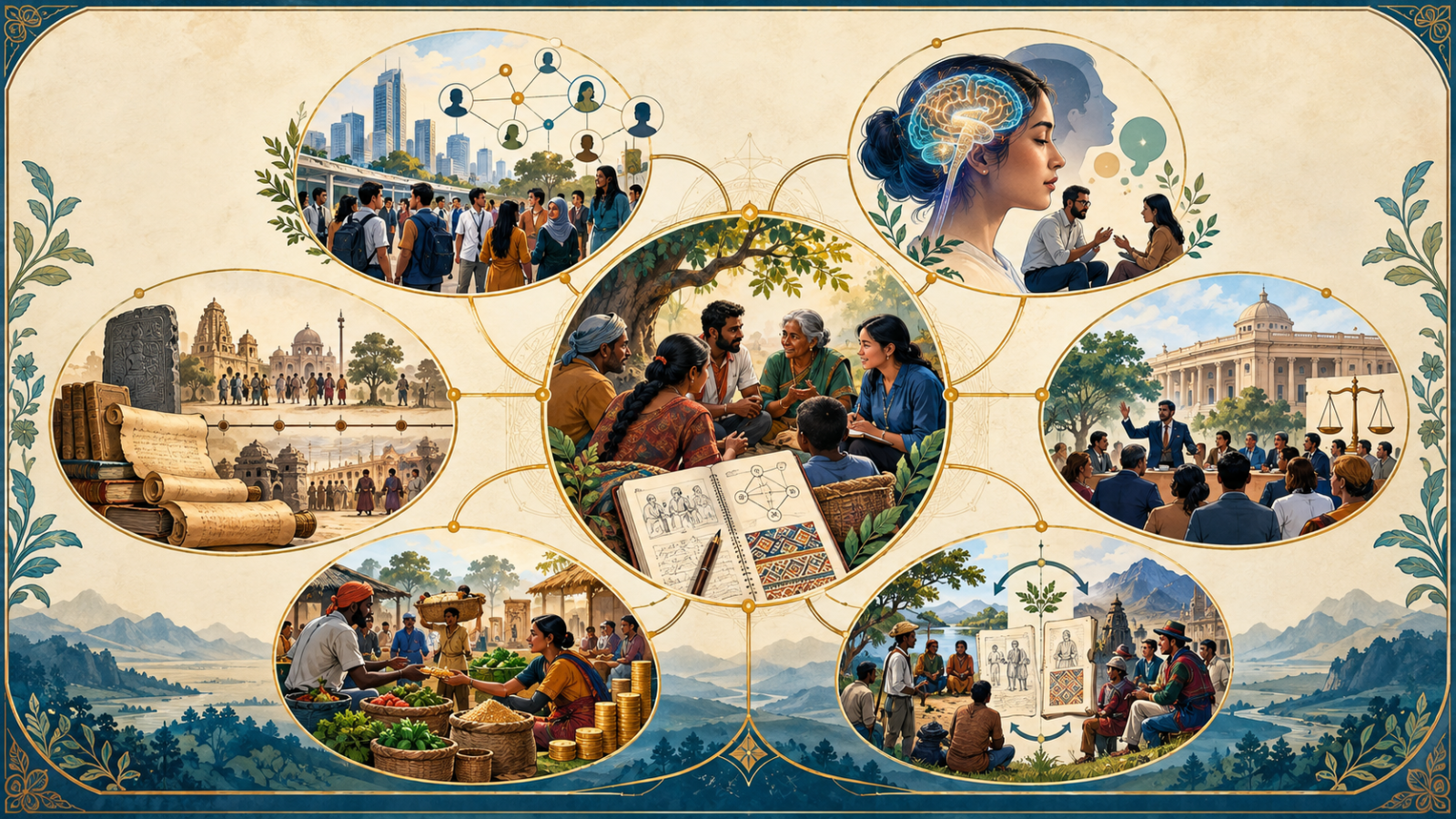
Social anthropology shares its subject, human social life, with sociology, psychology, history, political science and economics, but differs from each in field, method and emphasis. It studies whole societies through participant observation and cross-cultural comparison, while the other disciplines usually focus on one aspect of social life, such as the individual mind, the past, power or the economy. The differences are largely ones of emphasis.
This note compares socio-cultural anthropology with five sister disciplines for the UPSC Anthropology Optional. It falls under Paper I, topic 1.2 (relationships with other disciplines) of the Anthropology Optional syllabus. For the discipline itself, see our notes on social anthropology and cultural anthropology.
Comparison at a glance
| Discipline | Its main focus | How social anthropology differs | Meeting ground |
|---|---|---|---|
| Sociology | Social relations in complex, industrial societies | Small-scale, unfamiliar societies; participant observation; beliefs and values studied in their own right | Shared theory and problems |
| Psychology | The individual: mind, personality, behaviour | Studies the group, social structure and culture | Culture and personality school; psychological anthropology |
| History | Particular past events and why they happened | Mainly the present; seeks the general and typical | The past as explanation of the present; "encapsulated history" |
| Political science | The political system and power | Studies all sub-systems of society, with politics embedded in them | Political anthropology |
| Economics | Production, distribution and consumption, mostly in one's own economy | Studies the full range of economic systems across societies | Economic anthropology |
Social anthropology and sociology
Sociology is the closest companion discipline of social anthropology. The two share most of their theoretical problems, and historically differ in where and how they work (Barrett, 2009).
| Basis | Social anthropology | Sociology |
|---|---|---|
| Type of society | Pre-industrial, small-scale, less familiar societies | Industrial, complex, western-type societies |
| Place of research | Other cultures | The researcher's own society |
| Technique | Participant observation | Questionnaires and surveys |
| Data | Mainly qualitative | Mainly quantitative |
| Comparison | Cross-cultural comparison is central | Generalizations rarely tested cross-culturally |
Three further differences
- Range of interest. Sociology is concerned with social relations, and with other data only so far as they help to explain those relations. Social anthropologists also study beliefs, values and ideas, even where these are not directly tied to social behaviour.
- Field of work. Anthropologists have mostly worked in small-scale communities where person-to-person relationships are all-important. Their methods were developed there. This is a difference of field, not of fundamental theory.
- The problem of translation. Sociologists usually share a language and basic categories with the people they study. The anthropologist must first learn the language and ways of thought of another people, so questions of meaning and symbols take up more of the work.
Social anthropologists can therefore be described as sociologists who are at once something less, because their field has been more restricted, and something more, because they study other aspects of culture as well. Aspirants weighing the two subjects can also read our comparison of Anthropology and Sociology as UPSC optionals.
Social anthropology and psychology
Psychology is the study of mind and human behaviour. It covers the brain and behaviour, human development, personality, intelligence, learning and the influence of other people and of culture on the individual. Social psychology and social anthropology both deal with the relations between individuals and groups, communities, societies and cultures.
| Basis | Social anthropology | Psychology |
|---|---|---|
| Unit of study | The group | The individual |
| Specialization | Social structure and culture | Personality system; cognition, perception, learning, emotions and motives |
| What is held constant | Personality | Social structure |
| What is examined for variation | Social structure | Personality |
| Level of generalization | The social system | The personality system |
British and American attitudes to psychology
- British social anthropology has historically been opposed to psychology. It is anti-reductionist: it refuses to reduce the explanation of social life to another level. The view goes back to Durkheim, who held that a psychological explanation of a social phenomenon is certain to be wrong (Barrett, 2009).
- American cultural anthropology has been far more receptive. Franz Boas was interested in the relation between the individual and society. The culture and personality school followed, with its emphasis on modal personality.
- Psychological anthropology has emerged more recently as a distinct approach, focusing on attitudes and values, child-rearing practices and adolescence (Bourguignon, 1979).
For both disciplines the only real entity is the individual human being; each abstracts from it at a different level. Some anthropologists, sociologists and psychologists share common ground in trying to integrate social structure and personality.
Social anthropology and history
Historians are chiefly interested in the past: what happened and why. They attend to particular sequences of events more than to general patterns or laws. Social anthropologists are centrally, though not exclusively, interested in the present condition of the society they study.
Two ways in which history matters to the anthropologist
- The past explains the present. An anthropologist who wants a full understanding of a society must ask how it came to be as it is. The difficulty is that many societies studied by anthropologists had no documented, verifiable history before recent contact with the West.
- Ideas about the past are part of the present. What Collingwood called "encapsulated history", a people's own ideas about their past, shapes existing social relationships. Different groups may hold very different versions of the same events. Myths and traditional histories are thus collective representations of events, distinct from the events themselves.
The debate among anthropologists
- Radcliffe-Brown and some early functionalists denied that history had relevance for anthropology. They held that history deals with unique events, and that a scientific study of the past was not possible.
- Evans-Pritchard replied that neglect of history prevents the functionalist from studying diachronic problems and from testing his own functional constructions, since history provides the experimental situation. He went further and argued that anthropology is not a generalizing science but a branch of history.
- Boas (1897) had much earlier made historical inquiry a central feature of anthropological investigation.
The real difference
The difference lies less in subject matter than in the degree of generality. Historians study particular institutions in particular places; anthropologists look for what is general and typical. It is a question of emphasis (Ahmad, 1986). Barrett (2009) notes two further contrasts:
- Anthropologists use history to understand the present, not to document the past for its own sake.
- Historians are reluctant to generalize from their data, while anthropologists are expected to tie their ethnography to general theory.
Social anthropology and political science
The two disciplines grew from different roots. Anthropology was founded on evolutionism, biology and the social theory of Marx, Weber and Durkheim. Political science grew out of classical philosophy.
- Scope. Social anthropology deals with all the sub-systems of society. Political science focuses on the political system and power.
- Power in anthropology. Anthropology is not indifferent to power. Edmund Leach held that power is the most fundamental aspect of all social life, and political anthropology is an established specialization.
- Embedded politics. In simpler societies, political activity is embedded in kinship, religion and other activities. There is less functional specificity than in complex societies.
What each gives the other
| Anthropology offers political science | Political science offers anthropology |
|---|---|
| A wide range of polities against which any universal political theory can be tested | Political theory |
| An evolutionary framework for ordering societies | More precise behavioural methods |
| Understanding of local politics shaped by traditional culture, and of ethnicity | |
| Training in participant observation |
Research on local areas and institutions of the new nations has brought the political scientist and the anthropologist to the same populations and many of the same behaviours (R. Cohen, 1967).
Social anthropology and economics
Economics focuses on one institution. It is concerned with the production, distribution and consumption of goods, and with development, prices, trade and finance. Anthropology overlaps with it substantially: not every society has a monetary economy, but every society has scarce goods and some means of exchange. The specialization that studies this is economic anthropology.
| Basis | Social anthropology | Economics |
|---|---|---|
| Interest | The range of production and distribution systems in human societies | The working of the economist's own, mainly market, economy |
| Treatment of the economy | As one part of a whole society and culture | As a separate institution |
| Other economic systems | Central to the subject | Usually of little interest |
The formalist and substantivist debate
- Formalists hold that the ready-made models of western economics, especially micro-economics, are universally valid and can be applied to tribal and peasant economies.
- Substantivists hold that these models do not fit such economies, and that a different analysis is needed, suited to the societies in question.
Using this topic in a UPSC answer
- Open by stating that anthropology is holistic, while each sister discipline studies one segment of social life.
- For each discipline give three things: similarity, difference and meeting ground.
- Use a two-column table for differences; it saves words.
- Name the sub-field that bridges the two: psychological, political or economic anthropology, or ethnohistory.
- Conclude that the differences are of emphasis, and that the disciplines enrich one another.
For presentation, see our guide to anthropology answer writing with diagrams, thinkers and case studies.
Frequently asked questions
What is the difference between social anthropology and sociology?
Social anthropology has mainly studied small-scale, unfamiliar societies through participant observation and qualitative data. Sociology has mainly studied complex industrial societies, often the researcher's own, through questionnaires and quantitative data. Anthropology also studies beliefs and values in their own right.
Which discipline is closest to social anthropology?
Sociology is the closest companion discipline. The two share a great many theoretical problems and interests, and differ mainly in field and method, not in fundamental theory.
How is social anthropology related to psychology?
Both study human behaviour, but anthropology examines the group and its social structure, while psychology examines the individual and the personality system. They meet in the culture and personality school and in psychological anthropology.
Why did British social anthropology oppose psychology?
British social anthropology was anti-reductionist. Following Durkheim, it held that social facts must be explained by other social facts and not reduced to individual psychology.
How does social anthropology differ from history?
History studies particular past events for their own sake. Social anthropology is mainly interested in the present and in what is general and typical. Anthropologists use history to help explain the present condition of a society.
What is the relationship between anthropology and political science?
Political science focuses on the political system and power. Anthropology studies all sub-systems of society and shows how politics is embedded in kinship, religion and economy in simpler societies. They meet in political anthropology.
What is the formalist and substantivist debate in economic anthropology?
Formalists argue that the models of western economics apply to all societies. Substantivists argue that tribal and peasant economies need a different kind of analysis, because economic activity there is part of wider social relations.