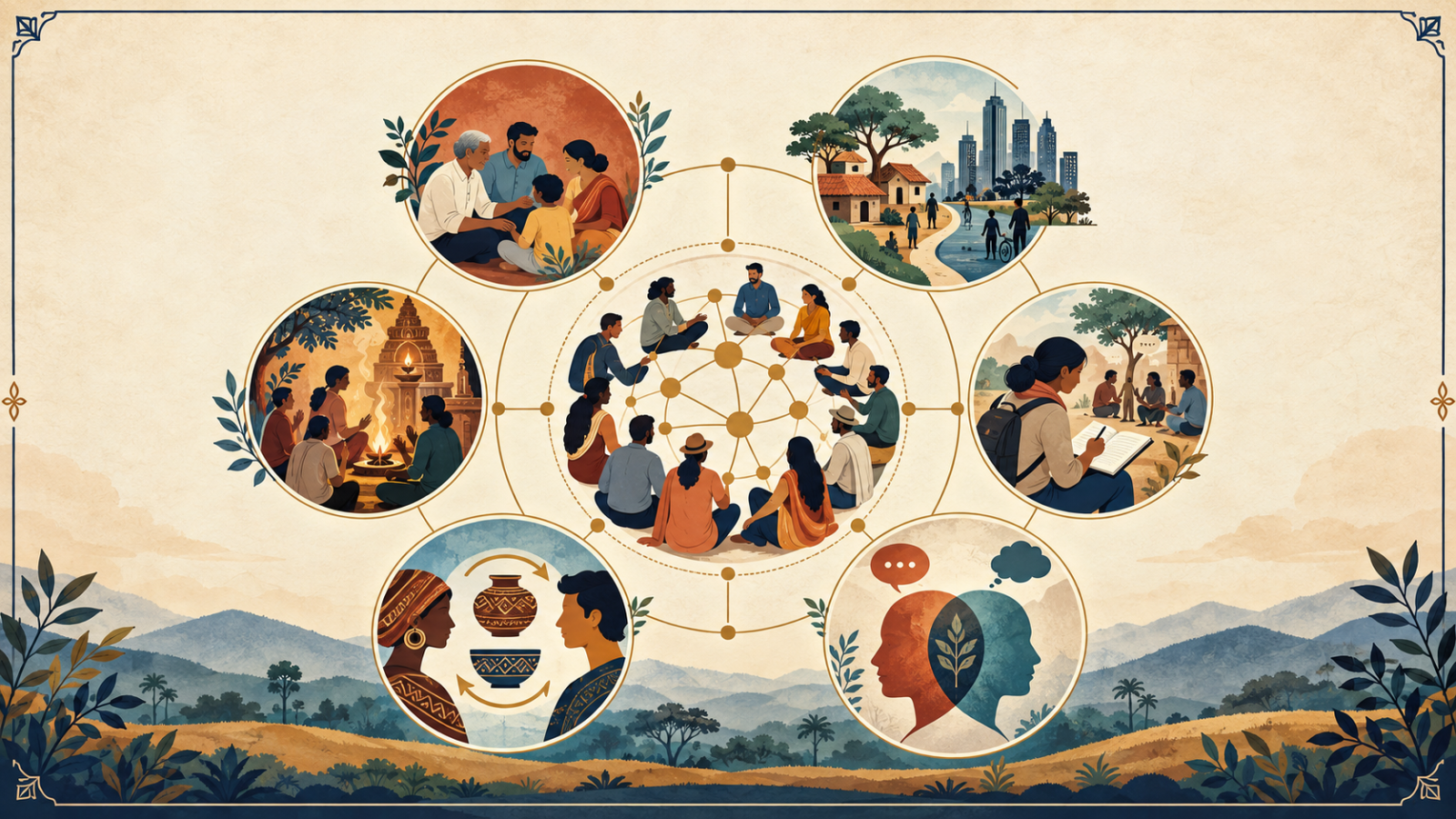
Social anthropology is the comparative study of human societies: their social relationships, institutions and the cultures bound up with them. It began as the study of small-scale tribal societies and, after the Second World War, widened to cover peasant and urban societies across the world. Today it is both a theoretical science of society and an applied discipline.
This note covers the meaning, history, scope, branches and research strategy of social anthropology for the UPSC Anthropology Optional (Paper I, topic 1.3: main branches of anthropology, their scope and relevance).
Key points at a glance
- Origin of the term: Sir James Frazer used the expression "social anthropology" in his 1908 lecture at Liverpool University.
- Founding fathers (Leach, 1982): Lewis Henry Morgan in the USA, Emile Durkheim in France and Max Weber in Germany.
- Limited scope: until the Second World War, the study of primitive (tribal, non-literate) societies.
- Widened scope: primitive, peasant and urban societies, nation-states and applied problems.
- Two major branches: ethnography and comparative ethnography.
- Six research approaches: fieldwork, holistic, comparative, systems and processes, emic and etic, and case study.
What is social anthropology?
Social anthropology is widely held to be a science of society in time and space. In practice it studies cultural practices as well, because society and culture cannot be separated.
Two definitions are worth remembering for the examination:
Social anthropology is the study of "institutionalized social behavior in terms of family, kinship systems, political order, legal procedures, religious custom and the relations between the contemporary or historical societies about which there is adequate data". (Evans-Pritchard)
"Social anthropology aims at understanding and explaining the diversity of human behavior by a comparative study of social relationships and processes over as wide a range of societies as possible." (Raymond Firth, 1967)
Firth added that the relationships studied are mainly those that are standardized or institutionalized: family, marriage and kinship, economic and political organization, social control including law, morality, ritual and religion.
History and origin of social anthropology
The expression "social anthropology" came into use in Britain in the early part of the 20th century. Sir James Frazer used it in 1908 while delivering a lecture at Liverpool University.
According to Edmund Leach (1982), the founding fathers of social anthropology were:
- Lewis Henry Morgan (1877) in the USA
- Emile Durkheim (1895) in France
- Max Weber (1919–1923) in Germany
British scholars took Morgan's Ancient Society (1877) as their guiding spirit and developed social anthropology on scientific lines, with society as the focus of attention. The discipline therefore evolved in England and diffused from there to the rest of the world.
Scope of social anthropology
The scope of social anthropology has widened as the subject has developed. It is best studied in two phases: a limited scope up to the Second World War, and a comprehensive scope after it.
Limited scope: the study of primitive societies
Social anthropology began as a science of primitive societies, also described at the time as tribal, non-literate, simple or non-industrial societies. Early scholars defined the subject in these terms.
| Scholar | View of the scope |
|---|---|
| James Frazer (1908) | Beliefs, rituals, ways of life and thought patterns of primitive peoples. |
| Bronislaw Malinowski (1926) | A "branch of sociology" restricted to the study of primitive societies. |
| A. R. Radcliffe-Brown | "Comparative sociology": the comparative theoretical study of forms of social life among primitive peoples. It studies culture too, because culture is "an epiphenomenon of social life". |
| E. E. Evans-Pritchard (1951) | A branch of sociological studies that chiefly devotes itself to primitive societies. |
| S. F. Nadel (1951) | The study of "the primitives, their cultures, their social life". |
| Ralph Piddington (1952) | The study of the culture of primitive communities. |
Note on terminology: "primitive" is the word these authors used. Contemporary writing prefers terms such as tribal, indigenous or small-scale societies.
Widened scope: from tribe to peasant, city and nation
The scope began to widen in the second quarter of the 20th century. G. P. Murdock's review (1951) of earlier research showed that social anthropology gained a wider scope between 1930 and 1950. Joseph Greenberg (1968) identified the stages through which this happened.
| Stage | What social anthropology studied |
|---|---|
| First | Intensive study of primitive societies and cultures. |
| Second | Peasants in villages, and peasants interacting with towns and cities. |
| Third | Urban communities, acculturated groups in non-western societies and larger units such as nation-states, along with the application of research to industry, agricultural development and health services. |
As Srivastava (1990) pointed out, the interest of social anthropology in primitive society continues, but to say that it is concerned only with primitive societies today "amounts to drawing an outdated caricature of the discipline".
Contemporary themes of study
According to Walter Goldschmidt (1968), Foster (1972) and others, the scope of social anthropology today centres on six themes:
- Modern adaptations of primitive societies and cultures, especially their integration with the modern world.
- Peasant societies throughout the world, especially their integration with the wider world.
- Modern society, including the study of one's own society.
- Specific institutions of modern society.
- National character.
- Freedom, peace, war, human rights, gender relations, ethnic relations, the development of communities, regions and nations, and international relations.
Through this expansion of scope and themes, social anthropology acquired an identity based on universal appeal and the applicability of its results.
Does social anthropology study society or culture?
It studies both. Scholars have differed only on the emphasis.
- Frazer (1908), Radcliffe-Brown (1939) and Nadel (1951) stated clearly that social anthropology studies cultural practices along with society.
- Evans-Pritchard (1951) held that it attends to the social relationships of a people rather than to the details of their cultural expression.
- Lévi-Strauss (1963), John Beattie (1964) and Leach (1982) emphasized that society and culture are inseparable, so the discipline continues to study both.
Srivastava (1990) sums up the two sides. In examining social life, social anthropology shows how a body of social relations exists among humans and binds them into corporate entities. In examining culture, it shows how culture acts as a design for living, and how its material and non-material items guide people in building reciprocal social relations and collective living.
Branches of social anthropology
Social anthropology divides its subject matter between two major branches (Hoebel and Weaver, 1979).
| Feature | Ethnography | Comparative ethnography |
|---|---|---|
| Nature | Descriptive account of one particular society | Analytical and generalizing |
| Basis | Fieldwork | Comparison of ethnographic accounts |
| Aim | Ideographic (the particular case) | Nomothetic (general principles) |
| Time frame | Synchronic | Synchronic or diachronic |
| Role | Supplies the raw material and building blocks of the discipline | Builds theory about society and culture |
Comparative ethnography develops in two directions:
- Topical specializations: every aspect of society and culture, such as kinship, economy, politics or religion, is cultivated as a branch of study.
- Area specializations: studies of the ethnographic zones of the world, each aiming at a total understanding of society and culture within that area.
Both kinds of specialization revolve around theory building about society and culture.
Research strategy: the six approaches of social anthropology
To cover primitive, peasant and urban societies, social anthropology uses a research strategy made up of six approaches.
| Approach | What it means |
|---|---|
| Fieldwork approach | Collecting information through participant observation, by "going native temporarily". |
| Holistic approach | Understanding the total social-cultural realm through its parts, and the parts in relation to the whole. |
| Comparative approach | Cross-cultural coverage to know the full range of human behaviour and the regularities that govern it. |
| Systems and processes approach | Breaking social and cultural systems into sub-systems, studying each alone and in interrelation, to reach an integrated picture. |
| Emic and etic approach | Combining the folk view (emic) with the scientist's view (etic) for a complete understanding. |
| Case study approach | In-depth study of individuals, groups and events in the communities chosen for fieldwork. |
Social anthropology as a pure and applied science
From its research results, social anthropology derives the principles, regularities or laws underlying the social and cultural life of humankind. This is its theory. When it applies those results to practical situations to solve the problems of different societies, it acquires an applied character. Social anthropology therefore stands as both a pure and a utilitarian study of human society.
Using this topic in a UPSC answer
- Open with a definition, such as Firth's or Evans-Pritchard's.
- Show the shift from limited to widened scope, using Greenberg's three stages.
- Name scholars with years to support each point.
- Add the two branches and the six approaches in a short table or diagram.
- Conclude on the pure and applied character of the discipline.
Frequently asked questions
What is social anthropology in simple words?
Social anthropology is the comparative study of human societies. It examines institutionalized social relationships such as family, marriage, kinship, economy, politics, law and religion, along with the culture that shapes them, across as wide a range of societies as possible.
Who coined the term social anthropology?
The expression is credited to Sir James Frazer, who used it in 1908 while delivering a lecture at Liverpool University. It came into general use in Britain in the early 20th century.
What is the scope of social anthropology?
The scope of social anthropology covers primitive, peasant and urban societies all over the world. Until the Second World War it was limited to primitive societies. It later widened to include peasant villages, cities, nation-states and applied fields such as industry, agricultural development and health services.
What are the branches of social anthropology?
The two major branches are ethnography and comparative ethnography. Ethnography is a descriptive, fieldwork-based account of one society. Comparative ethnography is analytical and generalizing, and includes topical and area specializations.
What is the difference between ethnography and comparative ethnography?
Ethnography is ideographic and synchronic: it describes one society at one point in time. Comparative ethnography is nomothetic and may be synchronic or diachronic: it compares societies to arrive at general principles.
What research approaches does social anthropology use?
It uses six approaches: fieldwork, holistic, comparative, systems and processes, emic and etic, and case study. Together they allow a complete study of social and cultural life.
Is social anthropology a pure or an applied science?
It is both. It builds theory by deriving the principles underlying social and cultural life, and it applies its findings to solve practical problems of societies.