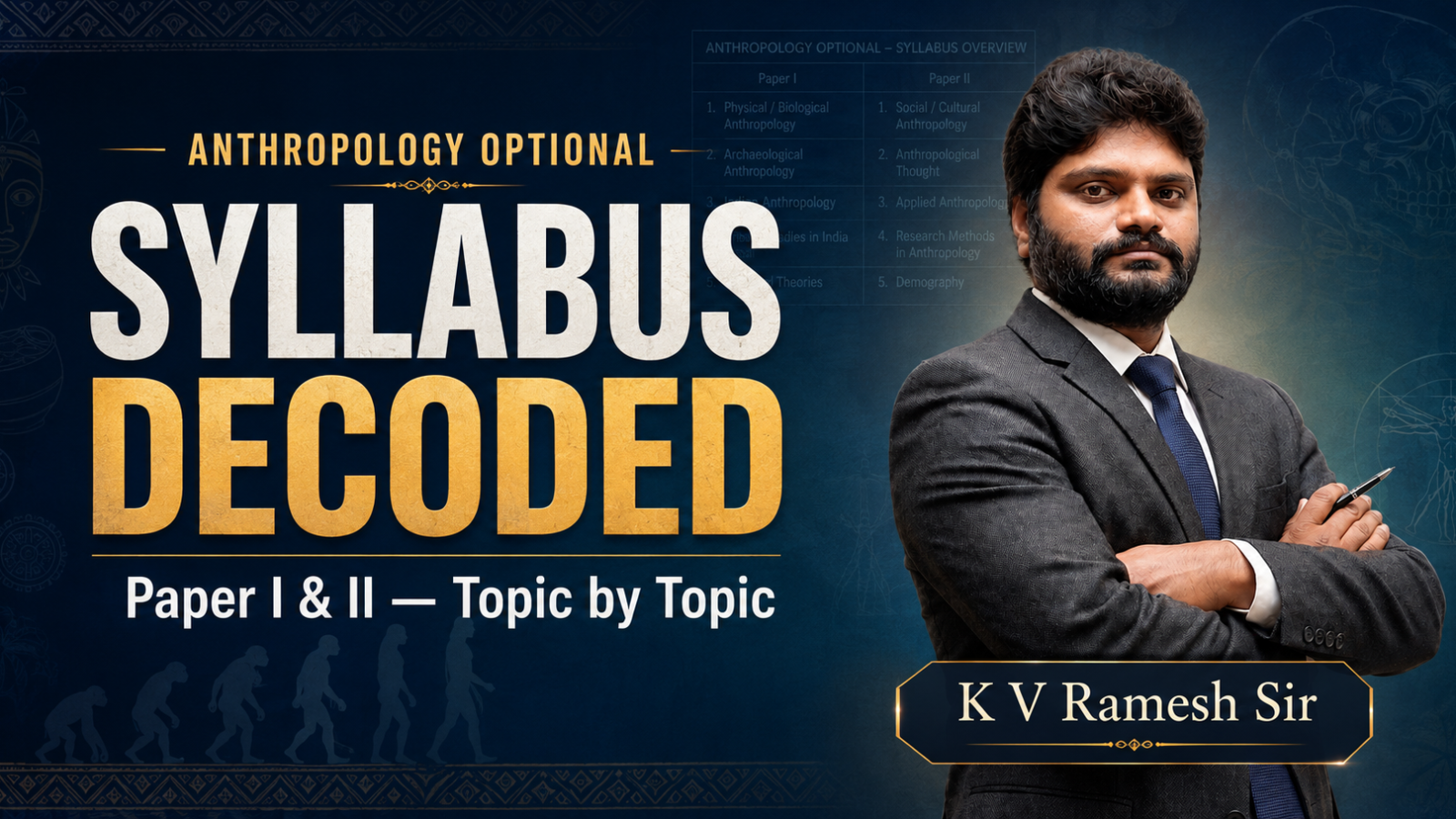
Choosing an optional is the single biggest structural decision in your UPSC journey, and understanding the syllabus before you commit is how serious aspirants avoid a costly mid-preparation switch. Anthropology has quietly become one of the most rewarding optionals in the Civil Services Examination — compact, logical, diagram-friendly and heavily overlapping with General Studies. But its reputation as a "scoring" subject only holds for candidates who actually understand what the two papers demand. This guide, prepared with the mentoring approach of K V Ramesh Anthropology faculty, decodes the entire K. V. Ramesh Anthropology Optional roadmap — Paper I and Paper II — topic by topic, so you know exactly what you are signing up for and where the marks are hiding.
If you are still weighing your options, start with our honest comparison of Anthropology vs Sociology as an optional. Once you have decided, this article becomes your master map. You can keep the official-style syllabus page open alongside it for the exact wording.
How the Two Papers Are Built
The Anthropology optional carries 500 marks — Paper I and Paper II, each worth 250 — out of the 1,750 marks that decide your Mains rank. That is nearly 29% of your written total riding on one subject, which is precisely why decoding it properly matters.
The division is clean and easy to remember. Paper I is the "science and theory" paper: human evolution, genetics, primates, prehistoric archaeology, social-cultural concepts, anthropological theories and research methods. It is largely universal knowledge — true for humans everywhere. Paper II is the "India" paper: it applies anthropology to Indian society, the caste system, tribal communities, development and governance. Paper II is also your bridge to GS — every tribal, caste or development question you answer here strengthens your GS-I society and GS-II governance answers too.
Let us walk through each paper the way it should actually be taught.
Paper I — The Foundation of the Discipline
1. Nature, Scope and the Four Branches
Everything begins with the meaning and scope of anthropology and its relationship with the social sciences, life sciences, medical sciences, earth sciences and humanities. You must be able to place anthropology at the crossroads of the natural and social sciences — this "holistic and comparative" identity is the theme examiners love to test. The four branches — social-cultural, biological (physical), archaeological and linguistic anthropology — and their scope and relevance form the conceptual spine of the whole subject. Get this section watertight; it seeds introductions for dozens of later answers.
2. Human Evolution and the Emergence of Man
This is where physical anthropology begins, and it is a high-yield, high-scoring zone. You will cover the biological and cultural factors in human evolution, the pre-Darwinian, Darwinian and post-Darwinian theories of organic evolution, the synthetic theory, and a cluster of concepts every year's paper dips into — Dollo's rule, Cope's rule, Gause's rule, parallelism, convergence, adaptive radiation and mosaic evolution. Master these as short, definable, diagram-supported units. We break down the complete hominin story in our dedicated post on the human evolution fossil record, which pairs perfectly with this section.
3. Primates
Primate characteristics, evolutionary trends, taxonomy, arboreal and terrestrial adaptations, primate behaviour, comparative anatomy of man and apes, and the skeletal changes due to erect posture. The erect-posture answer — pelvis, foramen magnum, spinal curves, foot arch — is a near-guaranteed diagram question. Learn it once, draw it perfectly, and never lose those marks.
4. Fossil Hominids
Phylogenetic status, characteristics and distribution of the major fossils: the Australopithecines of South and East Africa, Homo erectus across Africa, Europe and Asia (Java Man, Peking Man), the classical and progressive Neanderthals, Rhodesian Man, and the Homo sapiens forms — Cro-Magnon, Grimaldi and Chancelade. This is pure recall, so it rewards a clean comparative table and a memorised timeline more than long prose.
5. The Biological Basis of Life and Human Genetics
The cell, DNA structure and replication, protein synthesis, the gene, mutation, chromosomes and cell division form the biological foundation, and then genetics proper: methods for studying human heredity (pedigree analysis, twin studies, foster-child and co-twin methods, cytogenetics, biochemical and immunological methods, DNA technology), Mendelian inheritance in man, genetic polymorphism, the Hardy-Weinberg law, and the forces that change gene frequencies — mutation, migration, selection, genetic drift and inbreeding. Non-science graduates often fear this block; in practice it is the most formula-driven and predictable part of Paper I once explained cleanly.
6. Prehistoric Archaeology and Cultural Evolution
Principles of prehistoric archaeology, relative and absolute dating methods, and the broad outline of prehistoric cultures — Palaeolithic, Mesolithic, Neolithic, Chalcolithic, Copper-Bronze and Iron Age. Focus your energy on the dating methods (radiocarbon, potassium-argon, dendrochronology, fluorine) because they generate crisp, technical short notes.
7. The Social-Cultural Core: Culture and Society
Here the paper turns social. The nature of culture and civilization, ethnocentrism versus cultural relativism, the concept of society, social institutions, social groups and social stratification. These are the definitional building blocks that every socio-cultural answer draws upon, so precision in definitions pays off across the whole paper.
8. Marriage, Family and Kinship
This trio is the heart of social anthropology and one of the most reliably examined blocks in Paper I. Marriage: definition and universality, the laws of marriage (endogamy, exogamy, hypergamy, hypogamy, incest taboo), types (monogamy, polygamy, polyandry, group marriage), functions, regulations and payments (bride-wealth and dowry). Family: definition, types by structure, residence and descent, and the impact of urbanization, industrialization and feminist movements. Kinship: consanguinity and affinity, principles and types of descent, descent groups (lineage, clan, phratry, moiety, kindred), kinship terminology, and the descent-versus-alliance debate. This section rewards diagrams — kinship charts and descent trees — and thinker linkage (Radcliffe-Brown on descent, Lévi-Strauss on alliance).
9. Economic Organization
The scope of economic anthropology, the classic formalist–substantivist debate, and the principles of production, distribution and exchange — reciprocity, redistribution and market — across hunting-gathering, fishing, pastoral, horticultural and agricultural societies, plus the effect of globalization on indigenous economies. The formalist–substantivist debate is a perennial favourite; anchor it to Karl Polanyi and the substantivists.
10. Political Organization and Social Control
Band, tribe, chiefdom, kingdom and state; power, authority and legitimacy; and law, justice and social control in simple societies. The evolutionary sequence from band to state is a clean, high-scoring diagram, and this section connects beautifully to your GS-II material on the state and governance.
11. Religion
Anthropological approaches to religion (evolutionary, psychological, functional), the sacred and the profane, myths and rituals, tribal forms of religion (animism, animatism, fetishism, naturism, totemism), the distinction between religion, magic and science, and the magico-religious functionaries (priest, shaman, medicine man, sorcerer, witch). Link this constantly to thinkers — Tylor's animism, Frazer's magic, Durkheim's sacred/profane, Malinowski on magic.
12. Anthropological Theories
This is the intellectual backbone of the paper and, for many, the toughest block: classical evolutionism (Tylor, Morgan, Frazer), historical particularism (Boas), diffusionism, functionalism (Malinowski), structural-functionalism (Radcliffe-Brown), structuralism (Lévi-Strauss, Leach), culture and personality, neo-evolutionism, cultural materialism (Harris), symbolic and interpretive theories (Turner, Geertz), cognitive theories, and post-modernism. Because a strong theory answer can lift your whole paper, we have built an entire exam-ready map in our post on anthropological theories made simple — treat it as compulsory reading alongside this section.
13. Language, Research Methods and the Biological Remainder
The paper closes with several compact but scoring blocks. Culture, language and communication: the nature and origin of language, verbal and non-verbal communication. Research methods: the fieldwork tradition, the distinction between technique, method and methodology, and the tools of data collection (observation, interview, schedule, questionnaire, case study, genealogy, life-history). This section is where Malinowski's participant observation shines. Finally, the remaining biological topics — human growth and development, demographic and fertility theories, human ecology and biological adaptation (Bergmann's, Allen's and Gloger's rules), epidemiological anthropology, and the concept of race and racial classification, with the modern consensus that race has no valid biological basis. These closing topics are short, definable and disproportionately rewarding at revision time.
Paper II — Anthropology of India
Paper II is where Anthropology earns its reputation as a "GS-multiplier" optional. Almost everything here feeds directly into your GS-I society and GS-II governance answers, and into the Essay paper.
1. Evolution of Indian Culture and Civilization
The prehistoric and protohistoric foundations — Palaeolithic to Chalcolithic cultures, the Indus (Harappan) civilization in its pre-, mature and post-Harappan phases, and the contribution of tribal cultures to Indian civilization. Alongside this sit the palaeo-anthropological evidences from India — Ramapithecus and Sivapithecus from the Siwaliks and the Narmada Man — and ethno-archaeology, the study of surviving hunting, foraging, pastoral and craft communities as living windows into the past.
2. Demographic Profile, Varna and the Caste System
This is the analytical core of Paper II. You will cover the demographic profile of India and its ethnic and linguistic elements; the traditional Indian social system — varnashrama, purushartha, karma, rina and rebirth; and the caste system in full: the varna–jati distinction, theories of the origin of caste, dominant caste, caste mobility, the jajmani system, the tribe-caste continuum, and the future of caste. Add the sacred complex and the nature-man-spirit complex, and the impact of Buddhism, Jainism, Islam and Christianity on Indian society. The caste and jajmani material alone will strengthen a dozen GS-I answers on Indian society.
3. The Making of Indian Anthropology
The emergence, growth and development of anthropology and sociology in India — the colonial ethnographers, the census and survey tradition, and the great Indian scholars from G.S. Ghurye and D.N. Majumdar to M.N. Srinivas, S.C. Dube and Iravati Karve. Paper II genuinely rewards naming the right thinker for the right concept, so we have compiled a ready-reference in our guide to the Indian anthropologists you must know — from S.C. Roy to Iravati Karve, with each scholar's fieldwork, magnum opus and signature concept.
4. The Indian Village and Processes of Social Change
The significance of village studies, the Indian village as a social system, agrarian relations and the impact of globalization on villages; linguistic and religious minorities and their status; and the great processes of socio-cultural change — Sanskritization, Westernization, Modernization, the interplay of little and great traditions, Panchayati Raj, and media-driven change. These "change" concepts, especially Srinivas's Sanskritization, are among the most frequently asked ideas in the entire paper.
5. The Tribal Situation in India
The bio-genetic, linguistic and socio-economic characteristics and distribution of tribal populations, and their pressing problems — land alienation, poverty, indebtedness, low literacy, poor health and nutrition, and the impact of developmental projects, displacement and rehabilitation. This is one of the most reliably scoring zones in the paper and one of the most current. Our detailed post on Tribal India today — PVTGs, displacement and the development-versus-isolation debate covers this section as a live, exam-and-GS-ready topic. Keep an eye on our daily current affairs for the latest tribal and development updates to enrich these answers.
6. Constitutional Safeguards, Ethnicity and Movements
The problems of exploitation and deprivation of Scheduled Castes, Scheduled Tribes and OBCs, and the constitutional safeguards protecting them; social change among contemporary tribal societies; and the concept of ethnicity, ethnic conflict, regionalism, demands for autonomy and tribal movements across colonial and post-independence India. This block is the clearest example of anthropology feeding straight into GS-II — Fifth and Sixth Schedule areas, reservation, and social-justice governance.
7. Religion and the Tribe–Nation-State Question
The impact of Hinduism, Buddhism, Christianity, Islam and other religions on tribal societies, and a comparative view of tribe and nation-state — Indian tribal communities set against those in other countries. This is a compact but conceptually rich block that rewards comparative framing.
8. Tribal Administration, Development and Applied Anthropology
The paper closes with the machinery of tribal welfare: the history of tribal-area administration, tribal policies and development programmes, the concept and special programmes for Particularly Vulnerable Tribal Groups (PVTGs), the role of NGOs, and — crucially — the role of anthropology in tribal and rural development and in understanding regionalism, communalism and ethnic and political movements. Bring in PESA (1996) and the Forest Rights Act (2006) here for contemporary depth; they are the governance backbone of the entire tribal-development story and a favourite integration point with GS-II.
Where the Marks Actually Come From
Decoding the syllabus is only half the battle. Two candidates with identical knowledge can score forty marks apart on the same paper — the difference is presentation. Anthropology is a diagram-and-thinker subject, and the examiner rewards answers that combine a crisp definition, a labelled diagram, a named thinker and an Indian case study. We have distilled this into a repeatable method in our guide on how to score in Anthropology with diagrams, thinkers and case studies, and it is the single highest-return skill you can build.
A few strategic principles cut across the whole syllabus. Treat Paper I as your concept paper — build it once, deeply, because the concepts never change. Treat Paper II as your current-affairs-integrated paper — refresh it continuously with tribal, caste and development news. Always link theory to India: a theory answer that lands a Ghurye, a Srinivas or a live PVTG example will outscore a purely Western one every time. And never neglect the "small" biological topics — race, adaptation, growth — which offer some of the fastest marks-per-hour in the exam.
A Lean, Trusted Booklist
You do not need a library. For Paper I, the standard combination of an Introduction to Physical Anthropology text, Ember & Ember, and Nadeem Hasnain for social-cultural concepts covers most of the ground. For Paper II, Nadeem Hasnain's Indian Anthropology and Vaid's tribal-India material do the heavy lifting, supplemented by current affairs. Our curated notes, diagram sheets and PYQ compilations on the free resources page are designed to keep this list short and your revision fast.
How K. V. Ramesh Anthropology Optional Coaching Fits In
Knowing the syllabus is the starting line, not the finish. Converting it into ranks needs structured teaching, relentless answer practice and honest feedback — which is exactly what the K. V. Ramesh Anthropology Optional programme is built to deliver. As a specialist Anthropology Optional faculty for UPSC with over a decade of teaching, K V Ramesh sir has trained thousands of aspirants across the country, whether through offline classes as the leading choice for Anthropology Optional coaching in Hyderabad or through live and recorded UPSC Anthropology Optional online classes that make the same mentorship available as Anthropology Optional coaching across India.
Depending on where you are in your journey, there is a structured path for you. The complete Anthropology Foundation Course takes you from first principles to Mains-ready answer writing across both papers. The Anthropology Long-Term Test Series — built on unit-wise, sectional and grand tests — and the focused Anthropology Mains Test Series put you under real exam pressure with model answers and personal feedback. For those who already know the syllabus but keep losing marks in the exam hall, the dedicated Anthropology answer writing programme and Anthropology score improvement programme — including the AnthroEdge Score Booster — target exactly the gap between what you know and what you write.
Not sure yet? The best way to judge fit is to see the teaching for yourself. Watch a few free classes on our demo videos page, explore the full range of courses and programmes, and if you would like a personalised strategy — including a free 15-minute optional-choice counselling — simply get in touch.
Final Word
The Anthropology optional is compact, logical and deeply scoring — but only for the aspirant who reads its syllabus as a strategy document rather than a checklist. Paper I builds an unchanging conceptual core; Paper II turns that core into an India-facing, GS-multiplying weapon. Decode it once, prepare it with the right method, and 500 marks that many aspirants leave on the table become your strongest lever for a rank. For more deep dives across strategy, theory and current affairs, browse the full ANTHROPOLOGY blog — and when you are ready to convert this map into marks, the K. V. Ramesh Anthropology Optional team is here to guide every step.
External reference: the exact, official syllabus wording is always available in the UPSC Civil Services notification on the official UPSC website. Always cross-check with the latest notification before finalising your preparation plan.