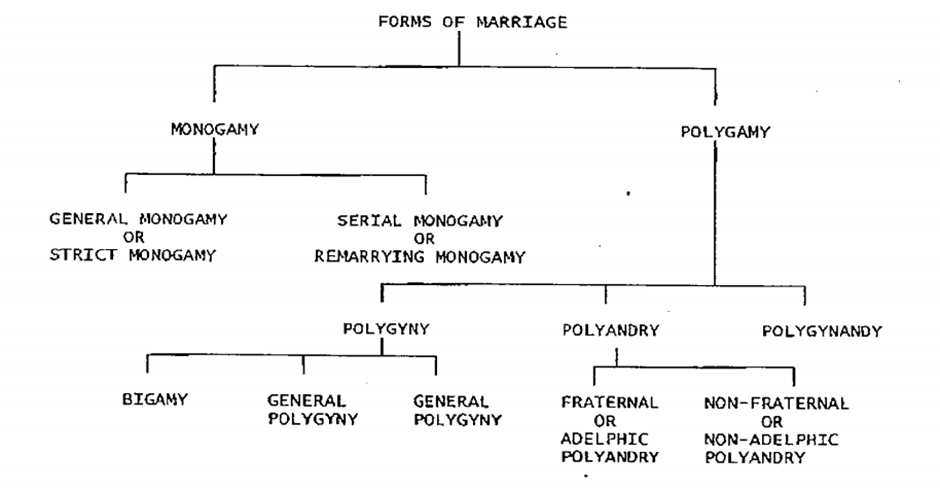
Anthropologists classify marriage by the number of spouses into monogamy and polygamy. Monogamy is the marriage of one man to one woman; it may be lifelong or serial. Polygamy has two main forms: polygyny, one man with several wives, and polyandry, one woman with several husbands. Polygynandry and group marriage, in which several men are married to several women, are rare. Indian tribes provide examples of nearly every form.
This note sets out the forms of marriage with definitions, causes and examples from Indian tribes and world ethnography, for the UPSC Anthropology Optional. It falls under Paper I, topic 2.3 (types of marriage: monogamy, polygamy, polyandry, group marriage) of the Anthropology Optional syllabus.
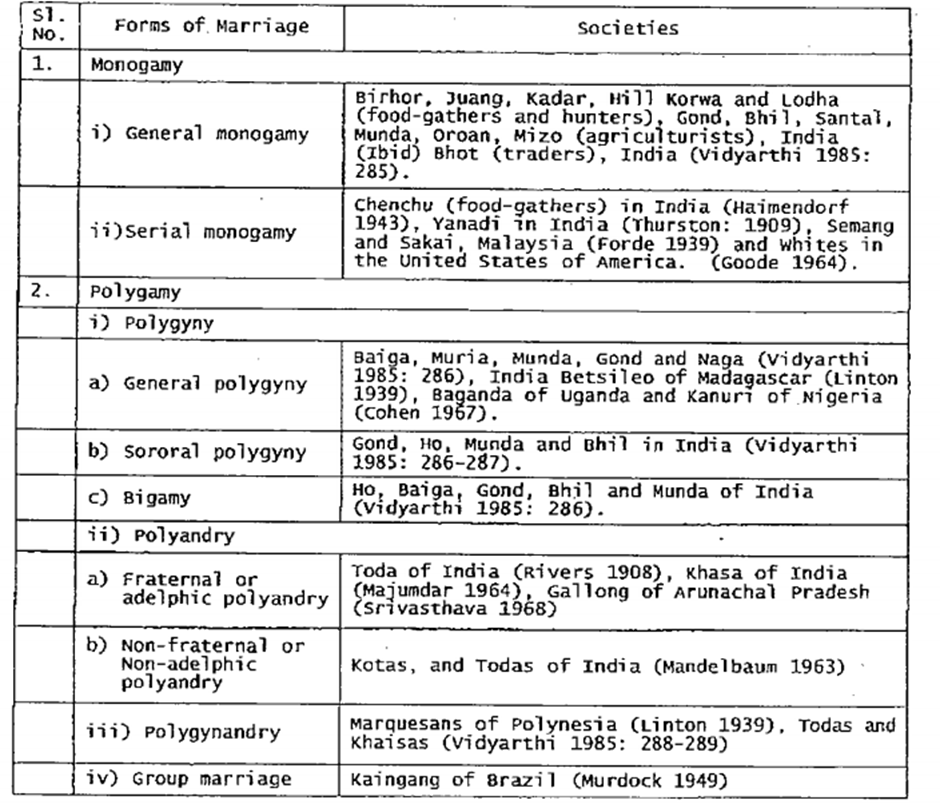
Forms of marriage at a glance
| Form | Sub-form | Meaning | Societies |
|---|---|---|---|
| Monogamy | General monogamy | One man and one woman | Birhor, Juang, Kadar, Hill Korwa and Lodha (food gatherers and hunters); Gond, Bhil, Santhal, Munda, Oraon and Mizo (agriculturists); Bhot (traders) |
| Serial monogamy | One spouse at a time, but several in a lifetime | Chenchu and Yanadi of India; Semang and Sakai of Malaysia; common in the United States | |
| Polygyny | General (non-sororal) polygyny | One man with several wives who are not sisters | Baiga, Muria, Munda, Gond and Naga of India; Betsileo of Madagascar; Baganda of Uganda; Kanuri of Nigeria |
| Sororal polygyny | The wives are sisters | Gond, Ho, Munda and Bhil | |
| Bigamy | Two wives at a time | Ho, Baiga, Gond, Bhil and Munda | |
| Polyandry | Fraternal (adelphic) polyandry | The husbands are brothers | Toda of the Nilgiris; Khasa of Jaunsar-Bawar; Gallong of Arunachal Pradesh; Tibet |
| Non-fraternal (non-adelphic) polyandry | The husbands are not brothers | Reported for the Toda and Kota; the traditional Nayar of Kerala | |
| Polygynandry | Several husbands share several wives | Marquesans of Polynesia; Toda and Khasa | |
| Group marriage | A group of men married to a group of women | Kaingang of Brazil |
Sources of the examples: L. P. Vidyarthi (1985), C. von Fürer-Haimendorf, E. Thurston, W. H. R. Rivers, D. N. Majumdar, D. G. Mandelbaum, R. Linton and G. P. Murdock (1949). They describe customary practice as recorded in ethnographies; many of these customs have since changed.
How common is each form?
G. P. Murdock's cross-cultural survey in Social Structure (1949) found that the large majority of societies permitted polygyny, a much smaller number insisted on monogamy, and polyandry was very rare. Two points follow:
- Permitted is not the same as practised. Even where polygyny is allowed, most men have one wife, because the numbers of men and women are roughly equal and several wives are costly.
- Monogamy is the commonest marriage in practice, even though it is the rule in a minority of societies.
Monogamy
Monogamy is the marriage of one man to one woman at a time.
- General monogamy. The norm among most Indian tribes, whatever their economy: foragers such as the Birhor and Kadar, cultivators such as the Santhal and Oraon, and traders such as the Bhot.
- Serial monogamy. A person has only one spouse at a time but, through divorce and remarriage, several over a lifetime. Fürer-Haimendorf described easy divorce and remarriage among the Chenchu. W. J. Goode noted the same pattern in the modern United States.
Why monogamy prevails: a balanced sex ratio; the cost of maintaining more than one spouse; less jealousy within the household; simpler rules of inheritance; and, in many modern states, the law.
Polygyny
Polygyny is the marriage of one man to two or more women at the same time. It is the commonest form of plural marriage.
| Type | Feature |
|---|---|
| Sororal polygyny | The co-wives are sisters. They usually share one house, and are said to quarrel less, having grown up together. |
| Non-sororal polygyny | The co-wives are unrelated. Each commonly has her own hut and hearth, and the husband visits in turn. |
| Bigamy | Polygyny limited to two wives. |
Explanations of polygyny
- Economic. Where women do much of the cultivation, more wives mean more labour and more food. This is common in hoe-farming societies of Africa.
- Prestige. Several wives are a sign of wealth and rank; chiefs and headmen are the usual polygynists. Among the Naga, wealthy men and chiefs took more than one wife.
- Demographic. Warfare may leave more women than men, and men often marry later than women.
- Long postpartum sex taboo. J. W. M. Whiting linked polygyny to societies in which a couple abstain for a long period after a birth.
- Desire for children. A second wife may be taken when the first is childless, often with her consent.
- Levirate. A man who inherits his brother's widow becomes polygynous.
Polyandry
Polyandry is the marriage of one woman to two or more men at the same time. It is rare, and is concentrated in South Asia and the Himalaya.
Fraternal polyandry
- Toda. W. H. R. Rivers described how a woman who married one man became the wife of his brothers as well. Because biological fatherhood could not be known, social fatherhood was fixed by a ceremony in which one husband presented the pregnant woman with a miniature bow and arrow. He was the father of that child and of later children until another husband performed the rite.
- Khasa of Jaunsar-Bawar. D. N. Majumdar described brothers sharing a wife, with the eldest brother holding authority in the household and being regarded as the father of the children.
- Tibet and the Himalayan border. Brothers take one wife so that the family's land and herds stay undivided.
Non-fraternal polyandry
The husbands are not brothers and may live in different places, the wife spending time with each or being visited by them. The traditional Nayar system of visiting husbands is the best-known case.
Explanations of polyandry
- Keeping property intact. One wife for a set of brothers means one set of heirs, so that scarce land is not divided.
- Scarcity of women. Rivers connected Toda polyandry with the female infanticide formerly practised by them.
- Limiting population. Fewer married women means fewer births in a harsh environment.
- Absence of men. Where herding, trade or military service takes men away for long periods, one husband is always at home.
- High bride price. Brothers pool resources to obtain one wife.
Polygynandry and group marriage
- Polygynandry. Several men are married jointly to several women. Among the Toda and Khasa it arose when polyandrous brothers took a second or third wife in common, as women became less scarce. Ralph Linton described a comparable arrangement among the Marquesans of Polynesia.
- Group marriage. A group of men and a group of women are all married to one another. Murdock found it only as an occasional arrangement among the Kaingang of Brazil, and never as the prevailing form in any society.
Nineteenth-century evolutionists such as L. H. Morgan believed that group marriage was a universal early stage of the family. The ethnographic record does not support this.
Polygyny and polyandry compared
| Basis | Polygyny | Polyandry |
|---|---|---|
| Composition | One husband, several wives | One wife, several husbands |
| Frequency | Permitted in most societies | Very rare |
| Common sub-form | Sororal polygyny | Fraternal polyandry |
| Usual explanation | Labour, prestige, surplus of women | Scarce land, scarcity of women, absent men |
| Paternity | Known | Fixed socially, by ceremony or by seniority |
| Effect on population | Does not limit births | Limits births |
| Indian examples | Naga, Gond, Baiga, Ho | Toda, Khasa, Gallong |
Change in the forms of marriage
- Polyandry has declined sharply. Among the Toda and the Khasa it has largely given way to monogamy, with education, wage work and a more even sex ratio.
- Polygyny is less common. Its cost, and the spread of schooling and new religions, have reduced it among most tribes.
- Law. The Hindu Marriage Act, 1955 requires monogamy for those it covers. Scheduled Tribes are largely governed by their customary law in matters of marriage.
- Serial monogamy is increasing in urban and industrial settings, with rising divorce and remarriage.
For the scholars named here, see our note on Indian anthropologists. For current issues among these communities, see tribal India today.
Using this topic in a UPSC answer
- Draw the classification as a tree: monogamy (general, serial) and polygamy (polygyny, polyandry, polygynandry, group marriage).
- Give one Indian tribe and one world example for each form.
- Explain causes, not only definitions: labour and prestige for polygyny; land and scarcity of women for polyandry.
- Use the Toda bow-and-arrow ceremony to show how paternity is fixed socially.
- Quote Murdock on frequency, and add the distinction between permitted and practised.
- Close with change: decline of polyandry and the rise of monogamy.
For presentation, see our guide to anthropology answer writing with diagrams, thinkers and case studies.
Frequently asked questions
What are the main forms of marriage?
The main forms of marriage are monogamy and polygamy. Polygamy includes polygyny, polyandry, polygynandry and group marriage.
What is the difference between polygamy, polygyny and polyandry?
Polygamy is any marriage with more than one spouse at a time. Polygyny is one man with several wives. Polyandry is one woman with several husbands.
What is serial monogamy?
Serial monogamy means having only one spouse at a time but a succession of spouses over a lifetime, through divorce or widowhood and remarriage.
What is sororal polygyny?
Sororal polygyny is the marriage of a man to two or more sisters at the same time. It is reported among the Gond, Ho, Munda and Bhil.
What is fraternal polyandry?
Fraternal or adelphic polyandry is the marriage of one woman to a set of brothers. The Toda of the Nilgiris and the Khasa of Jaunsar-Bawar are the classic Indian examples.
Which Indian tribes practised polyandry?
The Toda and Kota of the Nilgiris, the Khasa of Jaunsar-Bawar and the Gallong of Arunachal Pradesh are reported to have practised polyandry. It has declined greatly.
How was fatherhood decided among the Toda?
Among the Toda, one of the husbands performed a bow-and-arrow ceremony during the wife's pregnancy. He was then the social father of that child and of later children until another husband performed the ceremony.
Does group marriage exist?
Group marriage is extremely rare. Murdock found it only as an occasional arrangement among the Kaingang of Brazil, and nowhere as the normal form of marriage.