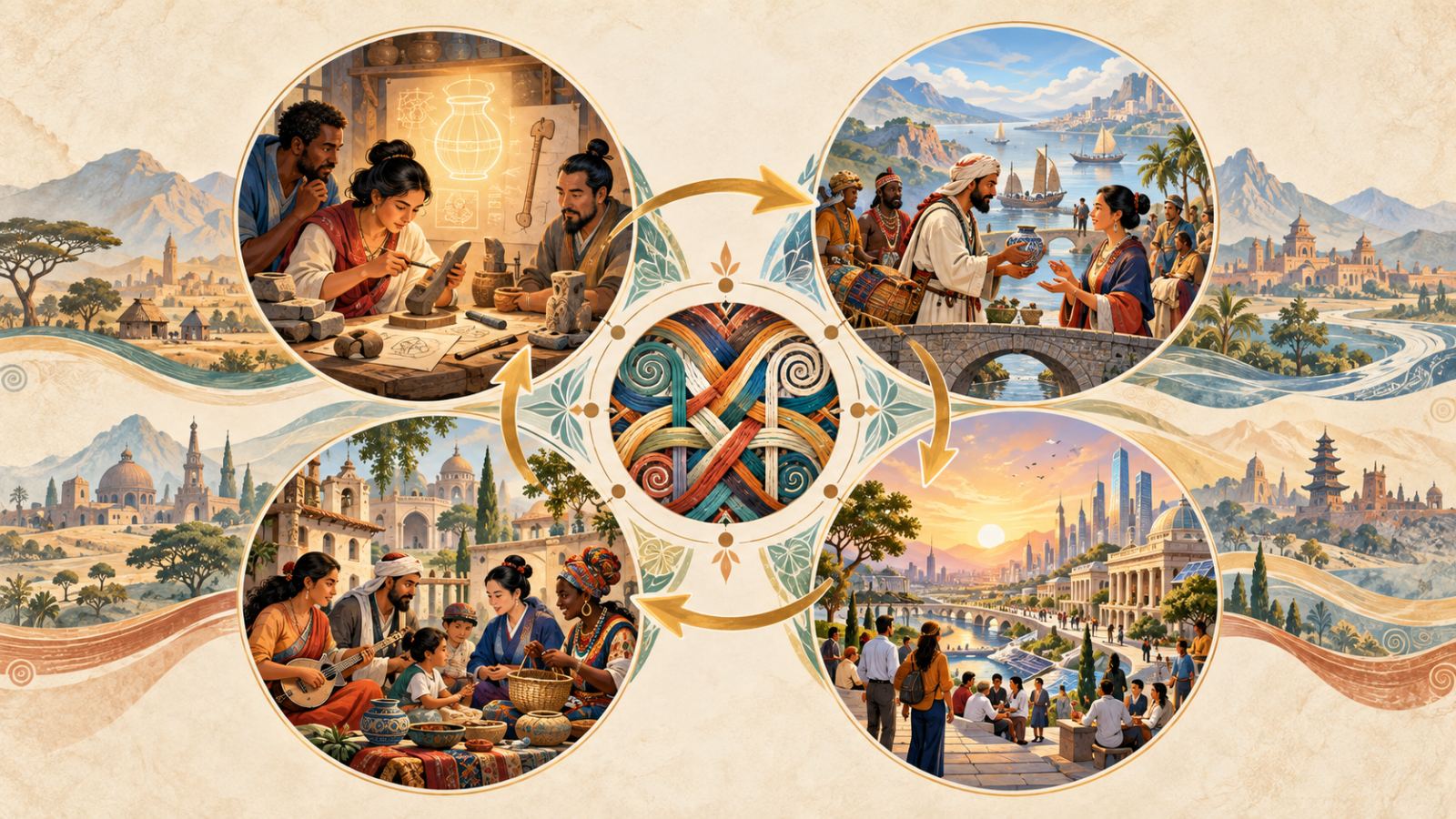
Cultures change through four main processes. Discovery and invention create new ideas and objects within a society. Diffusion is the borrowing of cultural elements from another society. Acculturation is extensive borrowing under intensive contact between societies of unequal power. Revolution is the rapid, usually violent, replacement of rulers. In every case, culture changes only when a society accepts the new element and uses it regularly.
This note explains each process with examples for the UPSC Anthropology Optional. It supports Paper I questions on the nature of culture and on diffusionism, and Paper II questions on culture contact and change among tribal communities. See the Anthropology Optional syllabus for where these sit.
Processes of culture change at a glance
| Process | Source of the new element | Key idea | Example |
|---|---|---|---|
| Discovery and invention | Inside (or outside) the society | New knowledge and its new application | The wheel; the spinning jenny |
| Diffusion | Another society | Selective borrowing | Spread of paper from China |
| Acculturation | A more powerful society in close contact | Extensive borrowing under unequal power | Native Americans on reservations |
| Revolution | Rebellion within a state society | Replacement of the ruling elite | French and Russian revolutions |
Why cultures change
No description of a culture is timeless. The !Kung of the 1950s lived by foraging and moved camp often; later they became more sedentary and took up wage labour. The impetus for such change comes from within the society or from outside it.
- From within: the pressure for consistency makes people adjust old behaviour to new, and people try out better ways of doing things. Michael Chibnik suggests that people facing a new problem conduct small mental "experiments", which can give rise to new traits.
- From the physical environment: people who move into an arid area must give up farming or develop irrigation.
- From the social environment: today the more frequent stimulus. The oil shortage of 1973–74 made North Americans think about conserving energy. Western imperial expansion forced drastic change on colonised peoples.
Discovery and invention
Discoveries and inventions are ultimately the source of all culture change. According to Ralph Linton, a discovery is any addition to knowledge, and an invention is a new application of knowledge. The new element, the innovation, may be an object (the wheel, the plough, the computer) or a form of behaviour or idea (buying and selling, democracy, monogamy).
An invention that is ignored changes nothing. Culture change begins only when society accepts it.
| Type | Meaning | Example |
|---|---|---|
| Unconscious invention (accidental juxtaposition) | Many small contributions over a long time, by people unaware of the final result | Children playing on a rolling log may have suggested rollers, and in time the wheel |
| Intentional innovation | A deliberate attempt to meet a perceived need | James Hargreaves built the spinning jenny when 18th-century English textile makers demanded more yarn |
The slowness of early invention does not show lower intelligence. The capacity of the human brain has been the same for perhaps 100,000 years.
Who innovates, and who adopts?
- Risk and wealth. Among Ashanti carvers in Ghana, the wealthiest and the poorest innovated most. The wealthy can afford the risk; the poor have little to lose.
- Social encouragement. In the Maya community of Zinacantán, Mexico, weaving had four fixed patterns around 1970. By 1991 designs were varied and elaborate, after the economy became commercialised and girls were allowed to learn by trial and error (Patricia Greenfield).
- Early adopters tend to be educated, high in status and well off. Those who most need an improvement are often the last to adopt it, so rapid technological change can widen the gap between rich and poor.
- Frank Cancian's qualification. When risks are unknown, the lower-middle class is more receptive than the upper-middle class, which catches up once the risks are known.
- Mode of learning. Change is slow where children learn mainly from parents and a few elders, and faster where they learn from many teachers, leaders and peers.
- Costs and benefits. A superior innovation is not always adopted. The QWERTY keyboard, designed to stop early typewriters from jamming, survives because switching is costly.
Diffusion
Diffusion is the process by which cultural elements are borrowed from another society and incorporated into the culture of the recipient group. Borrowing lets a society bypass stages and mistakes. Germany, and later Japan, industrialised quickly by learning from the errors of earlier industrial nations.
Ralph Linton showed how much of any culture is borrowed. In his portrait of a "100 per cent American" of the 1930s, the man sleeps in a bed of Near Eastern pattern, wears pyjamas of Indian origin, uses cotton domesticated in India, eats from pottery invented in China, pays with coins of Lydian origin and reads a newspaper printed on a Chinese material by a German process.
Three patterns of diffusion
| Pattern | How it works | Example |
|---|---|---|
| Direct contact | A trait passes to neighbouring societies and spreads gradually outward | Paper: invented in China (attributed to Ts'ai Lun, A.D. 105); reached the Arab world through Samarkand after 751; made in Baghdad by 793, Egypt about 900, Spain about 1150, England in 1494 |
| Intermediate contact | Third parties such as traders, soldiers or missionaries carry the trait | Phoenician traders took the alphabet to the Greeks; crusaders carried elements of culture between Europe and the Arab world; missionaries spread Western dress |
| Stimulus diffusion | Knowledge of a foreign trait stimulates the invention of a local equivalent | Sequoya created the Cherokee syllabary after seeing European writing, without adopting the English system |
With paper, the sequence was the same everywhere: first imported as a luxury, then as a staple, and finally, within one to three centuries, made locally.
Diffusion is selective
Diffusion does not spread like ripples from a stone. People are not sponges; they accept some traits and reject others.
- Fit with existing culture. Japan accepted much from China but rejected rhymed tonal poetry, civil service examinations and foot binding. The first did not suit the language, the second was unnecessary given the power of the aristocracy, and the third was repugnant.
- Ease of communication. Material techniques are easy to demonstrate and are judged on their merits. Ideas and values are hard to convey, as Linton noted of marriage ideals and religious concepts.
- Form over meaning. Bobbed hair swept North America in the 1920s as a sign of freedom. It did not catch on among Native American women of north-western California, for whom short hair signified mourning.
Acculturation
Acculturation refers to the changes that occur when different cultural groups come into intensive contact. As in diffusion, the source of new items is another society. Anthropologists mostly use the term where one society is much more powerful than the other. Acculturation is therefore extensive cultural borrowing in the context of superordinate and subordinate relations. Borrowing goes both ways, but the less powerful society borrows more.
Forms of pressure
| Form | Description | Example |
|---|---|---|
| Direct force | Conquest or colonisation, with force or the threat of it | Spanish conquerors compelled native groups in Mexico to accept Catholicism |
| Indirect force | Loss of land and livelihood leaves little choice | Native Americans driven onto reservations; compulsory schooling in the dominant society's values |
| Voluntary adoption | The new element is seen to have advantages | Inuit and Saami adopted snowmobiles and rifles gradually, without abandoning older ways |
| Persuasion | Development programmes that still push change towards the dominant culture | Formal schooling instils new values; health programmes can undermine the authority of shamans |
Outcomes of acculturation
- Assimilation: individuals acquire the social roles and culture of the dominant group. The term is used more by sociologists.
- Multiculturalism: the dominant society may prefer, or promote, the continued existence of distinct cultures.
- Resistance: the less powerful group may reject the new elements for a long time.
- Depopulation: many peoples never had the chance to acculturate. After European contact, measles, smallpox and tuberculosis devastated the Americas and the Pacific. The Yahi of California were reduced from several hundred to almost none in 22 years; Ishi was their last survivor.
Acculturation also applies to immigrants, who are usually a minority and change in the direction of the dominant culture, at varying speeds.
Diffusion and acculturation compared
| Basis | Diffusion | Acculturation |
|---|---|---|
| Contact | May be slight or indirect | Intensive and continuous |
| Power relation | Not necessarily unequal | Usually dominant and subordinate |
| Scale of borrowing | Single traits or complexes | Extensive, across many areas of life |
| Choice | Largely voluntary and selective | Often forced or constrained |
Revolution
The most drastic and rapid form of culture change is revolution: the replacement, usually violent, of a country's rulers. Rebellions occur almost always in state societies with a distinct ruling elite. Not every rebellion succeeds, and not every successful one changes customs and institutions.
The historian Crane Brinton, studying the American, French and Russian revolutions, identified four conditions that favour revolution:
- loss of prestige of established authority, often after failures in foreign policy or finance;
- a threat to recent economic improvement, which radicalises groups whose fortunes had just risen;
- indecisiveness of government;
- loss of support of the intellectual class.
Cross-national evidence suggests that rebellions have been most common in agrarian countries where the rulers' wealth rests on land, so that they resist reform. Revolutions often disappoint: one set of repressions may simply replace another.
Using this topic in a UPSC answer
- Open with Linton's distinction between discovery and invention, and the rule that change needs social acceptance.
- Give the three patterns of diffusion with one example each, and stress that diffusion is selective.
- Define acculturation by unequal power, and separate it from diffusion in a short table.
- Add Indian illustrations: tribal communities in contact with caste society, missions and the market; and policy debates on isolation versus development.
- Conclude that all four processes usually work together, and that people are active choosers, not passive receivers.
For presentation, see our guide to anthropology answer writing with diagrams, thinkers and case studies.
Frequently asked questions
What are the main processes of culture change?
The main processes are discovery and invention, diffusion, acculturation and revolution. The first arises mainly within a society; diffusion and acculturation bring elements from other societies; revolution replaces the ruling order.
What is the difference between discovery and invention?
According to Ralph Linton, a discovery is any addition to knowledge, while an invention is a new application of knowledge. Either becomes culture change only when society accepts and regularly uses it.
What is diffusion in anthropology?
Diffusion is the process by which cultural elements are borrowed from one society and incorporated into the culture of another. It occurs through direct contact, intermediate contact or stimulus diffusion, and it is always selective.
What is stimulus diffusion?
Stimulus diffusion occurs when knowledge of a trait in another culture stimulates the invention of a local equivalent. The classic example is the Cherokee syllabary created by Sequoya after contact with European writing.
What is acculturation?
Acculturation is the extensive cultural change that occurs when societies come into intensive contact, usually where one is much more powerful than the other. The subordinate society borrows most, whether by force, by constraint or by choice.
How is acculturation different from diffusion?
Diffusion can occur with slight or indirect contact and involves selective borrowing of particular traits. Acculturation involves intensive contact, unequal power and extensive change across many areas of life.
How is acculturation different from assimilation?
Acculturation is the process of cultural change through contact. Assimilation is one possible outcome, in which individuals take on the social roles and culture of the dominant group. The term assimilation is used more by sociologists.