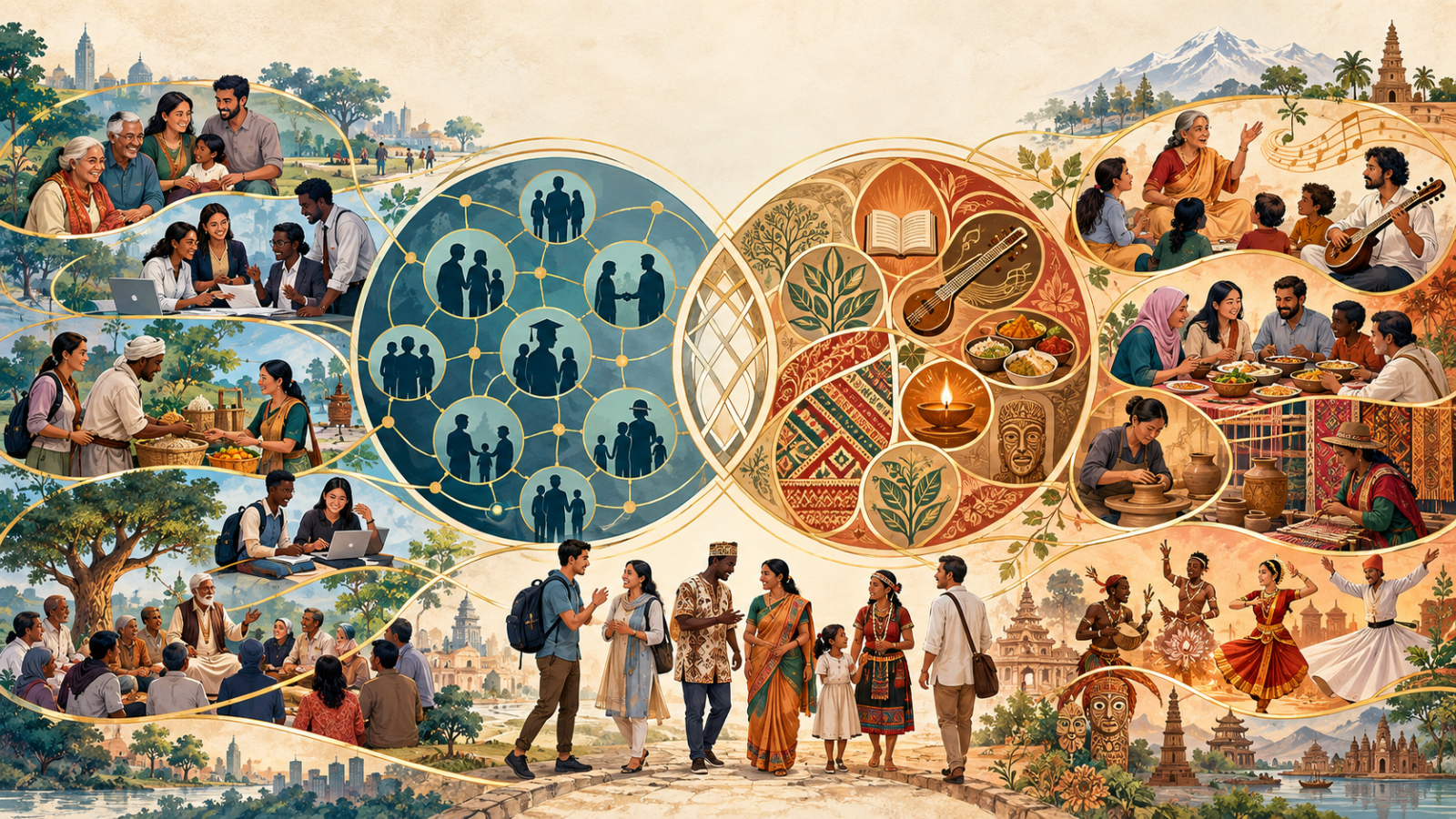
Society is an organised, interacting group of people; culture is the way of life they follow. A society is composed of people, and the way they behave is their culture. The two are distinguishable but inseparable: no culture exists without a society to carry it, and no human society exists without a culture to organise it. Society expresses itself through culture, and culture is produced and reproduced within society.
This note explains the distinction and the relationship between culture and society for the UPSC Anthropology Optional. It falls under Paper I, topic 2.2 (society and culture) of the Anthropology Optional syllabus.
Meaning of culture and society
- Culture is the sum total of learned, shared and socially transmitted behaviour. It includes the ideas, values and customs of a group of people.
- Society is a fairly large number of people living in the same territory, who interact in organised ways. Its members share a common language, which makes day-to-day exchange possible, and take part in a common culture.
How anthropologists distinguish the two
| Scholar | View |
|---|---|
| M. J. Herskovits | A culture is the way of life of a people; a society is the organised, interacting aggregate of individuals who follow that way of life. A society is composed of people; the way they behave is their culture. |
| S. F. Nadel | "Culture" must be distinguished from its companion term "society". They are two dimensions of the same reality: society is people seen in their relationships, culture is the same people seen in their patterned ways of acting. |
| A. L. Kroeber | Culture and society are "distinguishable yet inseparable". |
| Raymond Firth | They are two facets of one whole. Society stresses the human component, the people and the relations between them; culture stresses the accumulated resources, material and non-material, which the people inherit, use and pass on. |
| A. R. Radcliffe-Brown | Social structure, the network of actual relations, is the concrete reality to be studied. Culture is a characteristic of that social life. |
| Kroeber and Parsons (1958) | Culture is the transmitted content of values, ideas and symbols. Society, or the social system, is the system of interaction among individuals and groups. |
Culture and society compared
| Basis | Society | Culture |
|---|---|---|
| What it is | People in organised interaction | Their learned and shared way of life |
| Units | Statuses, roles, groups, institutions | Traits, complexes, patterns; values, norms, symbols |
| Answers the question | Who is related to whom, and how? | What do they know, believe, make and do? |
| Continuity | Through the recruitment of new members | Through enculturation and transmission |
| Found among | Humans and some animals | Humans, in its developed form |
| Tradition that stresses it | British social anthropology | American cultural anthropology |
The relationship between culture and society
They complement each other
- Society expresses itself through culture. A group is identified by the culture it practises: Javanese society by Javanese culture, for instance.
- Culture is produced and reproduced within society. In turn, society acts in certain ways because of its culture.
- Culture structures social relations. It is embedded both in the material setting and in the social institutions of a society. Material experience is organised, and group relations are structured, through culture.
- Culture is the medium of experience. It is through culture that the social world is experienced, interpreted and understood. In this sense culture is more basic than an ideological superstructure.
- The influence runs both ways. Culture is produced within the framework set by the socio-economic structure, and the cultural process among different groups and classes in turn affects the social structure (Erna Herawati, 2006).
They do not always coincide
- One society, many cultures. A plural society such as India contains many regional, linguistic, religious and tribal cultures.
- One culture, many societies. Elements of a single cultural tradition may be shared across several politically separate societies.
- Different rates of change. Social arrangements and cultural values may change at different speeds, producing strain.
- Survival. A society may disappear while parts of its culture survive in its language, art or techniques, adopted by others.
Culture as a tool for understanding society
Since the time of Franz Boas, culture has been the anthropologist's tool for understanding and describing unfamiliar societies. Cultural relativism allows cultures to be compared without assuming an evolutionary hierarchy. Each culture is valid in its own view of the world and does not exist to serve the purposes of another.
The practical lesson is one of method. Faced with a practice that seems shocking, the anthropologist's first task is to understand its reasons within that society, not to judge it by outside standards.
Culture and society in complex societies
The early notion of culture was developed to understand small, homogeneous societies, where one society had one culture. In the modern world the relationship is more complex.
- Society in the modern sense. According to Pertierra (2004), society can be seen as a collection of individuals pursuing their interests within formal rules administered by specialists and implemented by the state. Its members are mostly unknown to one another, yet are linked through abstract categories such as class, nation and gender. Society is the arena in which individuals play their roles to achieve different objectives.
- Culture in the modern sense. Early anthropologists treated culture as a set of practical and contingent meanings. Postmodernists use it to mark the domain of signifying practices, that is, the ways in which meaning is made.
- The result. In complex societies culture is not uniform. It is contested among groups and classes, and cannot be read off from the society as a single whole.
Using this topic in a UPSC answer
- Open with the one-line distinction: society is people; culture is the way they behave.
- Give a comparison table of four or five rows.
- Cite Kroeber's "distinguishable yet inseparable" to show the link.
- Add the point that the two do not always coincide, with India as a plural society.
- Close by noting that the merger of the two interests produced socio-cultural anthropology.
For presentation, see our guide to anthropology answer writing with diagrams, thinkers and case studies.
Frequently asked questions
What is the difference between culture and society?
Society is an organised group of interacting people. Culture is the learned and shared way of life those people follow. Society is made up of people and their relationships; culture is made up of their ideas, values, customs and products.
How are culture and society related?
Culture and society are interdependent. Society expresses itself through culture, and culture is produced, transmitted and changed within society. Neither can exist without the other in human life.
Can a society exist without culture?
No human society exists without culture, because culture supplies the language, norms and values that make organised interaction possible. Some animals live in societies without culture in the human sense.
Can culture exist without society?
No. Culture is learned and shared, so it needs a group of people to create, carry and transmit it. Parts of a culture can, however, outlive the society that created it when other societies adopt them.
Can one society have more than one culture?
Yes. Large, complex societies usually contain many cultures and sub-cultures. India is an example of a plural society with many regional, linguistic, religious and tribal cultures.
Why did anthropologists combine the study of society and culture?
British social anthropology stressed society and American cultural anthropology stressed culture, but in practice each studied both. Since the two cannot be separated, the fields were brought together as socio-cultural anthropology.