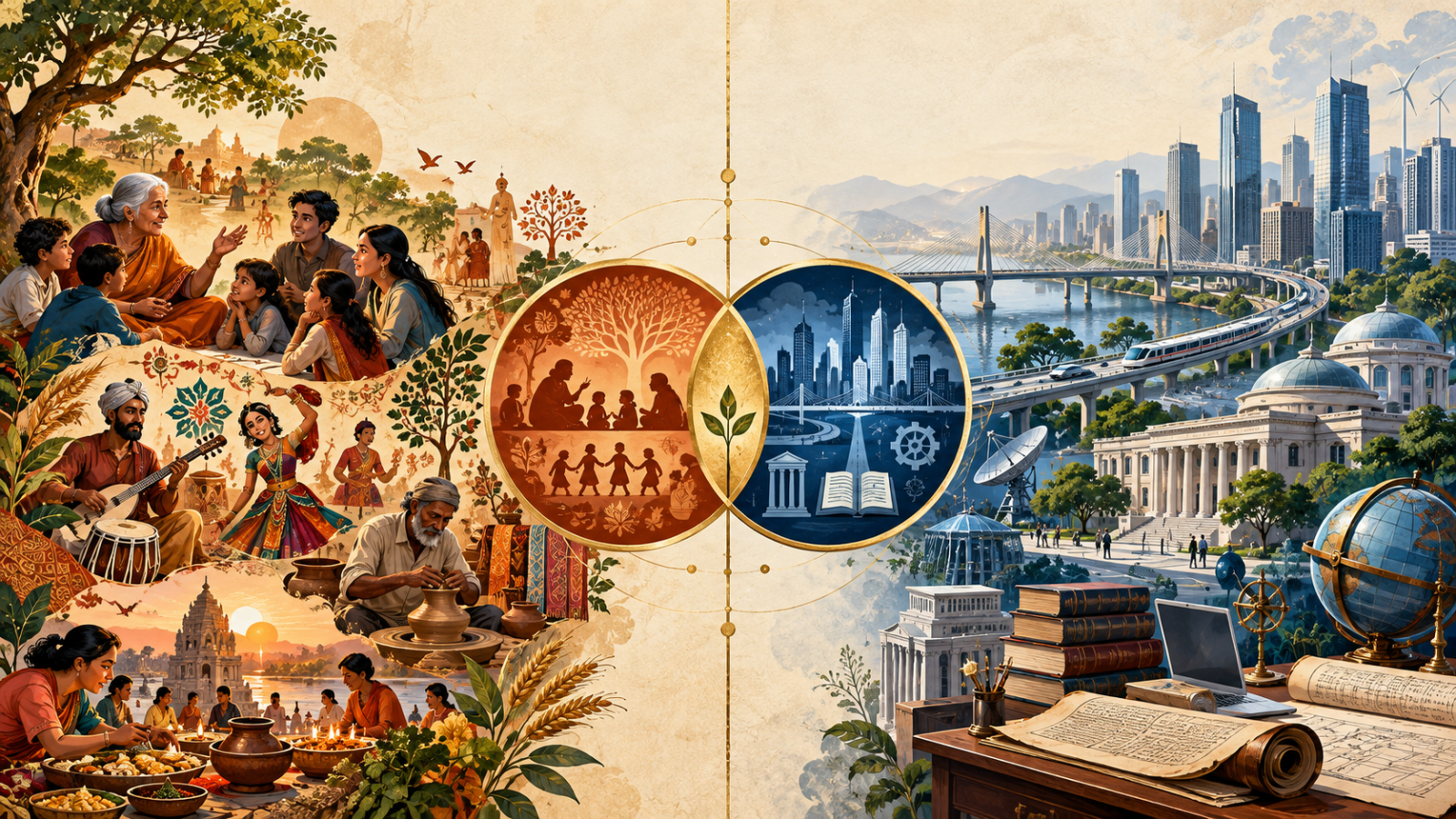
Culture is what a people are: their values, beliefs, arts, customs and ways of thinking. Civilization is what a people have and use: their tools, techniques, institutions and organisation for controlling the conditions of life. In MacIver's terms culture is an end in itself, while civilization is a means to an end. Culture can exist without civilization, but civilization cannot exist without culture.
This note explains the difference between culture and civilization for the UPSC Anthropology Optional. It falls under Paper I, topic 2.1 (the concept and characteristics of culture and civilization) of the Anthropology Optional syllabus.
Culture and civilization: comparison chart
| Basis | Culture | Civilization |
|---|---|---|
| Meaning | The manner in which a people think, behave and act | An advanced stage of social development and organisation |
| Nature | An end (values and goals) | A means (tools and techniques) |
| Represents | What we are | What we possess |
| Reflected in | Religion, art, literature, music, customs, morals, philosophy | Law, administration, technology, infrastructure, architecture |
| Expression | Inner refinement | Outer, general development |
| Measurement | No agreed standard of measurement | Measurable by efficiency |
| Advancement | Does not advance in a straight line | Always advancing |
| Pace of change | Slow; more stable | Rapid |
| Dependence | Can grow and exist without civilization | Cannot grow and exist without culture |
What is culture?
The word "culture" comes from the Latin cultura, from colere, "to cultivate". Culture is the way people live, reflected in the language they speak, the food they eat, the clothes they wear and the deity they worship. It is the set of knowledge, experiences and behaviours shared by a group, and it is gained through learning.
The classic definition is that of E. B. Tylor in Primitive Culture (1871): culture is "that complex whole which includes knowledge, belief, art, morals, law, custom, and any other capabilities and habits acquired by man as a member of society".
Note that Tylor opened this definition with the words "Culture or Civilization". He treated the two as the same thing. The distinction between them was drawn later.
What is civilization?
The word "civilization" comes from the Latin civis, "citizen", a person who lives in a town. The idea is not confined to towns. It refers to adopting better ways of living and making the best use of nature's resources to satisfy the needs of a group, and to organising society into groups that work together to improve food, education, dress, communication and transport.
Definitions of civilization
| Scholar | View |
|---|---|
| MacIver and Page | Civilization is "the whole mechanism and organization which man has designed in his endeavour to control the conditions of life". |
| Fairchild | A higher stage of cultural development, marked by intellectual, aesthetic, technological and spiritual attainment. Hence "civilized" as against "uncivilized" peoples. |
| Robert Bierstedt (1974) | Sophistication, self-criticism and awareness of others are the chief marks of civilization. |
| W. F. Ogburn | Culture has a material and a non-material aspect. The material aspect is civilization; the non-material aspect is culture proper. |
| Gillin and Gillin (1948) | Civilization is the material or tangible part of culture, the "culture equipment" that man has fashioned from his environment. |
Views that rank peoples as civilized and uncivilized are value-loaded, and social scientists today avoid using the term in that sense.
Civilization in the anthropological sense
Anthropologists use "civilization" in a second, descriptive sense: a complex form of society with cities, a state, writing, surplus production and occupational specialisation.
- L. H. Morgan placed civilization as the third stage of cultural evolution, after savagery and barbarism.
- V. Gordon Childe linked the rise of civilization to the urban revolution.
In this sense every civilization is a culture, but not every culture is a civilization.
Nine differences between culture and civilization
The points below follow the distinction drawn by MacIver and Page.
- End and means. Culture is an end in itself. A poem, a belief or a work of art gives direct satisfaction. The equipment of civilization, such as a car or a computer, is utilitarian: it satisfies only by helping to achieve some other end.
- Standard of measurement. Civilization can be measured by efficiency: a faster machine is a better machine. Culture has no such agreed standard; beliefs, norms and ideas cannot be ranked in this way.
- Advancement. Civilization is always advancing. Culture is not: the plays and poems of today are not necessarily better than those of Shakespeare.
- Transmission. Civilization passes to the next generation with little effort; buildings and machines are simply inherited. Culture must be learned, and learning it takes effort and understanding.
- Borrowing. Civilization can be borrowed without change; a television works the same everywhere. A borrowed belief or institution must be altered to fit its new cultural setting.
- Inner and outer. Culture relates to the inner qualities of a society, such as religion, customs and conventions. Civilization relates to its outer form, its apparatus and equipment.
- Stability. Culture changes over years or centuries. Civilization changes very rapidly.
- Variability. Different cultures may share the same civilization. American and Indian cultures differ greatly, yet their technical equipment is much the same.
- Creation. Culture is a social fact, the creation of the whole society. An item of civilization may be the invention of a single individual.
How culture and civilization are related
The two are distinct but not separate. Several scholars treat them as two sides of the same coin.
- Civilization rests on culture. Tools and institutions are created and used according to the values of a culture.
- Civilization carries culture. Printing, for example, is an item of civilization that spreads literature, an item of culture.
- They change at different speeds. Ogburn called the gap that opens when material culture changes faster than non-material culture "cultural lag".
Using this topic in a UPSC answer
- Open by noting that Tylor used the two terms as synonyms, and that MacIver later separated them.
- Give the end-and-means distinction in one line, then a comparison table of five or six rows.
- Add the anthropological sense of civilization, with Morgan and Childe.
- Use Indian examples: the Harappan civilization as a civilization; tribal cultures as cultures without cities or states.
- Conclude that the two are interdependent, with Ogburn's cultural lag.
For presentation, see our guide to anthropology answer writing with diagrams, thinkers and case studies.
Frequently asked questions
What is the main difference between culture and civilization?
Culture is an end in itself: the values, beliefs, arts and customs of a people. Civilization is a means: the tools, techniques and organisation a people use to control the conditions of life. Culture is what we are; civilization is what we have.
Can culture exist without civilization?
Yes. Every human society has a culture, including societies without cities, states or writing. Civilization cannot exist without culture, because its tools and institutions are created and used according to cultural values.
Who distinguished culture from civilization?
R. M. MacIver and C. H. Page drew the best-known distinction, treating culture as an end and civilization as a means. Earlier, E. B. Tylor had used the two words as synonyms.
Why is civilization said to advance but not culture?
Civilization can be measured by efficiency, so a newer machine can be shown to be better than an older one. Culture has no such standard: a modern poem cannot be shown to be better than an ancient one.
How did Ogburn relate culture and civilization?
Ogburn divided culture into material and non-material aspects. The material aspect corresponds to civilization and the non-material aspect to culture proper. When the material side changes faster, the result is cultural lag.
What does civilization mean in anthropology?
In anthropology, civilization also means a complex form of society with cities, a state, writing and occupational specialisation. Morgan treated it as the stage of cultural evolution that follows savagery and barbarism.