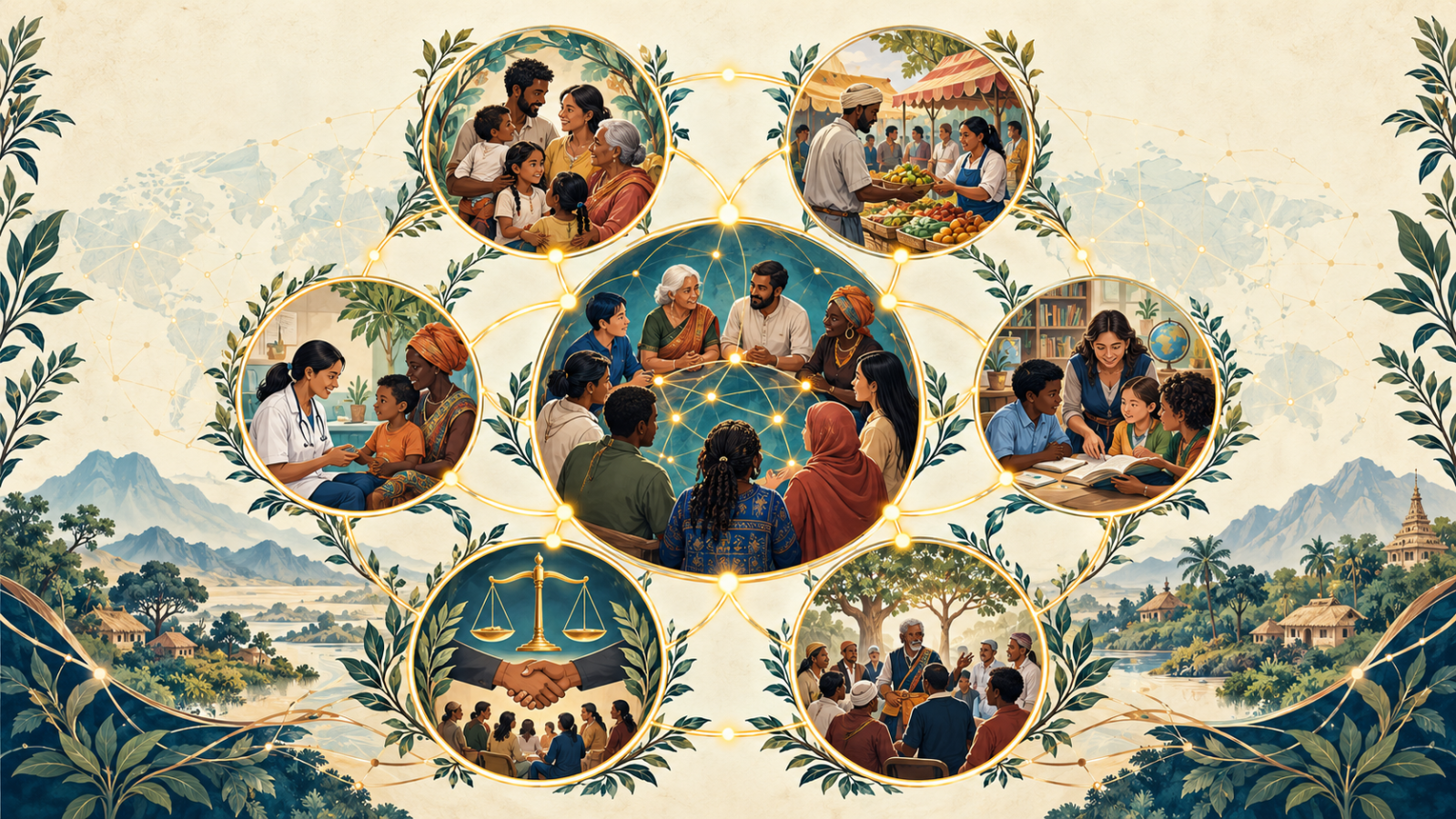
In anthropology and sociology, society does not mean a mere collection of people. It means the system of social relationships, and the pattern of norms of interaction, through which a group of people maintain themselves. MacIver called it "a web of social relationships". Society in this sense is an abstract entity: it is experienced in everyday life but cannot be seen. Its essential elements are likeness, difference, interdependence and cooperation.
This note covers the meaning, definitions, characteristics and elements of society for the UPSC Anthropology Optional. It falls under Paper I, topic 2.2 (the nature of society) of the Anthropology Optional syllabus. Society is the central concept of social anthropology.
Meaning of society
- In common usage, society is an aggregation of individuals.
- In anthropology and sociology, it is the complex pattern of norms of interaction that exists among those individuals.
- It is intangible. Society is a mental construct. People can be seen; the relationships that bind them cannot.
- Its core is relationship. What matters is the system of relationships by which members maintain themselves.
A working definition: a society is a group of people who share a common culture, occupy a particular territory and feel themselves to be a unified and distinct entity. Its members are related through persistent relations of status, role and social network.
Definitions of society
| Scholar | Definition |
|---|---|
| Morris Ginsberg | A collection of individuals united by certain relations or modes of behaviour which mark them off from others who do not enter into these relations or who differ from them in behaviour. |
| G. D. H. Cole | The complex of organised associations and institutions within a community. |
| MacIver and Page | A system of usages and procedures, of authority and mutual aid, of many groupings and divisions, of controls of human behaviour and of liberties; "a web of social relationships". |
| Ralph Linton | Any group of people who have lived and worked together long enough to organise themselves and to think of themselves as a social unit with well-defined limits. |
Functional and structural definitions
| Basis | Functional view | Structural view |
|---|---|---|
| Society is | A complex of groups in reciprocal relationships, interacting with one another | The total social heritage of folkways, mores and institutions; of habits, sentiments and ideals |
| Emphasis | What society does: it enables people to carry on life activities and fulfil their interests in association with others | What society is made of: its inherited forms and institutions |
| Scholars | MacIver, Parsons, LaPiere, Cooley, Leacock | Ginsberg, Giddings, Cole, Cuber |
Society as a relative unit
A society is generally conceived as a human group that is relatively large, relatively self-perpetuating in demographic terms, and relatively autonomous in organising its social relations. The word "relatively" is the important one.
- No society is completely independent or self-contained.
- The line that separates one society from another is often arbitrary.
- Anthropologists must not let these divisions hide the local, regional, national and international systems of relations in which every society takes part.
By extension, the term can denote the people of a region, a country, or even the world as a whole.
Characteristics of society
| Characteristic | Explanation |
|---|---|
| A web of social relationships | Relationships are of countless types. The family alone has many, based on age, sex and generation; outside it there is no limit. |
| Likeness | "Society means likeness" (MacIver). Mutual understanding depends on the likeness each person sees in the other. In early society likeness was centred on kinship, real or supposed; in modern society it has widened to nationality and beyond. |
| Difference | A society based only on likeness would have weak social ties. Social systems rest on differences that complement one another: of sex, aptitude, interest and capacity. The family rests on the biological difference between the sexes. |
| Difference subordinate to likeness | Difference alone does not create society. Likeness comes first. Primary likeness and secondary difference together create the division of labour. |
| Interdependence | No individual or group is self-sufficient. Social organisation diversifies the work of each and so makes each more dependent on others. Interdependence is both extensive and intensive. |
| Cooperation | All social institutions rest on cooperation. It avoids mutual destructiveness and brings economy of effort. Without it the fabric of society would collapse. |
Likeness, interdependence and cooperation are thus the essential elements that constitute a society.
MacIver's elements of society
MacIver's definition brings out six further elements.
- Usages. Every society has accepted ways relating to marriage, education, religion, food and speech. They differ from society to society.
- Procedures. Modes of action that maintain the unity and organisation of the society.
- Authority. Some authority is necessary to maintain order.
- Mutual aid. No society is stable without a feeling of mutual help among its members.
- Groupings and divisions. Family, village, city and other groups exist within every society.
- Controls and liberties. Liberty and control go together. Control over behaviour is meant to protect and promote liberty, not to destroy it.
Society and culture
Society and culture are distinguishable but inseparable. No society exists without a culture, and no culture exists without a society to carry it.
| Basis | Society | Culture |
|---|---|---|
| Refers to | People in organised relationships | The learned way of life of those people |
| Made up of | Statuses, roles, groups and institutions | Knowledge, beliefs, values, norms and material objects |
| Found among | Humans and also many animals, such as ants, bees and primates | Humans alone, in its developed form |
| Emphasised by | British social anthropology | American cultural anthropology |
Types of society studied by anthropologists
Anthropologists classify societies in several ways:
- By scale and complexity: simple (tribal), peasant and complex (urban-industrial) societies.
- By subsistence: foraging, pastoral, horticultural, agricultural and industrial societies.
- By political organisation: band, tribe, chiefdom and state, following Elman Service.
Using this topic in a UPSC answer
- Open by contrasting the everyday meaning of society with the anthropological one: relationships, not a headcount.
- Quote MacIver's "web of social relationships" and one structural definition, such as Ginsberg's.
- Set out the functional and structural views in two columns.
- Explain likeness, difference, interdependence and cooperation with the family as the running example.
- End with the link between society and culture, noting that animals have society but only humans have culture.
For presentation, see our guide to anthropology answer writing with diagrams, thinkers and case studies.
Frequently asked questions
What is society in anthropology?
In anthropology, society is the system of social relationships and norms of interaction among a group of people who share a culture, occupy a territory and see themselves as a distinct unit. It is not merely a collection of individuals.
Who defined society as a web of social relationships?
R. M. MacIver defined society as a web of social relationships. With C. H. Page he described it as a system of usages and procedures, authority and mutual aid, groupings and divisions, and controls of human behaviour and liberties.
What are the main characteristics of society?
The main characteristics of society are that it is abstract, it is a web of social relationships, and it rests on likeness, difference, interdependence and cooperation. It also has usages, procedures, authority, mutual aid, groupings, and controls and liberties.
What is the difference between the functional and structural definitions of society?
The functional definition sees society as groups in reciprocal relationships that enable people to fulfil their needs. The structural definition sees society as the total social heritage of folkways, mores and institutions.
Why is society called abstract?
Society is called abstract because it consists of relationships and norms, which cannot be seen or touched. Only the people who are related can be observed; the relationships are inferred from their behaviour.
What is the difference between society and culture?
Society is a group of people in organised relationships. Culture is the learned way of life they share. Society is found among some animals too, while culture in its developed form is unique to humans.
Why are both likeness and difference necessary for society?
Likeness gives members the mutual understanding without which association is impossible. Difference lets members complement one another. Together, with likeness as the primary element, they produce the division of labour.