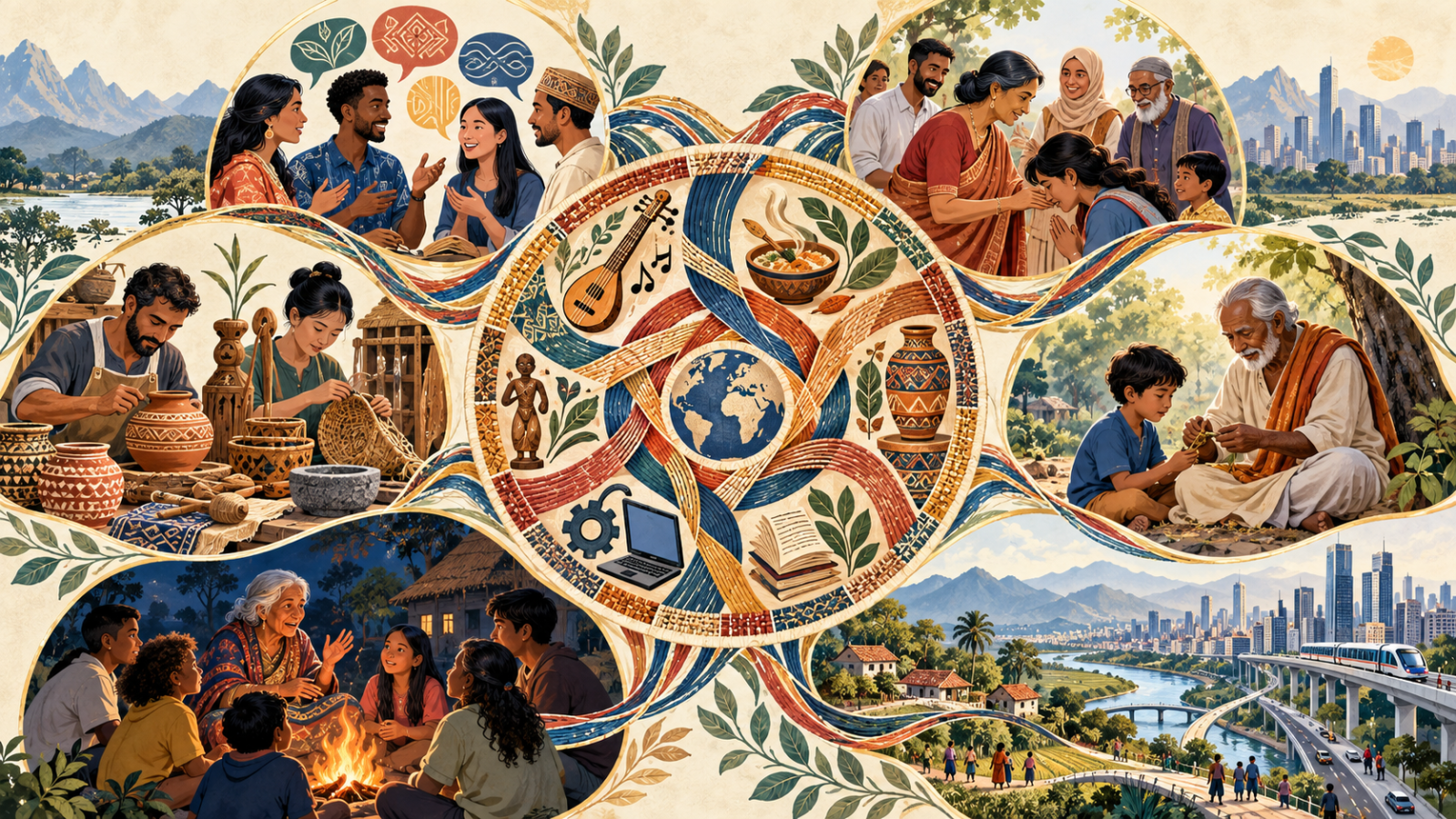
In anthropology, culture is the socially learned design for living that people acquire as members of a society. It covers everything a group has, thinks and does: material objects, ideas and values, and patterned behaviour. Culture is universal and unique to humans. It rests on human biology, such as a developed brain, nimble hands and a freely moving tongue, but it is not itself biological.
This note covers the meaning, definitions, elements and characteristics of culture for the UPSC Anthropology Optional. It falls under Paper I, topic 2.1 (the nature of culture) of the Anthropology Optional syllabus. Culture is the basic concept of cultural anthropology and is central to every sub-branch of the discipline.
Meaning of culture
- Universal. Every society has a culture. It may be simple in some societies and complex in others.
- Human. Every human being is cultured; culture is an attribute of the genus Homo.
- A design for living. Culture is the basis of human life.
- Based on biology, but not biological. Human biology made it possible to acquire a design for living. What has been acquired is not biological.
- A totality. Culture is the whole of mental, rational, material and technological processes and products.
Tylor's classic definition of culture
Anthropologists have debated the definition of culture since the discipline began in the 19th century. The classic definition was given by E. B. Tylor in Primitive Culture (1871):
"Culture or Civilization, taken in its wide ethnographic sense, is that complex whole which includes knowledge, belief, art, morals, law, custom, and any other capabilities and habits acquired by man as a member of society."
Why the definition matters
- It is broad. It covers almost everything about a people's way of life, from knowledge to habits.
- It separates the learned from the inborn. Tylor distinguished biologically determined characteristics from socially learned ones.
- The key phrase is "acquired by man as a member of society". Culture belongs to man as a member of a social group, not as a biological being.
- It points to enculturation. Culture is acquired through socialisation, not heredity. Enculturation is the process by which an individual learns the rules and values of his or her culture. It begins in the family from the moment a child is born.
Other important definitions of culture
Hundreds of definitions have been proposed since Tylor, and the number keeps growing. Each reflects a different theoretical basis for understanding human activity.
| Anthropologist | Definition in brief | Emphasis |
|---|---|---|
| Malinowski (1944) | Culture is an "instrumental reality", an apparatus for the satisfaction of biological and derived needs. | Need satisfaction |
| Kluckhohn and Kelly (1945) | The accumulated treasury of human creation: books, buildings, knowledge of adjusting to surroundings, language, customs, ethics, religion and morals built up through the ages. | Accumulated heritage |
| Herskovits (1948) | Culture is "the man-made part of the environment". | Human creation |
| Marvin Harris (1975) | The total socially acquired life-way of a group: its patterned, repetitive ways of thinking, feeling and acting. | Learned patterns |
| Gary Ferraro (1992) | Everything that people have, think and do as members of a society. | Three components |
Ferraro's three components of culture
| Verb | Component | Examples |
|---|---|---|
| Have | Material objects | Tools, houses, dress |
| Think | Ideas, values and attitudes | Beliefs, knowledge, ideals |
| Do | Patterned ways of behaving | Customs, rituals, etiquette |
Elements of culture
A culture is more than the sum of its parts; a mere list of customs and objects does not give a true picture of it. For analysis, however, culture is broken down into values, norms, sanctions, culture traits, culture complexes and culture patterns.
| Element | Meaning |
|---|---|
| Values | What a culture considers good, proper and desirable, or bad, improper and undesirable. Values influence behaviour and serve as a benchmark for judging the actions of others. |
| Norms | Standard patterns of behaviour accepted by a society. Formal norms are written down and their violation is punished. Informal norms are understood and followed without being recorded. |
| Sanctions | Rewards for following norms and penalties for defying them. Positive sanctions include a medal or a word of gratitude; negative sanctions include fines, imprisonment or a disapproving stare. The most cherished values carry the heaviest sanctions. |
| Culture trait | The smallest unit of a culture, comparable to the cell in the body. It may be material or non-material, and has form, use, function and meaning. |
| Culture complex | A cluster of related traits that acts as a unit, as several cells form a tissue. |
| Culture pattern | The systematic arrangement of traits and complexes that gives a culture its overall plan. |
Values, norms and sanctions are directly related: values are expressed in norms, and norms are enforced by sanctions.
Characteristics of culture
How culture is acquired
| Characteristic | Explanation |
|---|---|
| Unique to humans | No other species matches the human ability to learn, communicate, and store and use information. Tool and symbol making, language and a moral force guiding everyday action are distinctively human. |
| Non-genetic | Culture is a product of social learning, not heredity. Animals inherit behaviour, or at most have a proto-culture; humans acquire culture. |
| Socially learned | Culture is learned from parents, friends and surroundings through observation, instruction, reward, punishment and experience. Learning takes place in individual, social and cultural (symbolic) situations. |
| Inculcated | All animals can learn, but humans alone pass on their acquired habits to their children in considerable measure. This is enculturation. |
| Symbolic | Humans give things and events arbitrary meanings and grasp those meanings. Symbols are words, objects, gestures, sounds or images that stand for something else, with no natural connection between the two. |
How culture is organised
| Characteristic | Explanation |
|---|---|
| Integrated | The traits of a culture are not a random assortment; they are mostly consistent with one another. A change in one part tends to affect the others. |
| Structured | Traits form complexes, and these are arranged in a systematic manner. This arrangement is the structure of a culture. |
| Patterned | According to Ruth Benedict, cultures are not haphazard collections of customs but integrated, patterned systems. No trait has meaning outside its context. |
| All-encompassing | Culture is the sum total of human creation: intellectual, technical, artistic, physical and moral, traditional and recent. |
| Unity and diversity | All humans have culture, but cultures are not alike. "Culture" means the way of life of humankind as a whole; "a culture" means the way of life of one particular society. |
| Regional | A culture region is the territory in which a particular culture prevails. There are sub-cultures, regional, national and international cultures. |
How culture works and changes
| Characteristic | Explanation |
|---|---|
| Historically created | Each generation adds to what its ancestors created. Culture is therefore cumulative and dynamic. |
| Gratifying | Culture satisfies basic biological and social needs. Elements continue as long as they do so, and are changed or replaced when they fail. |
| Adaptive and maladaptive | Culture lets humans adapt to almost any environment. Yet cultural achievements can also threaten survival, as environmental problems and the side effects of technology show. |
| Stable yet changing | Culture is stable in the values handed on to the next generation, and yet ever-changing. Change is internal (invention) or external (diffusion). |
| Used creatively | Ideal culture and real culture differ. Rules say what to do, but people do not always follow them. |
| Superorganic | According to Kroeber, culture, once created, exists on a level above the individuals who carry it. It outlives each generation and has a degree of independence from the organic, though its origin is biological and it depends on human choice to continue. |
Universals, generalities and particularities
Culture is at once universal and unique: every human being experiences it, yet it varies from region to region.
- Universals are features found in every culture, which distinguish Homo sapiens from other species. The incest taboo is the standard example.
- Generalities are features common to several, but not all, human groups.
- Particularities are features unique to certain cultural traditions.
Culture shock
People take the practices of their own society for granted. It can therefore be surprising and disturbing to find that other cultures do not follow the same way of life. Culture shock is the psychological and social maladjustment a person experiences on first meeting an unfamiliar culture. It can be set off by physical objects or by the way people act, and it can occur even within one's own society.
Using this topic in a UPSC answer
- Open with Tylor's definition and underline "acquired by man as a member of society".
- Add one or two contrasting definitions, such as Malinowski and Herskovits.
- Group the characteristics under three heads: acquisition, organisation and change.
- Draw the trait, complex and pattern hierarchy as a simple diagram.
- Close with Kroeber's superorganic or with adaptive and maladaptive culture, using a current example.
For presentation, see our guide to anthropology answer writing with diagrams, thinkers and case studies.
Frequently asked questions
What is culture in anthropology?
Culture is the socially learned way of life of a group of people. It includes their material objects, their ideas, values and attitudes, and their patterned ways of behaving, all acquired as members of a society and not inherited biologically.
Who gave the classic definition of culture?
E. B. Tylor gave the classic definition in Primitive Culture (1871). He described culture as that complex whole which includes knowledge, belief, art, morals, law, custom and any other capabilities and habits acquired by man as a member of society.
What are the main characteristics of culture?
Culture is learned, shared, symbolic, integrated, patterned, adaptive, cumulative and dynamic. It is unique to humans, non-genetic, transmitted through enculturation and, in Kroeber's term, superorganic.
What are the elements of culture?
The main elements are values, norms, sanctions, culture traits, culture complexes and culture patterns. Traits are the smallest units; they combine into complexes, which are arranged into patterns.
What is enculturation?
Enculturation is the process by which an individual learns the rules and values of his or her own culture. It begins in the family at birth and continues through observation, instruction, reward and punishment.
Why is culture called superorganic?
Kroeber called culture superorganic because, once created, it exists on a level above the individuals who carry it. It outlives each generation and follows its own course with some independence from biology.
What is the difference between culture and a culture?
Culture, in general, is the way of life of human societies as a whole. A culture is the way of life of one specific society. All humans have culture, but each society has its own culture.