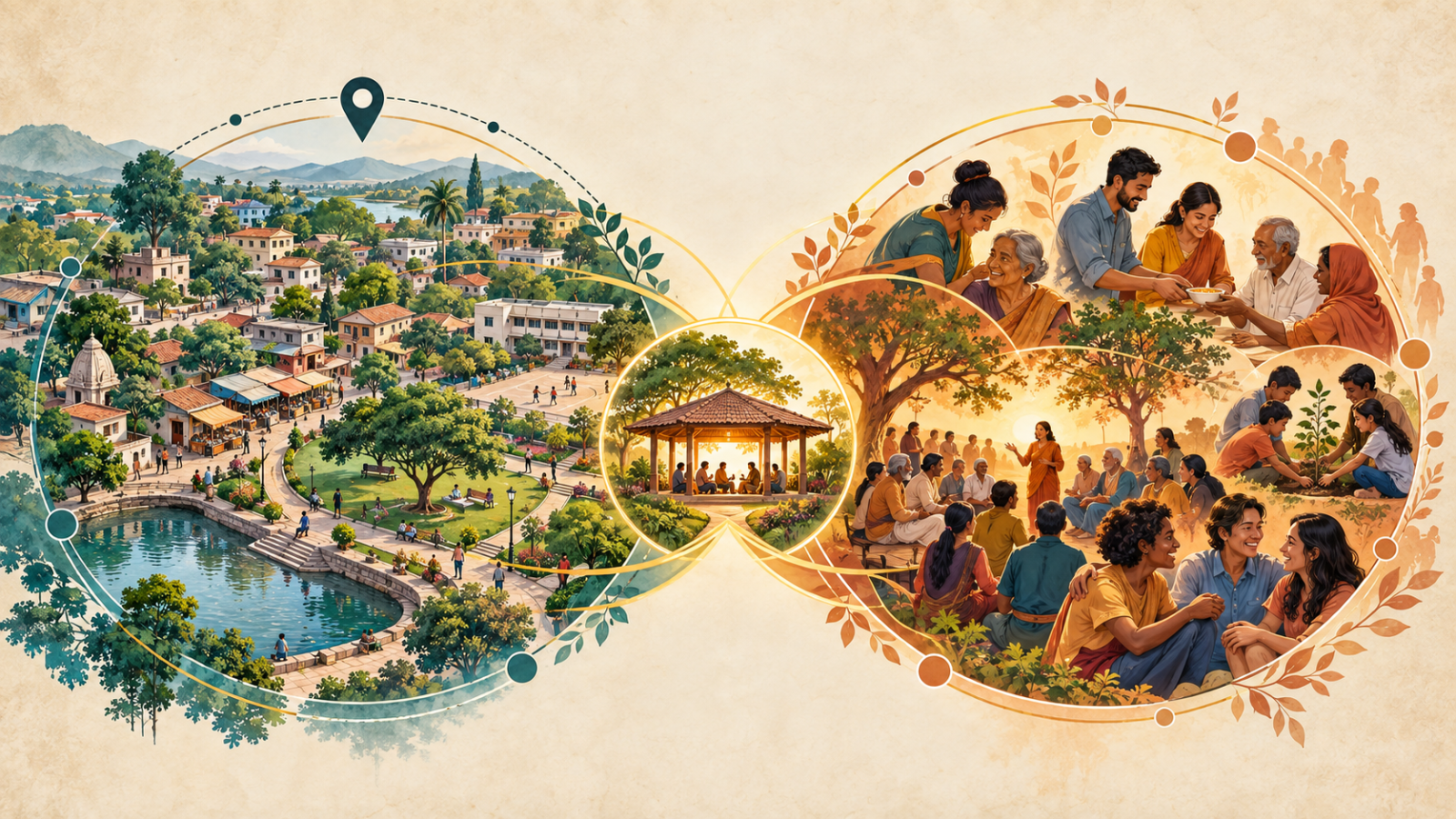
A community is a group of people who live together in a definite locality, share a common life and have a feeling of belonging together. Territory and community sentiment are its two essential bases. Kingsley Davis defined it as the smallest territorial group that can embrace all aspects of social life. A person can live his or her whole life within a community, such as a village or a tribe, but not within an association.
This note covers the meaning, definitions, characteristics and types of community, and its difference from society and association, for the UPSC Anthropology Optional. It belongs with social groups under Paper I, topic 2.2 of the Anthropology Optional syllabus.
Meaning of community
The mark of any social group is the presence of social relations. When a group in which people spend most of their lives is tied to a particular locality, and its members feel that they belong to it, the group is a community.
- Residential tie. A community is a collection of people with residential ties to a particular place. Territory is what separates it from other groups, which are not bound to a locality.
- Many interests. It is a permanent local aggregation of people with diverse as well as common interests.
- Origin of the word. "Community" comes from the Latin communis, "common" or "shared". It is often explained as com, "together", and munus, "service" or "duty": those who serve together.
Definitions of community
| Scholar | Definition |
|---|---|
| MacIver and Page | A group whose members live together in such a way that they share, not this or that particular interest, but a whole set of interests wide enough to include their lives. |
| Kingsley Davis | The smallest territorial group that can embrace all aspects of social life. |
| Ferdinand Tönnies | Gemeinschaft: a form of social life based on close, personal and lasting ties of kinship, neighbourhood and shared belief. |
| Robert Redfield | The "little community" is distinctive, small, homogeneous and self-sufficient. |
The test MacIver offers is simple. One cannot live one's whole life within a business firm or a club, but one can within a village or a city. A community is the setting in which all of a person's social relationships may be found.
Bases of community
- Locality. A community occupies a territorial area. Living together in one place produces common conditions of life.
- Community sentiment. Locality alone is not enough; there must be a sense of belonging together. MacIver analysed this sentiment into three elements:
- we-feeling: identification with the group;
- role-feeling: the sense of having a part to play in it;
- dependency-feeling: the sense of depending on it, physically and psychologically.
Characteristics of a community
| Characteristic | Explanation |
|---|---|
| Definite geographical area | A community is a spatial entity. Territory is a necessary condition, but mere co-residence is not enough: four friends sharing a room are not a community. |
| We-feeling | Attachment to one's home, locality or nation is the foundation of community. The sentiment develops over time. |
| Common culture and common life | Living in the same ecological conditions, members develop similar habits, behaviour and culture. |
| Close relationships | Living together and taking part in collective activities allows primary relations to develop. |
| Completeness of life | A community covers all aspects of life, including socialisation. |
| Natural growth and permanence | It is not formed for a particular aim. It grows spontaneously, and is therefore durable. |
| Wider ends | Its ends are general and natural, not specific. |
| A particular name | Each community has a name that expresses its identity. |
| Not a legal body | A community as such cannot sue or be sued; in law it has no rights or duties. |
Community is a relative term
In simple societies communities were largely self-sufficient. Today no community is. People live within ever larger communities: a village within a district, a district within a region, a region within a state, a state within a country.
Community and society compared
| Basis | Community | Society |
|---|---|---|
| Nature | Concrete: a group of people in a place | Abstract: a web of social relationships |
| Territory | Essential | Not essential |
| Community sentiment | Essential | Not necessary |
| Scope | Narrower; many communities within a society | Wider |
| Basis | Mainly likeness and common life | Likeness and difference, cooperation and conflict |
Community and association compared
| Basis | Community | Association |
|---|---|---|
| Origin | Grows naturally | Deliberately established |
| Interests | General; covers the whole of life | Specific; one or a few interests |
| Membership | By birth or residence | Voluntary |
| Duration | Permanent | May be temporary |
| Legal status | None | Often a legal body |
| Regulation | Customs and traditions | Written rules |
| Example | Village, tribe, city | Trade union, club, political party |
Types and examples of community
- Tribal community. Small, kin-based, with its own territory, dialect and customs.
- Rural (village) community. Agricultural, with face-to-face relations and strong informal control.
- Urban community. Large, heterogeneous, with weaker community sentiment and more secondary relations.
MacIver and Page regarded the village and the tribe as the best examples of community. They also treated places such as a prison or an asylum as communities of a limited kind, since the people in them lead a common life in one locality.
The community in anthropology
The community has been the anthropologist's basic unit of fieldwork.
- Robert Redfield described the little community by four qualities: distinctiveness, smallness, homogeneity and self-sufficiency. He placed communities along a folk-urban continuum.
- Indian village studies of the 1950s, by M. N. Srinivas, S. C. Dube, McKim Marriott and others, tested these ideas. They showed that the Indian village is not an isolated "little republic": it is tied to the wider society by caste, marriage, markets, pilgrimage and the state. See our note on Indian anthropologists.
- Tribal communities today face the same question of how far a community can remain distinct while joining the wider society. See tribal India today.
Community beyond locality
In modern usage the word is also applied to people who share an identity or interest without living together, such as a religious, professional or online community. Such groups have community sentiment but no common territory, so they do not meet the classical definition in full.
Using this topic in a UPSC answer
- Define community by its two bases: locality and community sentiment.
- Quote Kingsley Davis's one-line definition.
- Distinguish it from society and from association in a short table.
- Bring in Redfield's little community and the Indian village studies for the anthropological angle.
- Conclude that community is relative: no community today is fully self-sufficient.
For presentation, see our guide to anthropology answer writing with diagrams, thinkers and case studies.
Frequently asked questions
What is a community?
A community is a group of people living in a definite area who share a common life and culture and have a feeling of belonging together. A village, a tribe and a city are examples.
What are the two bases of community?
According to MacIver, the two bases of community are locality, meaning a definite territory, and community sentiment, meaning the feeling of belonging together.
What are the characteristics of a community?
A community has a definite territory, we-feeling, a common culture and way of life, close relationships, completeness of life, natural growth, permanence and a name. It is not a legal body.
What is the difference between community and society?
A community is concrete and tied to a locality, and requires community sentiment. Society is abstract, a web of relationships, and needs neither a definite territory nor community sentiment. A society contains many communities.
What is the difference between community and association?
A community grows naturally, covers the whole of life and is permanent. An association is deliberately formed for specific interests, has voluntary membership and written rules, and may be temporary.
What is community sentiment?
Community sentiment is the feeling of belonging together. MacIver analysed it into we-feeling, role-feeling and dependency-feeling.
What is Redfield's little community?
Robert Redfield described the little community as a small, distinctive, homogeneous and self-sufficient group, and used it as a model for studying folk and peasant societies.