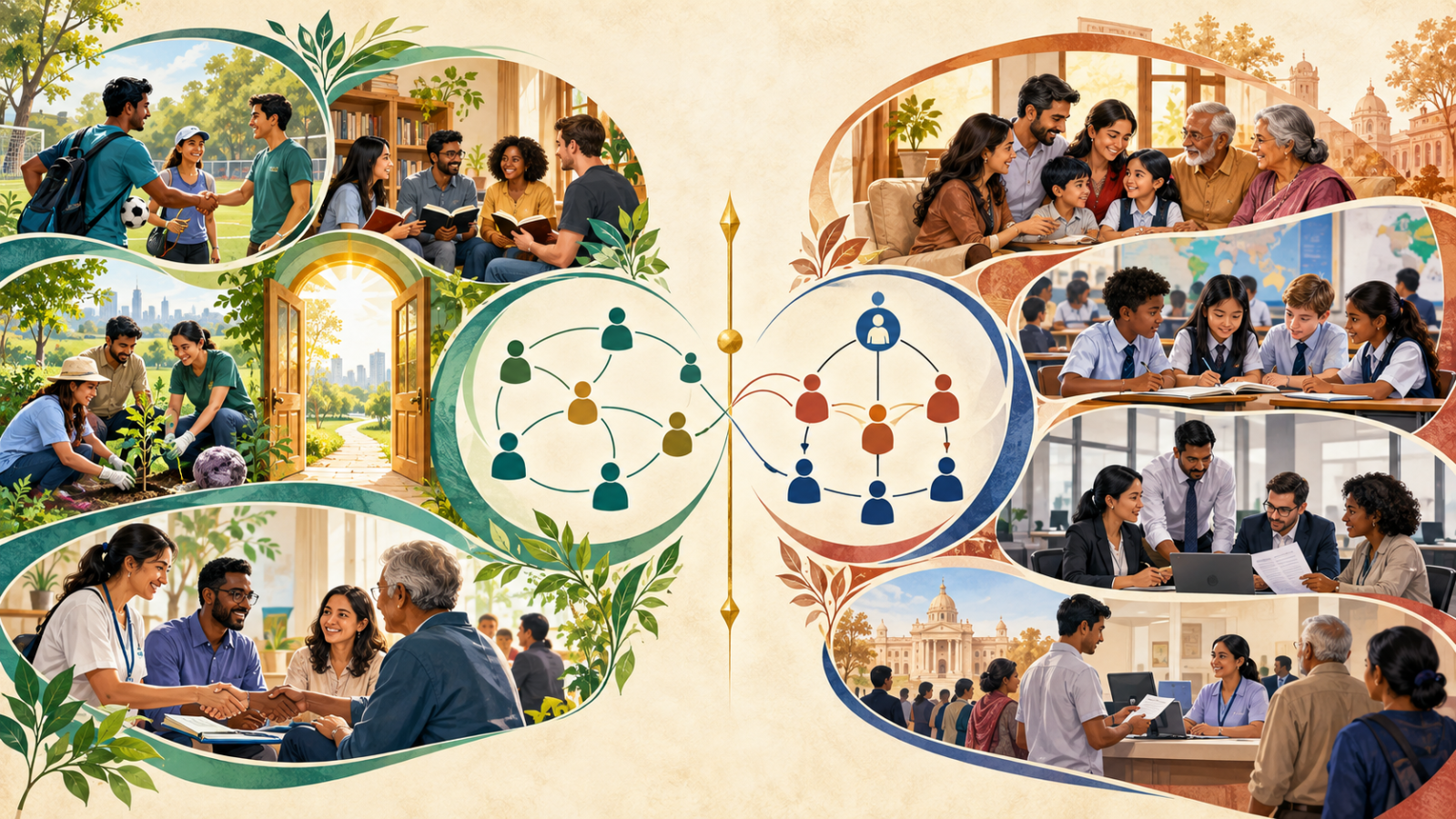
An association is a group of people deliberately organised to pursue a common interest or set of interests. MacIver and Page stressed that it is formed on purpose, has rules and has a specific aim. Anthropologists use the term for groups based on neither kinship nor territory, such as age-sets, men's and women's societies, and clubs. Associations may be non-voluntary, as in many egalitarian societies, or voluntary, as in most complex societies.
This note covers the meaning, characteristics and types of associations, with ethnographic examples, for the UPSC Anthropology Optional. It belongs with social groups under Paper I, topic 2.2 of the Anthropology Optional syllabus, and it also serves questions on age-sets, youth dormitories and tribal organisation.
Meaning of association
People can meet their needs in three ways: independently, through conflict with others, or through cooperation. When a group organises itself expressly to pursue certain interests together, an association is born.
An association is "an organisation deliberately formed for the collective pursuit of some interest or set of interests, which its members share". (MacIver and Page)
Three conditions follow from this definition:
- there must be a group of people;
- the group must be organised, with rules of conduct;
- it must have a common purpose of a specific kind.
Because people have many interests, they form many associations: political parties, students' unions, trade unions, chambers of commerce such as FICCI, professional bodies such as the Indian Medical Association, and international bodies such as the Rotary Club.
Characteristics of associations
| Sociological view (MacIver and Page) | Anthropological view (Ember and Ember) |
|---|---|
| At least two persons; a concrete group | Some kind of formal, institutionalised structure |
| Definite aims and objectives | Members with common interests or purposes |
| Deliberately created; does not grow spontaneously | Exclusion of some people |
| Membership is voluntary and governed by rules; members can be expelled | A discernible sense of pride and belonging among members |
| May be dissolved once its aim is achieved | Based on neither kinship nor territory |
The two views differ on one point. Sociologists, looking at modern societies, treat membership as voluntary. Anthropologists find that in many small-scale societies membership is non-voluntary: everyone of a given age or sex must belong.
Association, community and institution
| Basis | Association | Community | Institution |
|---|---|---|---|
| Nature | An organised group | A territorial group sharing a common life | A set of rules and procedures |
| Origin | Deliberately formed | Grows naturally | Evolves from usage |
| Interests | Specific | General; the whole of life | Serves a basic need |
| Membership | Has members | By birth or residence | Has no members; it is followed |
| Example | A college; a trade union | A village; a tribe | Education; marriage |
Classification of associations
Anthropologists classify associations on two dimensions: whether membership is voluntary, and what qualifies a person for membership.
| Recruitment criterion | Meaning | Non-voluntary examples | Voluntary examples |
|---|---|---|---|
| Universally ascribed | Qualities fixed at birth and found in all societies: age and sex | Age-sets; most men's and women's (unisex) associations | Youth and women's clubs |
| Variably ascribed | Qualities fixed at birth but found only in some societies: ethnicity, region, religion, class | Conscripted army | Ethnic and regional associations |
| Achieved | Qualities acquired in life: skills, occupation, interests | Military societies, trade unions, professional bodies, clubs |
In simple societies, with little division of labour, associations are few and inclusive, and take the form of age and sex groups. In modern societies they are many and specialised, each standing for a particular interest.
Non-voluntary associations
These are most characteristic of relatively egalitarian societies. They rest on age and sex.
Age-grades and age-sets
- Age-grade: a category of people who fall within a culturally recognised age range, such as "child", "warrior" or "elder".
- Age-set: a named group of people of similar age and the same sex who move through some or all of life's stages together.
Kinship organises most non-commercial societies. In some, age-sets cut across kinship and create strong additional bonds.
| Society | How the system works | What it does |
|---|---|---|
| Karimojong (cattle herders, north-eastern Uganda) | Men initiated within five to six years form an age-set. Five age-sets make a generation-set of 25 to 30 years. Two generation-sets are active at a time: the senior, which is closed, and the junior, which is still recruiting. | The senior set holds administrative, judicial and priestly authority; the junior set serves as warriors and police. Authority passes at a succession ceremony. A man may not marry until initiated. |
| Shavante (Mato Grosso, Brazil) | Every five years, boys of 7 to 12 enter a named age-set and live for five years in the bachelors' hut, learning hunting, weapon making and ritual. They then become "young men" and later "mature men". | The mature men's council takes community decisions, with older sets senior to younger. Girls are assigned to age-sets in name only and take no part in the council. |
Unisex associations
A unisex association restricts membership to one sex, usually men. Such associations often have dramatic initiation ceremonies and provide ties that cut across kinship.
| Association | Society | Main features |
|---|---|---|
| Bachelors' association | Mae Enga, New Guinea highlands | Men live in a separate communal house. Youths join at 15 or 16, observe strict avoidance of women and take part in purification rituals (sanggai) held in seclusion. The association supervises contact between the sexes and displays the solidarity of the clan. Wives come from enemy clans: "We marry the people we fight." |
| Poro (men) and Sande (women) | Kpelle and other Mande-speaking peoples of West Africa | Membership is universal and compulsory. Initiates spend about a year in seclusion learning adult skills. The leaders (Zo) form a "sacred" political structure alongside the secular chiefs and deal with serious disputes. Beryl Bellman showed that the "secret" lies in learning to keep secrets, which qualifies a person for political life. |
| Women's associations | Northern Ijaw, southern Nigeria | A married woman who trades independently must join the association of her husband's patrilineage. Associations mediate disputes, impose fines by consensus and lend money at interest. |
Cross-cultural research by Daphne Spain suggests that male age-sets with segregated men's houses and councils lower the status of women, by cutting them off from cultural knowledge and decision making.
Why do age-sets exist?
- S. N. Eisenstadt: age-sets arise where kinship groups fail to carry out political, educational and economic functions needed for the integration of society.
- B. Bernardi: they arise where there is territorial rivalry, no central authority and only dispersed kin groups.
- Cross-cultural evidence: supports the link with warfare, but not with weak authority or kinship. Age-sets appear where warfare is frequent and local groups change in size and composition through the year. A man cannot always count on kinsmen being near, but age-mates can be found everywhere.
Age-sets therefore arise in addition to kinship and political organisation, not as a substitute for them.
Voluntary associations
Voluntary associations are found in some simple societies but are far more common in stratified and complex ones, where people have many different and competing interests.
| Type | Basis | Example |
|---|---|---|
| Military associations | Shared experience as warriors (achieved) | The Cheyenne of the North American Plains had five military societies, such as the Fox and the Dog, open to any man ready for war and each led by four war chiefs. |
| Regional associations | Common place of origin | William Mangin studied migrants from the Ancash highlands in Lima, Peru. Their club lobbied government for services, helped newcomers adjust to city life, and kept up ties with the home region. |
| Ethnic associations | Ethnicity | Tribal unions in the cities of Nigeria and Ghana provide mutual aid, keep migrants in touch with their language and traditions, and fund improvements in the home area. |
| Rotating credit associations | Mutual trust | Each member contributes regularly to a fund that goes to each member in turn. Found across Asia, Africa and the West Indies. Default is rare because of social pressure. |
| Multi-ethnic associations | A shared problem that crosses group lines | The Wok Meri savings groups link women across tribal areas of Papua New Guinea. The Alaska Federation of Natives united many groups to secure land rights. |
| Interest groups | Achieved common interests | Trade unions, professional bodies, political parties, sports and social clubs. |
Why do voluntary associations multiply?
- Urbanisation. City migrants are separated from kin and custom. The first associations are usually mutual aid societies that take over the obligations of kin.
- Economic change. New group interests have to be organised, promoted and protected.
- Specialisation and achievement. In industrial societies, ethnic and regional associations tend to give way to narrower groups based on achieved interests.
- Media and mobility. Robert Putnam argued that civic associations were declining as people came to "bowl alone". Others reply that social media has created new forms of association.
Associations in India
- Youth dormitories of tribal India, such as the ghotul of the Muria, the dhumkuria of the Oraon and the morung of the Nagas, are associations based on age and sex that train the young and serve the village.
- Chit funds and self-help groups work on the principle of the rotating credit association.
- Caste and regional associations in cities help migrants find housing, work and marriage partners, much like the ethnic unions of West Africa.
See also our notes on tribal India today.
The link with the Sociology Optional
This topic is common ground between the two optionals, with a difference of emphasis.
| Basis | Sociology | Anthropology |
|---|---|---|
| Starting point | MacIver's distinction between association, community and institution | Groups that are neither kin-based nor territorial |
| Typical cases | Trade unions, parties, pressure groups, civil society | Age-sets, men's houses, secret societies, credit groups |
| Membership assumed to be | Voluntary | Often non-voluntary |
| Key question | What role do associations play in modern society and democracy? | Why do particular kinds of association arise in particular societies? |
If you are choosing between the two subjects, see our comparison of Anthropology and Sociology as UPSC optionals.
Using this topic in a UPSC answer
- Open with MacIver's definition, then add the anthropological sense: non-kin, non-territorial groups.
- Classify by voluntary and non-voluntary membership and by ascribed and achieved criteria.
- Give one ethnographic case for each: Karimojong age-sets; Poro and Sande; a regional or credit association.
- Explain why age-sets arise, naming Eisenstadt and Bernardi.
- Add Indian examples: youth dormitories and self-help groups.
For presentation, see our guide to anthropology answer writing with diagrams, thinkers and case studies.
Frequently asked questions
What is an association in anthropology?
In anthropology, an association is a group that is based on neither kinship nor territory. It has a formal structure, common interests, a sense of belonging among members, and it excludes some people. Age-sets, men's societies and clubs are examples.
How did MacIver define an association?
MacIver and Page defined an association as an organisation deliberately formed for the collective pursuit of some interest or set of interests which its members share.
What is the difference between an age-grade and an age-set?
An age-grade is a category of people within a culturally recognised age range. An age-set is an actual group of people of similar age and the same sex who pass through life's stages together.
What is the difference between association and community?
An association is deliberately formed for specific interests and has voluntary membership and rules. A community grows naturally in a locality, covers the whole of life and is permanent.
What are voluntary and non-voluntary associations?
In a voluntary association, people choose to join, as in a trade union or club. In a non-voluntary association, everyone of a certain category must belong, as in an age-set or the Poro and Sande societies.
Why do age-sets exist?
Cross-cultural evidence suggests that age-sets arise where warfare is frequent and local groups change in size and composition during the year. They give men allies wherever they are, in addition to their kin.
What is a rotating credit association?
A rotating credit association is a mutual aid group in which each member contributes regularly to a fund, and the whole fund is given to each member in turn. Chit funds work on this principle.