Anthropologists recognise eight customary ways of acquiring a mate: negotiation, exchange, service, probation, capture, intrusion, trial and elopement. They fall into three groups according to how far parents control the choice: negotiated mate choice (arranged marriage), partially free choice, and free choice by the partners themselves. Levirate, sororate and widow inheritance are further rules that supply a spouse after a death. Indian tribes provide examples of every form.
This note explains each way of acquiring a mate, with world and Indian tribal examples, for the UPSC Anthropology Optional. It falls under Paper I, topic 2.3 (marriage) and supports Paper II on tribal India in the Anthropology Optional syllabus.
What "acquiring a mate" means
The way of acquiring a mate is the customary procedure by which a husband or wife is found or obtained. It is also called mate choice or spouse selection. The descriptions here are drawn from classic ethnographies and are written in the ethnographic present; several of these customs have changed or disappeared, and some are no longer lawful.
Classification at a glance
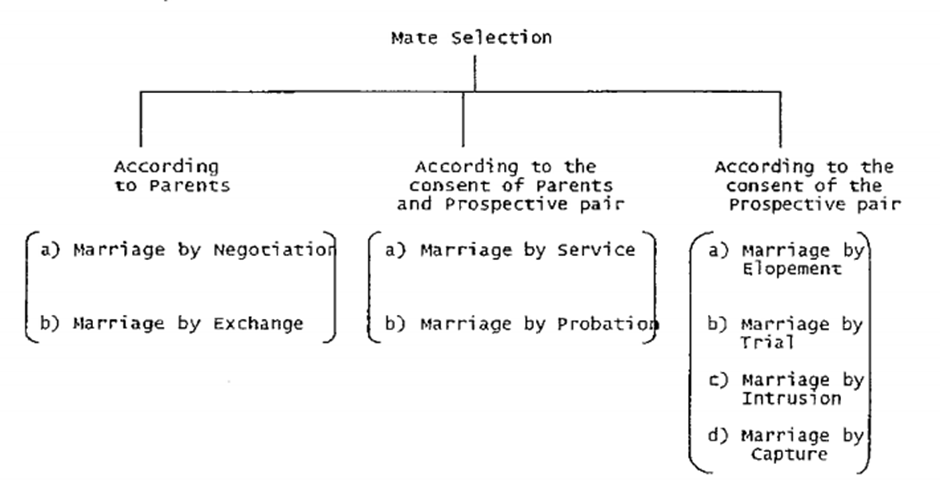
| Broad form | Role of parents | Sub-forms | Indian example |
|---|---|---|---|
| Negotiated mate choice (arranged marriage) | Parents and kin choose and arrange | By negotiation | Most tribes and castes; Chenchu, Andamanese |
| By exchange | Muria Gond, Baiga, Koya, Savara | ||
| By service | Gond (lamsena), Baiga | ||
| Partially free mate choice | The individual takes the initiative; approval of parents or community follows | By probation | Kuki of Manipur |
| By capture | Ho, Gond, Bhil, Kharia, Birhor | ||
| By intrusion | Ho (anader), Birhor, Kamar | ||
| By trial | Bhil | ||
| Free mate choice | Consent of parents not sought beforehand | By elopement or mutual consent | Muria Gond, Khond, Savara, Santhal |
1. Acquiring a mate by negotiation
This is the commonest way in all types of society, simple and complex. Either the boy's or the girl's parents, depending on custom, put forward the proposal. Go-betweens are often used: they know a wider network of families than any one family can, and neither side loses face if a proposal is refused.
Considerations in the negotiation:
- Marriage payments: bride price, dowry or an exchange of gifts. Where bride price is the main element, older textbooks call this "marriage by purchase".
- Reputation of the other family and kin group, in social standing or in personal qualities that make for pleasant affinal ties.
- Continuing an existing arrangement, such as the obligation to marry a cross-cousin or parallel cousin.
- Levirate or sororate obligations.
When the terms are settled, the acceptance is formally announced, together with the procedure for the wedding.
2. Acquiring a mate by exchange
Here the bride price is replaced by an exchange of women, usually the sisters or female relatives of the two grooms.
- It continues alliances. Apart from what is exchanged, the act of exchange itself creates solidarity between the groups.
- It avoids the bride price. Where marriageable women are few and compensation is heavy, exchange removes the difficulty.
Examples: Aboriginal Australian and Melanesian societies; the Tiv of Nigeria; in India the Muria Gond and Baiga of Chhattisgarh and the Bagata, Koya and Savara of Andhra Pradesh. It is also known in peasant societies.
3. Acquiring a mate by service
This is negotiation in which bride service takes the place of, or adds to, the bride price. The groom works for the bride's family for an agreed period.
| Consideration | Variation |
|---|---|
| Service or payment | Among the Chukchee of Siberia and the Muria Gond a man may choose between paying bride price and doing service. Among the Kaska of western Canada, the Lepcha of Sikkim and the Subanun of the Philippines he does both. |
| Duration | From a few weeks to several years. Two to three years is reported for the Gond and Baiga, the Bagata and Savara, the Chukchee and the Subanun. |
| Timing | Before the marriage among the Gond, Baiga, Bagata and Savara; after it among the Inuit and the San of the Kalahari. |
| Nature of work | An Inuit groom might meet the obligation by catching a seal for his in-laws. A San husband hunts for his wife's parents, by custom until several children have been born. |
| Relations during service | Among the Gond, Baiga, Bagata and Savara the pair are expected to behave as strangers until the service is complete. In some other societies they may live together during it. |
Among the Gond the serving son-in-law is known as the lamsena.
4. Acquiring a mate by probation
This requires the consent of the girl and of her parents. Among the Kuki of Manipur, the boy is allowed to stay in the girl's house for some weeks so that the two can judge whether they suit each other. If they do, the marriage is arranged. If not, they part and the boy pays compensation to the girl's parents.
5. Acquiring a mate by capture
Capture may be physical or ceremonial.
| Type | Description | Reported among |
|---|---|---|
| Capture in raids | Women taken from another village or group during fighting | Yanomamö of Venezuela and Brazil; some Naga groups in the past |
| Capture without the girl's consent | A suitor carries off a girl who has not accepted him | Ho (oportipi), Bhil, Bagata, Savara |
| Mock capture with consent | The girl and her relatives have agreed; the "capture" and the resistance are staged | Muria Gond, where the girl's parents may ask her cross-cousin to take her away |
| Ceremonial capture | The man applies vermilion mixed with oil to the girl's forehead in public, which is treated as equivalent to marriage | Kharia and Birhor of Jharkhand |
Reasons given for capture:
- scarcity of women;
- avoiding a heavy bride price, as among the Ho;
- delay by parents in arranging a daughter's marriage, as among the Muria Gond.
Capture without consent is a criminal offence under present Indian law. Where the custom survives, it does so mainly in its staged or ceremonial form.
6. Acquiring a mate by intrusion
This is found in a small number of societies. The initiative is taken by the woman, who enters the man's house and stays until she is accepted as his wife.
- Where the man is unwilling. Among the Ho (anader) and the Birhor, the girl puts up with rebuffs from his family and persists until they give way.
- Where the man evades responsibility. Among the Kamar of central India, a woman made pregnant in a casual relationship moves into the man's house and remains until she is accepted as his legal wife.
7. Acquiring a mate by trial
The young man must prove his courage and strength. Among the Bhil, at a festival held around Holi (known as Gol Gadhedo), a coconut and jaggery are tied to the top of a pole. Women dance in an inner ring and men in an outer ring. A young man who breaks through the women's ring, climbs the pole against their resistance, eats the jaggery and breaks the coconut wins the right to choose a bride from among the dancers.
8. Acquiring a mate by elopement
Elopement is a recognised way for determined individuals to choose their own partners, and is reported from societies in every part of the world, including the Muria Gond, Bagata, Savara and Khond in India.
- Why. It is the way out when family or social disapproval blocks a marriage the couple want, or when an unwanted marriage is about to be forced on one of them.
- Pattern. The couple run off and wait for days, months or even a year or two, hoping the marriage will be approved. The elders usually receive them back and allow them to live as husband and wife (Stephens, 1963).
Marriage by mutual consent, in which the couple choose each other and the families then agree, is closely related and is common among tribes with youth dormitories.
Levirate, sororate and widow inheritance
These are rules of secondary marriage. They supply a spouse after a death and keep the alliance between the two families alive.
| Rule | Meaning | Function | Examples |
|---|---|---|---|
| Levirate | A widow marries her dead husband's brother. In the junior levirate, only a younger brother may marry her. | Keeps the widow and children within the husband's group; no return of bride price is needed | Nuer; ancient Hebrews; in India the Santhal, Munda, Gond and Toda, and some north Indian castes |
| Sororate | A widower marries his dead wife's sister. Sororal polygyny is marriage to sisters while both are living. | Replaces the wife; continues the alliance; the children are cared for by their mother's sister | Many Native North American societies; Gond and Kharia in India |
| Widow inheritance | The widow passes to an heir of the dead man other than a brother, such as a son by another wife (filial inheritance) or a sister's son | Rights over the widow are treated as part of what the heir succeeds to | Some African societies; reported for the Sema Naga in India |
In the strict levirate, as among the ancient Hebrews, children born to the widow are counted as children of the dead husband. In widow inheritance they belong to the new husband.
Using this topic in a UPSC answer
- Start with the three-fold classification by degree of parental control.
- List the eight ways with one tribe each; a two-column table is enough.
- Use the vernacular terms where sure of them: lamsena (service), oportipi (capture), anader (intrusion), Gol Gadhedo (trial).
- Explain why a form exists: bride price explains service, exchange and capture.
- Add levirate and sororate as secondary marriages that preserve alliance.
- Close by noting change: education, law and the market have made negotiation and mutual consent the dominant forms.
For presentation, see our guide to anthropology answer writing with diagrams, thinkers and case studies. For present-day issues among these communities, see tribal India today.
Frequently asked questions
What are the ways of acquiring a mate in tribal societies?
The eight ways are negotiation, exchange, service, probation, capture, intrusion, trial and elopement. Marriage by mutual consent and by purchase (bride price) are also listed in some classifications.
What is marriage by service?
In marriage by service the groom works for the bride's family for an agreed period, in place of or in addition to paying bride price. Among the Gond the serving son-in-law is called a lamsena.
What is marriage by exchange?
In marriage by exchange two families exchange women, usually sisters, so that neither has to pay bride price. It is reported among the Muria Gond, Baiga, Koya and Savara.
What is marriage by intrusion?
In marriage by intrusion a woman enters the house of the man she wishes to marry and stays there until she is accepted as his wife. It is known as anader among the Ho.
What is marriage by trial?
In marriage by trial a young man must prove his courage or strength to win a bride. The standard example is the Gol Gadhedo festival of the Bhil.
What is marriage by probation?
In marriage by probation the couple live together for a short time in the girl's house, with her parents' consent, to test their compatibility before marriage. It is reported among the Kuki.
What is the difference between levirate and sororate?
In levirate a widow marries her dead husband's brother. In sororate a widower marries his dead wife's sister. Both keep the alliance between the two families in being.