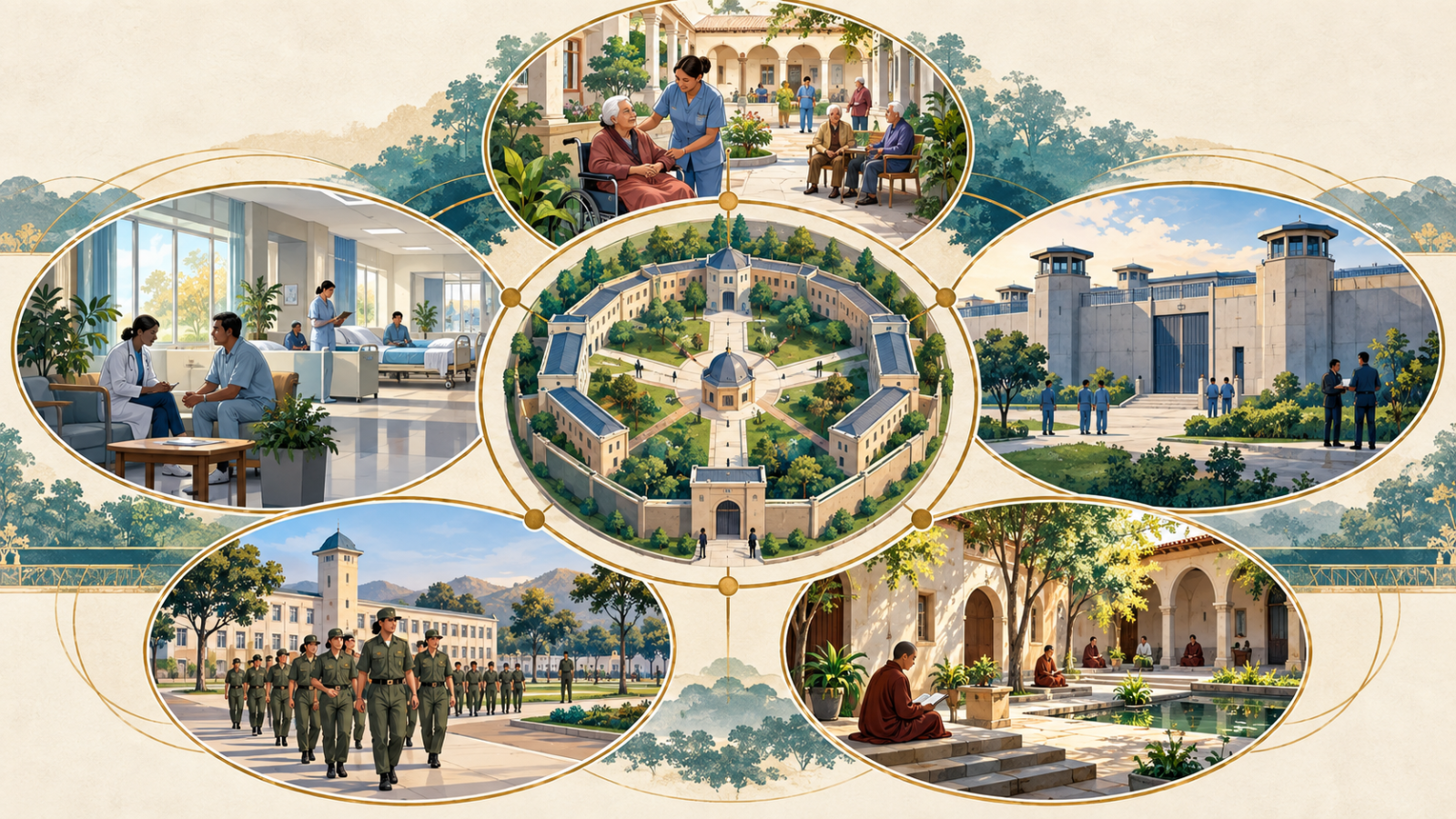
A total institution is a closed social system in which a large number of people live cut off from wider society, under a single authority, with every part of daily life governed by strict rules and schedules. Erving Goffman developed the concept in a 1957 paper and in his book Asylums (1961). Prisons, closed psychiatric hospitals, military barracks, boarding schools and monasteries are the standard examples. Their purpose is care, custody, training or resocialisation.
This note covers the meaning, types, characteristics and criticism of total institutions for the UPSC Anthropology Optional. It extends the study of social institutions under Paper I, topic 2.2 of the Anthropology Optional syllabus.
Meaning of a total institution
- Closed. It is separated from wider society by distance, law or physical barriers. Permission is needed to enter and to leave.
- Single authority. What happens inside is decided by one authority, whose will is carried out by a staff that enforces the rules.
- Similar members. Those who live inside are generally alike in some respect.
- Voluntary or involuntary. A person may choose to enter, as in a monastery, or be made to, as in a prison. Either way, the rules must be followed.
- New identity. The entrant leaves behind a former identity and takes on one given by the institution.
Total institutions generally exist to care for people who cannot care for themselves, to protect society from people seen as a danger to it, or both. Sociologically, they serve resocialisation and rehabilitation.
Erving Goffman and the concept
Erving Goffman is credited with establishing the term. He may not have been the first to use it, but his paper "On the Characteristics of Total Institutions", presented in 1957, is the foundational text. It became the opening essay of Asylums (1961).
The study is of interest to anthropologists because of its method. Goffman spent about a year doing fieldwork inside a large psychiatric hospital in Washington, D.C., observing daily life from the patients' side. It is an ethnography of an institution, using the participant observation that anthropologists had developed in small-scale societies.
Goffman observed that all institutions have "encompassing tendencies": each takes some of its members' time and interest. Total institutions differ in degree. They are far more encompassing than others, and this is symbolised by their barriers: high walls, locked doors, barbed wire, and sometimes cliffs or water.
Five types of total institutions
| Type | Purpose | Examples |
|---|---|---|
| 1. Care of the harmless | To look after people who cannot care for themselves and pose no threat | Homes for the aged, the blind and the destitute; orphanages |
| 2. Care of those who are an unintended threat | To care for members and also protect the public | Closed psychiatric hospitals; in Goffman's time, tuberculosis sanatoria and leprosy homes |
| 3. Protection of society | To protect the community from those seen as intentional dangers; the welfare of inmates is secondary | Prisons and jails; prisoner-of-war camps; concentration camps |
| 4. Work, education and training | Established on "instrumental grounds", to carry out a task better | Army barracks, ships, boarding schools, work camps, mining camps |
| 5. Retreat from the world | Spiritual or religious training | Monasteries, convents, abbeys and other cloisters |
Characteristics of total institutions
Goffman identified features common to all five types. Not every institution has all of them in the same degree.
1. Totalistic features
In ordinary life people sleep, work and play in different places, with different companions and under different authorities. A total institution breaks down these barriers.
- All aspects of life are conducted in the same place, under the same authority.
- Each activity is carried out in the company of a large batch of others, all treated alike.
- The day is tightly scheduled, with rules imposed from above.
- All activities are brought together in a single plan designed to fulfil the official aims of the institution.
Because people are handled in groups, a small staff can supervise a large population. A sharp divide separates the managed group, the inmates, from the supervisory staff, and each tends to see the other in stereotypes.
2. The inmate world and the mortification of self
On entry, a person goes through a "mortification process" that strips away the identity held outside.
- Personal clothing and possessions are taken and replaced by standard issue.
- Admission procedures such as registration, numbering, haircuts and uniforms mark the break with the past.
- Autonomy is lost, and contact with the outside world is limited or forbidden.
- The new identity is often a stigmatised one, lower in status than that of the staff and of people outside.
3. The privilege system
Alongside strict "house rules" there is a system of small rewards and privileges for obedience, and punishments for breaking the rules. It gives inmates a framework for reorganising their lives, and it secures cooperation with the authority.
4. Modes of adaptation
| Mode | What the inmate does |
|---|---|
| Situational withdrawal | Turns inward and attends only to what is immediately around |
| Rebellion (the intransigent line) | Openly refuses to cooperate with staff. Goffman noted that this itself requires close awareness of the rules. |
| Colonisation | Comes to prefer life inside and builds a contented existence from what the institution offers |
| Conversion | Takes over the staff's view and tries to be the perfect inmate |
Most inmates, Goffman found, combine these as the situation requires, "playing it cool" to get through with the least damage.
Total institutions and ordinary social institutions compared
| Basis | Ordinary social institution | Total institution |
|---|---|---|
| Hold on the individual | Partial; covers one sphere of life | Total; covers all spheres |
| Contact with outside | Open | Restricted or cut off |
| Authority | Several, in different spheres | Single |
| Process | Socialisation | Resocialisation |
| Examples | Family, marriage, a day school | Prison, barracks, monastery |
Related ideas and criticism
- Michel Foucault. In Discipline and Punish (1975), Foucault examined prisons, barracks, schools and hospitals as sites of discipline and surveillance. His concern, like Goffman's, was with what such places do to individuals.
- Institutionalisation. Long stays can leave people unable to manage life outside. Goffman's work influenced the movement to treat mental illness in the community instead of in large closed hospitals.
- Over-generalisation. Critics say the concept groups together very different places. A monastery entered by choice is not the same as a prison.
- Neglect of variation. Institutions of the same type differ in how closed and how harsh they are, and many have changed since the 1950s.
- One-sided view. Goffman wrote from the inmate's side and gave less attention to the staff's perspective or to the benefits of care and treatment.
Using this topic in a UPSC answer
- Define the total institution and name Goffman and Asylums (1961).
- List the five types in a table, with one example each.
- Explain the mortification of self and the four modes of adaptation; these carry the concept.
- Use Indian examples, such as prisons, army cantonments, monasteries and residential schools.
- Link to resocialisation, and end with one line of criticism.
For presentation, see our guide to anthropology answer writing with diagrams, thinkers and case studies.
Frequently asked questions
What is a total institution?
A total institution is a place of residence and work where a large number of similarly situated people, cut off from wider society for a considerable time, lead an enclosed and formally administered life under a single authority.
Who gave the concept of total institution?
The sociologist Erving Goffman developed the concept in his 1957 paper "On the Characteristics of Total Institutions" and in his book Asylums, published in 1961.
What are the five types of total institutions?
Goffman's five types are institutions for the care of the harmless, such as homes for the aged; for those who are an unintended threat, such as closed psychiatric hospitals; for the protection of society, such as prisons; for work or training, such as barracks and boarding schools; and for religious retreat, such as monasteries.
What is the mortification of self?
Mortification of self is the process by which a person entering a total institution is stripped of his or her former identity, through loss of personal possessions, uniform dress, fixed routines and restricted contact with the outside world.
What is resocialisation?
Resocialisation is the process of discarding earlier patterns of behaviour and identity and learning new ones. Total institutions carry it out deliberately, through control of the whole environment.
How do inmates adapt to a total institution?
Goffman described four modes of adaptation: situational withdrawal, rebellion, colonisation and conversion. Most inmates use a mixture of these.
What are the criticisms of Goffman's concept?
Critics argue that the concept groups together very different institutions, underplays the variation among them, and presents mainly the inmate's point of view.