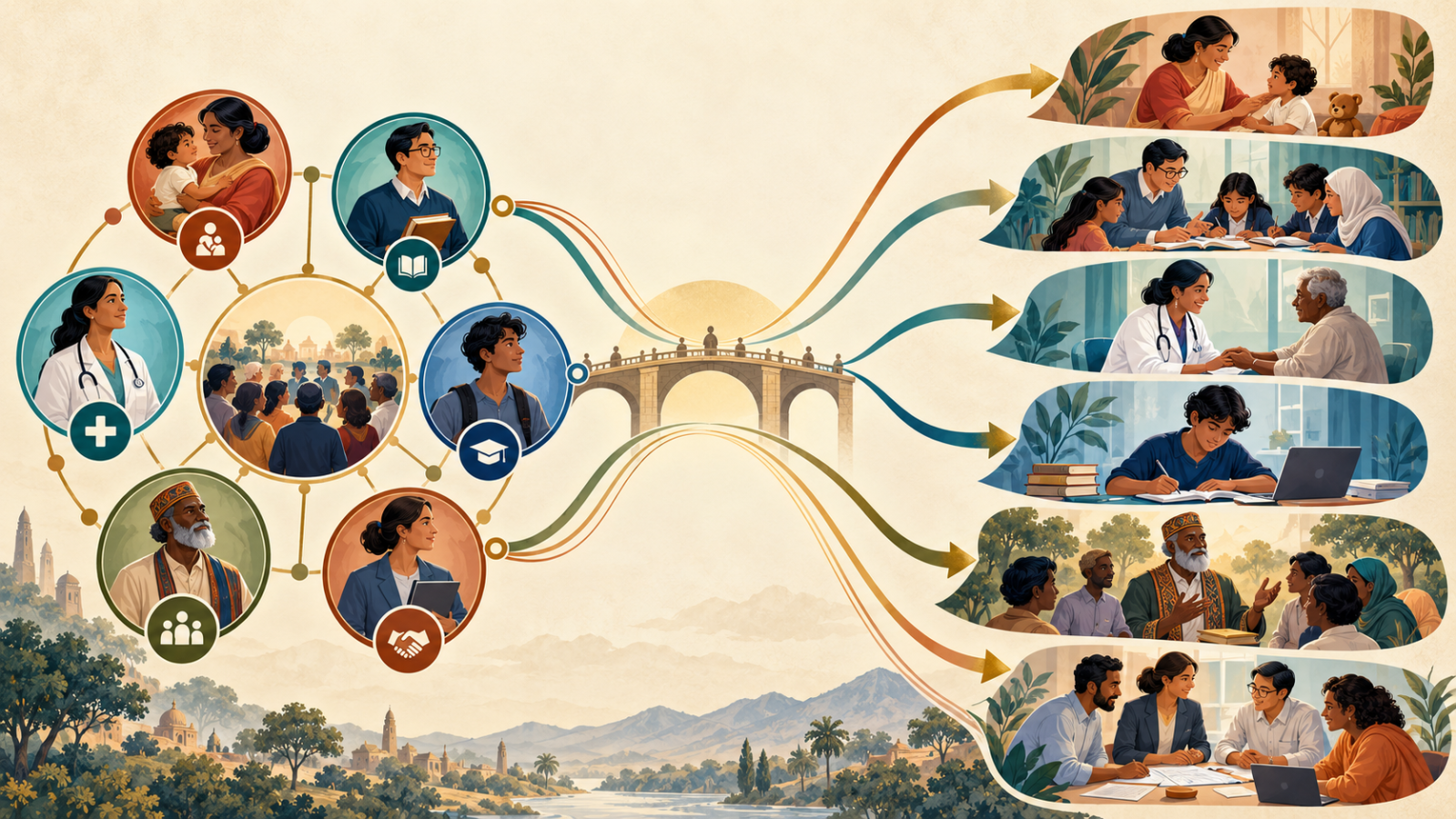
Status is a position a person occupies in society; role is the behaviour expected of someone in that position. Ralph Linton (1936) defined status as "a collection of rights and duties" and role as the dynamic aspect of status. Statuses are occupied and roles are played. A status is ascribed when it is assigned at birth, as with age, sex and kinship, and achieved when it is gained through effort, as with occupation and education.
This note covers the concepts of status and role, their types, role systems in simple and complex societies, and role conflict, for the UPSC Anthropology Optional. These concepts underlie the study of society and social stratification under Paper I, topic 2.2 of the Anthropology Optional syllabus.
The concept of status
Linton wrote that when a person puts into effect the rights and duties that make up a status, he is performing a role. Status and role are therefore two sides of one thing, and together they show how social life is organised and how activities are distributed.
- Status carries expectations. Each status has behavioural expectations attached to it; these are its roles.
- Status is ranked. Positions are not merely different; they are placed in a hierarchy. One occupation differs from another in prestige and reward as well as in task. Status is thus a basis of social stratification.
- Status is valued. Each status brings privileges or deprivations. Caste status in India once barred people from public wells and from eating or marrying with other castes. In the United States, race was for long a ground for denying employment and for segregation in schools and housing.
- The value of a status changes. Positions once stigmatised, on grounds of gender, disability, race or caste, have gained dignity through long struggles for rights. Statuses and roles are dynamic.
Ascribed and achieved status
| Basis | Ascribed status | Achieved status |
|---|---|---|
| Linton's definition | Assigned to individuals without reference to their innate differences or abilities | Left open to be filled through competition and individual effort |
| When acquired | At birth or with the life cycle | Over a lifetime |
| Criteria | Age, sex, kinship and race everywhere; caste and class by birth in some societies | Occupation, education, office, marriage |
| Typical of | Simple and traditional societies; closed systems | Complex and industrial societies; open systems |
The line between the two is not sharp. Ascribed statuses seem fixed but are not immutable: many societies now give legal recognition to transgender persons and to a third gender, as India did in 2014. Achieved statuses, in turn, are much easier to reach for those born into advantage.
Master status and status set
- Master status. One status tends to overshadow all the others in how a person is seen. Gender, race and caste often become master statuses in highly stratified societies.
- Status set. R. K. Merton used this term for all the statuses a person holds at one time: daughter, student, citizen, team captain.
The concept of role
| Scholar | Definition |
|---|---|
| Ralph Linton (1936) | The dynamic aspect of status. |
| Michael Banton (1965) | A cluster of rights and obligations. What is one person's obligation is his partner's right. |
| Ralph Turner | A cluster of behaviour and attitudes, which organises social behaviour at both individual and collective levels. |
| Giddens and Sutton (2014) | Socially defined expectations that a person in a given status follows. |
In a restaurant the waiter is obliged to serve and the customer has the right to be served. In a traffic jam we expect the police officer to restore the flow. Banton noted that the concept of role is, for this reason, one of the means of studying cooperation.
- Roles create order. They make interaction predictable.
- Roles are learned. Children watch how those around them behave and act out the parts of mother, father or teacher in play. People also take role models, from the family, the neighbourhood or the media.
- Roles are switched. We move from one role to another without effort. A lawyer behaves differently in court and at home; lives and roles are compartmentalised.
- Roles are negotiated. Not everyone conforms. Individuals constantly redefine the roles they play.
- Roles change. In India women were long expected to keep to domestic work. Many now take up roles once reserved for men. Such change is slow and often needs sustained struggle.
Status and role compared
| Basis | Status | Role |
|---|---|---|
| Nature | A position | The behaviour expected in that position |
| Aspect | Static, structural | Dynamic, behavioural |
| Verb | Occupied | Played or performed |
| Content | Rights and duties | Rights and duties put into effect |
| Example | Teacher | Teaching, examining, guiding |
Role theory: structural and interactionist approaches
| Basis | Structural approach | Interactionist approach |
|---|---|---|
| Scholars | Linton, Banton, Parsons, Merton | G. H. Mead, Ralph Turner, Erving Goffman |
| View of role | Norms and expectations attached to a status in the social structure | Something worked out in interaction |
| Key process | Role taking: individuals are socialised into given roles | Role making: individuals interpret, evaluate and negotiate their roles |
| Assumption | Consensus. Linton: the better members are adjusted to their statuses and roles, the more smoothly society functions. | Creativity within the limits of structure |
Mead showed how the self grows by "taking the role of the other", first in children's play and then in organised games. Goffman compared social life to a stage, on which people manage the impression they give, and he used the term role distance for the way a person signals detachment from a role he is playing.
Classification of roles
| Classification | Type | Meaning and examples |
|---|---|---|
| By mode of acquisition | Ascribed roles | Given at birth and learned through socialisation: roles of sex, age, kinship and caste. |
| Achieved roles | Acquired over a lifetime, largely by merit: farmer, banker, driver, lawyer, professor. | |
| By dependence on a partner | Relational roles | Defined in relation to a complementary role: wife and husband, debtor and creditor. Kinship roles are relational. |
| Non-relational roles | Not dependent on a complementary role: musician, painter, researcher. Age and sex roles largely fall here. | |
| By independence from other roles (Banton) | Basic roles | Fixed mostly by sex and age, ascribed at birth, and shaping conduct in a large number of contexts. |
| General roles | Mostly assigned on merit, and affecting many but not all contexts: for example, policeman or priest. | |
| Independent roles | Assigned on merit, with few implications for a person's other roles: leisure roles and many occupational roles. |
A person's sex role usually shapes his or her conduct, and the response of others, more than any occupational role does.
Role systems in simple and complex societies
According to Banton, one way to understand variation in social organisation is to study the criteria by which roles are allocated.
Simple societies
In the simplest societies, such as the San of the Kalahari and the Inuit of the Arctic, roles are allocated on the natural differences of sex, age and kinship.
| Criterion | How roles are allocated among the San |
|---|---|
| Sex | Men hunt, prepare skins, make weapons and build the fire. Women build the shelter, care for children, and gather and prepare food. |
| Age | A boy becomes a man when he kills his first buck; the passage is marked by ritual, after which he may marry. A girl takes up the role of wife when she matures. Elders are respected as experts on tradition, myth and descent. |
| Kinship | Parents bring up their children, who as adults owe them reciprocal obligations. Marriage between close relations is avoided to keep kin ties clear. |
Complex societies
As societies grow more complex, new criteria are needed.
- Social strata. Some societies are organised into ranks such as nobles, commoners and slaves. Members of a stratum share a similar existence, with the same privileges and duties. Strata can become rigid, so that birth decides a person's life chances. In the caste system a person was expected to follow the norms, occupation and rules of interaction of the caste of birth, and departures were punished, most severely when made by those ranked low. These rules have weakened under law and sustained struggle, but have not disappeared.
- Diversification and specialisation. Tasks are distributed by skill and training. Every organisation, large or small, has a division of roles.
The general movement, as Henry Maine put it, is from status to contract: from roles fixed by birth to roles entered by agreement and achievement. See also our note on social anthropology.
Dimensions of role
Role set and multiple roles
Linton assumed that each status has one role. R. K. Merton (1957) argued that each status has an array of roles, which he called the role set: the complement of role relationships in which a person is involved by virtue of occupying a particular status.
| Basis | Role set | Multiple roles |
|---|---|---|
| Number of statuses involved | One | Several |
| Meaning | The different roles attached to a single status, one for each role partner | The roles attached to the different statuses a person holds |
| Example | A medical student relates, as student, to teachers, nurses, physicians, patients and social workers | The same person is also a daughter, a friend and a team member |
Merton added that role partners may hold contradictory expectations, so that even a single status can produce tension.
Role signs
Role signs are visible markers, such as dress, uniform, titles and hairstyle, that tell others what role a person is playing. According to Banton they serve two purposes: communication, by shaping expectations and interaction, and control, by checking departures from the role.
| Type of role | Typical signs |
|---|---|
| Basic roles | Personal names, clothing and hairstyle distinguishing sex and age; titles such as Mr, Mrs and Miss. |
| General roles | Uniforms and insignia, used where it is necessary to make the role plain to everyone: police officer, nurse, ticket collector. |
| Independent roles | Few signs, relevant only in particular settings. To outsiders they often serve as signs of prestige. |
Role change and rites of passage
Roles do not remain the same. People move from one role to another and add new ones. When this happens, the person must learn the rights and obligations of the new role, and others must adjust their behaviour and expectations. This is why changes of role are so often marked by ceremony.
- Childhood to adulthood. The San boy's first kill; puberty rites for girls in many societies.
- Marriage. A ceremony attended by family, neighbours and community.
- Office. The oath taken by a chairperson, a prime minister or a president.
- Old age. Elders are relieved of heavy tasks and take on new roles, such as caring for grandchildren. Some societies honour them for their wisdom; others treat them as dependants.
Arnold van Gennep called such ceremonies rites of passage and found three stages in them: separation from the old status, a transitional or liminal stage, and incorporation into the new status.
Role conflict, role strain and role exit
| Concept | Meaning | Example |
|---|---|---|
| Role conflict | Incompatible expectations arising from two different statuses held by the same person | A working mother pulled between her profession and her family, especially where others have not adjusted to her new role |
| Role strain | Incompatible demands within a single status | A student who has an examination and an inter-school competition on the same day |
| Role exit | The process of leaving a role that has been central to one's identity | Retirement; leaving a religious order |
People manage role conflict by compartmentalisation, keeping what they do in one role separate from another, and by giving one role priority. Persistent strain or conflict can raise doubts about a role and lead in the end to exit.
Using this topic in a UPSC answer
- Open with Linton's definitions of status and role, and the line "statuses are occupied, roles are played".
- Distinguish ascribed from achieved status, and note that the line between them is blurred.
- Bring in Merton's role set and Banton's classification to show depth.
- Contrast role allocation in simple societies (sex, age, kinship) with complex societies (strata, specialisation).
- Use rites of passage as the anthropological illustration of role change.
- End with role conflict and its relevance to changing gender roles in India.
For presentation, see our guide to anthropology answer writing with diagrams, thinkers and case studies.
Frequently asked questions
What is the difference between status and role?
Status is a position in society, consisting of rights and duties. Role is the behaviour expected of a person who holds that position. Status is occupied; role is played.
How did Linton define status and role?
Ralph Linton, in The Study of Man (1936), defined status as a collection of rights and duties, and role as the dynamic aspect of status: a person performs a role when he puts those rights and duties into effect.
What is the difference between ascribed and achieved status?
Ascribed status is assigned at birth or by the life cycle, without regard to ability, as with sex, age, kinship and caste. Achieved status is gained through effort and competition, as with occupation and education.
What is a master status?
A master status is the one status that overshadows all the others in how a person is seen and treated. Gender, race and caste often act as master statuses.
What is a role set?
A role set, a concept of R. K. Merton, is the array of roles attached to a single status. A teacher, for example, plays different roles towards students, colleagues, the principal and parents.
What is the difference between role conflict and role strain?
Role conflict arises between the roles of two different statuses held by one person. Role strain arises from competing demands within a single status.
What are role taking and role making?
Role taking is the structural view that individuals are socialised into roles already laid down by society. Role making is the interactionist view that individuals interpret, negotiate and reshape their roles.
How are roles allocated in simple societies?
In simple societies roles are allocated mainly by sex, age and kinship. In complex societies they are also allocated by social stratum and by specialised skill.