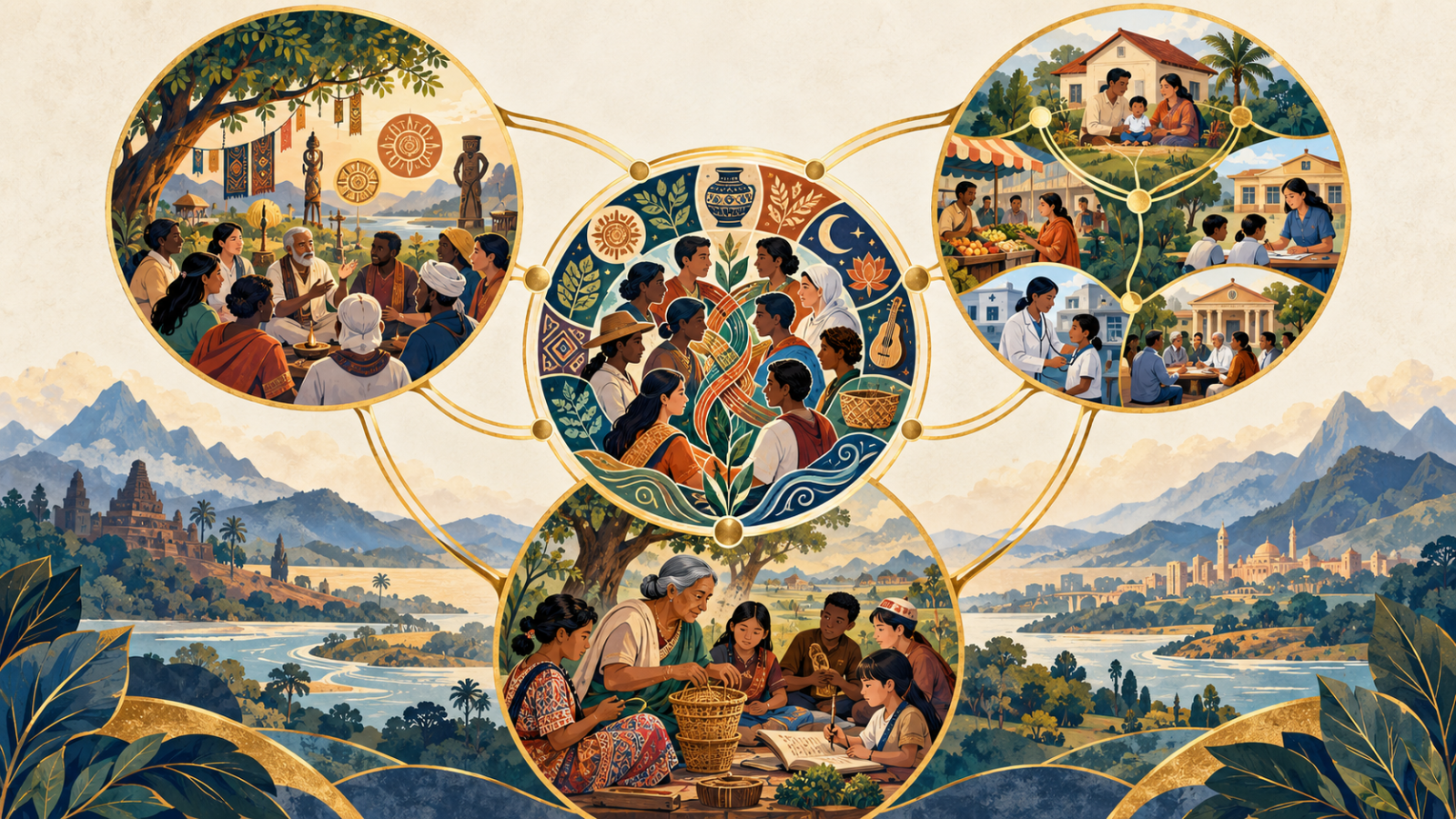
Culture is integrated or patterned because its traits are not a random assortment of customs; they are mostly adjusted to and consistent with one another. Three forces produce this consistency: the human need for cognitive consistency, less conscious psychological processes such as generalisation, and adaptation to the environment. The integration is never complete, so anthropologists say that culture is imperfectly patterned.
This note explains why culture is integrated and patterned, with thinkers and examples, for the UPSC Anthropology Optional. It falls under Paper I, topic 2.1 (the concept and characteristics of culture) of the Anthropology Optional syllabus.
What does "integrated" or "patterned" mean?
Anthropologists have always held that a culture is not a hodgepodge of unrelated behaviours and ideas. To say that a culture is integrated means three things:
- Consistency. Its customs, beliefs and institutions mostly fit with one another.
- Interdependence. A change in one part tends to produce changes in other parts.
- Context. No trait can be fully understood outside the whole to which it belongs.
"Patterned" adds the idea that the traits are arranged in a recognisable, recurring design that gives each culture its distinct character.
Thinkers on the integration and patterning of culture
| Thinker | Idea |
|---|---|
| W. G. Sumner | Folkways show a "strain toward consistency" with one another. |
| Bronisław Malinowski | Culture is an integrated whole in which every custom fulfils a function in meeting human needs. |
| A. R. Radcliffe-Brown | Institutions contribute to the maintenance of the social structure, as organs do to the life of an organism. |
| Ruth Benedict | In Patterns of Culture (1934), each culture selects from the range of human possibilities and builds a consistent pattern, comparable to a personality. Her examples are the restrained Apollonian Zuni and the ecstatic Dionysian Plains Indians and Kwakiutl. |
| A. L. Kroeber | Cultures are organised into patterns, some universal and some specific to a culture, which persist over time. |
| Morris Opler | A culture is integrated not by one pattern but by several "themes", which are balanced by counter-themes. |
Why is culture integrated? Three reasons
1. Cognitive consistency and rational choice
The ideas of a culture are stored in the minds of individuals. Research in social psychology suggests that people tend to modify beliefs or behaviours that are inconsistent with what else they know. If individuals lean towards consistency, at least some aspects of their culture will be integrated for that reason alone.
- Pressure from others. A child refused something will say, "But you said I could yesterday." Such pressure, from within and without, pushes people to be consistent.
- Rational decision making. People can work out that one custom makes another easier or harder. Where a society has a long postpartum sex taboo, couples are likely to sleep apart, because that makes the taboo easier to keep. Where people drive on the left, as in England and India, the steering wheel is placed on the right, because the driver can then judge oncoming traffic better.
2. Less conscious psychological processes
Integration is also produced without deliberate thought. People generalise, or transfer, their experiences from one area of life to another.
Where children are taught that it is wrong to express anger towards family and friends, the folktales of that society run parallel to the child-rearing: anger and aggression in the tales are directed only at strangers. The expression of anger close to home appears too frightening, even in stories. Child training and folklore, two apparently separate parts of culture, thus come to fit each other.
3. Adaptation to the environment
Adaptation is the other major reason for traits to be patterned.
- Maladaptive customs, those that reduce the chances of survival and reproduction, tend to disappear. Either the people holding them die out, or the customs are replaced.
- Adaptive customs, those that enhance survival and reproductive success, tend to persist.
- If a society has survived long enough to enter the ethnographic record, much of its cultural repertoire is therefore adaptive, or once was.
A custom is adaptive only in relation to a specific physical and social environment. What works in one setting may fail in another. Customs that suit a particular setting will be found together as a bundle wherever similar conditions occur. This is the line of reasoning developed in cultural ecology by Julian Steward.
Example: the !Kung hunter-gatherers
| Condition | Cultural trait that fits it |
|---|---|
| Game is mobile and plants ripen at different times | Nomadic way of life |
| Foraging cannot support many people in one area | Small social groups |
| People move frequently | Few material possessions |
These traits usually occur together wherever people depend on hunting and gathering. The pattern is produced by adaptation, not by chance.
Culture is imperfectly patterned
Integration is a tendency, not a law. Not all aspects of a culture are consistent, and a society is not forced to adapt its culture to changing circumstances.
- People may choose not to change. The Tapirapé of central Brazil kept their custom of limiting births to three children per woman even after contact with Europeans and their diseases had reduced them from over 1,000 people to fewer than 100. They continued to value small families while on the way to extinction.
- People may misjudge. People alter their behaviour according to what they think will help them, but what they think helpful may not prove adaptive.
- Parts change at different speeds. W. F. Ogburn's "cultural lag" describes the strain that arises when material culture changes faster than non-material culture.
- Ideal and real culture differ. What the rules say and what people do are not always the same.
The tendency for a culture to be integrated or patterned, then, is cognitively and emotionally, as well as adaptively, induced, and it is never complete.
Why this matters
- For method. It is the basis of the holistic approach: a custom must be studied in relation to the rest of the culture.
- For culture change. Because the parts are linked, introducing one new trait can have unplanned effects elsewhere.
- For applied anthropology. Development programmes among tribal communities succeed better when planners understand how subsistence, kinship and belief fit together.
Using this topic in a UPSC answer
- Begin by defining integration: traits are consistent, interdependent and meaningful only in context.
- Give the three reasons with one example each: postpartum taboo, folktales and the !Kung.
- Name Benedict's Patterns of Culture and Malinowski's functional integration.
- Add the qualification "imperfectly patterned", with the Tapirapé and cultural lag.
- Draw a simple diagram of the !Kung bundle: environment at the centre, traits around it.
For presentation, see our guide to anthropology answer writing with diagrams, thinkers and case studies.
Frequently asked questions
What is meant by saying culture is integrated?
It means that the traits making up a culture are not a random collection. They are mostly consistent with one another, so that a change in one part tends to affect the others, and each trait takes its meaning from the whole.
Why is culture integrated or patterned?
Culture is integrated for three reasons: people seek cognitive consistency and make rational choices that fit their other customs; they unconsciously generalise experience from one area of life to another; and customs that suit the same environment come to occur together through adaptation.
Who said that cultures are patterned?
Ruth Benedict developed the idea in Patterns of Culture (1934). She argued that each culture is an integrated, patterned system comparable to a personality, and not a haphazard collection of customs.
What is an adaptive custom?
An adaptive custom is one that enhances the survival and reproductive success of a society in its particular physical and social environment. A custom that is adaptive in one environment may not be adaptive in another.
Is culture perfectly integrated?
No. Culture is imperfectly patterned. Some customs are inconsistent with others, people may keep customs that have become maladaptive, as the Tapirapé did, and different parts of a culture change at different speeds.
What is the difference between integration and pattern in culture?
Integration refers to the fit and interdependence among the parts of a culture. Pattern refers to the overall recurring design in which those parts are arranged, which gives the culture its distinctive character.