▶ Explain the differences between cities, states, and civilizations.
▶ Compare the fundamental processes that led to the development of the earliest civilizations.
▶ Assess the role that cities played in these developments.
▶ Examine and identify the extent to which the concept of the state, viewed as a political organization, was essential to the emergence of all early civilizations.
- List some of the basic differences between the lifeways of ancient village farmers and the residents of early cities. What are the social,
economic, and political implications of city life? - Why were major river valleys the primary setting for so many early civilizations?
- In what ways did Old World and New World civilizations develop along similar lines? In what ways were they fundamentally different? Most importantly, how can we explain these similarities and differences?
The ruins of the city of Vijayanagara lie
strewn along the banks of the Tungabhadra River in South India (Fig. 15-1).
As you walk south from the river,
you’re seldom out of sight of broken
granite pillars and the shattered foundations of palaces, temples, and courtyards in fertile valleys surrounded by
hills that look like great jumbles of boulders. Founded in the early fourteenth
century and destroyed about two centuries later, Vijayanagara had a fairly
short life as cities go, but by all accounts,
it was an extraordinary place (Fritz
and Michell, 2003). With a sixteenthcentury population estimated at 500,000
(or about 2½ times the estimated population of London in 1600), the city covered roughly 10 square miles. It was the
capital of an empire that included other
states, both large and small, across South
India. Following the defeat of its armies
in a.d. 1565, Vijayanagara was destroyed,
its buildings burned, blown apart, or
pulled down with the aid of elephants;
its citizens were scattered, its riches
looted. The remnants of the empire
limped along for another century or so,
but it never recovered its former strength
(Stein, 1994).
The Vijayanagara ruins are now a
UNESCO World Heritage site. Where
once there were picturesque buildings,
crowded markets, busy city streets, royal
pageantry, and the fragrance of roses,
there are now tour buses, shepherds,
security guards, thorn bushes, and the
occasional leopard that snatches puppies
for late-night snacks. Vijayanagara lives
mostly in stories told to small children
in villages across South India about such
rulers as Krishnadevaraya and their
dynasties, their might, and the great
events they caused.
Vijayanagara exemplifies three interrelated concepts that are central to this
chapter—cities, states, and civilizations,
the earliest instances of which can be
identified in the archaeological record
after the emergence of true agriculture
thousands of years ago. Such developments also marked the beginning of
history in many parts of the world and
laid the foundation for the modern era.
By about 5,500 ya, some Old and New
Worlds societies were independently
transforming themselves into states and
civilizations.
Civilizations in Perspective
The term civilization is not, as many people think, just another word for culture
or society, nor is it the same thing as a
city or a state. In this section, we’ll clarify our use of the terms city, state, and civilization before discussing theoretical perspectives on their origins and describing
some archaeological examples.
Cities
Most of us take cities for granted. It just
seems natural that they exist, that they’re
big, and that they’re the social, political, and economic centers we often turn
to. We even treat some cities, such as
London, Paris, and New York, as icons
for entire civilizations. But 7,000 ya, the
complete absence of cities seemed just
as natural to our ancestors. Most settled
communities were hamlets, villages, or
towns, and that’s the way communities
had been for thousands of years.
Cities, when they developed in prehistory, were often at the center of
ancient states. Commonly, one or more
prominent cities dominated smaller
dependent towns and villages in a
region that also supported farming
hamlets. Cities are also characterized by
social complexity, formal (nonkin) organization, and diverse craft and administrative specialists (Redman, 1978). The
city is the nucleus where production,
trade, religion, and administrative activities converge (Cowgill, 2004). These central places usually proclaimed their own
importance in prehistory by erecting
prominent structures for ceremonial or
other civic purposes.
The roots of cities or urbanism are
currently best known archaeologically
in the Near East, where settled communities existed in some regions before
the beginning of the Neolithic and true
agriculture (Fig. 15-2). In Chapter 14,
for example, we saw that Natufians or
their contemporaries in the lower Jordan
River valley had established a permanent community of dome-shaped
dwellings at Jericho centuries before its
residents became fully reliant on farming (Kenyon, 1981). Although it never
attained the size or status of a true city,
early Jericho anticipated some of the
characteristics of later urban centers,
including evidence of social complexity. Before 10,000 ya, Jericho traders also
participated in the regional exchange of such commodities as salt, sulfur, shells,
obsidian, and turquoise. Some of these
products ended up as offerings in the
graves of individuals buried at Jericho.
More impressive were Jericho’s remarkable construction features, clearly the
products of organized communal effort.
A massive stone wall 6 feet thick, incorporating a 28-foot stone tower with
interior stairs, enclosed the settlement
of several hundred modest houses.
A deep trench, cut into the bedrock
beyond the wall, afforded even greater
security, but against whom or what is
unknown. Viewed initially as fortifications, Jericho’s wall and ditch may have
been intended instead to divert mud
flows brought on by severe erosion due
to deforestation and poor farming practices in the vicinity (Bar-Yosef, 1986). The
tower could have functioned either for
defense or as a community shrine.
Çatalhöyük, a 32-acre town in southcentral Turkey, was both larger and
somewhat later than Jericho (Hodder,
1996; Balter, 2005). It served as a trade
and religious center some 9,000 ya, during early Neolithic times. Çatalhöyük’s
timber and mud-brick houses had only
rooftop entrances; their painted plaster interiors included living and storage
space, sleeping platforms, and hearths.
The community’s several thousand
inhabitants farmed outside the town
walls or engaged in craft production
within. Some residents exploited nearby
sources of obsidian or volcanic glass to
make beads, mirrors, and blades to be
exported in exchange for raw materials
and finished goods. The wealth that this
trade generated may have supported
religious activities in the elaborately
decorated shrines uncovered at this site.
Many of these shrines held representations of cattle, then only recently domesticated, as focal points for worshipers.
Trade and religious activities promoted the development of Jericho and
Çatalhöyük into relatively large and
complex Neolithic communities. Even
so, they were not true cities, nor were
they part of any larger cultural entity
that could be described as a state. The
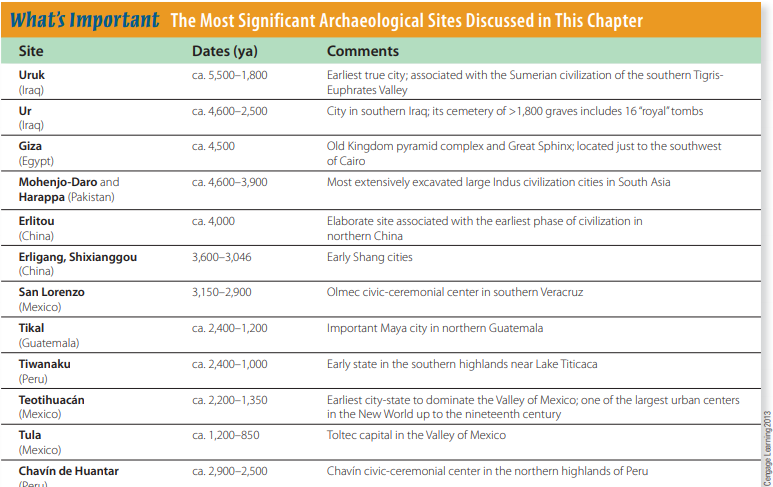
earliest true city yet discovered is Uruk,
in southern Iraq. Associated with the
Sumerian civilization of the southern
Tigris-Euphrates Valley, Uruk boasts
remnants of massive mud-brick temples
and residential areas that housed tens of
thousands of people after 5,500 ya.
States
The state is a complex form of political organization characterized by true
social classes, the concept of citizenship,
administrative bureaucracies, and a
monopoly in the use of force (for example, armies), as well as other governing
and administrative institutions typical of the societies in which most of us
live today.
Other types of political organization also exist, and while researchers disagree about how to define and
apply them, they provide the much
needed handles by which we can group
together politically similar societies
and study them. One common view
is that of Morton Fried (1967), who
describes the simplest, or least complex, societies as egalitarian. As the
name implies, there’s no social differentiation in egalitarian societies; leadership is informal, and “the best idea
leads.” Examples are most Paleolithic
hunter-gatherer bands. Ranked societies are more complicated, particularly
because some forms of social differentiation are present; a few people are
“chiefs,” but most are “Indians.” These
socially differentiated statuses and
roles can be inherited, but there are no
true social classes. Examples include
Neolithic farming villages in the Near
East and Mississippian chiefdoms in
eastern North America. In stratified societies, significant social differentiation is
present and true classes exist. An example is the Natchez, a Native American
group of west-central Mississippi,
whose society was rigidly hierarchical
by comparison with other documented
Mississippian chiefdoms. Finally, we
have the state, the complex form of political organization described at the beginning of this section.
The main disadvantage of pigeonholing ancient societies into such categories as egalitarian, ranked, and so
on, is that it implies an evolutionary
progression of past political institutions—even where there’s little or no
empirical evidence that such a view is warranted. In Fried’s typology, for
example, ranked societies follow egalitarian societies and precede stratified
societies, and so on. Through frequent
application in research, the built-in
sequence of cultural evolutionary
stages represented by Fried’s scheme
and others like it can begin to seem
both real and discoverable.
Over the years, researchers have
found that it’s important to understand
both the similarities and the differences
between ancient societies as part of the
larger task of explaining the development of the earliest states (Trigger, 2003,
p. 42). The result is still an evolutionary picture of the development of cities, states, and civilizations, but one that
examines cultural changes within a web
of possibilities rather than as the outcome of a succession of stages.
For our purposes, the state is a governmental entity that persists by politically controlling a territory and “by acting through a generalized structure of
authority, making certain decisions in
disputes between members of different
groups, maintaining the central symbols
of society, and undertaking the defense
and expansion of the society”(Yoffee,
2005, p. 17). Examples include most modern nations.
With the emergence of the earliest
states in antiquity, we also find archaeological evidence of other important
changes, among them social stratification, typically in the form of true social
classes (recalling Fried, 1967). This is so
consistent a feature of states that in his
recent comparative analysis of early civilizations, archaeologist Bruce Trigger
(2003) describes them categorically as
“class-based” societies. In ancient states,
most people worked the land, while
a smaller number performed essential specialized tasks of craft production, military service, trade, and religion. At the top of this social heap were
a few elite individuals who closely controlled access to goods and services produced by others, information, the means
of force, and symbols of valued status;
these individuals also made most essential decisions that affected the working
of society—usually with the proclaimed
sanction of gods and the assistance of a
bureaucracy of lesser officials. Such decisions covered many critical functions,
including the capacity to create and
enforce laws, levy and collect taxes, store
and redistribute food and other basic
goods, and defend or expand the state’s
boundaries.
The development of true social classes implies another important aspect of
states: Their main social institutions are
commonly organized on the basis of criteria other than that of kinship. This doesn’t
mean that families and kinship cease to
be important at every level of society,
from the greatest of rulers to the person
who hauls out the garbage at the end of
the day. What changes is that some of
the roles and duties that were once handled by your kin are now decided by the
state. For example, states tend to appropriate the right to decide which acts of
murder committed by its citizens will
be punished as crimes and which will
be rewarded with medals and marching bands. They also may take over the
authority to pass judgment on local civil
disputes, such as village squabbles over
property boundaries, contract breaches,
and the like. In nonstates, such as the
kinds of communities we described in
Chapter 14, these decisions were usually
decided in kin-centered institutions such
as families and lineages.
Civilizations
Civilizations comprise “the larger social
order and set of shared values in which
states are culturally embedded” (Yoffee,
2005, p. 17). And while cities and states
are building blocks of civilizations,
the civilizations of which they are a
part may show considerable diversity.
Unlike what archaeologists believed
half a century ago, we can’t trace a
simple developmental sequence in the
archaeological record from villages to
cities and then to states. For example,
the Vijayanagara empire (roughly a.d.
1300–1650) appears to have been more
unified and more urban than Maya civilization during the Classic period (a.d.
250–900). To understand why, we must
consider differences of culture, technology, history, external relations, and even
terrain, because they all played important roles, as shown in the archaeological records of these regions.
Why Did Civilizations Form?
A half century ago, V. Gordon Childe
specified the traits that he believed contributed to the evolution of early civilizations. His list reflects the view that
civilization is an outgrowth of increasing productivity, social complexity, and
economic advantage (Childe, 1950). The
use of writing, mathematics, animalpowered traction, wheeled carts, plows,
irrigation, sailing boats, standard units
of weight and measure, metallurgy, surplus production, and craft specialization, Childe argued, all had a stimulating effect and were themselves products
of changes initiated by earlier Neolithic
activities.
It was soon clear that Childe’s catalog of inventions and new social institutions was not applicable to all early
civilizations. Childe also failed to grasp
that a civilization is more than the sum
of its parts. His catalog of traits characterized the Near Eastern civilizations
with which he was most familiar, but it
didn’t fit important New World societies
such as the Maya and Inca. Nevertheless,
these were clearly civilizations, even
though they didn’t use sailing boats, animal traction, wheeled carts, and so on.
By the later twentieth century, most
archaeologists also agreed that descriptive approaches like Childe’s were inadequate at best because they couldn’t
account for why and how the earliest civilizations emerged when and
where they did. The search for such
answers continues to be one of the most
important objectives of archaeological research on complex societies. Let’s
now consider several competing explanations, with emphasis on Near Eastern
civilizations, which offer the advantage of being among the most studied
of the world’s earliest civilizations. Bear
in mind, however, that a good general
explanation should apply just as effectively to all civilizations, including those
in the New World.
Environmental Explanations
At first glance, it may seem unlikely
that the rise of civilizations could be
the product of purely natural causes,
independent of the actions of humans.
Nevertheless, researchers have weighed
the merits of these and many other
possible factors over the past century.
Theories that account for the origins
of civilization tend to take a position
between the extremes of environmental
determinism, in which people, culture,
and everything else obey the same laws
of nature, and cultural determinism, the
cultural relativist position that maintains
that human behavior can be explained
only in cultural and historical terms
(Trigger, 2003, pp. 653–655).
Let’s look briefly at an example of a
strong environmental hypothesis. Arie
Issar, a geologist, and his colleague
Mattanyah Zohar, an archaeologist,
argue that the fluctuating availability of
water resources caused by major climatic
changes was a key factor in the development of civilization in the Near East
(Issar and Zohar, 2004). Based on their
chemical analyses of lake sediments and
cave stalagmites, these researchers identify several periods between 6,000 and
5,000 ya during which the Near East was
drier than present and periods during
which it was colder than present. When
correlated with major cultural changes
documented in the archaeological record
of the region, climatic conditions, they
argue, are sufficient to account both for
production surpluses and for the concentration of the control of these surpluses
in the hands of ruling classes. This control gradually became more successful as administrative institutions and
such inventions as writing developed
in Mesopotamian society. Interregional
commerce, the military, administrative
bureaucracies, and local ruling dynasties, they argue, emerged because of the
changes promoted by optimal climatic
conditions. Climatic changes may also
account for the catastrophic flood legends that are indigenous to the region
(Issar and Zohar, 2004, pp. 112–113).
Elsewhere, however, research has
shown that the possible causal relationships between environmental factors
and early civilizations are much less
likely. In fact, in a recent international
conference on the relationship between
climatic change and early civilizations,
the participants agreed on one main point: “Climatic change for each civilization or community can act as a driving
force, or a supporting player, or merely
as background noise” (Catto and Catto,
2004). In other words, environmental
explanations generally and climatic
change in particular can’t, by themselves, explain the rise and fall of all
early civilizations.
Cultural Explanations
If environmental theories sometimes
leave little room for human culture and
agency to play important causal roles in
the development of civilization, some
cultural explanations go to the other
extreme and deny the importance of the
environment. According to the views of
cultural relativists, culture plays the significant role in shaping human behavior,
not noncultural factors such as climate,
population growth, and the like. From
this perspective, culture cannot merely
be reduced to the category of human
reactions to the whims of nature, but is a
force to be reckoned with in explaining
major prehistoric changes such as the
development of the earliest cities, states,
and civilizations.
For example, Kwang-chih Chang
argues that the rise of the earliest civilizations in China may have owed more to
the differential access by some groups to
the means of communication than to the
means of production (Chang, 2000). In
short, Chang (2000, p. 2) asserts that “the
wealth that produced the civilization was itself the product of concentrated
political power, and the acquisition of
that power was accomplished through
the accumulation of wealth. The key
to this circular working of the ancient
Chinese society was the monopoly of
high shamanism, which enabled the
rulers to gain critical access to divine
and ancestral wisdom, the basis of their
political authority. Most of the markers
of the ancient civilization were in fact
related centrally to this shamanism.”
Chang’s hypothesis is particularly interesting because it depends entirely on
cultural factors as the active ingredients
in developing early Chinese civilization. He pointedly denies the importance
of technological advances and increasing control of the means of production,
factors that are often mentioned as key
aspects in general theories of the development of the early civilizations.
Although it’s contested by many specialists on Chinese civilization, Chang’s
hypothesis has a novel twist in that
he also argues that all early civilizations, with the notable exception of
Mesopotamia in the Near East, controlled the means of communication
(Chang, 2000, pp. 7–10). It was only in
Mesopotamia, Chang reasons, that controlling the means of production was
a key factor in developing the region’s
earliest civilizations. This difference, he
conjectures, led to the creation of states
that were fundamentally different from
those of China and greatly influenced
the development of much of Western
civilization.
In his recent monumental comparative analysis of early civilizations, Bruce
Trigger (2003) identifies several important uniformities that cast doubt on civilization theories that adopt extreme
positions, whether they’re in the direction of cultural relativism or environmental forces. To take only a few examples, Trigger found no evidence of
Chang’s control of the means of communication; but in the cases he examined,
he did encounter relatively uniform conceptions of kingship, class systems, support of the upper classes through the
controlled use of force, and control of the means of production (Trigger, 2003,
pp. 272–273, 663). Significantly, Trigger
also found that only two types of political organization and two types of general administrative institutions are present
in all early civilizations. What’s striking about these and the many other cultural similarities he identifies is that it’s
not the sort of picture we would expect
to see if human culture were unconstrained by noncultural forces. If culture
were a free agent, so to speak, we would
expect considerable diversity in these
and other institutions across early civilizations as they respond to local cultural traditions and history. Similarly,
these cultural uniformities can’t be easily explained by the action of general
environmental factors, because the cases
Trigger examines are environmentally
diverse, ranging from tropical rain forest settings to near-desert conditions.
If culture and natural factors such
as climate cannot fully explain the rise
of the earliest civilizations, what is the
answer? Trigger (2003, pp. 272–274) proposes an essentially functional argument based on information theory. At
its root is the observation that the transition from villages to cities and states
is fundamentally one of increasing societal complexity, driven by economic or
political forces. With the increased complexity of the organization of society,
there must also be comparable increases
in the institutions that manage this
complexity. To put it another way, you
can’t manage a Fortune 500 multinational corporation from a small storefront in a suburban strip mall. What’s
missing from that picture is the massive organizational infrastructure necessary to keep a major corporation running on a daily basis, much less to keep
it profitable. To Trigger, a state faces the
same basic problem. The growth of the
earliest cities and states also required
the creation of new decision-making
institutions and the distribution of
power and authority. This is effectively what’s seen archaeologically
with increased material evidence for
the emergence of social classes, ruling
elites, administrative bureaucracies, settlement hierarchies, and the like. But
Trigger’s most important point may be
that for all the ways in which early civilizations differed around the world—
and there were many—“for societies to
grow more complex they may have to
evolve specific forms of organization.”
And as Trigger also observed, humans
found only a limited number of ways to
do this!
Old World Civilizations
So familiar to most people are the
ancient Near Eastern civilizations—
Egypt and Mesopotamia—that we
instinctively use them as a standard
against which to measure all others. Still,
it’s not appropriate to do so, for as Bruce
Trigger (2003) stresses, it’s essential to
understand both the differences and the
similarities between all early civilizations if we are to explain how and why
such entities developed. This section is a
selective glimpse into the development
of the earliest Old World cities, states,
and civilizations in several geographical regions: Mesopotamia, Egypt, the
Indus Valley in South Asia, and northern China (Fig. 15-3). Later, we will
take a similar look at the rise of several
of the earliest New World civilizations.
Each civilization devised ways of grappling with the challenges presented by
entirely new social, political, and economic circumstances. Their legacies have
survived for millennia, and we can often
recognize them within the framework of
modern societies.
Mesopotamia
During the centuries after 8,000 ya, pioneering farmers settled Mesopotamia,
the vast alluvial plains bordering the
lower Tigris-Euphrates river system (see
Fig. 15-2). These agriculturists shared the
heritage of such early Neolithic communities as Jarmo, in the Zagros foothills to
the east, and Çayönü, at the edge of the
Anatolian plateau (Nissen, 1988). In fact,
they were probably direct descendants
of Samarran farmers, who had practiced
small-scale irrigation agriculture along
the edges of the central Tigris Valley and
obtained painted pottery and obsidian
through trade with upland communities. Now expanding onto the southern
plains, these Ubaid farmers encountered great flood-prone streams bound only by
immense mudflats and marshes.
The annual floods in this region
began soon after the spring planting
season, when young crops were particularly vulnerable. These seasonal overflows deposited rich layers of alluvium,
and when the floodwaters receded, a
long, dry summer followed. At first,
farmers cultivated only the well-drained
slopes above the river. Generations later,
their descendants began the hard task
of redirecting the river’s flow, even cutting through its banks to channel floodwater onto low-lying fields. Irrigation
unlocked the fertility of the deep, stonefree alluvium that had accumulated
on the floodplain for millennia. Barley
was the Ubaidians’ primary grain,
but wheat and millet grew well, too,
along with the date palm and vegetable
crops. Common domesticated animals
included pigs, sheep, donkeys, and oxen.
The abundant harvests, supplemented
by fish and game, more than kept pace
with the rapidly growing floodplain
communities.
By around 6,500 ya, Ubaid villagers were beginning to prosper in the
southernmost Tigris-Euphrates Valley
(Lamberg-Karlovsky and Sabloff, 1995).
Each of their more populous towns, such
as Nippur, Eridu, and Uruk in the southern valley (see Fig. 15-2), centered on a
platform-based temple; even the smaller
communities had central shrines.
Perhaps to obtain the resources lacking in their new homeland, Ubaidians
stayed in touch with distant peoples
through trade in decorated pottery,
obsidian, ornamental stones, copper, and
possibly grain.
Important changes ushered in the
late Ubaid period, around 5,500 ya.
The population of certain communities
rapidly swelled into the thousands as
rural villagers migrated to the growing
towns. Expanding irrigation systems in
the lower Tigris-Euphrates Valley produced more food for the concentrated
populace. Altering the riverine environment on this scale by digging drainage
and irrigation channels was a challenging enterprise, one that the people could accomplish only with organized communal effort, including a great deal of
cooperation and direction. The activity
transformed not only the landscape but
also the nature of the agricultural societies themselves.
What might these concentrated populations mean to us? No less than the
birth of the Near East’s first true cities. But what stimulated their development? It’s possible that intensified economic or military rivalries in the region
forced populations to come together for
protection (Adams, 1981). Alternatively,
increased agricultural productivity and
efficiency may have fostered cultural
changes (social stratification, craft specialization, commerce, and so on) that
in turn promoted the development of
urban communities. Whatever the reason, these trends happened at settlements along the lower Tigris-Euphrates
Valley as people flocked to the developing cities. These cities became the
social environments within which the
earliest Mesopotamian states emerged
(Yoffee, 2005).
Sumerians Over several centuries,
Uruk grew to be a city with a population of as many as 20,000 people. Today,
the ruins of Uruk’s mud-brick buildings
cover nearly 1 square mile in southern
Mesopotamia, 150 miles southeast of
modern Baghdad (Nissen, 2001). The
most ancient parts of Uruk reveal some
features of the earliest city. Two massive
temple complexes, built in stages and
dedicated to the sun and to the goddess of love, probably served as focal
points of political, religious, economic,
and cultural activities. Inscribed clay
tablets associated with these structures
record that the temples distributed food
to the populace and controlled nearby
croplands. Growing social and religious
complexity, including the rise of powerful kings and priests, kept pace with the
city’s physical growth.
The developments associated with
Uruk and other urban centers were an
immediate prelude and stimulus to a
new order in southern Mesopotamia
around 5,000 ya. The inscribed tablets,
teeming populations, and large-scale
religious structures indicate that the
essential elements of a Mesopotamian
civilization had come together. Uruk
marked the beginning of the Sumerians,
the first complex urban civilization.
The region known as Sumer encompassed about a dozen largely autonomous political units, called city-states,
in the southernmost Tigris-Euphrates
Valley. About the same number of
Akkadian city-states hugged the river
to the north, near present-day Baghdad.
The Sumerians and their neighbors
shared the world’s first modern society between 4,900 and 4,350 ya. Each
Sumerian city-state incorporated a major
population center—Ur, Lagash, Umma,
Nippur, Eridu, and Uruk are examples—
as well as some smaller satellite communities and, of course, a great deal of irrigated cropland. These city-states were
controlled by hereditary kings, who
often fought for dominance with their
counterparts in neighboring cities.
The Sumerians had a technologically
accomplished urban culture, economically dependent on large-scale irrigation agriculture and specialized craft production (Kramer, 1963; Roaf, 1996). The influence of Sumerian cities reached beyond
Mesopotamia through exchange and
possibly even colonization. Excavations
in northern Iraq, Turkey, and the Nile
Valley of Egypt have revealed connections with Uruk through trade in prestige goods such as pottery, carved
ivory, and lapis (Roaf, 1996). These valued products furnished the tombs of
Sumerian elites in a society where social
differentiation was becoming more
pronounced.
Among the prerogatives of elite members of society was the right to burial
in a lavish tomb. Sir Leonard Woolley’s
excavations of the 4,500-year-old “royal”
tombs at Ur in the 1920s revealed that
King Abargi and Queen Puabi were
each accompanied in death by rich offerings—ceremonial vessels, tools, musical instruments, and even chariots
complete with their animals and, apparently, also their human attendants—
arranged within the burial pits (Woolley,
1929). Woolley interpreted other human
remains found in association with these
elite individuals as the men and women
of their court, who were bedecked with
precious jewelry, drugged, and then
sealed into the tombs.
Mesopotamian citizens constructed
brick walls around their city perimeters
for security. The heart of each urban
center was its sacred district, dominated
by a grand temple and flanked by noble
houses. In addition to a patron deity
associated with each city, citizens worshipped many other gods. Chief among
them was Enlil, the air god. Like most
Mesopotamian gods, Enlil exhibited
human characteristics, taking a fatherly
concern for mortals and their daily
affairs but also meting out punishment and misfortune. Some cities, like
Ur, regularly augmented their shrines
and eventually created an impressive
artificial mountain called a ziggurat
(Fig. 15-4). Rising from an elevated platform roughly the size of a football field,
these stepped temples were solidly built
of millions of baked mud bricks.
Outside the ceremonial district, narrow unpaved alleyways twisted through
crowded residential precincts. Much like
city dwellers everywhere, Sumerians
endured social problems and pollution
in their urban environment. The size
and location of individual homes correlated with family wealth and position. The houses of all but the nobility
were generally one story, with several
rooms opening onto a central courtyard.
Wall and floor coverings brightened the
interiors, which were furnished with
wooden tables, chairs, and beds and an
assortment of household equipment for
cooking and storage.
From our perspective, their writing system was perhaps the Sumerians’
most significant invention, enabling us
to discover more about them than their
other artifacts and monuments could
ever reveal. Literacy was a hard-won
accomplishment. By about 5,000 ya, the
original pictographic form of Sumerian
writing was evolving into a more flexible writing system using hundreds
of standardized signs. Highly trained
scribes formed the characteristic wedgeshaped, or cuneiform, script by pressing a reed stylus onto damp clay tablets, which were then baked to preserve
them (Fig. 15-5). Ninety percent of early
Sumerian writing concerned the kind of
economic, legal, and administrative matters that are typical of complex bureaucratic societies. Later scribes recorded
more historical and literary works,
including several epic accounts featuring the adventures of Gilgamesh, an
early Uruk king and culture hero reputed to have performed many amazing
deeds in the face of overwhelming odds.
The loose conglomeration of
Mesopotamian city-states faced hard
times after around 4,500 ya. At least part
of the problem may have been their long
dependence on irrigation agriculture,
which was slowly destroying the fertility of their fields because the irrigation
water deposited soluble mineral salts
in the soil and groundwater (Nentwig,
2007, but see Powell, 1985). Another part
of the problem was that this early civilization spent much of its energy in fruitless internal competition. Clustered
together in an area about the size of
Vermont, the city-states of Sumer and
neighboring Akkad, to the north, vied
with one another for supremacy in commerce, prestige, and religion.
Finally, around 2334 b.c., a minor
Akkadian official assumed the name
Sargon of Agade and led armies from
the north to victory in the Sumerian
lands and united what had been a collection of city-states into a territorial state.
Military expansion led to economic,
political, and linguistic dominance over
a broad area. Under Sargon, his sons,
and grandsons, the Akkadian state
endured only a century before dissolving. But once it began, the unification
process continued on and off for many
centuries in Mesopotamia—next under
the kings of Ur and later (about 3,800 ya)
under Hammurabi of Babylon, famed for
his “eye for an eye” code of law, among
other accomplishments.
Egypt
The pyramids of Egypt are unrivaled as
the ancient world’s most imposing monuments. They have adorned the banks of
the Nile for so long that they seem timeless. Even so, as we saw in Chapter 14,
Egyptian culture was rooted in the Nile
Valley long before the pyramids.
By 6,000 ya, Neolithic villages lined
the great river’s banks, where early farmers grew wheat and barley, among other
crops, and raised pigs, sheep, goats, and
cattle (Wenke, 2009). Even then, settlements in the section of the valley known
as Upper Egypt—just north of Aswan,
the “First Cataract” of ancient times—
contrasted somewhat with those in the
delta region, called Lower Egypt, close to
the river’s mouth. Archaeologists recognize a Mesopotamian influence at work
among the Upper Egypt villagers, possibly introduced through direct contact or
by way of Palestinian traders (Hoffman,
1991). Mineral resources, especially gold,
apparently drew outsiders to the region.
Around 5,300 ya, increasing political and social cohesion brought some of
these Upper Egypt settlements together
as local chiefdoms. Walls protected the
towns of Naqada and Hierakonpolis,
and well-stocked stone and brick tombs
marked the social status enjoyed by
important individuals (Wenke, 2009).
Pottery making and trading became
specialized economic enterprises
(Fig. 15-6). Continuing contact with
Mesopotamian cultures may have stimulated these developments, although
researchers do not yet have evidence of
comparable Egyptian
influence in the other
direction.
Over the next few
centuries, this part of
the Nile Valley developed into a strong territorial state. Historical
tradition and written
evidence record that
one of Upper Egypt’s
early chiefs took the
name Narmer and
seized control of both
Upper and Lower
Egypt (Fig. 15-7).
Narmer’s unification of
Nile Valley under one
king around 5,000 ya
(3000 b.c.) marks the traditional beginning of the First Dynasty of Egyptian
civilization.
After the first unification period, a
425-year span known as Old Kingdom
times (4,575–4,150 ya) represented the
first full flowering of civilization in the
Nile Valley. Most of the estimated population of 1 to 3 million people lived in
the far south (Trigger, 2003). The ruler,
or pharaoh, was the supreme power of
the society. Under his direction, Egypt
became a wonder of the ancient world.
Egyptians soon adopted a complex
pictographic script called hieroglyphics,
a writing system that is Egyptian in
form but possibly Mesopotamian in
inspiration. The earliest inscriptions are associated exclusively with the Egyptian
royal court, as are other high-status
products, such as cylinder seals, certain
types of pottery, and specific artistic
motifs and architectural techniques that
also seem to be derived from beyond
the Nile Valley. Advanced methods of
copper working came into use as well,
including ore refining and alloying, casting, and hammering techniques. Some of
these processes likewise were invented
elsewhere. An important by-product
of copper metallurgy was faience, an
Egyptian innovation produced by fusing
powdered quartz, soda ash, and copper
ore in a kiln. The blue-green glassy substance, molded into beads or statuettes,
became a popular trade item throughout
the region (Friedman, 1998).
Early pharaohs were godlike kings
who ruled with divine authority through
a bureaucracy of priests and public officials assigned to provinces throughout the kingdom. The pharaoh’s power
depended to a large degree on his
assumed control over the annual Nile
flood (Butzer, 1984), and throughout the
course of Egypt’s long history, pharaonic fortunes tended to fluctuate with
the river’s flow. Most Old Kingdom pharaohs maintained their royal courts
at Memphis, about 15 miles south of
present-day Cairo (see Fig. 15-2). In contrast to Mesopotamia, few urban centers emerged in the ancient Nile Valley,
and even the capital was of modest
size. Egypt remained almost entirely
an agrarian and rural culture, the vast
majority of its citizenry comprising
farmers and a few traders engaged in
their timeless routines (Aldred, 1998).
Only in the immediate vicinity of
Memphis and the sacred mortuary complexes along the Nile’s west bank was
Egypt’s grandeur clearly evident.
The familiar Old Kingdom pyramids
on the Nile’s west bank at Giza evolved
out of a tradition of royal tomb building that began at Hierakonpolis. In that
early community, brick-lined burial pits
were dug with adjoining chambers to
stock the offerings for a deceased king’s
afterlife, and these rooms were then
capped with a low, rectangular brick
tomb (Lehner, 1997). The scale of these
structures increased as successive rulers outdid their predecessors (Fig. 15-8).
Contrary to popular view, they weren’t
built by slaves, but by thousands of
Egyptian farmers, put to work during
the several months each year when the
Nile floodwaters covered their fields.
The ruins of nearby towns associated
with the construction and administration of several of these royal mortuary
sites have been found filled with closely
packed mud-brick houses aligned along
regular street grids (Bard, 2008).
In all, some 25 pyramids honored the
Old Kingdom’s elite (Lehner, 1997). The
first stepped pyramids of stone were
built after 2630 b.c. (4,630 ya), and little
more than a century later, the imposing tombs of Khufu and Khafra, Fourth
Dynasty rulers, were among the last
built in true pyramid form. Khufu’s
Great Pyramid is 765 feet square at its
base and 479 feet in height, with 2.3 million massive limestone blocks required
in its construction. Although Khafra’s
tomb is about 20 percent smaller, he
compensated by having a nearby rock
outcrop carved with the likeness of his
face on the body of a lion, today called
the Great Sphinx (Hawass and Lehner,
1994). Pyramid building ceased soon
after, during a time of political decentralization and greater local control over
such practical programs as state irrigation works.
The Old Kingdom pyramids represented a remarkable engineering
triumph and an enormous cultural
achievement that inspired the civilizations that followed. Bear in mind that
the stark structures we see along the
Nile today were adjoined by extensive
complexes of connecting causeways,
shrines, altars, and storerooms filled
with statuary and furnishings and ornamented with colorful friezes and carved
stonework. The mortuary cult of the
pharaohs also absorbed a large share of
the work and wealth of Egyptian society.
Later kings contented themselves
with being buried in smaller but still lavishly furnished tombs in the Valley of
the Kings, a cramped desert valley below
a natural pyramid-shaped mountain
near Thebes. Discovered in the 1920s, the
treasure-choked burial chamber of the
young pharaoh Tutankhamen, who died
more than 3,300 ya (about 1323 b.c.) during New Kingdom times, is convincing evidence that dead royalty were not
neglected even after the era of pyramids
had passed (Carter and Mace, 1923).
Much of what we
know of ancient Egypt’s
religion and rulers comes
not from the contents of
royal tombs, but from
the translation of countless hieroglyphic inscriptions (Fig. 15-9). In 1799 at
Rosetta, a small Nile delta
town, French soldiers discovered a 2½-by-2½-foot
stone bearing an identical decree engraved in
three scripts, including
Greek and hieroglyphics.
Twenty years later, JeanFrançois Champollion
finally succeeded in
deciphering Egyptian
hieroglyphic writing by
using the Rosetta stone
as a guide (Wenke, 2009,
pp. 87–90).
Egyptian hieroglyphics are a combination of
signs that represent ideas
with others indicating sounds. Because
hieroglyphics were used primarily in
formal contexts by members of the elite
classes and bureaucrats (much like
Latin in more recent times), their translation tells us much about pharaohs and
their concerns, revealing less about the
commonplace events and people of the
era. In fact, archaeologists can read disappointingly little about daily life in
Egypt’s Old Kingdom period outside
the major administrative and mortuary
centers, where tomb scenes occasionally portray peasants at work in their
fields or winnowing or grinding grain.
Happily, later periods of Egyptian society are more fully documented (Montet,
1981; Casson, 2001).
Although nothing surpassed the
original glory of the Old Kingdom period, Egypt proved remarkably resilient
through the centuries, surviving foreign invaders such as the Hyksos and
Hittites of southwest Asia, as well as frequent episodes of internal misrule and
rebellion. Its pharaohs enjoyed periods
of resurgence and revival until, in a state
of decline and defeated by the Persians
(about 2,500 ya), Egypt fell into the Greek
sphere under Alexander the Great and
eventually came under the rule of Rome.
Indus
As the first great pyramids rose beside
the Nile, a collection of urban settlements that dotted a broad floodplain far
to the east was forming into the Indus
civilization (Fig. 15-10). For seven centuries, between about 4,600 and 3,900 ya,
the banks of the Indus River and its
tributaries in what is now Pakistan and
India supported at least five urban centers, each with a population numbering
in the tens of thousands (Kenoyer, 1998,
2008; Possehl, 2002). Many hundreds of
smaller farming villages were socially
and economically, if not politically,
linked to these central places.
The people of the Indus were relative newcomers to the Indus Valley.
As we saw in Chapter 14, their ancestors cultivated the higher valley margins to the west at sites like Mehrgarh
by 8,000 ya. Farming and herding, along
with regional trade, sustained village
life in these uplands from an early period (Jarrige and Meadow, 1980). Around
5,300 ya, farmers began to populate the
Indus floodplain itself, possibly seeking more productive cropland or better
access to potential trade routes for valued copper, shell, and colorful stones.
Occupying slight natural rises on the
flat landscape at places like Kot Diji (see Fig. 15-10), they laid out fields for their
vegetables, cereals, and cotton on the
deep alluvium. As the new settlements
grew, farmers diverted part of the river’s
flow into canals to irrigate their fields.
They also constructed massive retaining
walls or elevated platforms to protect
their homes from the devastating effects
of seasonal floods.
Some of these settlements prospered and grew. By 4,600 ya, several
large urban centers hugged the river.
Why had people accustomed to living in
small farming communities congregated
in these cities? Possibly an increased
threat of flooding along the river—
brought on by extensive deforestation
and other poor farming practices—simply forced people to come together in
building and maintaining more levees
and irrigation canals. An alternative
hypothesis proposes that trade was the
“integrative force” behind Indus urbanization (Possehl, 1990). A few entrepreneurs may have fostered exchange
between the valley settlements and the
uplands, promoting resource development, craft specialization, and product distribution to stimulate and reap
the economic benefits. As commerce
began to pay off, other changes, including urbanism and social stratification,
attracted craftspeople, shopkeepers,
and foreign traders, all of whom transformed Indus society even more.
Indus Valley cities prospered as busy
centers of craft production and trade.
Workshops in different neighborhoods
turned out large quantities of wheelthrown pottery, millions of burnt bricks,
cut and polished stone beads and stamp
seals, molded figurines, and work in
copper, tin, silver, gold, and other metals. Boats plied the Indus River as a commercial highway and also moved goods
along the coast as far as Mesopotamia
and Oman (Ray 2003). Carts, too, carried
the colorfully dyed cotton cloth, pottery,
shell, and precious metal goods overland
to Mesopotamia. For a while, a distant
Harappan trade outpost was even established near Sumerian Ur.
So far, archaeologists have carried
out extensive excavations at several of
the major cities and a few of the smaller
contemporary agricultural and pastoral
villages (Fig. 15-11). The largest Indus
sites excavated so far are Mohenjo-Daro
and Harappa, which flourished between
about 4,600 and 3,900 ya in present-day
Pakistan. Raised on massive brick terraces above the river’s flow, these cities
were carefully planned, using grids of
approximately 1,300 by 650 feet for the
residential blocks. Although these large
sites certainly reveal social complexity and a certain degree of central control, the Indus civilization lacks grand
picturesque ruins of the type found in
Egypt and Sumer. Some large building
complexes interpreted as palaces have
been excavated at Mohenjo-Daro, but
generally speaking, evidence of sumptuous palaces and monumental religious structures is rare (Vidale, 2010). Their
absence may suggest a basic feature of
Indus society, whose people were less
focused on glorifying their individual
rulers. Richard H. Meadow, who has
been excavating at Harappa since 1987,
describes this civilization as “an elaborate middle-class society” (Edwards,
2000, p. 116). Gregory L. Possehl (2002),
another archaeologist with decades of
Indus civilization research experience,
describes it as a socioculturally complex civilization that lacks evidence of
the state form of political organization.
Possehl (2002, pp. 5–6, 56–57) argues
that the criteria by which the state is
archaeologically identified—a hierarchy of social classes, kingship, state
bureaucracies and the monopolization
of power, state religions, and so forth—
aren’t readily identifiable in the archaeological remains of the Indus civilization. This difference—that of a highly
successful, complex society based on
a form of political organization other
than the state—sets the Indus civilization apart and makes it clear that
we still have a lot to learn about this
extraordinary development in South
Asian prehistory.
Both Mohenjo-Daro and Harappa
encompassed a public district and several residential areas. Homes range
from modest brick-walled dwellings
that bordered unpaved streets and
alleys to spacious multistoried houses
with interior courtyards. What has been
proclaimed as the world’s first efficient
sewer system carried waste away from
these densely packed dwellings, many
of them equipped with indoor toilets
and baths.
What might this culture have to say
for itself? Unfortunately, the writing
system, consisting of brief pictographic
notations commonly found on seal
stones and pottery, remains undeciphered (Parpola, 1994; Possehl, 1996).
After little more than half a millennium, the Indus civilization’s major
sites declined, but hundreds of smaller
towns and villages outlasted them
(Lawler, 2008). Without written records
or any archaeological evidence of invasion or revolution, we can only guess
what caused its demise. Did competing
trade routes bypass the Indus? Did the
irrigation system fail, or did the river
shift in its channel, either flooding the
fields or leaving them parched? Could
shifts in the Indian summer monsoon
toward greater climatic variability and
increased aridity have contributed to the
Indus civilization’s decline, as recently
suggested by McDonald (2011)? All we
know for sure is that in the end, the river
that spawned the principal urban centers gradually reclaimed the surrounding fields and eventually the city sites
themselves.
Northern China
As we saw in Chapter 14, the deep roots
of China’s early civilizations were nurtured in the loess uplands and alluvial plains bordering its great rivers.
Specialized production and exchange of
valued ritual goods came to characterize
the prosperous farming societies along
the central and lower Yellow River valley and brought about increased contact
and conflict among them. This phase of
regional development and interaction
continued during the Longshan period
(about 4,600–4,000 ya) and culminated
in the formation of a distinctive Chinese
culture that emphasized social ranking
and ritualism accompanied by persistent
warfare (Liu, 2009).
During the Longshan period, the circulation of luxury products contributed
to the concentration of wealth and the
emergence of social hierarchies. Elite
consumers supported craft specialties, including fine wheel-thrown pottery, jade carving, and a developing
metal industry based on copper and
(later) bronze production. Status differences are reflected in the range of
burial treatments found in the large
Longshan cemeteries—from unusually
lavish to mostly austere. Walled towns,
some of which were up to 1 mile in circumference, dominated the region’s villages and hamlets (Yan, 1999). Town
walls were made of stamped earth,
compacted to the hardness of cement,
more than 20 feet high and 30 feet thick.
These enormous constructions obviously required a large supervised labor
force. Numerous arrowheads testify to
the prevalence of warfare, but no clear
explanations for these developments are
yet possible.
Perhaps because of the differential
access by some individuals and groups
to the means of communication within
Chinese society (as Chang suggests; see
pp. 379–380), their success in organizing and controlling communal agricultural efforts, or more directly through
violence and coercion, local leaders who
emerged in northern China over the next
few centuries commanded the allegiance
of ever-larger regions. The rising nobility
played an increasingly prominent role in
the next era of Chinese civilization.
Many Chinese archaeologists believe
that Erlitou (Fig. 15-12), in Henan
Province, confirms the existence of the
legendary Xia dynasty, proclaimed in
myth as the dawn of Chinese civilization (Chang, 1986). Other researchers question this association and argue
that the Xia dynasty has yet to be demonstrated to be more than legend (Liu
and Xu, 2007; Lawler, 2009). Regardless
of its relationship with the Xia dynasty,
this important site, which covered more
than 1 square mile, displayed evidence
of increased social complexity between
3,900 and 3,600 ya. It’s here, for the
first time, that walled palaces set onto
stamped-earth foundations literally
raised members of the royal household
above all others. Valuable stone carvings and bronze and ceramic vessels figured in elaborate court ceremonies and
rituals. Royal burials contrasted sharply
with those of commoners, who were
sometimes disposed of in rubbish pits.
The economy rested on multicropping
of rice, millet, wheat, barley, and possibly soybeans and on extensive trade in
utilitarian and ritual goods; salt production and transport may also have figured prominently in the development of
this community (Liu, 2009). The earliest
evidence of wheeled vehicles in China
also comes from Erlitou, where archaeologists have found ruts made by wheeled
carts or wagons in a road near the palace
complex (Liu and Xu, 2007).
Shang The following Shang dynasty,
beginning in the eighteenth century
b.c., attained a level of sophistication
in material culture, architecture, art
styles, and writing that only a highly
structured society could achieve.
Enduring for some six centuries, Shang
is generally acknowledged as China’s
first civilization, but its relationship to
older polities, such as that which built
Erlitou, is still far from clear. While
peasant farmers lived and labored as
they always had, an elite and powerful
ruling class, supported by slaves, craft
specialists, scribes, and other functionaries, topped the rigid Shang social
hierarchy. Unlike the Indus civilization,
the Shang territorial state included
multiple cities and covered roughly
8,900 square miles.
The power and actions of Shang rulers were sometimes directed through
the rite of divination, or prophecy. This
practice is of immense importance
because it also provides the most extensive evidence of early Chinese writing. Divination was performed by first inscribing
a question on a specially
prepared bone, such as
the shoulder blade of
an ox or deer or on turtle shells. Applying heat
to the thin bones made
them crack, and then
the answer to the question could be “read” from
the patterns formed by
the cracks. Divination
was a vital activity to the
Shang, and thousands of
the marked bones survive
as a unique historical
archive offering insights
into early Chinese politics
and society (Fitzgerald,
1978). These bones also
demonstrate that Chinese
writing is older than
Shang times. Its roots
may lie in the developing social complexity of late Longshan period towns
(Demattè, 2010).
Shang cities were significantly larger
than older Chinese settlements. By
3,500 ya, the city of Erligang, in Henan
Province, covered about 8 square miles
(von Falkenhausen, 2008). Its inner
enclosure alone, filled with palaces and
temples, was comparable in size to the
entire community of Erlitou. The city of
Shixianggou, also in Henan Province,
was enclosed by an outer ditch and
stamped-earth city walls that were 50 to
55 feet thick (von Falkenhausen, 2008).
Excavations inside Shixianggou’s city
walls have exposed elite compounds,
some of which were also walled.
While most ordinary people appear
to have lived outside the city walls,
Shixianggou also contained the homes
of lesser retainers and servants, as well
as workshops and specialized production areas, including several bronze
foundries, pottery kilns, and bone
workshops.
Shang artisans created remarkable
bronze work, particularly elaborate
cauldrons cast in sectional molds (Fig.
15-13). Decorated with stylized animal
motifs and worshipful inscriptions, the
massive metal vessels were designed
to hold ritual offerings of wine and
food dedicated to ancestors and deities.
They also served as prominent funerary
items in the royal tombs, about a dozen
of which were in the vicinity of the later
Shang capital at Anyang (Chang, 1986).
In addition to bronzes, lavish offerings of carved jade, horse-drawn chariots, and scores of human sacrificial victims accompanied the rulers in death.
In much later times, as in the tomb of
emperor Qin Shi Huangdi (died 2,200 ya)
at Xian, life-size clay sculptures of warriors and horses sometimes substituted
for their living counterparts.
It seems that the Shang kingdom was
only one of several contentious feudal
states in northern China. Despite their
political competition, all shared a common culture, one that served as a foundation for most future developments in
China. After the eclipse of the Shang
state, successive Zhou rulers (1122–221
b.c.) adopted and extended the social
and cultural innovations introduced
by their Shang predecessors. Much of
China remained apportioned among
competitive warlords until the Qin and
Han dynasties (221 b.c.–a.d. 220), when
this huge region was at last politically
unified into a cohesive Chinese empire.
Consolidated by Shi Huangdi and protected from the outer world behind
his 3,000-mile Great Wall (Fig. 15-14), China in later times maintained many
of the cultural traditions linking it to an
ancient past.
New World Civilizations
The rise of the earliest civilizations in
the Americas was closely intertwined
with the development of agriculture. In
many regions where early farming prevailed, the combination of maize, beans,
and plants such as squash came to substitute for diets rich in animal protein.
In time, these primary domesticates supported large populations and established
the economic basis for the development
of states and civilizations in several New
World areas.
Superficially, we can say that early
New World cities, states, and civilizations are broadly comparable to those
of the Old World. All shared some basic
similarities: state economies based on
agriculture and long-distance trade;
powerful leaders and social stratification; human labor invested in large-scale
constructions; public art styles; state religions; record keeping; and the prominent role of warfare. Still, there are significant points of contrast as well. For
example, domesticated animals played
only a small part in New World agriculture; the technological role of metal was
limited; and the wheel had no important function, nor did watercraft. These
differences reflect the unique historical
traditions, resources, and geography of
the continents on which the earliest civilizations developed. This section examines three New World civilizations that
developed in very different regions—
lowland Mesoamerica, highland Mexico,
and Peru (Fig. 15-15).
Lowland Mesoamerica
Olmec By roughly 3,500 ya, farming
villages dotted the river valleys and lowlands of Mesoamerica. Local chiefdoms
arose, and one of these groups, known
as the Olmec, achieved prominence in
the forests and swamps of the southern
Gulf Coast of Mexico between about
3,200 and 2,400 ya (Fig. 15-16). Richard
Diehl (2004) and Michael Coe (Diehl and
Coe, 1996) identify Olmec as “America’s
first civilization” and contend that it
exerted considerable influence on later
Mesoamerican cultures. Other archaeologists (e.g., Flannery and Marcus, 2000;
Spencer and Redmond, 2004) argue
that Olmec polities were chiefdoms,
not states, and that they were simply
part of a web of interacting chiefdoms
and early states. What’s more, Spencer
and Redmond (2004) maintain that the
most convincing archaeological evidence for the emergence of the earliest
Mesoamerican state can be found not in
the lowlands, but at the large Zapotec
center of Monte Albán in the highlands
of Oaxaca around 2,300 ya.
The two best-known Olmec sites
are San Lorenzo and La Venta (see
Fig. 15-16), which Diehl (2004) identifies
as the region’s first cities. At both sites,
people extensively modified the natural
landscape—without the aid of domestic
animals or machinery—to convert them
to proper settings for impressive constructions and sculptures of ritual significance (Coe, 1994; Diehl, 2004). Earthenmound alignments enclose the wide
courtyards, plazas, and artificial ponds
at San Lorenzo. A 100-foot-high coneshaped earthen pyramid dominates La
Venta. Within and near the sites themselves, there are hundreds of smaller
earthen platform mounds that once supported homes and workshops. In addition to ceremonial architecture, the Olmec produced remarkable
monumental sculptures and smaller,
well-crafted carvings of jade and other
attractive stones (Cyphers and Di Castro,
2009). Anthropomorphic forms predominate, including some figurines and
bas-reliefs that combine the features of
humans with those of felines, probably jaguars. Olmec art and iconography
are fascinating but poorly understood.
Who or what did these anthropomorphic beings represent? We don’t know.
Equally intriguing are the colossal
Olmec heads, each of which seems to be
an individualized portrait of a ruler in
helmet-like headgear, carved from massive basalt boulders weighing up to 20
tons (Fig. 15-17). Ten of these huge monuments have been found at San Lorenzo
itself. Archaeologists estimate that the
sustained effort of 1,000 workers was
needed to drag and raft these boulders
from their distant source, some 60 miles
from the site (Lowe, 1989).
Curiously, the Olmec intentionally
buried caches of beads, as well as carved
figurines and implements made from
their highly valued jade. One pit offering
at La Venta consisted of 460 green stone
blocks, arranged into a giant mosaic
design and then buried at a depth of
more than 20 feet. Another held an
assemblage of small jade figures
set into place so that they all seem
to be confronting one individual.
Then, still in position, the group
was buried (Fig. 15-18).
The latest Olmec controversy
concerns the origins of writing
in Mesoamerica. Several artifacts bearing signs reputed to
be glyphs that could be part of
an Olmec writing system have
recently been reported from sites
in the coastal states of Veracruz
and Tabasco (Pohl et al., 2002; del
Carmen Rodríguez Martínez et
al., 2006). One of these artifacts,
a serpentine block that bears 62
signs, or glyphs, could be as old
as 900 b.c. Critics argue that these
discoveries aren’t sufficient evidence of a fully developed system of writing (Stokstad, 2002; see also
Bruhns and Kelker, 2007).
To sum things up, the Olmec represent a fascinating early development
of complex society in the lowlands of
the Mexican Gulf Coast, but one about
which archaeologists have more questions than answers. Most evidence supports the view that the Olmec chiefdoms of southern Veracruz and Tabasco
were similar in many respects to their
neighbors in the highlands to the south and west and to those throughout central Mexico. The archaeological evidence
may or may not eventually live up to
Diehl’s claim that they were America’s
first civilization (Lawler, 2007).
Classic Maya Some suggest that the
roots of Classic Maya* rest partly with
the Olmec, whose art, architecture, and
rituals are reflected in several early
Maya sites. However, the development
of Maya civilization also clearly owed
much to its competitive interaction
with contemporary chiefdoms in several Mesoamerican regions, a process
that ultimately resulted in some of
them becoming true states and civilizations (Flannery and Marcus, 2000;
Braswell, 2003).
By roughly 2,100 ya, the elements of
Maya civilization were coming together.
Crucial materials that were lacking in
most of the Maya lowlands, especially
suitable stone for making tools and
milling slabs, were exchanged for commodities such as salt and the feathers
of colorful jungle birds, both of which
highland groups desired. Control of
trade routes or strategic waterways in
northern Guatemala may have promoted the growth of the Late Preclassic†
center at El Mirador, where archaeologists
have found the earliest evidence of Maya
palaces, and, later, at Uaxactún and Tikal
(see Fig. 15-16).
At these sites and others, Maya society came to be dominated increasingly
by an elite social class. A host of Maya
kings, each claiming descent through
royal lineages back to the gods themselves, held sway over independent citystates centered on elaborate ceremonial
precincts. Under the patronage of these
kings, writing, fine arts, and architecture
flourished in the Maya lowlands, as did
chronic warfare among rival kingdoms
(Sharer, 1996; Coe, 1999). Lisa Lucero
(2003) argues that successful Maya rulers
acquired and maintained their political
power by skillfully manipulating domestic rituals, which in turn promoted political cohesion.
The Maya are best known for their
impressive Classic period urban centers, with Tikal, Copán (Honduras),
and Palenque (Mexico) among them
(Fig. 15-19). These centers were
essentially capitals of regional Maya
city-states, despite their somewhat dispersed populace. Including the ruling elite and their retainers, crafters,
other specialists, and farmers, some
27,000 people were attached to the
important city of Copán (Webster
et al., 2000), although two-thirds
of them actually lived in farming
compounds scattered through the
Copán Valley, within walking distance of the Copán urban center.
Formal, large-scale architecture
dominated the largest cities. Tikal,
with over 50,000 residents, boasted
more than 3,000 structures in its core
precinct alone. Most impressive were
the stepped, limestone-sided pyramids
capped with temples. Facing across
the broad stuccoed plazas were multiroom palaces (presumably elite residences), generally a ritual ball court or
two (Fig. 15-20), and always elaborately carved stelae (Fig. 15-21). Other features might include graded causeways
leading into the complex masonry reservoirs for storing crucial runoff from
tropical cloudbursts. The ancient Maya
typically painted their structures in
bold colors, so the overall effect must
have been stunning.
Maya writing was well developed by
300–200 b.c. (Houston, 2006), and scholars are now able to decipher many of
the inscriptions found on Maya stelae,
temples, and other monuments. Many
stelae proclaim the ancestry and noble deeds of actual Maya rulers and provide
a precise chronology of major events
in lowland Mesoamerica (Schele and
Miller, 1986). These inscriptions offer
direct insights to Classic Maya sociopolitical organization, including the
uneasy and frequently embattled relationships among leading ceremonial centers and their rival aristocracies (Schele
and Freidel, 1990; Coe, 1992).
Religion was a key component of
Maya society, just as it was in all early
civilizations. Architecture and art were
dedicated to the veneration of divine
kings and the worship of perhaps hundreds of major and minor deities. The
nobility included a priestly caste that
carefully observed the sun, moon, and
planet Venus; predicted the rains; prescribed the rituals; and performed the
sacrifices. Most of the priestly lore and
learning faithfully recorded in the Maya
codices, or books (Fig. 15-22), was lost
when the Spanish burned these ancient
texts during the conquest.
Archaeologists historically have
devoted much of their attention to the
most spectacular Classic Maya sites, but
in recent decades they have also begun
to learn a lot about the lives of ordinary
people. For example, extraordinary discoveries, such as the buried Maya community at Cerén, in El Salvador, give
us detailed glimpses of village life
(Sheets, 2002, 2006). Cerén—once a hamlet of mud-walled, thatched huts—lay
entombed for 1,400 years beneath 18 feet
of ash from the eruption of a nearby volcano. The inhabitants fled their homes,
which were quickly buried by the volcanic ash. Remarkable traces of Maya peasant life survived, including a plentiful
harvest of maize, beans, squash, tomatoes, and chilies stored in baskets and
pots, arranged as if they had just been
gathered from nearby garden plots.
The rise and fall of Maya city-states
continued for centuries, and we now
know a great deal about the historical
events that figured in the changing fortunes of Maya kings. Things came to a
head around a.d. 900, after which artisans no longer turned out their distinctive decorated ceramics, nor did they
carve and erect inscribed stelae. The
construction of palaces, temples, and
other major works ceased altogether, and
nearly all major Classic Maya sites were
abandoned.
The remarkable collapse of Classic
Maya civilization has intrigued scholars for decades. Archaeologists are not
yet sure what happened, let alone why.
Proposed explanations, none of which
are adequate by themselves to explain
every case, include devastation by hurricanes or earthquakes, insect infestations, epidemic diseases, malnutrition, overpopulation, an unbalanced
male/female sex ratio, peasant revolts
against the elite, and mass migrations.
Other researchers argue that Classic
Maya city-states collapsed primarily
because they failed to integrate into a
single unified political system, such as
that achieved by the Aztecs in central
Mexico and the Inca in highland South
America (Cioffi-Revilla and Landman,
1999, pp. 586–588). Recent evidence
also points to possible climatic factors,
including multiple major droughts and
widespread deforestation, as important
elements in the demise of many Classic
Maya cities (Pringle, 2009).
Highland Mexico
In central Mexico, far to the northwest of
the Maya area, the convergence of two
mountain ranges forms a great highland of some 3,000 square miles, commonly called the Valley of Mexico (see
Fig. 15-16). An elevated plateau rimmed
by mountains and volcanic peaks to
the west, south, and east, the rich agricultural soils of the Valley of Mexico
were watered by several rivers and large
lakes. This broad semiarid valley, which
is today dominated by Mexico City, was
the stage on which several important
prehistoric states and civilizations developed. Teotihuacán, the earliest citystate to dominate the region, became
one of the largest urban centers in the
New World up to the nineteenth century
(Cowgill, 2000).
Teotihuacán With its fields nourished by a system of irrigation canals,
Teotihuacán was a successful, growing
community around 2,200 ya. Its closest
competitor, Cuicuilco (see Fig. 15-16),
had a population of around 20,000 at
its peak but vanished from the scene around 2,000 ya, when it was buried
by a lava flow. This unfortunate event
worked to Teotihuacán’s advantage, and
it soon was the most important polity in
the Valley of Mexico. Its influence can
be archaeologically recognized in many
parts of Mesoamerica, as far away as
Guatemala, after 1,700 ya (Spencer and
Redmond, 2004).
At its height between 1,700 and 1,400
ya, Teotihuacán had more than 100,000
residents and covered nearly 8 square
miles. Somewhat in contrast to the Maya
centers, Teotihuacán’s layout was more
orderly and its population more highly
concentrated. Built on a grid pattern
with a primary north-south axis, its avenues, plazas, major monuments, and
homes alike—and even the San Juan
River—were aligned to a master plan.
The city’s inhabitants lived in some
2,000 apartment compounds, arranged
into formal neighborhoods based on
occupation or social class and ranging from merchants to military officers
and even foreigners. Civic and religious
leaders enjoyed more luxurious facilities in the central district (Millon, 1988).
Artisans laboring in hundreds of individual household workshops produced
ceramic vessels, obsidian blades, shell
and jade carvings, fabrics, leather goods,
and other practical or luxury items.
An impressive civic-ceremonial
precinct covered nearly 1 square mile
in the heart of the city. Imaginative
Spanish explorers assigned the name
Avenida de los Muertos (literally,
“Avenue of the Dead”) to the main thoroughfare, which extends northward
2.8 miles to a massive structure, the
Pyramid of the Moon. An even greater
Pyramid of the Sun, its base equal to
that of Khufu’s pyramid at Giza in
Egypt (though it rises only half as high),
occupies a central position along the
same avenue. Archaeologists have come
to recognize that the Teotihuacán rulers
built this immense structure to resemble a sacred mountain, and they raised
it directly over a natural cave that symbolized the entry to the underworld.
Flanking the south end of the Avenida
de los Muertos, the Ciudadela was the
administrative complex, and the Great
Compound served as Teotihuacán’s central marketplace.
Unlike Maya art, that
of Teotihuacán doesn’t
show identifiable rulers or personalized representations. There also
are no Teotihuacán counterparts of Maya stelae
commemorating the conquests and lineages of
a given king. Artistic
expression is both impersonal and repetitive,
the same elements or
motifs appearing again
and again; this pattern
is particularly evident in
Teotihuacán architecture,
the repetitive nature
of which was relieved
mostly by the use of
bright colors (Fig. 15-23).
Although social differentiation clearly existed
in Teotihuacán society,
it was mostly expressed
in art by differences of costume, not
by representations of the human body
(Cowgill, 2000).
Warfare appears to have been common among Mesoamerican states, but
cultural differences determined how
war was expressed artistically (Brown
and Stanton, 2003). These differences
went unappreciated by archaeologists
for a long time, and it was believed that
Teotihuacán was a relatively peaceful state. Now that researchers better
understand Teotihuacán culture, we can
see that warfare was an important part
of this early state.
Mention of warfare leads us logically to examine the possible influence
that Teotihuacán wielded throughout
Mexico’s central region and beyond.
The society’s fine orange-slipped
ceramics, architectural and artistic
styles, and obsidian products are said
to be present at distant contemporary centers, such as Monte Albán in
Oaxaca; the Maya site of Kaminaljuyú
in the Guatemalan highlands; and
Tikal, Uaxactún, and Becán in the Maya
lowlands (Berlo, 1992). Some also argue
that Teotihuacán played a large role in
the development of Maya states (e.g.,
Sanders and Michels, 1977; Sanders et
al., 1979).
As with many—if not most—archaeological generalizations, the more
we learn, the more complex the picture gets. And while no one doubts
that Teotihuacán interacted with
other regions, the precise nature of
this interaction is still being explored
(Braswell, 2003). Some scholars point
to the Escuintla region on the Pacific
coast of Guatemala, where evidence
was recently found of a Teotihuacán
colony that established itself at several
sites and soon made itself felt throughout this region as well as in southern Chiapas and western El Salvador
(Bove and Busto, 2003). Other scholars,
many of them Maya specialists, view
the whole notion of Teotihuacán “influence” as greatly exaggerated; in cases
where there is indisputable material
evidence of contact, they argue that it
hasn’t yet been proved that Teotihuacán
had a significant local impact or that it
changed anything (e.g., Iglesias Ponce
de Léon, 2003). The truth probably lies
somewhere between these opposed
views, but precisely where we’ve yet
to discover.
Like the Classic Maya collapse,
Teotihuacán’s demise remains an
archaeological mystery. After prospering for more than 600 years, conditions became unfavorable. Human
remains excavated from the site’s later
features show common skeletal indicators of nutritional stress and disease as
well as high infant mortality rates. Still,
the city endured and population levels
remained stable for another century or
so before declining rapidly.
The end came in flames and havoc
about 1,350 ya (Cowgill, 2000). The
entire ceremonial precinct blazed as
temples were thrown down and their
icons smashed, though residential areas
remained unscathed. In the frenzy,
some of the nobility were seized and
dismembered, apparently by their own
people. As archaeologist George L.
Cowgill (2000, p. 290) puts it, “What
ended was not just a dynasty, it was
the belief system that had supported
the state.” The city may even have been
abandoned, or nearly so, for a brief
period, but researchers still have much
to learn about this period of the city’s
past. Regardless, the destruction ended
Teotihuacán’s political and religious
preeminence, and many of its residents
scattered to other communities.
Toltecs Teotihuacán’s collapse did not
leave a political, economic, or religious
vacuum in highland Mesoamerica. Of
the many groups contending for control
over the region during the next few centuries, the Toltecs eventually emerged
as the most powerful. They established
a capital at Tula, in the northern Valley
of Mexico some 40 miles northwest
of Teotihuacán. By 1,200–1,100 ya, the
city may have had as many as 50,000
to 60,000 residents. This city-state covered about 5 square miles and included
several pyramids and ball courts in
two ceremonial precincts (Healan and
Stoutamire, 1989).
Although its more modest ceremonial precincts scarcely rivaled those of
Classic period times, Tula does show
some artistic and architectural continuities with Teotihuacán (Cowgill, 2000).
The Toltecs also briefly enjoyed a commercial and military enterprise that
expanded through trade and tribute networks, colonization efforts, and probably conquest (Davies, 1983; Healan, 1989).
Toltec prestige reached in several directions. We even recognize their influence in the copper bells, ceremonial ball
courts, and other exotic products found
on Hohokam sites in the American
Southwest, from which the Toltecs
acquired their valued blue turquoise
stone, probably by making long-distance
exchanges (see pp. 367–368).
As Toltec power declined around
850 ya, a prolonged drought was withering many of the farming communities
in northern Mexico and the American
Southwest, bringing streams of refugees
into the Valley of Mexico and throwing
the region into chaos once more. One of
the groups that appeared on the scene at
this point was the Mexica, better known
historically as the Aztecs (Smith, 2003,
2008). They built many city-states, the
best known of which is the imperial capital of Tenochtitlán, and dominated the
Valley of Mexico until 1519, when the
Spanish conquered them.
Peru
At first glance, Peru seems an unlikely
region for nurturing early civilizations (Fig. 15-24). Its narrow coast is a
dry fringe of desert broken by deeply entrenched river valleys that slice
down from the mountains to the sea.
The Andes Mountains rise abruptly and
dramatically behind the coastal plain,
forming a rugged, snowcapped continental divide that extends the length of
South America (Fig. 15-25). These geographical contrasts figured prominently in Peru’s prehistory (Bruhns, 1994). In
fact, the dynamic tension between coast
and highlands—between fishers and
farmers—provides a key to understanding the region’s cultural past.
Fishing, Farming, and the Rise of
Civilization Most of the world’s early
civilizations were built on the shoulders of farmers. However, in the central
Andes region—that is, in Peru and parts
of Bolivia and Ecuador—things played
out a little differently, and archaeologists
continue to explore the relative contributions of both fishing and farming to the
development of Peruvian civilization
(Moseley, 1975; Wilson, 1981; Bruhns,
1994). Archaeologist Michael Moseley
points out that the deep, cold Pacific currents off the Peruvian coast that create
the richest fishing waters in the Western
Hemisphere are also responsible for the
climatic conditions that make the central
Andes coastal plain one of the world’s
driest deserts (Moseley, 1992, p. 102).
Marine resources surely supported people in this region from the earliest period
of human settlement.
Between 6,000 and 4,500 ya, when
farming was already under way in a few
highland areas, coastal fishing groups
settled as permanent residents at sites
such as Paloma (see pp. 365–366). The
productive fisheries may have delayed
farming in this dry coastal region for
some time, until the long-term effects of
a stronger, recurring El Niño pattern and
other factors promoted the development
of a simple form of agriculture. In early
farming efforts near the coast, people
planted squash, gourds, and beans in the
damp beds of seasonal streams flowing
down from the Andes.
Social differentiation and the intensification of agriculture spread widely
in western South America between
5,500 and 3,800 ya, and evidence can
be found at coastal sites in Ecuador
and Peru (Pozorski and Pozorski, 2008).
For example, the coastal site of Aspero,
located in the Norte Chico region to
the north of Lima and dated to 5,000–
4,500 ya (see Fig. 15-24), depended on
marine resources as well as several
domesticated food crops plus cotton.
Aspero covers about 37 acres and
includes six platform mounds. It provides good evidence that social differentiation and a certain amount of centralized power was present in some
coastal centers at a very early date
(Haas and Creamer, 2004).
Recent research at inland sites in the
Norte Chico region has revealed more
than 20 major preceramic sites with
monumental architecture and large residential areas between 5,000 and 3,800 ya
(Haas et al., 2004). The large urban center of Caral in the Supe Valley covers
roughly 270 acres and includes sunken
circular plazas, large and small platform
mounds, and many residential and other
building complexes. Although Caral
lies 14 miles inland, the faunal remains
found in excavations of this site are all
marine animals, principally small fishes
such as anchovies and sardines (Haas
and Creamer, 2004).
Haas and Creamer (2004) argue that
when you consider Norte Chico sites
such as Caral and Aspero together, it’s
evident that a sort of symbiotic economic
relationship existed between inland and
coastal sites. Coastal sites like Aspero
provided the region’s main source of
animal protein, mostly in the form of
anchovies and sardines, and inland sites
like Caral provided the main source of
plant resources, including cotton for
fishnets and gourds for net floats. The
inland sites also appear to have had the
upper hand in the emergence of leadership and political power in the region.
At the inland sites, we find archaeologically identifiable status differences,
larger monumental architecture, motifs
and features such as sunken circular
plazas that appear to be precursors
of pan-Andean patterns, control over
agricultural resources, and evidence of
agricultural intensification (Haas and
Creamer, 2004, pp. 46–47).
Peru’s coastal regions were wholeheartedly committed to subsistence agriculture after about 3,800 ya. Farming
communities are found in river valleys
such as the Moche, where irrigation was
feasible (see Fig. 15-24). There, local communities dug canals to irrigate crops
of maize, peanuts, and potatoes, plants
originally domesticated in Mexico and
the Andean highlands. Such staple crops
made farming a worthwhile endeavor,
especially considering the periodic
unreliability of coastal resources due to
El Niño. The success of these lowland
communities may be measured by the
imposing size of ceremonial complexes
found in more than two dozen coastal
valleys and several upland sites in central and northern Peru.
Sechín Alto, on the Casma River, is
an early example of the “corporate construction” projects that became common
in Peru at this time. At Sechín Alto and
other sites, huge U-shaped arrangements
of temples, platforms, and courtyards—
as well as irrigation networks in many
instances—represent the efforts of large
labor forces. Sites of this kind became
important ceremonial and possibly market centers for several neighboring valleys (Pozorski and Pozorski, 1988).
What inspired the collective efforts
that produced the early Peruvian civic
architecture and art styles? Most archaeologists interpret these developments
as evidence of greater social complexity
and greater authority invested in civil
or religious leaders. Under their direction, public energies were applied to
large-scale construction projects. But
what motivated individuals to participate in these collective enterprises? And
what guided their leaders? What was
the source of their persuasive or coercive
powers? In Peru, as elsewhere, archaeologists have considered such factors
as militarism, religion, and control of
resources to explain the rise of civilizations (e.g., Haas et al., 1987).
Chavín Around 3,200–2,850 ya, the
peoples of the northern Peruvian highlands and coast came together in a
religious fervor that brought a degree
of cultural unity to this broad region.
Underlying their unity was some form of centralized authority (Kembel and
Rick, 2004), with a shared ideology that
the people expressed especially through
their ritual art. Chavín de Huantar, an
intriguing civic-ceremonial center set in
a high Andean valley, is the best-known
archaeological example of this iconography (Burger, 1992, 2008). There, raised
stone tiers flank sunken courtyards
where ceremonies took place near a temple riddled by underground chambers
and passageways. Anthropomorphic
stone sculptures and other art at the site
combine human characteristics with
the features of jaguars, snakes, birds of
prey, and mythological beings. Although
Chavín may have been an agent of widespread cultural change in the region, at
least on a stylistic and ideological level,
its influence had faded considerably by
about 2,500 ya.
Early States Several Peruvian kingdoms, or states, including the Moche
culture of Peru’s north coast, formed
between 1,900 and 1,300 ya (Stanish,
2001). The Moche rulers consolidated
their hold over neighboring valleys
initially through warfare and then by
greatly expanding irrigated agricultural lands in the conquered areas. The
archaeologist Charles Stanish (2001,
p. 53) suggests that the Moche capital
(of the same name) may have been “the
first true city in the Andes.” Among this
city’s monumental works, the Huaca del
Sol, or Pyramid of the Sun, incorporated
some 100 million hand-formed bricks
and was one of the largest prehistoric
structures in the Americas.
Artistic specialists created remarkable objects that served the elite as status symbols in life and in death. Unique
polychrome ceramic vessels modeled
to represent portraits, buildings, everyday scenes, or imaginative fantasies
were a Moche specialty (Fig. 15-26).
Metalsmiths also hammered, alloyed,
and cast beautiful ornaments, ceremonial weapons, and religious paraphernalia from precious gold, silver, and copper. Unlike Old World societies, those in
the Americas seldom employed metal for
technological purposes, generally reserving it for ornamental use as a badge of
social standing.
The contents of excavated tombs of
Moche warrior-priests rival those of the
rulers of Egypt or Mesopotamia (Alva
and Donnan, 1993). These high officials, both male and female, officiated
over the human sacrifice ceremony that
was an important component of Moche
state religion. Upon their own deaths,
these officials were dressed in the elaborate and distinctive regalia of their elevated position. Protected by dead attendants, llamas, and dogs, their tombs
have yielded ceremonial headdresses,
earrings, necklaces, and goblets.
As Moche influences faded around
1,400 ya, the Wari and Tiwanaku states
emerged in the central and southern
highlands (Isbell, 2008). The name Wari
(also spelled Huari) derives from the
capital city of Wari, the urban core of
which covered roughly 2 square miles in
an architectural plan that was repeated
in other Wari centers (Stanish, 2001).
Like Wari, Tiwanaku, which was
situated near Lake Titicaca, in Bolivia
(Fig. 15-27; also see Fig. 15-24), used
trade, control of food and labor
resources, religion, and military conquest to extend its interests from the
Andes to the coast (Isbell and Vranich,
2004). Wari and Tiwanaku shared similar expressions of religious art, including the prominent Staff God deity
(Fig. 15-28), the origins of which can
be traced back before Chavín to early
representations known from the Norte
Chico region around 3,250 ya (Haas and
Creamer, 2004, pp. 48–49). Beneath these
similarities, however, their architecture,
lifeways, and cultural landscapes appear
to have been fundamentally different
(Isbell and Vranich, 2004).
The rise and fall of highland states
was not limited to Moche, Wari, and
Tiwanaku. Peru’s north coast, for example, became the center of yet another
episode of expansion beginning around
1,100–1,000 ya. The Chimor (archaeologically called Chimú) kingdom of
the north was centered in the Moche
Valley (Moore and Mackey, 2008). The
eroded mud-brick architecture of its
capital, Chan Chan (Fig. 15-29), still
blankets several square miles of coastal
desert there. Among its ruins are nearly
a dozen walled compounds, each of
which served as a grand palace, storehouse, and tomb for the successive
monarchs of ruling lineages. By contrast, the insubstantial quarters of tens of thousands of urban peasants once
crammed the spaces below the massive compound walls (Moseley and
Day, 1982).
The pattern of conquest and control
set by Chimor was seen again in their
successors—the Inca, the last native
empire builders of ancient Peru. From
its beginnings in the Cuzco area around
1,000 ya, this highland society used bold
military initiatives and strategic alliances to dominate the southern highlands by 550 ya. The aging Chimor kingdom itself was conquered by the Inca
about a.d. 1470. The Inca soon controlled
all of modern Peru and the neighboring region, briefly becoming the largest empire in the pre-Hispanic Americas
(Covey, 2003, 2008), only to succumb in
the 1500s, like Tenochtitlán in the Valley
of Mexico, to the invasion of the New
World by the Old.