Q. What is observation? Discuss the chief types of observation
Definition:
Observation may be defined as an act of noticing the things and events as they exist and occur respectively. It is a complex process that involves eyes, ears, nose, mind and tongue. It is a device for obtaining, information on any item that can be perceived.
Most primitive and most modern technique
Observation is probably the oldest technique of scientific enquiry. As the scientific attitude developed in social research simple observation was made more perfect. Attempts were made to devise, ways and means to make observation more precise,
embased, pointed and infallible. Several types of controls were introduces for systematic observation. Observation is thus the most primitive and the most modem or research techniques.
Importance of observations
Observation becomes a scientific technique only when:
1. It serves formulated research purpose;
2. It is planned systematically rather than haphazardly,
3. It is systematically recorded and related to more, general pro-position rather than a set of interesting curiosities;
4. It is subjected to checks and controls with respect to validity, reliability and procedures.
Observation techniques has the following advantages:
- 1. Perhaps the greatest asset of observational techniques is that it permit the recording of the behaviour simultaneously with its spontaneous occurrence.
- 2. Local reporters take things for granted. However truth can be known only through observation.
- 3. In addition to its independence of a subjects ability to report, observation is also independent of a subjects willingness to report.
Observation techniques has several disadvantages:
- Observation lacks time depth because the time given for field work is not too long.
- All aspects of life cannot be observed as all are not open to the observer. A community may be as small as a tbmily or as large as a city. It be a closed community like a family or a tribe, it may be an open community such as a factory town or a village. An important difference between the two is that in the open community an observer car. sometimes remain unnoticed while in the closed this is impossible.
- Spontaneous occurrence of the event about which you are going to study be predicted (suppose marriage, birth, death etc., cannot occur).
- Observation is a complex process with the involvement of the mind and the five senses
- Control and check upon the observer to maintain objectivity may not always be possible.
Chief types of observation:
Observation takes many forms according to the method used and the type of control exercised. The chief types of observation are shown in the following chart:
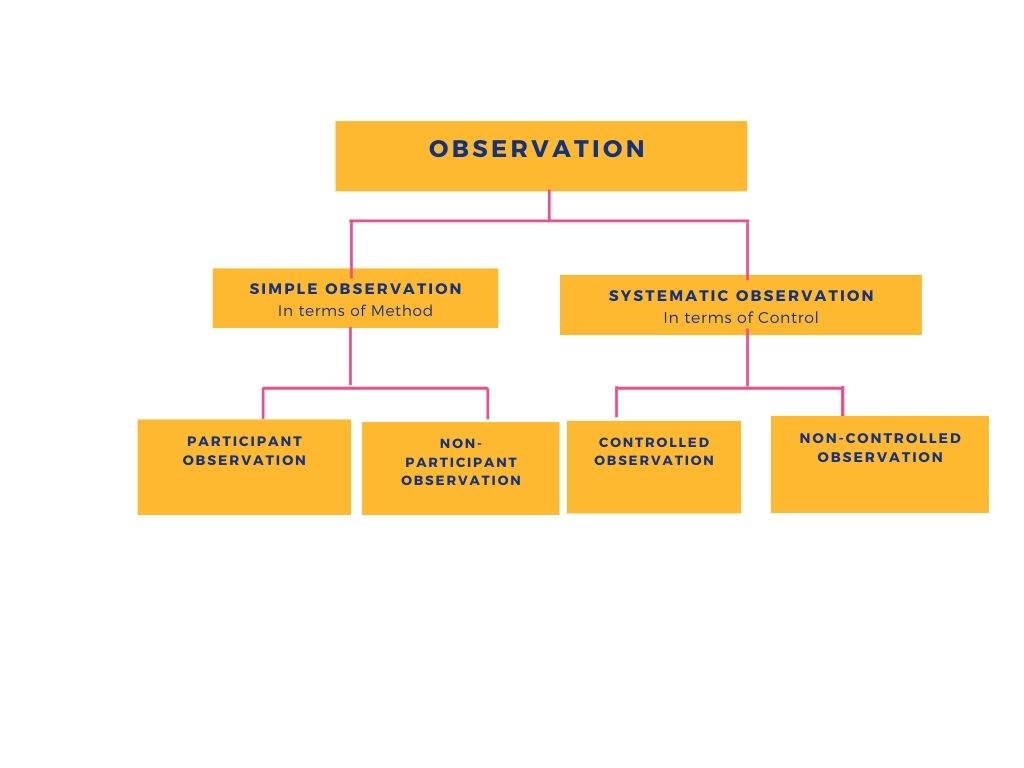
A) Participant observation:
When the observer participates with the activities of the group under study it is known as participant observation. Thus a participant observer makes himself as a part of the group under study.
- He will be an active member of the group. He need not necessarily carry out all the activities as carried out by other members of the group.
- He not only participates in the group life but also observes the group behaviour. For this reasons he is a participant-cum-observer.
- That means a social investigator becomes a participant if he is present in some capacity other than an observer viz., historian, a correspondent etc. –
- He freely mixes with the group, and participated in some of its working, functions and festivals.
- He works not as a total alien but as full fledged member of the group, not as outsider trying to have a critical study of what they do, but a willing member trying to participate in what they do.
- Thus under participant observation, the purpose of critical study is concealed under the desire to leam folklore, mores, traditions and customs.
- Bufford Junker formulated a research sequences for anthropologists engaged in field work and using observation is a research technique. According to. Junker an investigator achieves particular status levels on the basis of his degree of rapport with the group under study. Thus the investigator may be in any of the status levels of an outsider, partial observer , full observer, observer-as-participant, participant-as-observer, participant observer and full participant. Further, Junker says, the status levels of the investigator are directly related to the investigator is that of an outsider. He cannot get information. It he is a partial observer he gets little information. If he is a full observer he gets increased information and so on. This reveals how the status levels of the investigator are directly related to the derivation of information.
This sequence is a follows:
| STATUS LEVEL | DEGREE OF INFORMATION |
|---|---|
| Outsider | No information derived |
| Partial observer | Limited information derived through the process of observation only. |
| Full observer | Increased information derived but restricted to the process of observation |
| Observer-as-participant Lynds-Middle town White-Street comer society, Italy | Increased information derived through the combined processes of observation and participation, but the emphasis is still upon derivation with only limited participation possible. |
| Participants-as-observer (Malinowski) | Increased information derived through the combined processes of participation and observation but the emphasis is now upon participation |
| Participant-observer | Most intensive derivation of information with extreme emphasis upon participation. |
| Full participation (knud Rasmusson and Peter Frenchen-Eskimo) F-H. Cushing | Increased derivation of information but highly based and non-objective. |
The above sequence shows how the participant observer can get the most intensive information with extreme emphasis on part participation.
The advantages of participation observation are:
- l. The advantages of participant observer is able to record the natural behaviour of the group he is studying.
- 2 The observer obtains a greater depth of experience, while being able to record the actual behaviour of other participants.
- 3. Since the period of observation may continue for months, the range of material collected will be much wider than that gained from a series of even lengthy interview schedules
- 4.. He is able further to record the context which gives meaning to the expression of opinions, thus surpassing the richness of usual questionnaires.
- 5. He can grasp the “imponderablia of actual life” of the group under study. So, , he can check the truth of the statements made by the members of the groups.
- 6. His subjects are generally very much willing to explain the significance of their various social activities tc an outsider who is keen and willing to learn that to a person who has only academic interest in them.
- 7. He can learn things that are not open to observations. For example, Malinwski lived in the village of Trobrinders and was able to sec the customs, sometimes participate in some of the ceremonies. So he achieved grasp of what he called the “imponderablia of actual life” which cannot possibly be recorded by questioning or consulting documents.
The disadvantages of a participant observer are:
- 1. To the extent that the investigator actually becomes
- 2. To the extent that he participates emotionally, he comes to lose the objectivity.
- 3. As he learn the correct modes of behaviour he comes to take them so much for granted that they seem perfect, natural and frequently he fails to note the details.
- 4 . There is the danger of environment in which the investigator may take on a particular friendship circle. This narrows his range of experience,
- 5. His role is supposed to be natural. While playing the role there may arise a conflict between two parties that involves him to take sides.
- 6. He may not be admitted to participate in every aspect of life (domestic life, criminal life, prison life etc).
B) Non-Participant Observation
When the observer does not actually participate in the activities of the group, but simply observes them -from a distance it is known as non-participation observation. Pure non-participation observation is extremely difficult. We cannot imagine a kind of relationship in which a person is always present but never participates. The observer in fact participates in some of the ordinary activities while remaining only a distant observer in theirs. Therefore a non-participant observation in practices is only a quasi-participant observation .
The advantage of non-participation are as follows:
- 1. Objective and a purely scientific out-look can be maintained. The observer remains unattached and impartial without having any prejudices of his own.
- 2. He maintains a purely impartial status and thus can command respect and cooperation from every groups of the people.
- 3. The investigator maintains the stranger value. Because of his being a stranger people are more ready and willing , to disclose even their weaknesses, than if he was known to them.
- 4. It helps him to observe even minute things which would otherwise have been left as a common place things.
- 5. The investigator can maintain a detached view and keep himself aloof from petty factions and quarrels among the group.
The disadvantages of the non-participant Observations are
- 1. The researcher fails to appreciate the significance of a member of actions and activities as he cannot view them from the point of the persons who are doing them. This lack of appreciation may make some of his findings biased in the background of his own understanding.
- 2. He can observe only those activities that take place before him, but they from only a small part of the whole range. He cannot understand them in proper sequence unless he has actively participated
- 3. People generally feel mere suspicious of a person who stands as a critic. They fail to behave normally due to consciousness of his presence. This results in the creation of bias and what the researcher observes is not a natural or normal thing but a formality and show-affair,
- 4. The researcher himself and the whole group may feel very uncomfortable due to this strange attitude of the researcher. It is very difficult to take the presence of a person in a natural way who is always present to observe but never participates in anything.
C) Controlled observation
Because of the defects of non-controlled observation, controlled observation techniques have been developed. Controlled observations techniques afford greater precision and objectivity and can be repeatedly observed under identical conditions. The main purpose of a controlled observation is thus, to check any bias due to faulty perception, inaccurate data , and influence of outsider factors on the particular incident.
The control exercised in the observation is of two types:
1. Control over the phenomena (phenomena is put to laboratory type of list, under guided conditions).
2. Control over the observation (the researcher tries to control and guide his own perception and thus avoid any bias due to faculty observation).
The following seven kinds of control devices are generally used for this purpose:
- (a) Detailed plan for observation
- (b) Use of scheduled for objective and standardised observation.
- (c) Use of mechanical appliances such as photos, films and sound recorders to aid proper observation and objectivity.
- (d) Formulation of a specific hypothesis to known exactly what things are specially to be observed..
- (e) Control through team observation. While one person may be at fault a team of persons can never be wrong.
- (f) Use of control groups the purpose of valid generation, specially for determining cause and effect relationships.
D) Non-Controlled Observation
When the observation is made in the natural surroundings, and the activities are performed in their usual course without being influenced or guided by any external force it is known as non-controlled observation. Thus is the case of non-controlled observation ‘ the observer visits the place of occurrence of phenomena in order to observe (for example, study of slum conditions or study of folklore).
The advantages of non-controlled observation are:
- 1. Non-controlled observations enables the investigator to observe life situations in their exact social and cultural settings.
- 2. Non-controlled observation is a major source of social research data because human beings are such as can hardly provided a chance for laboratory type study and social phenomena have therefore to be observed in the natural surroundings where may take place.
The disadvantages of non-controlled observation are:
- 1. Non-controlled observation is generally not very reliable.
- 2. The observation itself may be biased and coloured by the view of the observer because there is no check upon him.
- 3. Various observers may observe the same thing differently and draw different conclusions.
- 4 The observer may be included to generalize from stray incident without properly verifying them