Geological Calendar
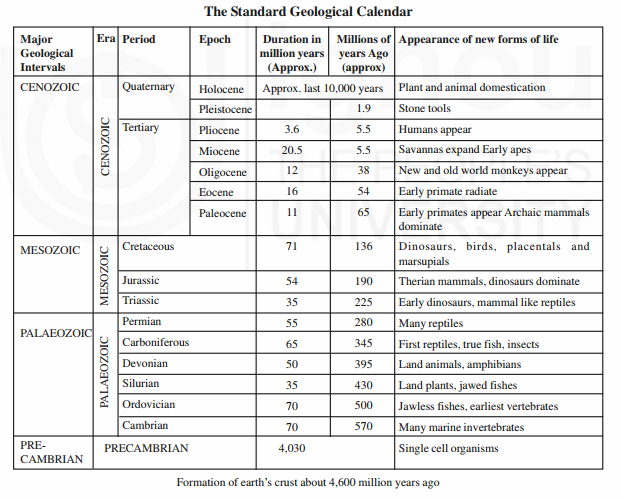
The history of the earth is subdivided by the geological calendar. Originally this history was organised by the relative age of the various rock formations that comprise the stratigraphic record of the science of historical geology. Later this relative chronology was converted to an absolute chronology by the use of the various radiometric-dating techniques. The oldest rocks, of Pre-Cambrian age, have been dated to 4.6 billion years ago by uranium-lead radiometric assays.
Younger sub-divisions of the geological calendar are dated in a relative sense by the fossil content of the rock units and in an absolute manner through the broad range of isotopic decay techniques.
The subdivisions of the geological calendar with taxonomic breakdown into eras, periods and epochs are presented in the table. The Cenozoic, the latest era, is the subdivision during which modern forms of life evolved. The Cenozoic era is subdivided into two periods, the Tertiary and Quaternary, respectively the third and fourth subdivisions of the geological calendar. The Tertiary period saw the rise of mammals, including primates during the last 65 million years. The Quaternary is of prime importance to the study of cultural evolution because it is the period of humankind. During the Quaternary, the fossil record shows the biological evolution of humans and their primate relatives over the last two million years.
Glacial Calendar
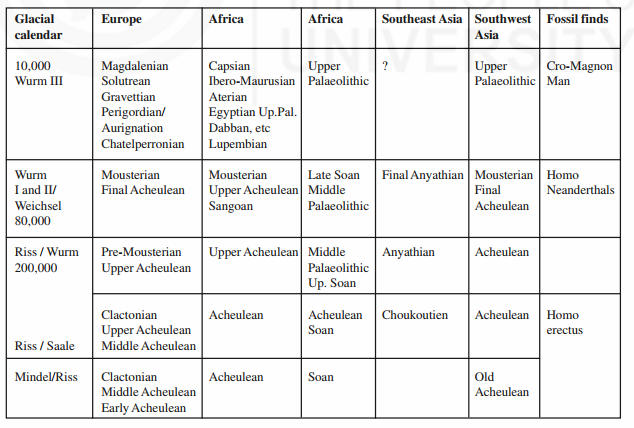
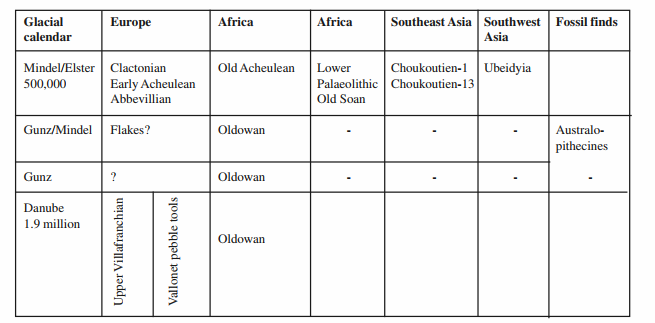
The Quaternary period of the geological time scale in turn is subdivided into two epochs, the Pleistocene and the Holocene. The Pleistocene is characterised as the “Ice Ages” when pre-modern humans evolved. Fully modern humans, called Homo sapiens in biological terminology, appear at the end of Pleistocene and flourished during the last 10,000 years, epoch called Holocene. The Holocene epoch is the geological interval following the ice ages and hence is often called post-glacial. It has witnessed essentially modern climates and is marked by the appearance of the first agricultural village and ultimately of urban civilisation. The Pleistocene is characterised as an epoch of widely fluctuating climates with world temperature averages ranging between 4º and 5º C below today’s values. During cold climatic episodes the polar icecaps thickened and continental glaciers advanced as snow accumulated at high latitudes, while mountain glaciers formed and advanced in middle latitudes. While water was stored in ice sheets, the world sea level dropped because of the retention of water at high latitudes. Alternately during warm, interglacial episodes of the Pleistocene, the icecaps melted, glaciers retreated, and sea levels rose.
The glacial calendar is subdivided according to oscillation of climates from cold to warm. The cold episodes are called glacial stages. In Europe at least four glaciations have been recognised and named as Gunz, Mindel, Riss and Wurm in Alps mountain region and Elster, Wieschel, Saale and Wardha in Scandinavian region. Three warm climate phases have been identified and named Gunz-Mindel, Mindel-Riss and Riss-Wurm interglacial in southern Europe, and Cromerian, Holsteinian and Eemian in northern Europe. The capitalised glacial stage names are pulses of cold climate with internal variations. These minor oscillations of intense cold are called stadials while the intervening relatively warmer subepisodes are called inter-stadials. Chronological Chart of Pleistocene Period and Palaeolithic Cultures in the Old World
Customarily, the Pleistocene epoch is periodised in a three-fold scheme as upper (late), middle and lower (basal). The Lower Pleistocene is marked by: 1) the first cold phase, 2) the Biber glaciation, 3) the two Donau glaciations, and 4) the Gunz glaciation. The time interval of the Lower Pleistocene period extends from 700,000 to 2.0 million years ago. The Middle Pleistocene contains the Cromerian and Holesteinian interglacial plus the Mindel and Riss glacial stages, according to the terminology of the Alpine-Swiss sequence of Europe. The corresponding glacial stages, Elster and Saale, are advances of the Scandinavian sheet that pushed down from the Baltic Sea onto the north German plains. And finally, the late (upper) Pleistocene epoch is a comparatively short period of time approximately of 100,000 years including the Eemian interglacial and Wurm / Weichsel glaciation and ending about 10,000 years ago with the final retreat of the worlds continental and mountain glaciers. The Pleistocene period in Africa has witnessed the downpour of rains called pluvials. These are named as Kageran, Kamasian, Kanjeeran and Gamblean pluvials corresponding to the glacial episodes of Europe.
These pluvials are alternately represented by inter-pluvials such as Kageran-Kamasian, Kamasian-Kanjeeran, and Kanjeeran-Gamblian. These pluvials and inter-pluvials represent wet and dry climates respectively.