Distribution:
- The Lower Palaeolithic cultures occur in all parts of India except Tinnelvelly District in Tamilnadu and the Kerala State in South India and the Sindh province in North West India.
- In Peninsular India, they occur in the middle and the upper reaches of rivers and streams, foot hills, caves, and rock ‘shelters (M.P., T.N. and Maharashtra) forested areas (Bulsar In Maharashtra and Peemala in M.P) and at open air factory sites (Nevasa, Lalitpur, Anangawadi, Vadamadurai, etc.,)
- In Extra-Peninsular India, they occur in the glacier- pluvial deposits of Kashmir and in the middle and upper reaches of river Valleys of Punjab, Kashmir, Assam, Meghalaya, and Arunachal Pradesh. These cultures occur at open-air sites on river banks (Sohan River in West Punjab), on high hills (Phalgaon in Kashmir), in thick forests and perennial river streams (Kangra in Punjab) and foot-hills (Meghalaya and Arunachal Pradesh).
Environment:
- The environment in which the Lower Palaeolithic cultures existed was not uniform. When the Potwar Plateau and Kashmir Valley in extra-Peninsular India were under the influence of the great Ice Age characterized by glacial and inter glacial phases, the river Valleys in Peninsular India were experiencing climatic fluctuations in terms of pluvial conditions during Pleistocene epoch.
- The environment was rich in flora and fauna. The floral remains occur in the form of a carbonized trunk of Terminalia Arjuna species at Mulanagar in Ahmednagar dist, unidentifiable silicified wood pieces at Nevasa and Pollen grains of Chilbil from the fossil soil near Imamgaon in Poona Dist.- all in Maharashtra.
- Several sites located in the areas between Hoshangabad and Narsingpur Dist. in M.P., yielded remains of wild elephant, wild horse, wild Ox, hippopotamus, rhinoceros, deer and seven more animals. The remains of wild elephant and wild ox have been found at sites like Nandumadhaneswar, Mulanagar, Yeldani, Kalegaon, Chandoli, Kalarnb, Amaravathi, Chanda and Wardha in Maharashtra, Chikdauli, Yelhaiti and Kitlur in Karnataka.
Chronology:
There are diverse views on the chronology of Lower Palaeolithic culture in India.
- De Terra and Paterson (1939) considered the geological and palaeontological evidences and placed the Lower Palaeolithic culture in the Middle Pleistocene.
- Zeuner (1962) and Wainwright (1964) studied the sea level changes on the west coast in India and concluded the Lower Palaeolithic existed in the Upper Pleistocene.
- Sankalia (1964) studied the geological and stratigraphic evidence in the Narmada, Godavari. Prabha. and Krishna River Valleys and estimated the time period of Lower Palaeolithic between the Late Middle Pleistocene and is upper level to the Upper Pleistocene times.
- Paterson and Drummond (1962) compared the Archaeological evidence in the contiguous places from Potwar in West Punjab to South Africa and concluded that the Lower Palaeolithic in Kashmir existed in the third glacial and the third interglacial periods of Pleistocene.
- Investigations Into the marine and semi-marine formation of the east coast near Madras and West coast yielded archaeological evidence placing the Lower Palaeolithic at Sohan in the second inter-glacial period of the Middle Pleistocene.
Materials:
The Lower Palaeolithic people utilized the raw materials available in their environment. Their principle material used for making tools was granular quartzite in the form of river pebbles. Very rarely people collected fine-grained quartzite collected from the riverbeds, raw materials for making tools.
Cultural diversities:
The Lower Palaeolithic culture was not uniform. It may be divided into three broad groups.
- a) Soan culture (Soan Valley in Pakistan- Choppers and Chopping tools).
- b) Narmada culture (Adamgarh Hill) – Higher occurrence of cleavers and a combination of hand axes and Choppers and Chopping tools).
- c) Madras culture (Attirampakkam site situated on Budida manuvanka and Kartalayar near Vadamadurai — Hand axes).
A) Soan Culture :
H.P. De Terra and T.T, Paterson ‘of Yale-Cambridge expedition between 1930-35 Soan (sobhana in Sanskrit) culture. Soan is a tributary of Indus. It flows past the city of Rawalpindi. De Terra and Paterson (1935) excavated and reconstructed six- terraces- TD to T5. These 6 terraces formed due to three aggradational and three erosional phases starting from second glacial period and continuing up to the beginning of Holocene period. These events or periods show decreasing and increasing glacial activity in Soan Valley.
De Terra and Paterson have shown the development of stone tool industries associated with the terraces on the basis of a cross-section of Soan river.

| TD = Pre-Soan: | a) Big flake tools resulted due to horizontal or vertical splitting of pebbles (comparable with cromerian flake tools in Europe) b) Other flake tools removed by ordinary methods and converted into tools |
| Tl = Early Soan: | a) Choppers, Chopping tools, discoid cores, core flake tools of simple as well as Clactonian tradition. b) Choppers, Chopping tools discoid cores, and single faced flake tools with little retouch made by Levalloisian tradition. |
| T2 = Late Soan: | a) Choppers, Chopping tools Levalloisian flake tools and long flake tools and blades. b) Choppers, chopping tools and more cores and all the tools made by the Levalloisian techniques. More developed than (a). |
| T3 = Sterile: | |
| T4 = Evolved Soan: | Majority of the tools are pebble tools and Clactonian flake tools |
These terraces in the Soan Valley have also yielded crude heavy hand axes besides Choppers and Chopping tools from the upper terraces whereas in the lower ones small finely worked hand axes, cleavers, discoid cores, flake tools and Chopping tools were found. In all the industries the Chopping tool is common type but more in proportion in the earlier industries than in the Late Sohan; sometimes their proportion being more than half of the finished types. This, according to De Terra and Paterson indicates progressive development of hand axes and other core tools, which has been supported by the work of Lai (1956) in the Beas River Valley, another tributary of the Indus on the Indian side of the frontier and of Sen (1960) in Sirsa Valley of Sutlej in Punjab in India.
B) Narmada Culture:
- De terra, Paterson, Sankalia, Sen, Supekar, Joshi, Singh and others studied the Narmada Culture.
- De Terra and Paterson excavated tire sites at Hoshangabad and Narsingpur from of the Narmada Valley in Madhya Pradesh.
- Sankalia, Sen, Joshi, and Singh excavated Maheshwar of the Narmada Valley near Jabalpur, Malva and Damoh areas in Madhya Pradesh. These excavations yielded Lower Palaeolithic tools like Abbevillian and Acheulean hand axes besides Chopper Chopping tools and cleavers.
On the whole the Narmada stratigraphy is complicated and poses many problems. Two of the major problem are “ variations of stratigraphy from place to place because the Valley is a rift Valley; and differential availability of faunal evidence. More number of faunal evidences are present in the Hoshangabad – Narsingpur area, whereas in other places the distribution of fossils is at random. Since this stratigraphy is not in a definite sequential manner, it is very difficult to assign the tool types to their respective cultural development stages. But in general the main tool types present range from Choppers two Hand axes,
cleavers, scrapers, flake tools, and cores.
The Lower Palaeolithic cultures in Rajasthan, Gujarat and Maharashtra were almost similar to the Narmada Culture. In Gujarat, Zeuner and Subbarao excavated the sites in Sabarmathi River Valley. They identified five wet and five dry periods, which yielded, Choppers and Chopping tools and large hand axes. In Rajasthan Mishra excavated Nagri and Chittorgarh and other sites in the Banas, Gaxnbir and Cbambal river Valleys and obtained the Choppers and Chopping tools from the Basal gravel layer. These Valleys experienced climatic changes twice. Similarly, the Excavation of Sankalia and his students near Bombay and Ratnagiri, at Nevasa in Pravara Valley, Gangawadi in Godavari Valley, Ahmednagar, and so on yielded Chopper and Chopping tools, large hand axes and cleavers.
C) Madrasian Culture :
- The Madrasian culture spread Tamilnadu, Andhra Pradesh and Karnataka.
- Robert Bruce Foot identified this culture in 1863 at Attirampakkarn in Tamilnadu.
- Later, De Terra, Paterson, Krishnaswamy, Banerjee. Joshi and a host of others excavated the sites at Attirampakkarn and Vadamadurai in Tamilnadu and brought to light the Madrasian culture.
- De Terra and Paterson excavated the banks of Kartalayer River at Vadamadurai.
Transverse section through Kartalayer Valley.
T2 Lower Palaeolithic tools
I stage- Abbevillian hand axes
II stage — Acheulean hand axes
III stage- Acheulean hand axes. Cleavers, Levalloisian flake tools
T3 = Middle Palaeolithic tools
Post-Acheulean flake tools and a few scrapers
No representatives of Upper Palaeolithic tools were found. The hand axe industry developed in these stages.
- a) First Stage: Witnessed the presence of Abbevillian hand axes and irregular cores and flake tools bearing cortex on one of the surfaces. They are smooth water-worn indicating that they have been carried out by the force of river water from long distances the tools bear a thin layer of patination .
- b) Second Stage: Showed the hand axes of middle Acheulian found in they upper levels of detrital laterite. These hand axes are of various shapes. They bear patination of red colour.
- c) Third Stage: Included hand axes of Ipper Acheulian types made by cylinder hammer techniques. Further there were cleavers Levalloisian flake tools.
Joshi, Banerjee and other excavated the site of Attirampakkarn situated on a small river stream called Budidamamivanka.
| Layers(bottom to top) | Tools excavated |
|---|---|
| 5. Silt | Mesolithic (Microliths) there is no — evidence for Upper Palaeolithic |
| 4. Brown silt | Sterile (No archaeological tools) |
| 3. Detrital laterite | Middle Palaeolithic (Flake tools, — Points, scrapers, borers and a few long blade like flake tools.) |
| 2. Shale clay | Lower Palaeolithic (Acheulian – Hand axes, cleavers and other tools) |
| 1.Shale (rock) | no tools |
The Madras culture occurs not only in Tamilnadu but in Andhra Pradesh and Karnataka also. Accordingly to the excavations made by Subbarao, Sankalia, Murthy and Others in the river Valleys of Krishna, Godavari, Tungabhadra, Swarnamukhi and Penna in different Districts of Andhra Pradesh, the general idea of stratigraphy is as follows:
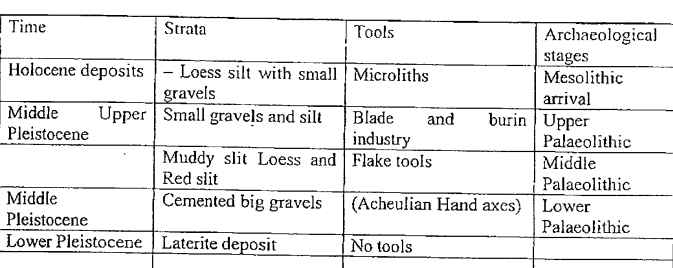
In Karnataka, the Lower Palaeolithic is not so abundant as in Andhra Pradesh though the sequence of climatic changes occurred twice or thrice, as in Andhra Pradesh. Seshadri, Joshi, Pappu, Paddayya and others excavated the sites in Malaprabha and Ghataprabha Valleys and in Chitradurga, Chickmagulur, Tumkur and Bellary Districts and unearthed Abbevillian and Acbeulean hand axes, cleavers, Choppers and flake tools which are similar to those existing in Andhra Pradesh.
In Uttar Pradesh, Bihar, West Bengal, Orissa and other parts of the country similar evidence has come to light. The excavations made by Zeuner, Krishna swami, Sounder Rajan and others in Singrauli Basin, Rihand of Bichinala in U.P., Chotanagpur in Bihar Sisunia Hills in W.B, Kuliana in Orissa, and some places in Meghalaya yielded pebble tools, hand axes, cleavers, of Levalloisian flake tools
Summary:
The Lower Palaeolithic culture indicates the dawn of culture in India as whole during the Middle Pleistocene. There are no fossils indicating the owners of these cultures. The Lower Palaeolithic culture was not uniform. It may be divided into three broad zones the Soan, the Narmada and Madrasian
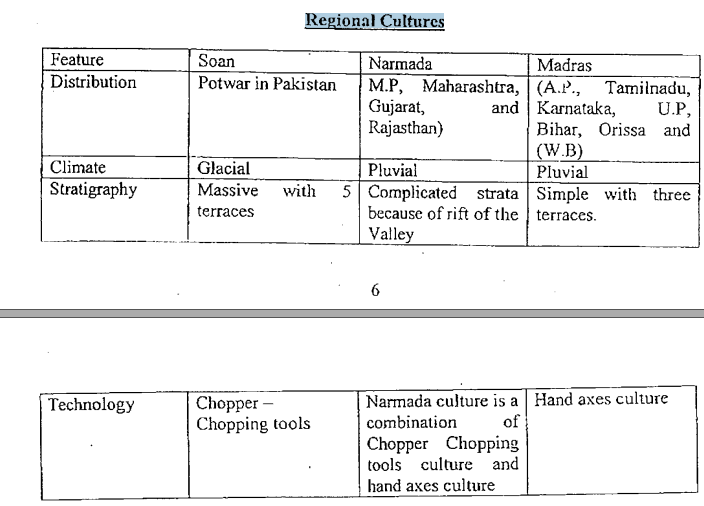
In all the three zones ,, majority of the tools arc made of quartzite available in the form of pebbles, rock-out crops and boulders. The tools were made from large flake tools are pieces removed from the starting material on nodular or parent rock by employing block- on block technique, stone hammer technique and step flaking technique where necessary. In the later stages of Lower Palaeolithic period, flake tools removed from tortoise cores have been converted in to tools, which become the main technique for producing the flake tools of Middle Palaeolithic.
Among the Lower Palaeolithic folk those who lived and used Chopper and Chopper tools in the extra-Peninsular region were simple food gatherers and those who used hand axes and cleavers lived in Peninsular areas and who were big game hunters.