- Raymond Dart, a young Professor of Anatomy at Johannesburg on 7th Feb, 1925 announced the discovery of an early Pliocene- Pleistocene hominid with a small brain case. The type specimen, an infant skull (about six years old), was discovered in the end of year 1924 by workers in a lime stone quarry at Taung (Ta- ung = place of lion), in what is now Botswana, South Africa.
- Dart named his find as Australopithecus africanus (Southern African ape) and mentioned the many ape like feature of the skull including the small size of the brain ( 380- 500 c.c) and pointed to its pongid affinities; albeit he also emphasised the fact that there were a number of features of the skull and the dentition which were man-like. He placed this new genus and species in a family intermediate between hominids and pongids i.e. Homo-simiidae. The teeth of the juvenile are very large, but morphologically similar to those of later hominids.
- The best-known, most widely distributed, and most diverse of the early African hominins are colloquially called australopiths.
- In fact, this diverse and very successful group of hominins is made up of two closely related genera, Australopithecus and Paranthropus.
- These hominins have an established time range of over 3 million years—stretching back as early as 4.2 mya and not becoming extinct until apparently close to 1 mya— making them the longest- enduring hominins yet documented.
- In addition, these hominins have been found in all the major geographical areas of Africa that have, to date, produced early hominin finds.
Geographical distribution:
There are four main species of Australopithecus and two or three species of Paranthropus. The former including Gracile forms and latter robustus forms.
Australopithecus: (Gracile forms)
- Australopithecus Ramidus : Aramis (Ethiopia)
- Australopithecus Anamnesis: Allia bay , Kamapa (Kenya)
- Australopithecus afarensis: E.Turkana (Kenya), Fejej, Hador (Lucy), Omo Valley (Ethiopia), Laetoli (Tanzanias)
- Australopithecus Africanus : Makapan Sgat , Swart Krans , Sterkfontein , Taung (Raymond Dart 1924)- (Republic of south Africa) , Kanapoi , Lothagan (Kenya) , Ohio (Ethiopia)
Paranthropus (Robustus forms)
- Australopithecus aethiopithecus : West Turkana(Kenya)
- Australopithecus robustus / Paranthropus robustus: Sivart Krans (South Africa)
- Paranthropus Boisei/ Australopithecus boisei: Ohio (Ethiopia), Olduvai Gorge (Tanzania),Lake bering (Kanya)
Overall , the major features that all australopiths share:
- They are all clearly bipedal (although not necessarily identical to Homo in this regard).
- They all have relatively small brains (at least compared to Homo).
- They all have large teeth, particularly the back teeth, with thick to very thick enamel on the molars.
In short, then, all these australopith species are relatively small-brained, big toothed bipeds.
| Gracile Form | Robusts Form | |
| Time | 4.4 – 2.0 mya | 2.3 – 1.8 mya |
| Height | 3′.5″- 4 Ft. | 3′.11″- 4.4″ (robustus) |
| Weight | 30- 70 Kgs. | 40- 80 Kgs. |
| Bodiiy features | a) Light built | a) Heavily built (robustus) |
| b) Relatively long arms | b) Relatively long arms. | |
| c) Ape-like features (A.afarensis) d) More human features (A.africanus) | c) Human features | |
| e) Marked to moderate sexual dimorphism. (A. afarensis) f) Probably less sexual dimorphism (A.africanus) | e) Moderate sexual dimorphism. (Robustus) f) Marked sexual dimorphism (A.boisei) | |
| Cranial Capacity | a) 400- 600 CC (A.afarensis) b) 450- 600 CC (A.africanus) | a) 500-600 CC |
| Cranial Vault | a) Low (A.afarensis) b) High and expanded (A.africanus) | a) Low placed and not expanded. |
| Saggital Crest | Absent, human character | Present, less prominent in robustus but more prominent in super robustus. |
| Position of occipital torns | low | Relatively or slightly higher in position |
| Temporal fossa | Medium size | Very large |
| Frontal region | a) Low,flat forehead (A.afarensis) b) Higher or rounded and well developed forehead(A.africanus) | a) Under developed, long, broad, flat face (robustus) b) Very long, broad flat face. ( Super robustus ) |
| Zygomatic region | Moderately large | Massive |
| Supra orbital region | a) Lack of development, prominent brow ridges (A. afarensis) b) Less prominent brow ridges. (A.africanus) | Large |
| Mastoid process | Slightly developed | Not developed |
| Foramen magnum | Quite forwardly placed | Even from forwardly placed. |
| Jaws | Large and extremely prognathis | Large but relatively less prognathis |
| Dental arcade | Parabolic | May be parabolic or less parabolic |
| Simian Shelf | Absent | Present |
| Dentition | a) Relatively large incisors and cannines and moderate size molars. Presence of gap between upper incisors and cannines (A.afarensis). b) Small incisors and cannines; larger molars, absence of gap between upper incisors and cannines (A.africanus) | a) Small incisors and cannines, large premolars and very large molars. |
| Pelvis and leg bones | Very close to hominid pattern | A combination of the gorilloid and hominoid patterns. |
| Foot | Absence of divergent big toe | Presence of divergent big toe |
| Conclusion: | All these characters indicate that the gracile antrolopithecus was essentially bi-pedal and erect in posture. | All these characters indicate that the robust ones are sufficiently bi-pedal and less erect than the gracile type. |
There are two theories that explain the evolution of australopithecus:
Two branch theory was proposed in 1979 by the discoverers of A.afarensis, Donald C. Johanson and his colleague Timothy White and the theory remained remained generally accepted till 1985. The theory states that A.afarensis split into two branches- an australopithline represented by A.africanus to A.robustus to A.boisei; and a Homo line represented by Homo habilis to Homo erectus to Homo Sapiens. The branching was supposed to have occurred 3 million years ago into these two bipedal hominid lines.
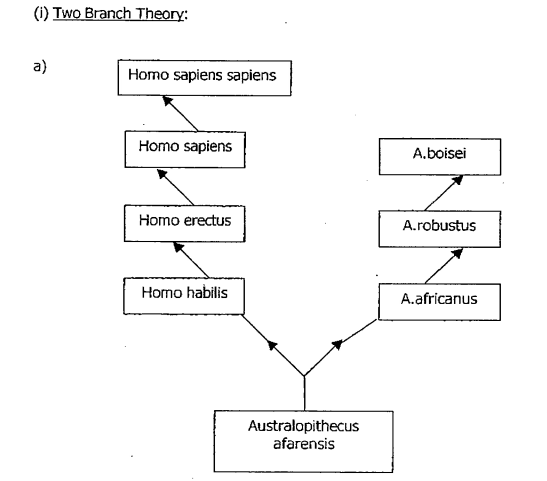
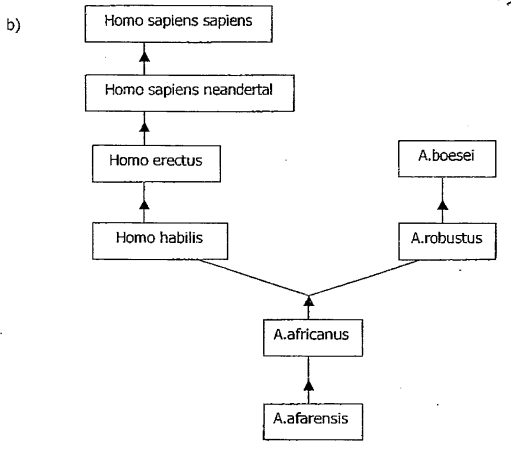
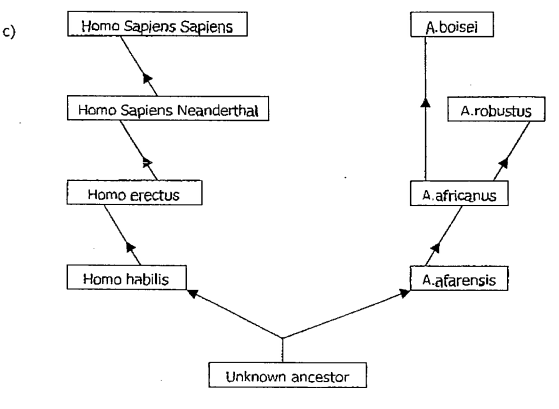
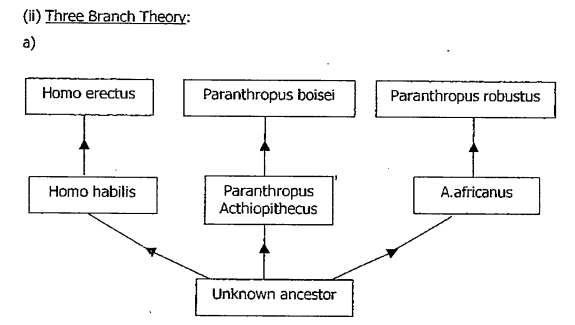
The two branch theory of Johanson and White was generally accepted until the discovery in Northern Kenya in 1985 by Alan Walker of a complete new type of hominid skull called A.aethiopithecus. majority of anthropologists believe that early hominids had three branches instead of two one to homoline, second to boisei line and the third to africanus- robustus line..
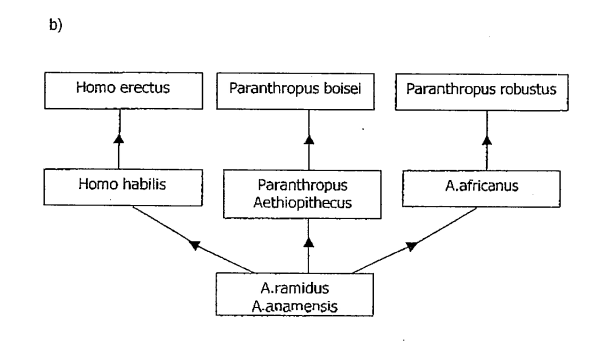
Phylogenetic status
Different researchers have different ideas, most of the ‘lumpers’ recognise only one genus called Australopithecus to accommodate at least four distinct species at present i.e. Australopithecus africanus in South Africa, Australopithecus robustus in East Africa, Australopithecus afarensis in Hadar (Ethiopia) and Laeotoli (Tanzania) and Australopithecus ramidus in Afar ( Ethiopia) region.
The overall pattern of early human evolution in Africa appears to have taken the following course. First was the early Australopithecus ramidus, the apparent ancestral stock which appeared about 5 to 6 million years before present; later came another smaller but better developed form, Australopithecus afarensis which appeared around 3.75 million years ago; after that came the gracile and robust forms i.e Australopithecus africanus and Australopithecus robustus which appeared about 2 to 1 million years before present, respectively.
Some investigators argue that the important differences in dental proportions between Australopithecus africanus and Australopithecus robustus, the gracile and robust forms, respectively, do not correspond with allometric trends noted among modern primates. According to them these differences may be morphologically significant adaptations, perhaps indicating dietary modifications or may be even social behaviour.
The genus Homo appeared to be and was apparently the descendant of one of the Australopithecus forms, but, it is still not clear what led to the evolution of the genus Homo. The phylogentic position of Australopithecus is quite clear that it is a hominid and that is why it is included under the subfamily Homininae and the family Hominidae to which the present day humans also belong.