Introduction:
“Dead men do tell tales” a one phrase translation of forensic science emerged in 1889 in a noteworthy French
murder case in which a four month old exhumed skeleton unfurled enough of secrets to trace the victim and the
murderers. Briefly the story goes like this; In November 1889, French police received two cases one after other,
one of Gouffe, a French baliff being missing and three days later another of a corpse found near riverside at
Lyons. Upon autopsying the body by Dr. Paul Bernard, it was confirmed that the two cases weren’t related.
However Monsieur Goron, Chief of the Surete, believed that the two incidents are related and was convinced
that the corpse is that of Gouffe. After four months he sent a petition to court to reopen the case, got permission
to exhume the body and then sent a request to Dr. Alexandre Lacassagne; Professor of Forensic Medicine at
Lyons University. Dr. A. Lascassagne was a renowned criminologist who used to solve very difficult cases.
After cautiously inspecting the skeleton and the other remaining parts of the body like hair; he confirmed it was
Gouffe. The biggest challenge in this case was to reveal three accurate information 1) to identify the cadaver 2)
to estimate time of death 3) to explain the cause of death. Dr. A. Lascassagne, was skillfully able to deduce all
the three information; ion a n era when there were no big techniques like PCR (Polymerase chain reaction)
etc.{Reference}It was these early findings that laid a plinth to the modern forensic science.
Technically speaking, it is easy to inspect a fresh corpse about cause and time of death. Challenge is put forth to
the experts of forensics when a badly decomposed or exhumed or disintegrated cadaver is to be examined. For
example, a worst case scenario is when a disintegrated skeleton is brought for examination to the morgue. The
examination commences by examining whether the skeleton is of human or any other origin. If the remains are
of a human origin, next step is to determine the age at death, sex, and stature of the decedent which is job a
Forensic Anthropologist (FA) {reference}. Following step is to know the cause of death. Finally, it’s a job of a
FA to prepare a report to be presented at court. So, by now we know one of the important tasks in forensics is to
know cause and time of death; a detailed discussion on same is presented below.
Time and causes of death
The most critical scenario in forensic science since the times immortal has been the assessment of the time and
the cause of death. Determining time and causes of death is very difficult, unless someone should be evident of
seeing the person dying. Documentation from ancient times shows the early traces of the science of exploring
event of death.
The role of a Forensic Anthropologists in a death investigation is crucial to the field of forensic science as a
whole. A trained Forensic Anthropologist vigilantly examines the site of death of an individual for seeking
evidences in the surroundings. Forensic Anthropologists understand the forms and variations of various skeletal
properties, and apply their knowledge to their work in order to obtain reasonable conclusions. This involves a
detailed analysis of skeletal trauma, form of trauma and distinguish among the cause/source of injury e.g.
injuries caused by sharp/blunt objects, bullets/explosives, or other instruments .Their main focus is to process
crime scenes, examines and process remains, develop a biological profile, compile appropriate documentation,
and testify in the provincial and federal courts. The knowledge of Forensic Anthropologist of the human body
contributes to the outcome of a death investigation by providing law enforcement agencies with expert answers
and conclusions, which ultimately aids in the outcome of any given case 6.
Estimating Taphonomy [time of death (TOD)]
As said above determining time of death (TOD) is a very critical and difficult job for FA. First thing a FA
inquires about is the last seen time of the individual and the earliest seen time of corpse; giving a time frame for
the period of death. If the body is fresh you can narrow your estimate to a fairly narrow range of time. 7
However, if the human remains brought to morgue are badly decomposed or exhumed after a long time, it
becomes tough job to estimate the time of death. To address the query of death time an, anthropologists uses
taphonomy- study of post death alterations to the body till it is discovered. The methods to explore the TOD of
an individual vary depending on discovered remains whether they are of historic importance or of judicial
importance. During ancient times only viable tools to determine TOD was the naked eye exploration of the
individual. Then as time proceeded, microscopic changes were taken into consideration. In modern times we
have many techniques in addition to the previously used techniques, like carbon dating, gene profiling etc. This
topic has been focused at the forensic science related to judicial matters. The cases pertaining to police
investigation are again of two types broadly speaking, a recent death or a disinterred body. In either scenario
FA looks for clues that point to the time elapsed from the TOD. Techniques utilized to address TOD are physical
examination of corpse or remains of an individual, chemically testing the surroundings and samples extracted
from the cadaver. Further, time elapsed from the event of death can be calculated entomologically, i.e. to
evaluate the stages of worms/insects feeding on corpse. Additional procedures carried out can be designed
towards, associated artifact and investigation of context. Following the preliminary arrays of diagnosis of TOD a
pathologist or a toxicologist proceed with the cause of death.
If a body is badly decomposed or fully skeletonised, then determining TOD involves an infinite no. of variables
which affect rate of decomposition of the body. These variables fall under two key categories one is the cadaver
itself and second is the surroundings of site at which corpse is recovered as briefed below.
The cadaver
The first consideration is that of the size and mass of the body; as the decomposition rate is inversely
proportional to the either factors. Hence implying, larger a body longer it takes to decompose.
The second consideration as mentioned previously is whether the corpse found is integrated or not,
intact body means an intact skin surface which protects the body from assault by microorganisms. After
death, decomposition begins around natural body opening, particularly the head and then proceeds to the
area of the body with the moist tissue. If there are wounds on the body there are more openings for the
organisms to attack accelerating decomposition.
The third consideration is most critical and delicate i.e. handling of corpse post recovery. For example,
after discovering a dead body, if the body is kept nude on the ground, it will decompose faster than the
wrapped body.
A body kept in coffin then buried will decompose slower as compared to a body directly buried under sod. Soils
being home to many microbes that scavenge on body hasten the decomposition many times. Human body is
composed of variety of tissue, so varies the rate of decomposition of the different tissues. For instance, adipose
tissue, muscles decompose faster than the fibrous tissue or tough tissues like bones and hair which are the last
body tissues to decompose. If only a skeleton is recovered then TOD can also be estimated by the stages of bone
decomposition. If the skeleton found has splotchy brown discoloration and greasy texture in the bones, it implies
that adipocytes are still present in the texture of bones, consequently deriving the fact that the death has occurred
recently i.e. a couple of months old. In contrast if a skeleton is recovered after longer time duration post death
the bones blench and turn snowy white followed by the development of cracks and exfoliation leading to the
bone surface flaking off.
Rigor mortis, the stiffening of voluntary and involuntary muscles, usually starts in the small muscles and stiffens
the major group muscles in 4-8 hours. The entire body and trunk will stiffen in 8-12 hours. Rigor generally
endures for 24-48 hours and then the body again becomes flaccid. Rigor is affected by several things like
external and internal heat, age, muscle development and victim’s activity prior to death.
The commencement of rigor is enhanced by hot environment and increased body temperature. The onset of rigor
is faster in young and old but slower in heavily muscles individuals.
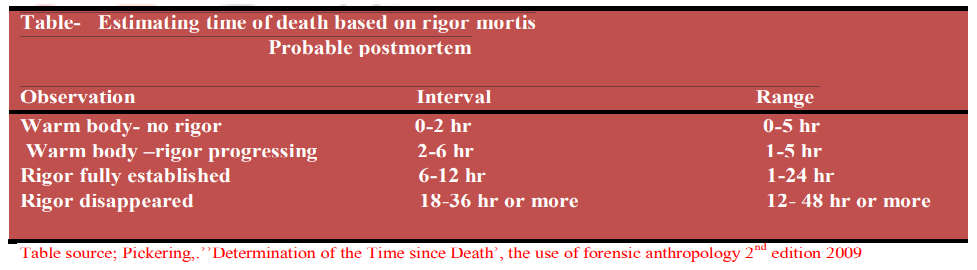
Livor mortis: It is the gravity – produced settling of blood to dependent portion of body, which appears in
pressure free skin surfaces and produces a color like a bruise. The skin remains white and blanched where there is pressure on the body either from contact with the ground, or some other objects or due to cloth tightening.
Blanching gives useful information about position of body at the time of death.
Livor mortis can’t be well defined initially, then after 2 hours or next 3-4 hours, it becomes well developed.
Algor mortis: It is the loss of body heat which begins immediately after the death due to fall in body temperature
fall to that of the surrounding environment. Cooling of the body occurs due to convection, radiation, conduction
and evaporation. The loss of body heat is highly variable as it depends upon’ body temperature at death, sex of
the body, the type of clothing on the body, percentage of skin exposer, and environmental conditions like
temperature , moisture, wind, time of day, and the surface on which the body is lying.
The microenvironment (surroundings of corpse)
There are various microenvironment variables that affect the rate of decomposition of a body. They are:
1) Weather, temperature and humidity: The three terms are actually interrelated, and all the three play a
very crucial role in the rate of decomposition. For instance a corpse found in a region where weather is
generally cold; it will take the body long time to decompose in relation to the body recovered in
temperate region. Likewise a frozen body does not where as bodies that thaws after being frozen or
which are not frozen decomposes rapidly. High humidity and ambient temperature is suitable condition
for most of microbes that cause decomposition of body to grow and act rapidly.
2) Light: Light on its own has a dual role in decomposition. Firstly it can cause photo-catalytic
decomposition or it can act a source of for growing microbes. However, it cannot be affirmed that
decomposition of corpse is proportional to the intensity of light. Broadly, it can be understood that the
direct sunlight rushes decomposition while area under shade slows down the rate of decomposition.
3) Burial place and soil: As mentioned above, the burial of body plays key role in the rate of
decomposition. If the corpse is buried in the coffin, it will decompose slowly as compared to the open
burial. Further in case of open burial the rate of decomposition also varies depending upon the other
factors of soil e.g. acidity, moisture and pH. The acidity of soil will have an effect on bones and tissues
of the body as shown in graphs (Fig.1 and 2) below.
4) Organisms: Animal and bird scavenger, necrophilous (dead –flesh eating) insects, saprophytic bacteria
and other organism etc affect the time period and degree of decomposition of body.
Taphonomy helps to estimate the elapsed time from the TOD or time period for which the corpse has been
buried or otherwise exposed. In recent cases several postmortem changes help refine the suspected range of time
since death.
Current methodology to determine TOD
Currently in the field of forensic science we have 2 methods by which nearest possible TOD can be calculated.
- Temperature-based methods: The first method where in TOD can be estimated on the basis of temperature
variation from the normal body temperature. Taylor and Wilkins were the first to repot this phenomenon of post
death cooling of body in 1863. Normal temperature of a human body during lifetime is 37 degrees of Celsius.
However, when a person dies its temperature starts to fall and body starts to get colder. Temperature is measured
by inserting a thermometer in rectum. Generalized equation is derived from the experience that there is a fall of
1.5 degree Celsius per hour. However this method has a limitation, i.e. a precise estimation can be made only if
the death is very recent. Best estimation is made within 24 hours. However as the time passes, the variance goes
beyond mathematical equation of 1.5 degree Celsius loss per hour. Furthermore, it was in1894 that the effect of
surrounding temperature on the corpse temperature was appreciated. A detailed exegesis on effect of
temperature on estimating time of death is given in a review by G.S.W De Saram titled “Post-mortem
Temperature and the Time of Death”. - Post mortem assessment methodology: The second class of techniques is designed to assess the body after
death i.e. the deteriorating process of decomposition of corpse with time. The science of entomology is the
foremost sought evidence for calculation of TOD. In addition in the post-mortem various anatomical and
histological changes are taken into consideration to assess the TOD.
Methodology to assess TOD by postmortem:
Following are the methods to estimate the TOD via post mortem exploration of the changes occurred to body:
To assess the flexibility or degrees of movement of intensity and immovability of joints, development
and receding into rigor mortis, and hardening of the cornea or drying of same.
To assess the reactions of muscles in response to different stimuli i.e. supra-vital reactions. Evaluation
of skeletal muscle response against mechanical stimulus (known by Zsako’s Phenomenon) .Other
stimuli can be electrical or chemical. Electric impulse can be given to read the reaction of facial muscles
like orbicular muscles of mouth or eye (orbicular oris, orbicular oculi) or response of pupils to
pharmacological entity like pilocarpine (for contraction of pupil) or atropine (for dilation of pupil).
These chemicals can be applied either to the conjunctival sac or infused into the anterior chamber of the
eyeball.
Fluorescence of bones against UV radiation or presence of amino-acids can be utilized to estimate the
TOD.
C-14 dating a robust technique has been used vastly by archeologists to study fossils. However this
technique has been inaugurated in forensic science too. It can be used to study the age of skeleton and consequently near down a precise measurement of TOD. A detailed account ant justification can be
studied on the website of National Institute of Justice.
To analyze the biochemical processes taking place in dead body, i.e. inspection of biochemical catalysts
or enzymes in various tissues and body fluids or exudates. Determination of organic and non-organic
compounds, including products of degradation of proteins. Among such methods using biochemical
processes, worthy of note for the TOD estimation is the method consisting in examination of the liver
enzymes’ activity: lactate dehydrogenase and malate dehydrogenase. It enables assessment of the TOD
with a precision range of several days, even as long as 35 days after death.
Assessment of DNA decomposition, by flow cytometry.
H-MRS (1H-magnetic resonance spectroscopy) – one of the modern science technologies has been
recently applied in forensics and has proved very fruitful. It is based on the principle to identify
products of brain tissue decomposition. According to its inventors-MRS allows estimating the TOD
within a period of time from 30 to 400 h post mortem.
Trauma, Manner and Causes of death:
Many people, including some specialist working in the area, have difficulties in distinguishing among cause,
manner, and mechanism of death. While Death is the cessation of all biological function of the living body, its
causes and manners are different.
Cause of Death
Any effect which can be a disease or injury that engenders pathophysiological alternation in the normal being to
cause death (e.g., gunshot wound, blunt force, trauma, stab wound etc). To exemplify, consider a man gets shot
in the chest. The person will die of cardiovascular shock as a result of hypohemovolumic shift due to bleeding
into mediastinum, pleural cavity. Likewise a person suffering from some cardiovascular malady like
hypertension will show in post mortem report increased ventricular weight and vascular wall thickening. A
person riding a bike gets hit by a car or bus dies on spot would show any set of injuries e.g. pontomedullary
laceration or injuries to the other regions of brain or spinal cord. A series of physiological changes that follow
each other or act simultaneously to terminate into death is put under the heading ‘cause of death’. Causal agent
of death can be anything like a toxin, an overdose, drowning, accident, gunshot or a disease. Either any of the
cases death can be caused immediately or effects can be prolonged to culminate into death of an individual. On
spot or immediate deaths can be caused by a disease or any sort of mishap an individual is insulted with e.g. an
accident or toxin or gunshot wound etc. Secondly the causal agents can prolong their effect, despite therapeutic
intervention overtime the effects aren’t absolved, concomitantly lead to death. For instance a person gets shot in
abdomen sustains the injury however the wound results in other complications like peritonitis, aortic aneurysm,
septicemia, intravascular coagulation. So over a period of few months even after going through multiple
surgeries or other therapeutic intervention the individual dies. So it can be concluded that he underlying cause of
death was gun shot.
Mechanisms of Death
The process of pathological deviations that lead to physiochemical alterations in the body that terminate into
lethal effects are categorized under ‘mechanism of death’. The termination point of mechanisms responsible for
death is generally cardio vascular in nature and commencement can be due to any xenobiotic. Generally,
cardiac arrhythmia, intravascular coagulation, hepatic failure, septicemia, chronic or acute local inflammation,
tissue ischemia and anoxic encephalopathy.
Manner of Death
The underlying cause that initiates a series of physiological responses that terminate fatally falls under the
subheading ‘manner of death’. Manner of death can be natural, accidental, homicide or suicide. All disease that
takes life of an individual are categorized under natural reason of death. Another example of a person riding a
bike gets hit by a heavy vehicle from behind and dies immediately can be put under accidental or homicidal
category depends on the intension of the heavy vehicle driver (upon investigation). If the driver was lost control
of car or even can be fault of biker too that makes it accidental. However, if it’s case of taking revenge or else
the death can be categorized into homicidal. A person taking overdose of any drug that leads to death or self
inflicted gunshot is put in suicidal category. The classic example is the one of a gunshot injury (cause of death),
which could be classified as four manners of death: homicide (someone shot the victim), suicide (the shot was
self-inflicted), accident (the shot was self-inflicted unintentionally) and undetermined (there are no witnesses to
the event) and the autopsy failed to clarify the manner of death).
Trauma: It is the injuries that occurred during life or injures that could be attributed to the individual’s cause of
death. Trauma can also occur after death, such as with dismemberment of a corpse. According to the timing of
the event trauma is classified as antemortem, perimortem, postmortem:
Antemortem means’ before death’. It helps in identification of individual. In this case of trauma, the
anthropologist is searching for evidence of past injury to bones or joints (fractures, dislocations, etc.), which
may be healed or active. In most cases, it is not related to the cause of death but may be critical in the
identification of a missing person. For e.g. if some person fractured a bone , say his or her tibia and its
subsequently healed there likely to be evidence in the form of bony callous as shown in the fig.
Perimortom: Perimortem injuries are those that occur around the time of death. . It helps in finding how the
individual died. As bone retains its organic component for some time after death (though this is variable
dependent upon taphonomic factors, it is extremely difficult to differentiate between damage inflicted to living
bone, or to bone shortly after death. This can, however, be undertaken using
Scanning electron microscopy (when it can be detected after about 12 hours –Jones and Boyd 1993). The first
change that can he detected macroscopically is often a Localized periosteal reaction. An e.g. of perimortem
trauma would be gunshot wound without any evidence of healing. A gunshot wound with the remodeled (i.e.
healed) margins would be evident that it was an antemortem injury that the person survived. It is also possible
that although survivable the gunshot wound might have triggered other events that eventually resulted in death.
FAs are generally concerned with 3 types of perimortem trauma;
Sharp force trauma (bone cut)
Blunt force trauma (broken bone)
Sharp force and projectile (gunshot and fragmentation injuries).
The comprehensive study includes analyzing trauma of skeleton trauma and to differentiate causal agent of
injuries e.g. whether caused by bullets or sharp/blunt objects or other instruments i.e. blunt force, sharp force
and projectile (gunshot and fragmentation injuries). Surgical trauma may also be recorded as perimortem, if
individual did not survive the procedure long enough for skeletal healing to be evident.
Sharp force trauma can be defined as an injury to skin and underlying tissues by a pointed or slim object over a
very small area of body. For instance a wound caused by knife, chisel etc. The effect of sharp force trauma
complication depends on the site of injury and force of stab or slash or cuts. They can badly injure intestinal wall
or can cause trauma to the bone. A detail research article published by C. Crowder, C. W. Rainwater and J. S.
Fridie, in NIJ (Document No. 235611) give a detailed account of effect of sharp force trauma on bone and
cartilage. In contrast, when the surface of contact between body and object is large, its termed blunt force
trauma. They are notorious for causing fractures of the arm or leg bones or can harm the cephalic bones. Bone
fracture caused by the blunt force depends upon strain rate, energy and the characteristics of bone i.e. bone
density, elasticity. (Identification and differential diagnosis of perimortem blunt force trauma in tubular long
bones Pr. K. Moraitis, C. Spiliopoulou, Forensic Science, Medicine, and Pathology 2006, Volume 2, Issue 4, pp
221-229).
Sharp force and projectile (gunshot)
Gunshot wounds are special type of blunt force trauma involving the impact of a projectile. The type of injury
can be very based on the caliber, type of projectile, distance and angle of impact. Distinguishing between the
entrance wounds and exit wounds, especially on the cranium is accomplished by observation of the internal and
external beveling.
*For further reading MDCT Analysis of Projectile Injury in Forensic Investigation H. Theodore Harcke et al. AJR 2008; 190:W106–W111
and references there in)
Strangulation is murdering by pressing against neck either by the use of hands, any form of cloth or wire etc.
strangulation is determined by inferring the pressure against the hyoid bone and the thyroid cartilage. Further,
determination is also done on the basis of such as blood infiltration to soft tissues (facias, muscles), laceration of
intimae of jugular vein and carotid artery and of course, externally, the ligature marks on the skin.
In addition to these traumas other forms of trauma that could cause death are thermal, chemical, electrocution,
high pressure cum chemical trauma by explosions, anoxia and toxic.
For FA, the vital piece of injury is the pattern of injury that gives him direct information to the causal agent of
the injury. For example, multiple fractures can incline to either a repeated assault and if fractures or blunt
injuries are severe they can suggest a fall from great height .Likewise sharp injuries on hands and arms can
incline to homicidal injury wherein victim tried to defense. Furthermore, the point of impact of a projectile
wound can give initial information of suspect’s story. The biggest job of a FA is to picturesquely portray the
cause and scenario of death from the trauma study. Even though they cannot solely and wholly determine cause
of death from jurisdiction point of view, but the information anthropologists collect can assist the medical
examiner to make their official judgment in the case or provide exegesis on the same.
Postmortem means ‘after death’ and observations of changes that occur to the body during this time period are
critical in the determination of time since death. In general postmortem changes are not associated with death
and are the results of natural taphonomic processes. Postmortem involves two very important terms i.e.
Postmortem dismemberment and disarticulation. There is very fine difference the two. While dismemberment is
the process of cutting bones into pieces at any location, e.g. cutting in the middle of femur. And disarticulation is
removal of body parts at the natural joints (e.g. at the junction between the distal femur and proximal tibia). For
dismembranement either both hands or saw can be used, knife is used for disarticulation