Similarities
- Gorilla and Man: In hands, feet and pelvis and in the size of the brain
- Chimpanzee and man: the skull , the pigmentation of the body. and the chest proportion
- Orangutan and Man: high forehead and the same number of pairs of ribs
- Gibbon and Man: The length of legs and the erect gait
- It is very difficult to identify the man’s closest relative among the four non-human primates or apes. This is especially true when all the physiological, anatomical, morphological, anthropological and genetic characters are considered.
Differences
1.The Skull
The skull consists of a rounded brain case which surrounds and protects the brain and also provides attachment for muscles, especially those used for chewing. In an ape, the foramen magnum (the hole through which the spinal cord passes) lies towards the rear of the skull, so large neck muscles are needed to prevent the head from sagging forward. These are particularly strongly developed in male gorillas and run from the nuchal crest on the rear of the skull to the large spines (parts that stick out the back of each vertebra) of the thoracic vertebra.
In a human skull the foramen magnum is more or less in the center of the skull. As a result the skull is balanced on the first neck vertebra. So little muscle muscular energy is used to support it and the neural spines are correspondingly small (Apes vs Humans & Skeletal Differences, n. d.).
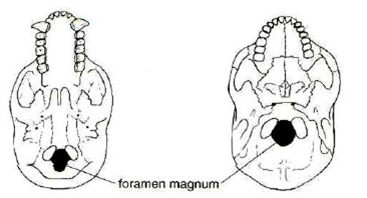
Characteristics of Modern Human Skulls
- Small mandible with prominent chin.
- Small zygomatic arch gap through which jaw muscles pass.
- No sagittal crest so reduced jaw muscles.
- Vertical face with no snout/muzzle.
- No brow ridges and forehead is vertical.
- Large brain size (cranium capacity). Enlarged particularly in the frontal and occipital regions, associated with increased reliance on vision and advanced thinking including speech.
Characteristic of Gorilla Skulls
- Large mandible with no real chin.
- Prominent snout/muzzle.
- Massive zygomatic arch – gap through which jaw muscles pass.
- Large saggital crest- attachment of strong jaw muscles.
- Nuchal crest- attachment of strong neck muscles.
- Receding forehead.
- Large brow ridges.
- Smaller cranium capacity (Apes vs Humans & Skeletal Differences, n. d.).
2.Teeth and Jaws
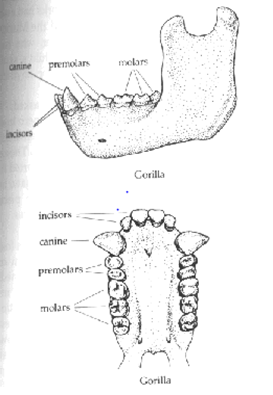
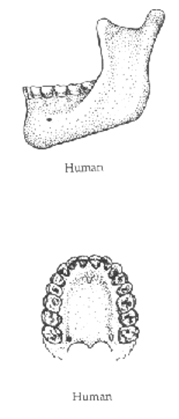
The teeth are much smaller with reduced enamel thickness in humans. This is probably due to the development of tools as weapons and food cutters, the size of teeth would be less important.
- There is a noticeable reduction in the size of the incisors.
- There is no sexual dimorphism in humans.
- The tooth row (dental arcade) is parabolic (bow shaped) in humans but is U-shaped in apes.
- In apes the lower canine fits into a gap or diastema between the upper canine and first premolar
The apes has a large lower jaw with large teeth thick enamel particularly molars. This causes the lower jaw to protrude and gives a sloping face. In modern humans the lower jaw is reduced because the teeth are smaller with less enamel. The shorter lower jaw causes the face to be flatter in shape. In apes, the upper jaw teeth arrangement is U shaped whereas in humans the teeth arrangement is bow shaped
3.Backbone
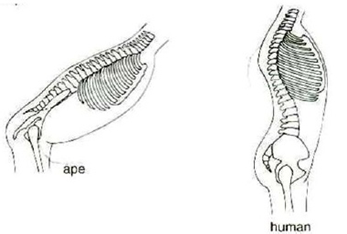
An ape’s backbone has a single gentle curve, a human backbone is ‘S’ shaped. This enables the weight to be carried nearly directly above the hip joints (Apes vs Humans & Skeletal Differences, n.d.).
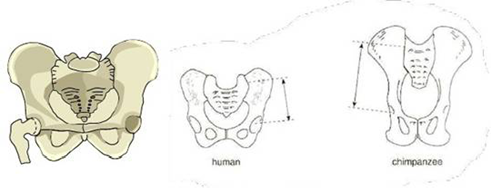
4.Hip Girdle
In quadrupedal mammals the hip bone is long, but in humans it forms a bowl shaped support for the abdominal organs. It reduced height and brings the sacroiliac joint close to the hip joint (Apes vs Humans & Skeletal Differences, n.d.)
5. Knee
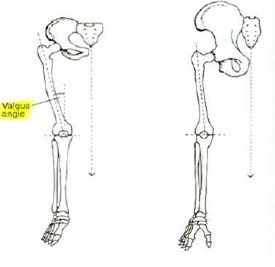
Unlike apes humans are ‘knock-kneed’, each knee being almost directly underneath the center of the hip girdle. As a result, when one foot is lifted off the ground, the other is only slightly to one side of the center of gravity and there is little tendency to lose balance. The only way an ape can avoid falling over is to lean to other side. When an ape attempts to walk on two legs it therefore sways from side to side. Humans have a larger ‘carrying angle’ or better known as the valgus angle. This angle allows the leg to be close to the body’s center of gravity (Apes vs Humans & Skeletal Differences, n. d.)
6. Foot
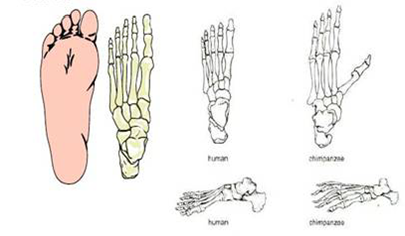
The foot in man supports and transmits body weight and acts as a locomotor organ. But in apes the foot is also a grasping organ besides being an organ for locomotion. These differences in function have led to certain structural variations in the feet of man and apes. With regard to the general shape and arrangement of bones, the foot of man resembles that of the apes. The differences are:
- In man the great toe is non-opposable. It is the biggest digit and is in line with the other digits. In the apes the great toe is opposable. It is not well developed and it is not in line with the other digits.
- In man the lateral toes are reduced in size, the fifth one is very small.
- In the apes the lateral toes are well developed.
- In man either the first or the second digit is the longest, while in the apes the third one is the longest digit.
- In man the dorsal and ventral surface of all digits are in the same way, the ventral surfaces being directed downward. In the apes the ventral surface of the great toe does not face downwards laterally.
- In man the head of the first metatarsal also included in the common transverse metatarsal ligament while in the apes it is not found in that manner.
- In man the metatarsal of all the digits are incorporated in the tissue of the foot. A common covering includes the digits up to the midpoint of the basal phalanx while in the apes the great toe is free from the common covering.
- In man the first metatarsal presents a flattened area at its posterior and to articulate with the flat articular facet of the cuneiform bone. In the apes the articular region of the cuneiform is convex and that of the metatarsal is concave (8 unique comparisons between man and ape, n. d.).
Comparison of Femur of Man and Gibbon
In general form and arrangement, a femur of man resembles that of a gibbon in the following characters. The femur of gibbon is long and slender, its shaft is straight and cylindrical showing more or less circular cross section, in man the femur is not so long and is comparatively stout. Its shafts are not perfectly straight but slightly curved and it presents three surfaces and three borders thus the cross-section is not circular.
Upper Extremity
- In gibbon the neck of femur is short, stout and forms a less obtuse angle on the shaft.
- In gibbon the lesser trochanter is placed postero-medially whereas in man it is placed posteriorly.
Shaft
- The linea aspera is faintly developed in the gibbon but in man it is well developed forming a ridge.
- In gibbon the popliteal area is not well marked. The area is convex from side but straight from above to downwards. In man the popliteal area is well marked. It is convex from side to side as well as above downwards.
Lower Extremity
- In gibbon two condyles are almost equal in size while in man the medial condyle is larger than the lateral.
- The medial condyle does not extend below the lateral condyle in the gibbon, but it does so in man.
7.Hand
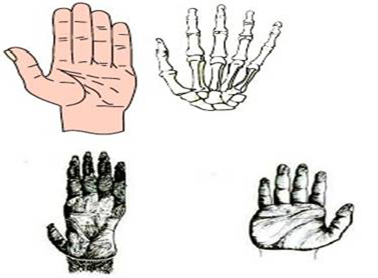
The human hand is essential in manipulating objects. The key features are the thumb, which in human differs from that of apes in two important ways:
- It is relatively longer.
- The first metacarpal is connected to the wrist by a saddle joint.
- This enables the thumb to be brought across the hand and touch the tip of any finger.
Another distinctive differences seen in the hand is the phalanges. In humans the phalanges (fingers) are straight, in apes they are curved, allowing the hands to act as hooks during brachiating.
All primates can hold things using a power grip but humans can also use a precision grip for fine manipulative movements (Apes vs Humans & Skeletal Differences, n. d.).
8.Chest
The human’s chest is flatter from front to back than in apes. This causes the body weight to be concentrated as close to the spine as possible (Apes vs Humans & Skeletal Differences, n. d.).
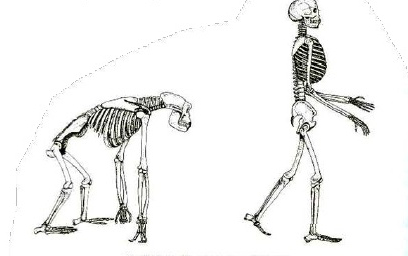
9.Shoulder
Humans have a longer clavicle (collar bone) than apes. The scapula (shoulder blade) in humans is positioned on the back, rather than on the sides of the chest as in quadrupeds (Apes vs Humans & Skeletal Differences, n. d.).
10. Skin
Humans have just as many hair per square cm of skins as a chimpanzee. The difference is humans have very fine and short hair that give the impression of nakedness. Humans’ skin does differ to that of apes as we have a greater density of sweat glands (Apes vs Humans & Skeletal Differences, n. d.).
| Feature | Humans | Apes |
| Skull & Head | ||
| Location of Head | Well balanced on Spinal Column hence nuchal muscles disappear | More Posteriorly placed |
| Foramen Magnum | Situated centrally at the base of Skull | Rear of center of on the base of skull |
| Nuchal Crest | Absent | Present |
| Sagittal Crest | Absent | Present |
| Cranial Capacity | 1300 – 1450 c.c | Gorilla : 500 c.c Chimpanzee : 404 c.c Orangutan : 395 c.c Gibbon: 128 c.c |
| Facial Development | Cranial Region more than Facial region | Facial region more than cranial region |
| Facial Angel | Orthogonal | 60 – 45 degrees , Prognathous |
| Orbits | Larger and Closed togather | Relatively smaller |
| Supra-orbital ridges | Absent | Prominent |
| Frontal Bone | Highly developed | Less Developed |
| Forehead | Vertical | Receding back |
| Pre-maxilla | Absent | Present |
| Zygomatic Process | Moderately developed | Well developed |
| Nose | Prominent and elongated | Depressed and broader |
| Nasal Bridge | Prominent and High | Not developed |
| Nasal Root | Distinct | Not distinct |
| Jaws & Teeth | ||
| Jaws | High cranial region reduced the jaws | More pronounced jaws due to less cranial region |
| Mandible | Slender and light with chin | Large and Massive without chin |
| Ascending Ramus | Narrow and high | Broad , short and large |
| Jaw Profile | orthognathous | Prognathous |
| Canine | Moderate and Same height has other teeth | Well-developed conical projections and more height than other teeth |
| Diastema | Absent | Present |
| Canine Interlocking | Absent | Present |
| Dental Arch | Parabolic / elliptical | U- Shapped |
| Teeth | Small | Large |
| Brain | ||
| Frontal Lobe | Expanded | Less Developed |
| Brocas Area (Speech area) | Greatly developed in left Frontal lobe | Absent or least developed |
| Parietal lobes | Highly developed | Very small |
| Occipital lobes | Small in relation to rest of lobes | Larger |
| Neck | Slender | Strong due to presence nuchal muscles |
| Vertebral Column | 4 curves | Nil |
| Spinal Column – Pelvis axis | Close to articulation of pelvis and femur | Away from articulation of pelvis and femur. |
| Pelvis | ||
| Illium | Basin Like and Extremely short | Long and Elongated |
| Sacral part of illium | Wide | Narrow |
| Accetabulum | Larger and thicker | Not larger and thicker |
| Limbs | ||
| Fore Limbs main function | Not for locomotory | Participate in locomotion |
| Shape of Phalanges | Straight | Curved |
| Thumb | Well developed and opposable | Not well developed though opposable. |
| Angel between thumb and index finger | More | Less |
| Arms | Shorter than legs | Longer than hind limbs |
| Hind Limb | ||
| Femur | Long , slender and ridges for attachment of muscles. | Short , thick and curved |
| Linea aspera | Present | Absent |
| Neck of Femur | Makes large angle with shaft | Short and thick. It does not make angle with shaft |
| Foot Structure | ||
| Heel | Well developed | Poorly developed |
| Transverse Ligament | Present | Absent |
| Great Toe | Non-opposable and used supporting organ | Opposable and used as grasping organ |
| Usage of foot | Support and transmit the body weight | Locomotary and grasping organ |
| Long toe | 1st or 2nd | 3rd |
| Lateral toes | Shows decrease in size | Well developed |
Relation of Anatomy and Posture
The way a species sits, stands or hangs during feeding also influences its anatomy. For example, a siamang’s ability to hang by its arms and legs may be more important in enabling it to feed from small branches than as a means of moving from one place to another. Likewise, the structure of a marmosets hand is influenced by the need to hold and process food as well as to grasp a support when moving.
We can relate details of primate anatomy to differences in locomotion and posture and can use the information to reconstruct the behaviour of species known only from fossil. However, we scarcely understand why some species leap, others are arboreal quadrupeds, some swing by their arms and one is a biped.
How anatomy is related to movement ?
From field studies we can learn the movements of each species and the ecological context in which they are used. Understanding how anatomy is related to movements is complicated by the fact that most primates can move in many ways, most leap at some times and run quadrupedally at others and many occasionally suspend themselves from branches. Anatomy hence reflects a series of compromises and an ability to do many things. Nevertheless differences in the frequencies with which primate species use different types of locomotion are reflected in muscles and bones. For example, two closely related species of larger Presbytis from Malaysia show differences in muscular and skeletal anatomy that are associated with the fact that one leaps about 20 per cent more frequently than the other.