I. DARWINISM
Charles Robert Darwin (1809-1882) was born on 12th Feb, 1809 at Shrewsbury in England. As a student, he studied the Greeks and encountered the views of Thales, Empedocles, and Aristotle. He also read the view of his grandfather and the comprehensive theory of Lamarck. With this background, it is apparent that Darwin had at least been exposed to much of the past development of evolutionary thought. Darwin was given an opportunity by British government in 1831 to travel by HMS Beagle for a voyage of world exploration. He went on voyage from 1831 to 1833 and explored the fauna and flora of a number of continents and islands of which Galapagos Islands are the most important. Here Darwin found a living laboratory of evolution.
The publications of T.R. Malthus, Sir Charles Lyell and Alfred Russel Wallace influenced Darwin very much. Malthus (1798) published an essay titled “On the Principles of Populations” which states that populations increase geometrically and the food sources increase arithmetically. Lyell wrote a book entitled “Principles of Geology” which explained the gradualism (earth has changed slowly and gradually through ages) and uniformitarianism (fundamental laws operate today on the earth in the same way as they did in the past). Wallace wrote a paper entitled “On the tendency of varieties to depart from original types”.
Darwinism consists of five principles which are: Prodigality of over production, Variation and Heredity, Struggle for existence, Survival of the fittest and Modifications of species. Darwin published “The Origin of Species”. Darwinism is the term coined for the explanation offered by Charles Darwin for the origin of species by natural selection. Darwin’s theory of natural selection is based on several facts, observations and inferences. Darwin published his concept of evolution in his book entitled “The Origin of Species”. Darwinism consists of the following five principles.
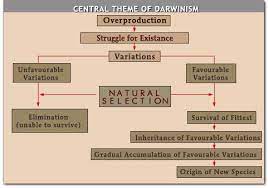
1. Over-production or prodigality of over-production: Many more individuals are born each generation than will be able to survive and reproduce (The writhing of Thomas Malthus influenced Darwin on this point and provided him with the idea of a struggle for existence).
2. Variation and Heredity: There is natural variation among individuals of the same species. (This had been noted by naturalists from Aristotle through Lamarck but Darwin’s own observations made the greatest impression of this fact upon him). Many of the favourable adaptations are hereditary and are passed on to the progeny of future generations. (Darwin, like Lamarck, believed in an incorrect theory of heredity; however, he interpreted the process in the proper context. Darwin himself was not satisfied with his blending theory of inheritance and as early as 1857 he wrote a letter to Huxley for an alternative to it).
3. Struggle for existence: Organic beings increase by a geometrical ratio, while food production only increases in an arithmetic ratio. So that in a very short time, an area will be overpopulated with any one species, unless some thing happens to check the increase. As a result there is a struggle for existence which is three fold as given below.
• (a) Intraspecific struggle: The intraspecific struggle is found among the individuals of the same species. The competition is heavy in case of intraspecific struggle, because the needs and requirements of the members of the same species are same who live in the same environment. It is the most severe check on the rate of reproduction.
• (b) Interspecific struggle: It is found among organisms of different species living together. Members of one species struggle with other species for similar requirements i.e., food, shelter and mating.
• (c) Struggle with the environment: Living organisms struggle with the adverse environmental conditions like floods, cold waves, heat waves and earthquakes, etc.
4. Survival of the fittest or natural selection: Individuals with certain characteristics have a better chance of surviving and reproducing more than others with less favorable ones. (This is the concept of the survival of the fittest through favourable adaptations to the conditions of life).
5. Modifications of species / Origin of new species: Gradual modification of species could have occurred over the long periods of geological time through additive process occurring in the past in the same manner as they are occurring in the present. (Charles Lyell’s geological interpretations provided knowledge of the long span of time necessary for evolution to proceed and supplied Darwin with the concept of uniformitarianism as a modus operandi for the process of biological evolution).
Darwin illustrated the survival of the fittest by taking example of a giraffe. In Darwin’s Words giraffes exhibited great variations in the length of their neck and legs. Since grass was scarce on the land these had to eat the leaves of tall trees. Obviously, giraffes with long neck and longer legs had advantage over those with shorter legs and necks because the former could get more food easily and had better chances of survival than the latter. The former fed and reproduced and became abundant. On the contrary, giraffes with short necks starved and gradually became extinct.
On the basis of above observations, Darwinism made certain conclusions under the heading:
’Origin of Species’ bv Natural Selection – The theory concludes that as a result for struggle for existence, variability and inheritance, the successive generations tend to become better adapted to their environment. These adaptations are preserved and accumulated in the individuals of the species and ultimately lead to the origin of new species from the old ones.
The environment is ever changing and it leads to further changes and the appearance of new adaptations in the organism. As natural selection continues, the latter descendants after several generations become markedly distinct from their ancestors, Further more certain members of a population with one group of variation may become adapted to environmental changes in one way, while others with a different set of variations may become adapted in a different way. As a result, two or more species may arise from a single ancestral species.
In the ‘Origin of Species,’ Darwin makes no reference to the human problem, but his thesis clearly led both his supporters and opponents to think that man must be subject to the same laws that attempt to explain the evolution of plants and animals. In 1863, Thomas H. Huxley (1825-1895), staunch defender of Darwin, published his book ‘Evidence as to Man’s Place in Nature’ in 1871, Darwin himself especially described his own point of view in ‘The Descent of Man.’
Darwin’s Theory of Artificial Selection:
According to Darwin, the commonest method of producing new race of individuals is that of selection under human control. The man selects only useful variety of plants and animals and breeds them together expecting that off-spring will have beneficial characters. Thus, various new races of Plants and animals are produced which are more useful, viable and of domestic value to common man.
Darwin’s -Theory of Sexual Selection:
According to this theory, there is always a contest among males for During this context, inferior males are eliminated possession of beautiful female. (due to their less courageous nature or ill-equipped with weapons of combat) and superior males dominate. Thus, sexual dimorphism becomes marked in highly developed individuals. Examples given were a stag fighting among the male alligators for the possession of females, fighting among the male salmons etc..
Darwin’s Theory of Panaenesis:
Darwin proposed this theory to explain the laws of inheritance. He says:
- All somatic cells of organism produce minute particles called Pangenes, which are included in the germ cell.
- After fertilization, the pangenes of the zygote dictate development of individual.
- The pangenes may be dormant for some generation and again reappear.
- There is competition among the pangenes to be included in the germ cells.
- The stronger ones being included, the weaker ones being rejected.
Criticism of Darwinism
Several objections were made to the Darwin’s theory.
- According to Darwin’s theory, small fluctuating variations play a key role in the process of evolution. But this is far from true because to a large extent they become non-heritable in the struggle for existence the younger ones will be eliminated before they reach maturity. Unless they live upto their maturity they will not be able to give full impression to the variations they have inherited. In other words, no scope is given to variations to continue for longer periods and help the organisms in their struggle for existence.
- While natural selection theory explains survival of the fittest, it does not explain the arrival of the fittest.
- Darwin’s explanation is inadequate because selection creates nothing. It merely eliminates or preserves already existing variations without indicating their cause, which is the main question.
- Darwin was unable to explain the mechanism of inheritance of characters. Darwin proposed the theory of pangenesis to explain this phenomenon. He said that every cell or organ produces minute hereditary particles called pangenes or gemmules. These were carried through the blood and deposited in the gametes. This theory was not accepted. Thus, Darwin did not differentiate between somatic and germinal variations. He considered all variations as heritable.
- Natural selection cannot account for degeneracy—to say an organ is no longer useful and, hence, disappears. According to natural selection, only useful organs are favoured by natural selection. The existence of vestigial organs in organisms could not be explained. Thus, a number of useless or non-adaptive characters or organs could not have arisen by natural selection. In this connection, Darwin said that we are not sure of the non-adaptive nature of these organs.
- Darwin’s theory is not able to explain the arrival of natural traits and the acquired traits but he failed to explain how the natural traits have become the acquired traits and how the acquired traits have become natural traits.
- Over-specialization of some organs like tusks of elephants, antlers of deer have developed so much that instead of providing usefulness to the possessor they often give hindrance to them. These organs or body structures should not have reached a harmful stage, if natural selection was operating. However, such cases of overspecializations have been explained by Darwin on the basis of discontinuous variations or “sports” which, according to him, do not play any role in evolution.
- There is doubt about the struggle for existence being as fierce as it had been supposed to be and also he didn’t consider the role of co-operation in species evolution(mutualism)
- The superiority or inferiority of one individual as compared to another of the same species is apparently not the result of the development of a particular characteristic, but rather of the general capacity of the organism.
- Darwin indirectly accepted the Lamarckian idea of inheritance of acquired characters in the form of pangenesis hypothesis, which cannot be accepted in the light of present knowledge of genetics.
- Darwin proposed artificial selection for improving races of domestic plants and animals,but these could never lead to permanent,specific variations
- Special objection was raised against the theory of sexual selection of Darwin. The theory involves passivity on part of male and an active choice on part of female about a more beautiful attractive and more powerful male. This theory has its own drawbacks,which are obvious.
- Natural selection does not explain the evolution of terrestrial animals from aquatic forms.