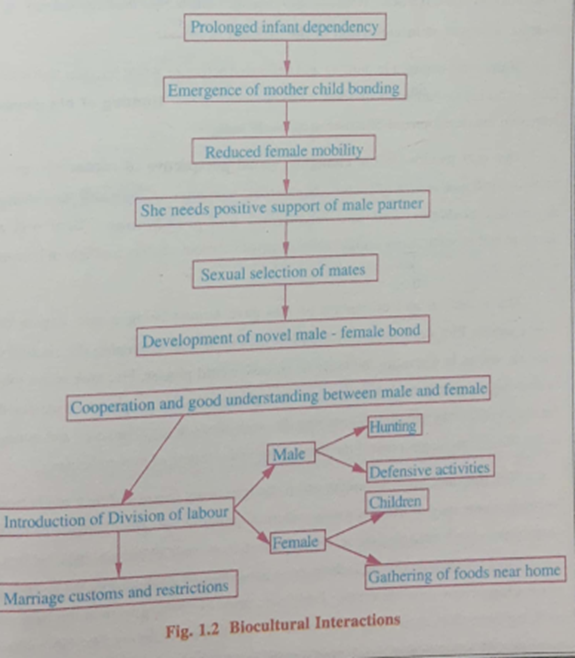
The hominization process consists of evolutionary transformation of hominoids into hominids. It is a process that has occurred in the hominid- since its divergence from the last common hominoid ancestor shared with any living ape. The term hominization process includes all those aspects of structural and behavioural changes that occurred in the hominid line finally leading to man. This process is inter-paly of Biological and Cultural evolution. Various authors termed it has , Sherwood L.Washburn termed it as Bio-cultural feedback and Charles Lumsden and E.O Wilson termed it has gene culture co-evaluation.
Bi-pedalism – Analysis of post-cranial elements of A.africanus, A.aferensis, A.ramidus and A.anamensis cearly establishes bi-pedalism to be one of the oldest of all hominid characteristics.
The age of most primitive australopithecines, A.ramidus is estimated to be 4.4 million years ago, perhaps 1 million years after separation of ancestral lines leading to great apes and man. According to Craig B. Stanford, A.ramidus was a biped; its lower body was clearly adapted for walking on the ground, though they may have continued to use trees for gathering fruits and for shelter at night.
Postcranial elements of A.aferensis are well documented. The hind limbs and pelvis show many bipedal adaptations. Ilial blades were short and broad; ischium was short; anatomy of hand and ankle joints were favourable; big toe was parallel. In all such features afarensis was more human-like than ape-like.
In addition to post-cranial elements, the Laetoli (Tanzania) footprints of A.aferensis, australopithecine to have existed around 3.77 million years ago, is another proof of bi-pedalism. It shows a convergent big toe, heel strikes,arches etc. similar to humans in many aspects.
Hand-anatomy and Tool use –
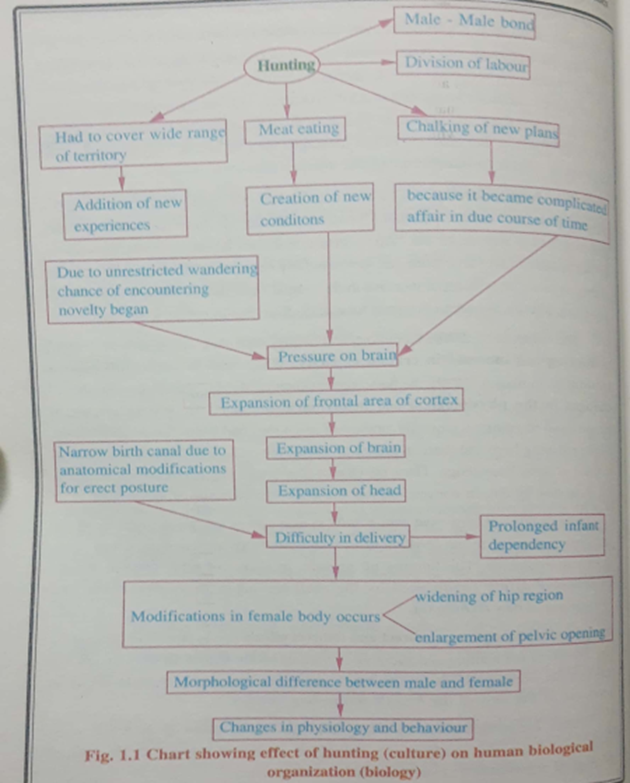
- The earliest evidences of hand-manipulations different from apes and sufficiently similar to Homo can be found in A.aferensis though its hand anatomy differs from both. Hands are approximately to human proportions but differ from those of humans in having fingers more curved suggesting great power grip. The precision grip was greater than Chimpanzee but lesser than the humans. A.afarensis was spending more time on land than the trees and so the hand-anatomy started adapting the characteristics of hands of the Homo and different from those of apes. The use of tools by primitive hominids, may, in fact, have been a major factor in the evolution of the cerebral cortex and higher intelligence. The elaborate brain of Homo sapiens may be a consequence of culture as much as its cause.
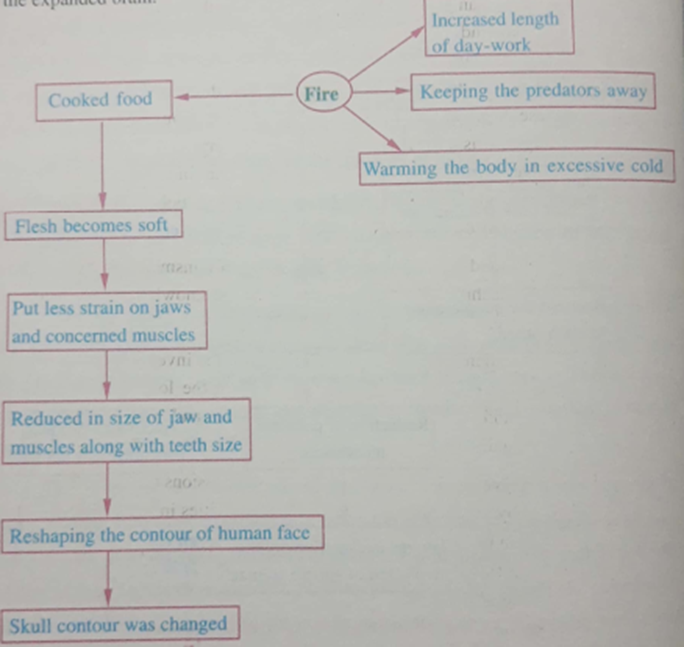
- Homo Erectus had not only perfected the art of making stone tools considerably but also had learnt how to control and use fire. With fire, humans could cook their food, keep themselves warm in cold weather; ward off predators; and light up the dark to see.
- Neandertal people practiced ritual burial in Europe and the Near East at least 60,000years ago, suggesting that religious beliefs had developed by that time.
- By 40,000 years ago or a little later, Cro-Magnon people began constructing their own dwellings and living in communities. The domestication of animals and plants, development of agriculture and the dawn of civilization is very much quicker that characterize modern humans.
Modification of Jaw and Teeth – Apes are characterized by larger, thick enamelled teeth, large jaw and jaw muscles, large canines, high cuspid molars and a higher ratio of cheek teeth area to body weight. Australopithecines, Paranthropines and Homo habilines differed from apes in some features.
A.ramidus had teeth, which resembled those of Homo in some features- they were smaller with thin enamel and smaller canines. A.afarensis but canines were low grounded and incisor like A.africanus bad dentition similar dentition had some ape-like and some homo features. The incisors were chimp-like to those of afarensis except that the cheek teeth were slightly bigger
In Paranthropus, front teeth were smaller than those of afarensis and africanus but cheek teeth, jaw and jaw muscles were massive in them. Dental variation among these hominids is peculiar. There is gradual reduction in the sizes of the front teeth, where as there is gradual increase in the sizes of cheek teeth in case of paranthropus. Hominization process in dental morphology thus, consisted of reduction in sizes of teeth, jaw and jaw muscles, reduction in cusp-height of teeth, and constant cheek teeth area. These features are seen to begin with australopithecines and Homo habilis.
The combined effects of improved cutting, pounding, and grinding tools and techniques and the use of fire for cooking surely contributed to a documented reduction in the size of hominin jaws and teeth over the past 2.5 to 5 million years, but it is impossible to relate them precisely. It is not known when hominins gained control over fire or which species may have employed it thereafter for food preparation, warmth, or protection against predators. It is very difficult to discern whether a fire was deliberately produced by hominins or occurred naturally. For example, in a wildfire, burned-out tree stumps might leave circular accumulations of charcoal residue that could be mistaken for hearths, whereas campfires built by mobile hominins would leave no lasting evidence.
Enlargement of Brain – Earlier palaeo-anthropologists believed that evolution of human brain occurred after bi-pedalism and changes in the dentition were complete. Recent endo-cranial cast or endo-cast studies indicate that encephalisation process progressed along with other changes that characterize hominids. Endocast studies of Homo habilis clearly indicate that its brain volume was much greater than those of australopithecines. The hominization process that involved evolution of hominid brain can be said to have resulted between 2 to 1.5 million years ago. Speech – The speech apparatus of human consists of three physiological components: the subglattal system that includes lungs and associated muscles which provide the power for speech production; the larynx which communicates the subglattal system to upper supralaryngeal vocal tracts; and the supralaryngeal tracts itself which modulates acoustic energy generated by the first two systems. The comparative anatomy of the living primates and hominid fossils suggest that evolution of supralaryngeal vocal tract probably started in early African populations of Homo erectus. However, the hominization process took some time to complete. There are definite proof that hominids from the Israeli sites of Skhul and Qafzeh had definite human supralaryngeal airways. Neandertals, the only hominids that seemed to have had retained the non-hominid supralaryngeal airways. Endocast studies of such forms indicate that their neural mechanisms had not appropriately developed, whereas those of from Skhul and Qafzeh were capable of producing human speech. Hominin brain expansion tracks so closely with refinements in tool technology that some scholars ignore other factors that may have contributed to the brain’s increasing size, such as social complexity, foraging strategies, symbolic communication, and capabilities for other culture-mediated behaviours that left no or few archaeological traces.

Alternative Answer
TRENDS IN HUMAN EVOLUTION
Hominin Evolution
Paleoanthropologists are trying to answer a number of questions about human evolution.
- Why did our earliest ancestors stand up?
- How did our ancestors provision themselves?
- Why did some species become extinct until only one species, Homo sapiens, was left?
- When, where and why did modern humans evolve?
- What was the role of the Neandertals?
- What makes us human?
While hypotheses have been suggested, new research continues to change and hone the picture of the evolution of humanity. This section of the course is not intended to provide a complete review of paleoanthropological research, but merely to provide an overview of key finds and outline trends in hominin evolution.
Morphological Trends in Human Evolution
There are a number of trends in the evolution of the proto-hominins to modern Homo sapiens. These traits do not occur all at once, but over millions of years. In general, the trends include:
- the forward movement of the foramen magnum
- a reduction in the size of the canines
- an increase in the size of the molars
- disappearance of the diastema (gap between the incisors and canines)
- an increase in cranial capacity
- rounding of the skull
- a decrease in prognathism (jutting forward of the bottom part of the face)
Again, not all of these traits occur at the same time and there is variation among the various hominin species, but all of these morphological characteristics occur in the evolutionary line of Homo sapiens.
Three other trends are important in the evolution of hominins: bipedalism, non-honing chewing complex, and encephalization of the brain.
1. Bipedalism
Bipedalism, or upright walking, was the first morphological trait on the road to humanity. Human bipedalism differs from the bipedalism practiced by other primates in that it is habitual. In other words, it is the primary form of moving around. Other primates practice facultative bipedalism, which is a temporary form of bipedal locomotion, e.g., primates like chimpanzees may walk bipedally while they carry something in their hands. Few other animals are habitual bipeds, e.g., birds and kangaroos.
There are numerous anatomical changes that evolved to make hominins efficient bipedal locomotors. Here are some, but not all, of the major changes that occurred (eLucy 2007):
- foramen magnum: the foramen magnum is the hole at the bottom of the skull, allowing for the spinal cord to pass through perpendicular to the ground
- spinal cord: the s-shape of the spine lowers the center of gravity needed for efficient bipedal walking
- lumbar vertebrae: hominins have five lumbar instead of four like gorillas, which are also larger than those of gorillas, allowing for more flexibility in the lower back which in turn allows the hips and trunk of the body to swing forward
- pelvis: the pelvis became bowl-shaped to help support the upper body while walking, aid in balance, and provide for the necessary muscle attachment that allows for the forward swing of leg; the hip joint is larger than other apes to help with stress absorption; the ilium has a more lateral orientation that helps prevent the leg that is on the ground during walking from collapsing toward the swinging leg; wider hips help with maintaining the center of gravity.
- femur: the larger femoral head along with the hip joint absorbs more stress while walking; femur, along with the knee joint, is angled toward midline of hip to help with balance–the angle is called the bicondylar angle (this is sometimes called being “knock-kneed”)
- knee: the knee joint, is closer to the midline of the hip to help with maintaining balance while walking upright
- tibia: placement is almost directly parallel with center of gravity
- feet: big toe, or hallux, is inline with other toes, which allows for more force when pushing off while walking; the heel bone is robust, which helps with shock absorption and stability–it also allows the attachment of strong ligaments from the ankle to the foot that form a double arch, helping with shock absorption.
The morphological changes associated with bipedalism take millions of years to evolve. They first appear with the proto-hominin Sahelanthropus tcahdensis, which is dated to 6.0-7.0 million years ago (mya), but are not fully in place until around 4.0 mya. These physical changes continue to refine until we see them as we do today in modern Homo sapiens (Jurmain et al. 2013).
Hypotheses on the evolution of bipedalism
Several hypotheses have been proposed over the last century or so to explain the evolution of hominins. As bipedalism is the first trait on the road to modern humans, these hypotheses focus on the emergence of habitual bipedalism. Many have been refuted as new data is discovered.
The first hypothesis was the hunting hypothesis proposed by Charles Darwin. The hunting hypothesis claims that the key to human evolution was the shift from an arboreal life to a terrestrial one. He predicted that the earliest hominins would be found in Africa based on the similarities he saw between humans and African apes. He suggested that bipedalism gave the first hominins an advantage in that it freed up their hands to carry weapons used to hunt animals. Darwin also suggested that larger brains preceded bipedalism as intelligence was needed to make the tools. Now we know that habitual bipedalism predates large brains so Darwin’s hypothesis is no longer considered an adequate explanation. With the discovery of new data, other hypotheses have been proposed including the patchy-forest and provisioning.
The patchy forest hypothesis suggests that the emerging mosaic environment that began emerging at the end of the Miocene made bipedalism advantageous. The phrase mosaic environment in this case refers to an environment that had patchy forest interspersed with grasslands that eventually became the African savannas that we know today. This caused food resources to become spread out over the landscape. For traveling long distances, bipedalism is more energy efficient than quadrupedalism. Traveling bipedally freed up hands for carrying provisions and the early hominins could have easily fed from both terrestrial and arboreal resources.
The provisioning hypothesis states that having hands free to carry food allowed males to provision females and offspring. Since much of the females energy went to child-rearing, the ability of a male to provision her and her offspring would have been an attractive quality. Those males who could walk more efficiently bipedally while carrying food would have been prime mate material, allowing both the male and female to reproduce successfully.
2. Non-honing Chewing Complex
Apes have a honing chewing complex, which is good for cutting and shredding food. Their upper canines are large, pointed (triangular shape), and projecting. In the photo to the left, you can see how the large canine on the maxilla of a chimpanzee fits into the gap, or diastema, in front of the canine on the mandible. These two teeth also have a sharp edge on the back. This edge is kept sharp because each time the jaws close, the upper canine rubs against, or hones, the sharp edge of the lower third premolar. This can happen because of the diastema present on the jaws that allows for the jaws to close completely. Without the honing action, the canines and premolars would not be able to efficiently shred leaves and fruit. Over time, hominins lose this honing complex. The diastema disappears, the canines reduce in size, and the molars increase in size (Larsen 2014).
3. Encephalization of the Brain
Encephalization of the brain refers to a couple of things: 1) the increase in brain size over time and 2) the size of the brain in relation to total body mass. The brain-size to body mass ratio does not change that much in the hominins. “The stature of A. afarensis varied from 3.3 to 5.0 feet (1.0 to 1.5 meters) tall, while that of modern humans varies from approximately 4.5 to over 6.0 feet (1.4 to 1.8 meters)” (Campbell and Loy 2000: 285). However, while there is gradual increase in brain size throughout the australopithecine lineage, it is not until early Homo that there is a significant increase in cranial capacity, approximately a 20% increase over australopithecines. More significantly is the approximately 50% increase in brain size of Homo erectus and the earlier Homo species. It is not just the size of the brain that is important. During this process of encephalization, there is also a rewiring of the brain that coincides with the emergence of material culture such as stone tools. It is not until this occurs that hominins leave Africa, enabled greatly by cultural advances.
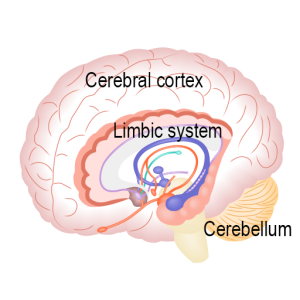
Non-human primate brains are symmetrical as are the brains of early hominins. With the emergence of Homo we see the lateralization of the brain–it becomes asymmetrial (right brain, left brain). Based on endocasts, researchers determined that three areas of the brain began to change in Homo: the cerebellum, which handles learned motor activities, the limbic system, which processes motivation, emotion and social communication, and the cerebral cortex, which is responsible for sensory experiences. It is these changes that may have allowed the early members of our genus to develop cultural adaptations to environmental pressures.
Why did the brain change in early Homo?
The question that confronted paleoanthropologists was why the brain changed. Big brains have some disadvantages:
- it take approximately 25-30% of a human’s metabolic energy to run their brain
- requires infants to be born prematurely, resulting in a longer period of infant dependency (the average infanat brin is about 1/3 the size of an adult brain)
- longer infant dependency is an increased drain on maternal energy; the mother must have proper nutrition not only for herself but for the nursing infant
- it has been suggested that larger brains decrease the bipedal efficiency of females because they must have a wider pelvis and birth canal to give birth to a large brained infant
So, for large brains to become fixed in the Homo population, the advantages had to outweigh the disadvantages listed above.
One possible explanation incorporates the interaction of three different variables: group size, complex subsistence patterns, and the nutritional value of meat (Campbell and Loy 2000: 318). Let’s address group size first.
Research suggests that brain size and size of social groups correlates positively among living primates, implying that big brains helped individuals keep track of such things as dominance hierarchies, allies, etc.
Second, a big brain allows for primates to keep track of large subsistence territories and allows for omnivores to develop strategies for collecting a wide-variety of foodstuffs.
Third, eating meat is a relatively easy way to get the nutrition needed to run a big brain, which, as mentioned above, in modern humans takes about 1/3 of our daily metabolic energy. The argument for this, the social brain hypothesis, is laid out by Robin Dunbar in this. Dunbar also claims that it was changes in the neocortex, a 2-4mm thick top layer of the cerebral hemispheres, that were critical in the “homininzation” (development of cognitive abilities) of our ancestors.
Geology & Environmental Background
- The Miocene period (roughly 23-5 million years ago) was geologically active in Africa. This is the period of the adaptive radiation of the apes and a period of mountain building that led to the formation of the Great Africa Rift Valley. With the emergence of the rift mountains, the rains that heretofore had moved across the continent from the Atlantic Ocean were blocked (referred to as a rain shadow), leading to the aridification of Eastern Africa . The savanna environment that evolved in Eastern Africa was and is a much more open environment than the forested environment of Western and Central Africa, leading to rise of new adaptations for plants and animals. It is in this newly emerging environment that hominin evolution takes off, although recent research indicates that proto-hominins lived in Western Africa.
- Grasslands spread in Africa between 10-5 million years ago during a cooling and drying phase. It is during this time frame that the common ancestor of African apes and humans lived. The common ancestor was more than like a quadruped who was arboreal or at least spent a significant amount of time in the trees. In the middle of this period, approximately 7-6 million years ago, the first bipedal hominin emerged, Sahelanthropus tchadensis. Sahelanthropus and a few other early hominins are referred to as proto-hominins in recognition of their primitive, ape-like features.
- In the mid-Pliocene period, 3-2 million years ago, yet another cooling and drying phase is correlated with the adaptive radiation of the hominins, including the emergence of the robust australopithecines (note: some paleoanthropologists place these species in a separate genus, Paranthropus. In this course we will refer to the robust species as Australopithecine) and the genus Homo.
- Near the beginning of the Pleistocene period, also known as the Ice Age, the environment continued to get drier. Open habitats spread in East Africa. During this period, Homo ergaster (Homo erectus) emerges and finally leaves the African continent.
- This data has a tendency to make us think that hominin evolution was driven by environmental changes; however, the presence of Sahelanthropus tchadensis in West Africa forces paleoanthropologists to acknowledge the possibility that geologic, climatic, and environmental changes occuring in Africa during the Miocene, Pliocene and Pleistocene had little to do with the evolution of hominins.