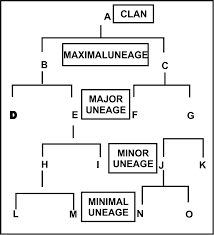
Lineages can be divided and subdivided into smaller segments, This process of division, known as segmentation, takes place as the generational distance from the founding ancestor increases. Segmentation commonly occurs when lineages get too large or when antagonisms arise among members.
Case Study : Tiv of Nigeria
The nearly one million Tiv, who live in Northern Nigeria, believe that they are descended from a single male ancestor who lived some fourteen to seventeen generations ago (Bohannon 1953}. The sons of this ancestor and male descendants in succeeding generations are viewed as the founding members of a series of sublineages. The process of lineage segmentation continues up to about three or four generations from the present living elders, at which point segmentation is supposed to cease, This final subdivision forms minimal lineage segments, which serve as the primary political and residential units among the Tiv.
Case Study: The Nuer
The Nuer of the Southern Sudan studied by Evans-Pritchard’s , in his ethnography The Nuer: A Description of the Modes of Livelihood and Political Institutions of a Nilotic People explained segmentary linages among Neur tribe.
As an attempted overview, the Nuer is a Nilotic—inhabitants of the river Nile—tribe that includes around 500,000 individuals and has a particular physical and linguistic similarity with their neighbours the Dinka. Nuer are segmented. In other words, the interrelation of territorial segments within their political system, and the relations of other systems to this system, is formed by groups that are part of a segmentary system. Moreover, Nuer are not centralised in power terms and have a sort of an ordered anarchy with no government. Regarding Nuer political segments, the most significant one in terms of magnitude is the tribe. Tribe members have an obligation to unite in warfare against intruders/outsiders and a right for compensation. Continuing, tribes are divided into tribal segments called sections; concretely, into primary and secondary sections forming the largest groups, and further tertiary sections, which are characterised by closer ties among its members as they are composed by villages, and these villages by domestic groups counting with kinships and domestic clans.
There exists an institution of blood-feud that, following the aforesaid Evans-Pritchard’s ethnography, contributes to maintain the equilibrium among political forces of different segments and groups with the help of a mediator, the leopard-skin chief. This blood-feud has sometimes structural implications in sparking off warfare. Regarding kinship, Nuer are agnatic in terms of lineage—Nuer trace their descent solely through males to a common ancestor. The clan is thus the Nuer largest group of lineages—diverging branches of a common ancestor—and it is further divided into segments from the largest to the smallest one: maximal lineages, major lineages, minor lineages and minimal lineages. The importance of the blood-feud and the collective identity at each level determined by agnation are key features for understanding the political equilibrium in segmentary systems, as it is in-depth approached below. In terms of social hierarchy, Nuer are not ranked. There are no classes or rankings as Nuer consider themselves as equal and they disregard wealth or other comparative features.