Approaches to the study of family.
The approaches to the study of family are as follows:
A) Typological approach : different classification families based on multiple criteria
B) Processual approach : growth and decline as cycle. (Note: refer domestic group)
A) Typological approach – The typological approach emphasizes that the family must be studied as an association of certain persons related by proximate kinship bonds and the group is there to serve important cultural purposes. The different typological forms that the family might acquire in diverse societies depend upon the demographic, economic and political factors. These typological forms have always remained in a state of flux in accordance with the changing cultural needs of the society.
Typology of families means systematic classification of the families into several types. They are as follows:
I.On the basis of marriage:
(1) Monogamous Family – This type of family is based on monogamous marriage i.e., marriage between a man and a woman. It is the simplest among all types of family as it consists of a man; his wife and children.
(2) Polygamous Family – This type of family is made up of two or more nuclear (monogamous) families. Polygamous families are of two types:
a) Polygynous family – Here a man marries more than one woman and leads life in the same household with all his wives and children.
Eg.
- i) Kulin Brahmins of Bengal,
- ii) Muslims of Middle East.
- iii) Siwai of Polynesia.
- iv) Nagas of North East India
- v) Gond and Baiga of Middle India
b) Polyandrous family – Here a Woman marries several men and lives together with all husbands and children.
Eg ,
- I) Marquesans of Polynesia.
- ii) Toda of Nilgiri Hills.
- iii)Khasa of Janunsar, Dehradun
- iv) Gallong of Arunachal Pradesh.
(3) Endogamous family– a family where man is supposed to marry within one’s own group/clan/gotra/caste/varna. Endogamy rules of marriage are practiced in this type of family. Example: Among Muslims and Christians in Kerela, it is necessary to marry within one’s group.
(4) Exogamous family– a family where one is supposed to marry outside one’s own gotra/clan/varna/caste/panda/village/parivar. Here rules of exogamy, like four gotra rule, sapinda system are practiced. This type of family can be found in northern region of India among jats of Haryana and many others.
II ) On the basis of descent:
Descent refers to the way in which one acquires membership of a kinship group. Descent is of several types:-
A) Unilineal Descent Groups
1) Patri-lineal descent- If the descent is traced through father in ever/ generation it is called patri-lineal descent.
- Hindus, Chinese, Egyptians- Advanced societies
- Gond , Bhil, Khonds- Primitive societies.
2) Matri-lineal descent – Here the descent is traced through mother every generation.
- Hopt Red Indians in USA
- Nayars in South India
- Khasi, Garos In Meghalaya.
3) Double descent/Bi-lineal descent – Traces ancestry through father as well as mother simultaneously.
- Thodas of Udagamandalam (Tamil Nadu)
- Yako of Nigeria
- Ashanti of Ghana
- He He of South Africa
- He roro of South Africa
4) parallel descent – Here sons belong to the patri-lineal descent and daughters belong to the matri-Iineal descent or vice-versa or odd number of children belong to father’s descent group and even number of children belong to mother’s descent group.
- Saka/Saha of Venezuela.
- Apinaiye of Brazil (Python-eaters).
B) Multi-lineal Family
1) Ambi-lineal/bilineal – Here tracing of ancestors changes from generations to generations or across the generations, mechanism in societies where resources are limited. It serves as an adaptive
- Eg.:- Kwaio of Melanesia.
- Ranko Kanitri Red Indian of Brazil.
2) Cognatic/Non-Lineal descent – Cognatic descent is a rule in which a person traces his ancestry through males, females and other combinations across generations. Thus, an individual may be practicing patri-lineal, matri-lineal and ambi-lineal simultaneously.
- Eg:- Maori of New Zealand
- Subanum of Philippines.
- Iban of Indonesia
III. On the basis of Post-Marital Residence:
1) Patri-local residence -If residence is with or near the groom’s parents it becomes patri-local.
Eg:- Bagata of India,Tallens of Ghana
2) Matri-local residence – If residence is with or near the bride’s parents it becomes matri-local . Eg : Khasi and Garo of Meghalaya ; Hopi of USA
3) Avuncu-local residence -If the residence is either with or near groom’s mother’s parents or with or near groom’s mother’s brother it becomes Avuncu-local. In Latin avunculus means mother’s brother.
Eg. Trabriand Islanders
4) Duo-local residence – Here husband resides in his family and wife resides in her family.
Eg.: Ashanti tribe of Ghana
5) Bi-local residence – Here, the newly married couple is free to decide where they will live, whether with or near the husband’s kin, or with or near the wife’s kin. Here, necessity determines the residence pattern.
Eg: Hawaii Islanders.
6) Neo-local residence – After marriage the couple do not live with or near the dose kins of either side. They make a completely separate entity of their own’where they reside.
Eg:- Shoshone of US
7) Uxorilocal family– man changes residence, not necessarily to wife’s matrilineal place but near to the wife’s matrilineal relatives. Example: Nayars of Kerala, mainly to look after the property of his wife, husbands move to nearby place.
8) Virilocal family– in this family, woman stays near the husband’s patrilineal relatives along with
her husband.
IV. On the basis of Authority:
Authority refers to the right to have power of exercising influence over the members of the family.
1) Paternal authority-If the authority is in the father, it is paternal authority. In the paternal families, authority runs in the male line. It is vested generally in the eldest male living or in the eldest son.
Eg:- Khond, Oraon, Santhal, Bhil.
2) Maternal authority – If the -authority is in the mother . it is maternal authority. In maternal families authority runs In the female line. It is vested in the eldest female living or in the eldest daughter.
Eg: Khasi , Garo of Meghalaya
Nayar of Kerala.
3) Egalitarian family-in this type power/authority is equally shared/distributed among husband and wife. Both of them are decision maker, take joint decisions and share each other’s responsibilities. Both son and daughter together inherit/gets property in equal shares.
V. On the basis of Succession:
The transmission of office or rank is called Succession,
1) Matri-lineal Succession – It means the passing of titles or ranks from females to females.
Eg:- Khasi & Garo
2) Patri-lineal Succession – It means the passing of titles or ranks from males to males through males.
Eg:- Bagata,
Accordingly, the families may be classified into patri-lineal family and matrilineal family.
VI. On the basis of inheritance of Property:
1) Primogeniture- Here the eldest son inherits the property in the, family.
Eg:- Namboodri’s of Kerala
2) Ultugeniture- Here the youngest daughter inherits the property in the family.
Eg:- Kakkadhu of Khasi Tribe
Nokhala among Garo’s
VII. On the Basis of Nature of Blood Relations Family is classified into two types:
a) Conjugal family– in this type two adult individuals of different sexes are related to each other by marriage, a heterosexual pair, who may/may not have children. Example: nuclear family of USA.
b) Consanguineous family– in this type husband and wife are related to each other, they are either cross-cousins or parallel cousins. Husband and wife are related by blood. Example: Muslims or some groups of Reddys of Andhra Pradesh or among some non-Brahmins of Kerala.
VIII) On the Basis of Size, Structure and Composition : Family is divided into three types:
a) Conjugal family-this family consists of a husband and wife who got married. After this couple may/may not have children.
b) Nuclear family-this type is the most elementary and ideal form, found all over the world. The nuclear family consists of a husband, wife and their unmarried children. This constitutes a basic unit of family, the family size is small. This is an independent autonomous unit. This is also known as primary family. Orientation and procreation are its parts.
c) Extended or joint family-the size of this family is large which extends beyond a nuclear family. And may have more than two nuclear families. This type is most commonly found among Hindu joint family. This family is comprised of father, mother, their sons and their wives, unmarried daughters, grand children, grand father, uncles, aunts, their children, father’s parallel cousins their children and so on. Earlier, joint families were engaged in one type of business / occupation and the next generations follow that business/occupation. But now with globalization, modernization and westernization each family member is engaged in different/similar job. Joint family mostly includes members of three to four generations. It extends parents-child relationship.
G.P MURDOCK classification of family based on multiple criteria
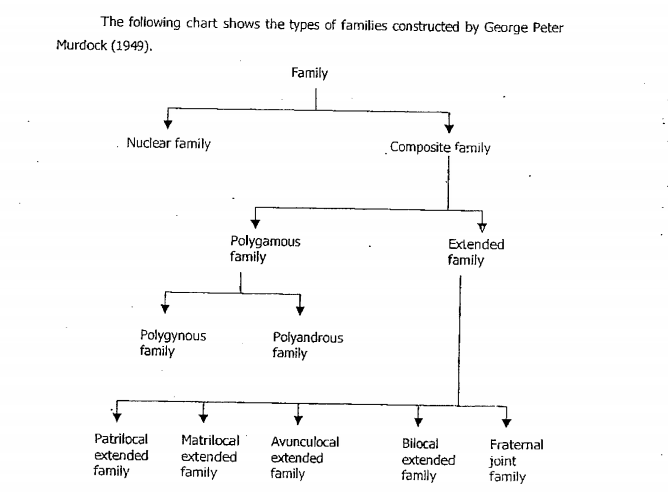
The nuclear family consists of a married man and woman with their off-spring although in individual cases one or more additional persons may reside with them.
The Composite family is an aggregation of two or more nuclear families. It may be divided into two types: the Polygamous family and the extended family. A polygamous family consists of two or more nuclear families. Polygamous family may further be divided into polygynous family and polyandrous family. Extended family is based on blood relations extending over 3 or more generations i.e., by joining the nuclear family of a married adult to that of his parents. Depending upon post-marital residence an extended family may be patrilocal, matri-local, bi-local and avunculocal.